Browse by Category
Fiction
- Action & Adventure
- African American
- Anthologies
- Children's Fiction
- Classics
- Comics & Graphic Novels
- Coming of Age
- Contemporary
- Cultural & Regional
- Drama
- Erotica
- Fantasy
- General
- Historical Fiction
- Horror
- Humor & Satire
- Literary Fiction
- Mystery, Thriller & Suspense
- Poetry
- Religious & Inspirational
- Romance
- Science Fiction
- Short Stories
- War & Military
- Westerns
- Women's Fiction
- Young Adult
Non-Fiction
- Antiques & Collectibles
- Arts & Photography
- Biographies & Memoirs
- Business & Money
- Children's Non-Fiction
-
Computers & Technology
- Artificial Intelligence
- Computer Science
- Cybersecurity & Cryptography
- Data Science & Analytics
- Databases & Big Data
- Game Development & Design
- General
- Hardware & DIY
- Mobile App Development
- Networking & Cloud Computing
- Operating Systems
- Programming
- Robotics
- Software
- Software Engineering
- User Experience (UX) & Design
- Web Development & Design
- Cooking, Food & Wine
- Crafts, Hobbies & Home
- Education & Teaching
- Engineering
- General
- Health, Fitness & Dieting
-
History
- African History
- African History - North Africa
- African History - Sub-Saharan Africa
- American History
- American History - 20th Century
- American History - Civil War
- American History - Colonial Period
- Ancient History
- Asian History
- Asian History - China
- Asian History - India
- Asian History - Japan
- Asian History - Southeast Asia
- European History
- European History - Ancient Greece
- European History - Ancient Rome
- European History - Medieval
- European History - Modern
- European History - Renaissance
- General
- Middle Eastern History
- Military History
- Military History - Aviation
- Military History - Naval
- Social & Cultural History
- World History
- Humor & Entertainment
- Industrial Technology
- Language Learning
- Law
- LGBTQ+ Non-Fiction
- Literary Criticism
- Medical Books
- Parenting & Relationships
- Philosophy
- Politics & Social Sciences
- Reference
- Religion & Spirituality
-
Science & Math
- Agricultural Sciences
- Astronomy & Space Science
- Behavioral Sciences
- Biological Sciences
- Botany & Plant Science
- Chemistry
- Earth Sciences
- Engineering - Chemical
- Engineering - Civil
- Engineering - Electrical
- Engineering - Mechanical
- Environment
- General
- Geology
- Mathematics
- Nature & Ecology
- Oceanography
- Paleontology
- Physics
- Statistics
- Self-Help
- Sports & Outdoors
- Study Aids
- Sustainability & Green Living
- Textbooks
- Transportation
- Travel
- True Crime
- Urban Planning & Development
- Veterinary Medicine
- Writing & Publishing
Jump to Section
MixCache.com Total Access
Unlimited reading and audiobooks for every book published by MixCache.com.
Included titles carry the MTA badge.
Learn more →
Cities of Europe: Urban Life from Rome to the Global Metropolis
MTA
Comparative urban history examining governance, commerce, and culture in European cities
About this book:
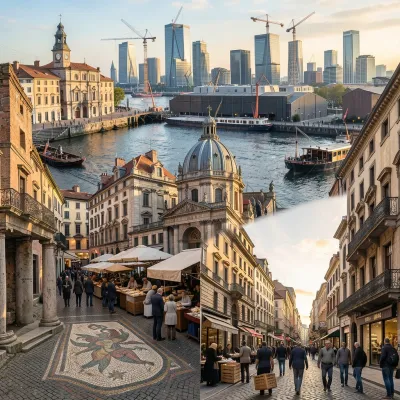
"Cities of Europe: Urban Life from Rome to the Global Metropolis" offers a comprehensive comparative urban history spanning two millennia, tracing the evolution of European cities through their governance, commerce, and culture. The book begins with the classical foundations of Rome, examining the development of public spaces like forums and baths, and then explores the transformative period of Late Antiquity, where cities faced collapse but also saw the rise of the episcopal city. It then moves to the medieval era, highlighting the crucial roles of charters and guilds in fostering urban autonomy and shaping economies, as well as the symbolic and practical significance of cathedrals and market squares.
The narrative continues through the Renaissance, focusing on cities like Florence and Ferrara as laboratories for new artistic and political ideas, and then to the age of absolutism, where capitals such as Paris, Madrid, and Vienna were remade as instruments of royal power. The book also dedicates attention to gateway cities like Istanbul, Trieste, and Odessa, shaped by imperial ambitions and global trade at the crossroads of civilizations. The Enlightenment introduced rational reforms, leading to the "policed city," before the Industrial Revolution brought unprecedented growth and squalor to factory towns like Manchester and Lille, prompting the "housing question" and early social reforms.
The latter half of the book explores the drastic remaking of urban space by railways and boulevards in the 19th century, exemplified by Haussmann's Paris, and the vital role of port cities like Liverpool, Marseille, and Antwerp in global trade flows. The rise of nationalism profoundly influenced urban identity, leading to intense monument building and contested urban memory. The devastation of the World Wars spurred massive reconstruction efforts, often guided by modernist principles or acts of historical restoration, as seen in Rotterdam, Dresden, and Warsaw.
Finally, the book examines the rise of "welfare urbanism" in the postwar era, a state-led approach to providing housing and public services, contrasting it with socialist planning in Moscow and East Berlin. It then delves into the impact of migration and multiculturalism in postcolonial cities like London and Paris, followed by the "neoliberal turn" of privatization and financialization, which reshaped cities into competitive, entrepreneurial hubs. The concluding chapters address contemporary challenges: European integration's influence on urban governance through regions and networks, and the imperative of sustainability and resilience, with Copenhagen and Freiburg as pioneers. The book ends by exploring "smart urbanism" in Barcelona and Tallinn, where data and technology are transforming daily life, concluding that the European city remains a remarkably adaptable and inventive organism, continuously reinventing itself amidst deep historical layers and new global forces.
What You'll Find Inside:
- Traces two millennia of European urban governance, showing continuity and change from Roman councils and medieval charters to absolutist capitals, socialist planning, and contemporary EU multi-level networks.
- Examines how commerce and trade networks—from Roman roads and Mediterranean maritime republics to Hanseatic League, industrial ports, and global finance hubs—shaped city form and economic life.
- Highlights the cultural life of cities, including public forums, cathedrals, market squares, monuments, and how they express power, piety, and collective memory.
- Details the evolution of urban infrastructure and technology: aqueducts, streets, railways, boulevards, sanitation, housing, and modern smart‑city data systems.
- Explores social challenges such as overcrowding, disease, migration, and the policy responses ranging from welfare urbanism and postwar reconstruction to sustainability and resilience initiatives.
Who's It For:
This book will be valuable for urban planners and policymakers seeking historical precedents for contemporary governance and sustainability challenges; students and scholars of urban history, European studies, and geography who need a comparative, longitudinal framework; and general readers interested in how Europe’s cities have evolved as laboratories of political, economic, and cultural innovation.
Table of Contents:
- Introduction
- Chapter 1 <Foundations of the Classical City: Rome and the Urban Inheritance>
- Chapter 2 <Streets, Forums, and Baths: Public Space and Civic Life in Antiquity>
- Chapter 3 <From Collapse to Continuity: Late Antique Transformations>
- Chapter 4 <Medieval Charters and Guilds: Autonomy and Urban Economies>
- Chapter 5 <Cathedrals and Market Squares: Power, Piety, and Exchange>
- Chapter 6 <Maritime Republics: Venice, Genoa, and Mediterranean Networks>
- Chapter 7 <The Hanseatic World: Commerce and Governance in the North>
- Chapter 8 <Renaissance Urbanism: Florence, Ferrara, and the Arts of Power>
- Chapter 9 <Capitals of Absolutism: Paris, Madrid, and Vienna>
- Chapter 10 <Empires and Gateways: Istanbul, Trieste, and Odessa>
- Chapter 11 <Enlightenment Reforms and the Policed City>
- Chapter 12 <Industrial Urbanization: Manchester, Lille, and the Factory Town>
- Chapter 13 <Housing the Masses: Tenements, Sanitation, and Social Reform>
- Chapter 14 <Railways, Boulevards, and the Remaking of Urban Space>
- Chapter 15 <Port Cities and Global Flows: Liverpool, Marseille, and Antwerp>
- Chapter 16 <Nationalism, Monuments, and Urban Memory>
- Chapter 17 <Modernism and Garden Cities: Interwar Experiments>
- Chapter 18 <War, Ruins, and Reconstruction: Dresden, Rotterdam, and Warsaw>
- Chapter 19 <Welfare Urbanism and the Postwar Consensus>
- Chapter 20 <Socialist Planning and the Command City: Moscow and East Berlin>
- Chapter 21 <Migration and Multiculturalism: Postcolonial London and Paris>
- Chapter 22 <The Neoliberal Turn: Privatization, Finance, and the Entrepreneurial City>
- Chapter 23 <European Integration and Urban Governance: Regions, Networks, and the EU>
- Chapter 24 <Sustainability and Resilience: Copenhagen, Freiburg, and Beyond>
- Chapter 25 <Smart Urbanism and the Datafied Street: Barcelona and Tallinn>
Author:
Published By:
Date Published:
May 14, 2026
Type:
Nonfiction
Language:
English
Word Count:
75,844 words
Reading Time:
5 hours 19 minutes
Sample:
Order:
Order Cities of Europe: Urban Life from Rome to the Global Metropolis (Hardcover) on MixCache.com:
Buy NowPrint copy is made to order and ships worldwide. Includes the ebook free, ready to read instantly.
$5 account credit for all new MixCache.com accounts, usable toward any ebook purchase!*