Browse by Category
Fiction
- Action & Adventure
- African American
- Anthologies
- Children's Fiction
- Classics
- Comics & Graphic Novels
- Coming of Age
- Contemporary
- Cultural & Regional
- Drama
- Erotica
- Fantasy
- General
- Historical Fiction
- Horror
- Humor & Satire
- Literary Fiction
- Mystery, Thriller & Suspense
- Poetry
- Religious & Inspirational
- Romance
- Science Fiction
- Short Stories
- War & Military
- Westerns
- Women's Fiction
- Young Adult
Non-Fiction
- Antiques & Collectibles
- Arts & Photography
- Biographies & Memoirs
- Business & Money
- Children's Non-Fiction
-
Computers & Technology
- Artificial Intelligence
- Computer Science
- Cybersecurity & Cryptography
- Data Science & Analytics
- Databases & Big Data
- Game Development & Design
- General
- Hardware & DIY
- Mobile App Development
- Networking & Cloud Computing
- Operating Systems
- Programming
- Robotics
- Software
- Software Engineering
- User Experience (UX) & Design
- Web Development & Design
- Cooking, Food & Wine
- Crafts, Hobbies & Home
- Education & Teaching
- Engineering
- General
- Health, Fitness & Dieting
-
History
- African History
- African History - North Africa
- African History - Sub-Saharan Africa
- American History
- American History - 20th Century
- American History - Civil War
- American History - Colonial Period
- Ancient History
- Asian History
- Asian History - China
- Asian History - India
- Asian History - Japan
- Asian History - Southeast Asia
- European History
- European History - Ancient Greece
- European History - Ancient Rome
- European History - Medieval
- European History - Modern
- European History - Renaissance
- General
- Middle Eastern History
- Military History
- Military History - Aviation
- Military History - Naval
- Social & Cultural History
- World History
- Humor & Entertainment
- Industrial Technology
- Language Learning
- Law
- LGBTQ+ Non-Fiction
- Literary Criticism
- Medical Books
- Parenting & Relationships
- Philosophy
- Politics & Social Sciences
- Reference
- Religion & Spirituality
-
Science & Math
- Agricultural Sciences
- Astronomy & Space Science
- Behavioral Sciences
- Biological Sciences
- Botany & Plant Science
- Chemistry
- Earth Sciences
- Engineering - Chemical
- Engineering - Civil
- Engineering - Electrical
- Engineering - Mechanical
- Environment
- General
- Geology
- Mathematics
- Nature & Ecology
- Oceanography
- Paleontology
- Physics
- Statistics
- Self-Help
- Sports & Outdoors
- Study Aids
- Sustainability & Green Living
- Textbooks
- Transportation
- Travel
- True Crime
- Urban Planning & Development
- Veterinary Medicine
- Writing & Publishing
Jump to Section
MixCache.com Total Access
Unlimited reading and audiobooks for every book published by MixCache.com.
Included titles carry the MTA badge.
Learn more →
Rivers of Grain: Food, Famine, and Statecraft in Chinese History
MTA
A comparative study of food systems, famine responses, and agricultural policy across dynasties
About this book:
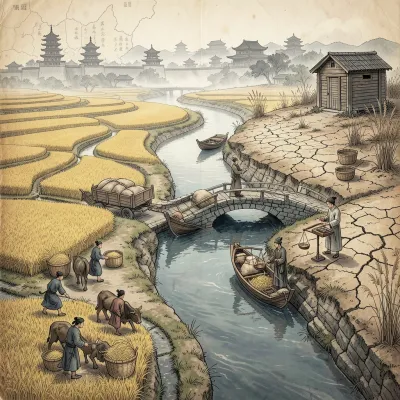
*Rivers of Grain: Food, Famine, and Statecraft in Chinese History* explores the central role of agricultural management and food security in the legitimacy and longevity of Chinese dynasties. From the Neolithic period to the modern era, the book argues that Chinese statecraft has been defined by a "Mandate of Grain," a moral and political contract where a ruler’s right to power is tied to their ability to feed the populace. This imperative drove centuries of innovation in hydraulic engineering, such as the Grand Canal and Dujiangyan, as well as the development of sophisticated administrative tools like the "ever-normal" granary system, land registers, and diverse taxation models.
The narrative moves through key historical transitions, highlighting how ecological shifts and technological breakthroughs reshaped the empire. The introduction of Champa rice during the Song Dynasty and New World crops like the sweet potato during the Ming and Qing eras provided demographic buffers that allowed for massive population growth. However, the book also details how these systems frequently buckled under the weight of information failures, corruption, and ideological rigidity. It contrasts the flexible, market-hybrid approaches of the Song and High Qing with the catastrophic centralized failures of the Great Leap Forward, illustrating how the suppression of local knowledge and honest reporting can transform manageable scarcity into mass famine.
In its final sections, the study examines the modern logistics state, where satellite surveillance, big data, and global trade have replaced traditional courier networks and local granaries. It addresses contemporary challenges, including the South-to-North Water Transfer Project and the intensifying risks posed by climate change to China’s water-scarce northern plains. By comparing dynastic responses to disasters like floods, droughts, and locusts, the author identifies recurring themes of resilience and redundancy. Ultimately, the book concludes that while technology has advanced, the fundamental challenge of governance remains unchanged: sustainable statecraft depends on the state’s ability to maintain a just and reliable flow of grain in an inherently unpredictable environment.
What You'll Find Inside:
- How the Mandate of Heaven tied political legitimacy to grain security, making famine relief a core state obligation from Zhou dynasty to modern China
- The evolution of granary systems and food storage strategies as critical instruments of statecraft across dynasties, from Han ever-normal granaries to PRC strategic reserves
- Water management as statecraft: how hydraulic engineering (Dujiangyan, Grand Canal, South-North Transfer) reshaped agricultural productivity and food distribution
- The recurring tension between state intervention and market mechanisms in grain policy, from Qin-Han monopolies to reform-era dual-track systems
- Famines as diagnostic tests exposing governance failures, particularly information breakdowns that turned scarcity into catastrophe (e.g., Great Leap Forward, 1876-79 North China Famine)
Who's It For:
This book is ideal for students and scholars of Chinese history, agricultural studies, development economics, and food security policy. It will particularly benefit researchers examining historical precedents for modern challenges like climate adaptation, grain reserve management, and state-market relations in food systems, as well as policymakers seeking long-term perspectives on building resilient agricultural governance.
Table of Contents:
- Introduction
- Chapter 1 The Mandate of Grain: Legitimacy and the Moral Economy
- Chapter 2 Seeds and Soils: Ecologies from the Neolithic to Zhou
- Chapter 3 Qin and Han Foundations: Standardization, Salt–Iron, and the First Granary Regime
- Chapter 4 Water as Statecraft: Dujiangyan, Early Canals, and River Control
- Chapter 5 Taxation and Land: From Equal-Field to the Tang Two-Tax System
- Chapter 6 Song Innovations: Champa Rice, Markets, and Urban Appetite
- Chapter 7 Frontiers and Famines: Liao, Xia, and Jin in a Shared Ecology
- Chapter 8 Yuan Experiments: Multiethnic Rule and Grain Logistics
- Chapter 9 Ming Granaries: Ever-Normal Ambitions and the Single-Whip Reform
- Chapter 10 The Grand Canal: Caoyun Transport and Feeding the Capital
- Chapter 11 High Qing Plenty: Population, Land, and Administrative Reach
- Chapter 12 Shock and Drought: The North China Famine of 1876–79
- Chapter 13 Philanthropy and the Public Sphere: Gentry Activism and Mission Relief
- Chapter 14 Silver and the World: Globalization of China’s Food System
- Chapter 15 War, Occupation, and Hunger: Crises of the 1930s–1940s
- Chapter 16 Land Reform and Collectivization: Reordering the Village
- Chapter 17 The Great Leap Famine: Policy Failure and Information Breakdown
- Chapter 18 After the Famine: Recovery, Grain Reserves, and Price Controls
- Chapter 19 Reform-Era Transitions: From Rationing to Markets
- Chapter 20 South-to-North: Water Transfers, Dams, and Ecological Trade-offs
- Chapter 21 New World Crops to Hybrid Rice: Technology and Yield Revolutions
- Chapter 22 Disaster Governance: Floods, Droughts, Locusts, and the Toolkit of Relief
- Chapter 23 Data, Surveillance, and Procurement: The Modern Logistics State
- Chapter 24 Food Security in a Warming China: Climate Risk and Adaptation
- Chapter 25 Lessons for Governance: Resilience, Redundancy, and Justice
Author:
Published By:
Date Published:
May 14, 2026
Type:
Nonfiction
Language:
English
Word Count:
67,261 words
Reading Time:
4 hours 43 minutes
Sample:
Order:
Order Rivers of Grain: Food, Famine, and Statecraft in Chinese History (Paperback) on MixCache.com:
Buy NowPrint copy is made to order and ships worldwide. Includes the ebook free, ready to read instantly.
$5 account credit for all new MixCache.com accounts, usable toward any ebook purchase!*