
Browse by Category
Fiction
- Action & Adventure
- African American
- Anthologies
- Children's Fiction
- Classics
- Comics & Graphic Novels
- Coming of Age
- Contemporary
- Cultural & Regional
- Drama
- Erotica
- Fantasy
- General
- Historical Fiction
- Horror
- Humor & Satire
- Literary Fiction
- Mystery, Thriller & Suspense
- Poetry
- Religious & Inspirational
- Romance
- Science Fiction
- Short Stories
- War & Military
- Westerns
- Women's Fiction
- Young Adult
Non-Fiction
- Antiques & Collectibles
- Arts & Photography
- Biographies & Memoirs
- Business & Money
- Children's Non-Fiction
-
Computers & Technology
- Artificial Intelligence
- Computer Science
- Cybersecurity & Cryptography
- Data Science & Analytics
- Databases & Big Data
- Game Development & Design
- General
- Hardware & DIY
- Mobile App Development
- Networking & Cloud Computing
- Operating Systems
- Programming
- Robotics
- Software
- Software Engineering
- User Experience (UX) & Design
- Web Development & Design
- Cooking, Food & Wine
- Crafts, Hobbies & Home
- Education & Teaching
- Engineering
- General
- Health, Fitness & Dieting
-
History
- African History
- African History - North Africa
- African History - Sub-Saharan Africa
- American History
- American History - 20th Century
- American History - Civil War
- American History - Colonial Period
- Ancient History
- Asian History
- Asian History - China
- Asian History - India
- Asian History - Japan
- Asian History - Southeast Asia
- European History
- European History - Ancient Greece
- European History - Ancient Rome
- European History - Medieval
- European History - Modern
- European History - Renaissance
- General
- Middle Eastern History
- Military History
- Military History - Aviation
- Military History - Naval
- Social & Cultural History
- World History
- Humor & Entertainment
- Industrial Technology
- Language Learning
- Law
- LGBTQ+ Non-Fiction
- Literary Criticism
- Medical Books
- Parenting & Relationships
- Philosophy
- Politics & Social Sciences
- Reference
- Religion & Spirituality
-
Science & Math
- Agricultural Sciences
- Astronomy & Space Science
- Behavioral Sciences
- Biological Sciences
- Botany & Plant Science
- Chemistry
- Earth Sciences
- Engineering - Chemical
- Engineering - Civil
- Engineering - Electrical
- Engineering - Mechanical
- Environment
- General
- Geology
- Mathematics
- Nature & Ecology
- Oceanography
- Paleontology
- Physics
- Statistics
- Self-Help
- Sports & Outdoors
- Study Aids
- Sustainability & Green Living
- Textbooks
- Transportation
- Travel
- True Crime
- Urban Planning & Development
- Veterinary Medicine
- Writing & Publishing
Jump to Section
MixCache.com Total Access
Unlimited reading and audiobooks for every book published by MixCache.com.
Included titles carry the MTA badge.
Learn more →
Spices in Baking and Pastry
MTA
Techniques for Infusing Doughs, Fillings, and Confections with Aromatic Spices
About this book:
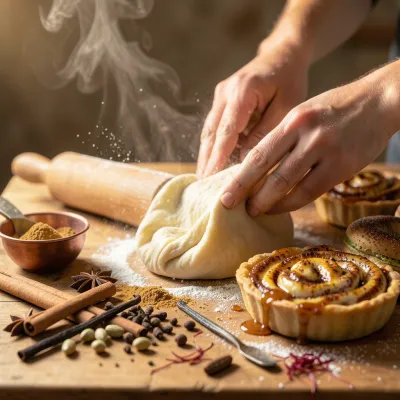
This technical guide explores the scientific and culinary principles of using spices in professional pastry work, framing aromatics as structural flavor elements rather than mere ornaments. The book establishes a foundation in spice botany and processing, emphasizing that a spice’s quality is determined by its harvest timing and post-harvest handling. It details how the sensory perception of aroma is a matter of volatile chemistry, explaining that different compounds—terpenes, aldehydes, and phenolics—respond uniquely to the "gauntlet" of the baking environment, where heat, time, and pH levels can either enhance or destroy delicate top notes.
The text provides a rigorous framework for extraction and delivery, categorized by solubility. It explains how fats like butter and cocoa butter act as protective carriers for non-polar volatiles, while water and alcohol serve as different types of solvents for infusions and tinctures. The book introduces a "layering" strategy for flavor development, encouraging bakers to build profiles using "base" notes for foundational warmth, "bridge" spices for complexity, and "spark" aromatics for immediate sensory impact. This methodology allows for precise control over the finished product’s aromatic arc, ensuring that flavors persist from the first scent to the lingering finish.
Specific chapters provide technical deep-dives into spice families—ranging from the "warm core" of cinnamon and allspice to the bright, citrusy notes of cardamom and coriander, and the pungent heat of ginger and pepper. The book also addresses "atmospheric" aromatics like lavender and rosemary, which require extreme restraint to avoid soapy or medicinal off-notes. Throughout, the author stresses the importance of technique-driven applications, such as blooming spices in fat to shield them from oven heat or using post-bake syrups and tinctures to replenish volatiles lost during the bake.
The final section applies these principles to a wide array of pastry formats, including yeasted doughs, laminated pastries, custards, and high-sugar confections. It examines how different matrices—from the porous, airy structure of meringues to the dense, cold environment of frozen desserts—affect flavor release. By combining chemical theory with practical procedures like maceration, pre-cooking, and multi-stage infusion, the book equips the pastry chef to treat spices as precision tools, capable of transforming standard formulas into sophisticated, multidimensional desserts.
What You'll Find Inside:
- Learn how spice botany, harvest, and processing affect potency and flavor stability, enabling informed sourcing and storage decisions.
- Understand the sensory science of aroma: how volatile compounds are perceived, how heat, time, and pH alter spice character, and strategies to preserve delicate notes.
- Master extraction techniques—infusions, tinctures, and oleoresins—to liberate spice aromatics into usable carriers tailored to specific pastry applications.
- Explore solubility and carrier systems (fat, water, alcohol, sugar) to control which spice compounds dissolve, how they are protected, and when they release during baking and confectioning.
- Apply these principles across doughs, fillings, and confections—from laminated croissants and custards to cookies, frozen desserts, and chocolate work—to build layered, balanced spice profiles that survive processing.
Who's It For:
This book is designed for professional pastry chefs, bakers, and advanced home bakers who want to move beyond simply adding spices to fully understanding and controlling aromatic impact in baked goods and confections. It will benefit those developing recipes, troubleshooting flavor loss, or seeking to create signature spice blends with precision and consistency across various pastry formats.
Table of Contents:
- Introduction
- Chapter 1 Spice Foundations: Botany, Harvest, and Processing
- Chapter 2 The Sensory Science of Aroma: Volatiles and Perception
- Chapter 3 Selecting, Storing, and Grinding for Potency
- Chapter 4 Extraction Methods: Infusions, Tinctures, and Oleoresins
- Chapter 5 Solubility and Carriers: Fat, Water, Alcohol, and Sugar
- Chapter 6 Heat, Time, and pH: Preserving Delicate Aromatics
- Chapter 7 Balancing Sweetness, Acidity, Bitterness, and Heat
- Chapter 8 Blending and Layering: Building Signature Spice Profiles
- Chapter 9 Vanilla Beyond the Bean: Varietals, Pastes, and Extracts
- Chapter 10 Cinnamon, Cassia, and Allspice: The Warm Core
- Chapter 11 Bright and Citrusy: Cardamom, Coriander, and Grains of Paradise
- Chapter 12 Pepper, Ginger, and Pungency in Desserts
- Chapter 13 Floral and Herbal Accents: Lavender, Rosemary, Bay, and Mint
- Chapter 14 Cocoa, Coffee, and Spices: Synergy in Chocolate Work
- Chapter 15 Yeasted and Enriched Doughs: Buns, Babka, and Brioche
- Chapter 16 Laminated Doughs: Tempering Flavors in Croissants and Danish
- Chapter 17 Quick Breads and Muffins: Tender, Spiced Crumbs
- Chapter 18 Cakes and Cupcakes: Emulsions, Soaks, and Frostings
- Chapter 19 Cookies and Biscotti: Spices in Low-Moisture Systems
- Chapter 20 Pies, Tarts, and Fruit Fillings: Maceration and Pre-Cooks
- Chapter 21 Custards and Creams: Gentle Heat, Maximum Aroma
- Chapter 22 Meringues and Macarons: Volatiles in High-Sugar Matrices
- Chapter 23 Frozen Desserts: Ice Creams, Sorbets, and Semifreddo
- Chapter 24 Syrups, Caramels, and Confections: Toffee, Nougat, Marshmallow
- Chapter 25 Chocolate, Ganache, and Pralines: Cocoa Butter as Carrier
Author:
Published By:
Date Published:
May 13, 2026
Type:
Nonfiction
Language:
English
Word Count:
98,730 words
Reading Time:
6 hours 55 minutes
Sample:
MixCache.com Total Access
Get unlimited access to this book + all books published by MixCache.com for $11.99/month
Subscribe to MTAOr purchase this book individually below
Order:
Buy the Spices in Baking and Pastry ebook on MixCache.com:
Buy Now
Full ebook will be available immediately
- read online or download as a PDF file.
$5 account credit for all new MixCache.com accounts, usable toward any ebook purchase!*


Ratings & Reviews
Ask Questions About This Book
Have a question about the content? Ask our AI assistant!
Start by asking a question about "Spices in Baking and Pastry"
Example: "Does this book mention William Shakespeare?"
Thinking...