
Browse by Category
Fiction
- Action & Adventure
- African American
- Anthologies
- Children's Fiction
- Classics
- Comics & Graphic Novels
- Coming of Age
- Contemporary
- Cultural & Regional
- Drama
- Erotica
- Fantasy
- General
- Historical Fiction
- Horror
- Humor & Satire
- Literary Fiction
- Mystery, Thriller & Suspense
- Poetry
- Religious & Inspirational
- Romance
- Science Fiction
- Short Stories
- War & Military
- Westerns
- Women's Fiction
- Young Adult
Non-Fiction
- Antiques & Collectibles
- Arts & Photography
- Biographies & Memoirs
- Business & Money
- Children's Non-Fiction
-
Computers & Technology
- Artificial Intelligence
- Computer Science
- Cybersecurity & Cryptography
- Data Science & Analytics
- Databases & Big Data
- Game Development & Design
- General
- Hardware & DIY
- Mobile App Development
- Networking & Cloud Computing
- Operating Systems
- Programming
- Robotics
- Software
- Software Engineering
- User Experience (UX) & Design
- Web Development & Design
- Cooking, Food & Wine
- Crafts, Hobbies & Home
- Education & Teaching
- Engineering
- General
- Health, Fitness & Dieting
-
History
- African History
- African History - North Africa
- African History - Sub-Saharan Africa
- American History
- American History - 20th Century
- American History - Civil War
- American History - Colonial Period
- Ancient History
- Asian History
- Asian History - China
- Asian History - India
- Asian History - Japan
- Asian History - Southeast Asia
- European History
- European History - Ancient Greece
- European History - Ancient Rome
- European History - Medieval
- European History - Modern
- European History - Renaissance
- General
- Middle Eastern History
- Military History
- Military History - Aviation
- Military History - Naval
- Social & Cultural History
- World History
- Humor & Entertainment
- Industrial Technology
- Language Learning
- Law
- LGBTQ+ Non-Fiction
- Literary Criticism
- Medical Books
- Parenting & Relationships
- Philosophy
- Politics & Social Sciences
- Reference
- Religion & Spirituality
-
Science & Math
- Agricultural Sciences
- Astronomy & Space Science
- Behavioral Sciences
- Biological Sciences
- Botany & Plant Science
- Chemistry
- Earth Sciences
- Engineering - Chemical
- Engineering - Civil
- Engineering - Electrical
- Engineering - Mechanical
- Environment
- General
- Geology
- Mathematics
- Nature & Ecology
- Oceanography
- Paleontology
- Physics
- Statistics
- Self-Help
- Sports & Outdoors
- Study Aids
- Sustainability & Green Living
- Textbooks
- Transportation
- Travel
- True Crime
- Urban Planning & Development
- Veterinary Medicine
- Writing & Publishing
Jump to Section
MixCache.com Total Access
Unlimited reading and audiobooks for every book published by MixCache.com.
Included titles carry the MTA badge.
Learn more →
The Science of Flavor: A Cook's Guide to Taste, Texture, and Aroma
MTA
Practical food science for better seasoning, pairing, and kitchen results
About this book:
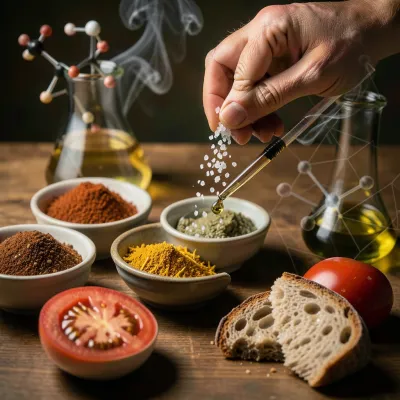
"The Science of Flavor: A Cook's Guide to Taste, Texture, and Aroma" translates sensory science into practical cooking techniques, aiming to equip home and professional cooks with the knowledge to create consistently delicious meals. The book begins by dissecting "flavor" into its component senses—taste (salt, sour, sweet, bitter, umami), smell (orthonasal and retronasal olfaction), and trigeminal sensations (heat, cooling, astringency). It emphasizes that flavor is an active experience, assembled in the brain from these diverse signals, and is profoundly influenced by context, memory, and even saliva. The introduction sets the stage for a systematic approach to cooking, moving beyond guesswork to intentional manipulation of these sensory inputs.
Subsequent chapters delve into the core elements of flavor and cooking processes. Key chapters explore the individual roles of salt, acidity, fat, sweetness, bitterness, umami, and aroma, detailing their chemical behaviors and how they interact with each other. For instance, salt's influence extends beyond mere taste to protein structure and moisture retention, while acidity acts as a "brightness switch," balancing richness and preserving color. Fat is presented as a "carrier" for aroma and texture, affecting mouthfeel and heat transfer, while umami and kokumi are explained as drivers of savory depth and mouthfulness. The book also covers fundamental kitchen transformations like gelatinization of starches, denaturation of proteins, emulsification of sauces, and the browning reactions of Maillard and caramelization, explaining the science behind everyday phenomena like bread staling or meat tenderizing.
The book is structured as both a reference and a workbook, consistently integrating short experiments and tasting exercises designed for a home kitchen. These practical applications are crucial for calibrating the palate and building sensory memory, transforming abstract concepts into concrete, repeatable practices. For example, readers are encouraged to compare brined versus unbrined meats, adjust acidity in a soup incrementally, or observe how different fats affect browning. The final chapters integrate these foundational elements into broader culinary strategies, addressing cooking methods (conduction, convection, radiation, pressure), texture engineering, iterative seasoning, sophisticated flavor pairing (complement, contrast, bridge, echo), and the transformative power of fermentation. The concluding section on designing experiments and recipes reinforces a scientific mindset, emphasizing variables, controls, and consistency as paths to predictable, excellent results.
Ultimately, "The Science of Flavor" demystifies cooking by revealing the predictable chemistry and physics behind every ingredient and technique. It encourages cooks to view their kitchen as a laboratory, where informed choices—rather than accidental successes—lead to reliable deliciousness. By understanding how taste, smell, and touch interact, and how ingredients respond to heat, time, and each other, cooks gain the confidence to troubleshoot, adapt, and invent recipes with a scientist's clarity and a chef's intuition, making cooking a more engaging and rewarding pursuit.
What You'll Find Inside:
- Learn how the five basic tastes—salt, sour, sweet, bitter, and umami—interact and how to adjust them for balanced flavor.
- Discover the science of aroma, retronasal olfaction, and techniques to preserve or enhance volatile compounds during cooking.
- Master texture engineering—crunch, creaminess, and crumb—to control how flavor is released and perceived in every bite.
- Apply core food‑science processes such as brining, emulsions, starch gelatinization, the Maillard reaction, and fermentation to improve juiciness, thickness, browning, and depth.
- Develop a calibrated palate through iterative tasting and small adjustments, turning ‘season to taste’ into a reliable, repeatable practice.
Who's It For:
This book is ideal for home cooks who want to move beyond following recipes and gain a deeper, science‑based understanding of why techniques work, as well as for professional chefs or culinary students seeking a shared vocabulary and practical tools to train teams, troubleshoot dishes, and create consistent, delicious results.
Table of Contents:
- Introduction
- Chapter 1 What Is Flavor? Taste, Smell, and Touch at the Table
- Chapter 2 The Flavor Equation: Balance, Contrast, and Harmony
- Chapter 3 Salt: Diffusion, Perception, and Seasoning Strategies
- Chapter 4 Acidity: pH, Sourness, and Brightness in the Kitchen
- Chapter 5 Fat: Carrier of Flavor, Texture, and Heat
- Chapter 6 Sweetness and Bitterness: Managing Opposites
- Chapter 7 Umami and Kokumi: The Chemistry of Savory Depth
- Chapter 8 Heat and Tingling: Trigeminal Sensations and Pungency
- Chapter 9 Aroma: Volatiles, Retronasal Olfaction, and Memory
- Chapter 10 Water, Osmosis, and Brining: Juiciness by Design
- Chapter 11 Starches: Gelatinization, Retrogradation, and Thickening
- Chapter 12 Proteins: Denaturation, Coagulation, and Tenderness
- Chapter 13 Emulsions: Stable Sauces from Vinaigrettes to Mayonnaise
- Chapter 14 Gels and Hydrocolloids: Gelatin, Pectin, and Friends
- Chapter 15 The Maillard Reaction and Caramelization: Controlled Browning
- Chapter 16 Temperature and Time: Precision Heat for Predictable Results
- Chapter 17 Cooking Methods: Conduction, Convection, Radiation, and Pressure
- Chapter 18 Texture Engineering: Crunch, Creaminess, and Crumb
- Chapter 19 Seasoning to Taste: Iterative Tasting, Calibration, and Palate Training
- Chapter 20 Flavor Pairing: Complement, Contrast, Bridge, and Echo
- Chapter 21 Fermentation and Cultured Acidity: Lacto, Yeast, and Mold
- Chapter 22 Sauces and Condiments: Concentrated Flavor Builders
- Chapter 23 Vegetables, Grains, and Legumes: Maximizing Flavor from Plants
- Chapter 24 Meat, Fish, and Eggs: From Brining to Browning
- Chapter 25 Designing Experiments and Recipes: Variables, Controls, and Consistency
Author:
Published By:
Date Published:
May 6, 2026
Type:
Nonfiction
Language:
English
Word Count:
71,899 words
Reading Time:
5 hours 2 minutes
Sample:
Order:
Order The Science of Flavor: A Cook's Guide to Taste, Texture, and Aroma (Paperback) on MixCache.com:
Buy NowPrint copy is made to order and ships worldwide. Includes the ebook free, ready to read instantly.
$5 account credit for all new MixCache.com accounts, usable toward any ebook purchase!*


