
Browse by Category
Fiction
- Action & Adventure
- African American
- Anthologies
- Children's Fiction
- Classics
- Comics & Graphic Novels
- Coming of Age
- Contemporary
- Cultural & Regional
- Drama
- Erotica
- Fantasy
- General
- Historical Fiction
- Horror
- Humor & Satire
- Literary Fiction
- Mystery, Thriller & Suspense
- Poetry
- Religious & Inspirational
- Romance
- Science Fiction
- Short Stories
- War & Military
- Westerns
- Women's Fiction
- Young Adult
Non-Fiction
- Antiques & Collectibles
- Arts & Photography
- Biographies & Memoirs
- Business & Money
- Children's Non-Fiction
-
Computers & Technology
- Artificial Intelligence
- Computer Science
- Cybersecurity & Cryptography
- Data Science & Analytics
- Databases & Big Data
- Game Development & Design
- General
- Hardware & DIY
- Mobile App Development
- Networking & Cloud Computing
- Operating Systems
- Programming
- Robotics
- Software
- Software Engineering
- User Experience (UX) & Design
- Web Development & Design
- Cooking, Food & Wine
- Crafts, Hobbies & Home
- Education & Teaching
- Engineering
- General
- Health, Fitness & Dieting
-
History
- African History
- African History - North Africa
- African History - Sub-Saharan Africa
- American History
- American History - 20th Century
- American History - Civil War
- American History - Colonial Period
- Ancient History
- Asian History
- Asian History - China
- Asian History - India
- Asian History - Japan
- Asian History - Southeast Asia
- European History
- European History - Ancient Greece
- European History - Ancient Rome
- European History - Medieval
- European History - Modern
- European History - Renaissance
- General
- Middle Eastern History
- Military History
- Military History - Aviation
- Military History - Naval
- Social & Cultural History
- World History
- Humor & Entertainment
- Industrial Technology
- Language Learning
- Law
- LGBTQ+ Non-Fiction
- Literary Criticism
- Medical Books
- Parenting & Relationships
- Philosophy
- Politics & Social Sciences
- Reference
- Religion & Spirituality
-
Science & Math
- Agricultural Sciences
- Astronomy & Space Science
- Behavioral Sciences
- Biological Sciences
- Botany & Plant Science
- Chemistry
- Earth Sciences
- Engineering - Chemical
- Engineering - Civil
- Engineering - Electrical
- Engineering - Mechanical
- Environment
- General
- Geology
- Mathematics
- Nature & Ecology
- Oceanography
- Paleontology
- Physics
- Statistics
- Self-Help
- Sports & Outdoors
- Study Aids
- Sustainability & Green Living
- Textbooks
- Transportation
- Travel
- True Crime
- Urban Planning & Development
- Veterinary Medicine
- Writing & Publishing
Jump to Section
MixCache.com Total Access
Unlimited reading and audiobooks for every book published by MixCache.com.
Included titles carry the MTA badge.
Learn more →
CubeSat Engineering and Mission Design
MTA
From concept to launch: building, testing, and operating small satellite missions
About this book:
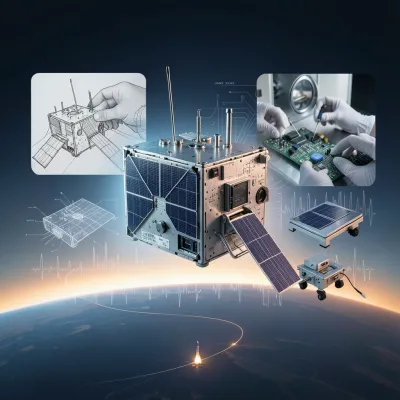
*CubeSat Engineering and Mission Design* serves as a comprehensive technical manual for developing small satellite missions within the 1U to 6U form factors. The book transitions from high-level mission concepts and systems engineering to the granular details of subsystem design, including structures, power, thermal management, and attitude control. It emphasizes the "unapologetically hands-on" nature of CubeSat development, where extreme constraints in mass, volume, and power require rigorous trade studies and disciplined budgeting to ensure mission success.
Beyond pure engineering, the text delves into the complex logistics of the space industry, covering programmatic essentials such as costing, team organization, and agile project management. It provides critical guidance on navigating the "living contract" of CubeSat standards, as well as the administrative hurdles of spectrum licensing, export controls, and launch procurement. By treating these regulatory and logistical tasks as core design parameters, the book prepares teams to manage the entire lifecycle of a satellite, from initial Concept of Operations (ConOps) to rideshare integration.
A significant portion of the book is dedicated to the "crucible" of verification and validation. It outlines a tiered testing philosophy that moves from bench-level functional tests and hardware-in-the-loop (HIL) simulations to full environmental campaigns involving vibration, thermal vacuum (TVAC), and electromagnetic compatibility (EMC) testing. These chapters highlight that for small satellites, the lack of redundancy makes ground testing the primary safeguard against the "unforgiving reality" of orbital failure.
The final chapters transition into the operational life of the spacecraft, detailing commissioning sequences, anomaly response strategies, and the creation of automated data pipelines. The book concludes by emphasizing the importance of responsible space citizenship through end-of-life deorbit planning and mission closeout. Ultimately, the work frames CubeSat design as a balance between scientific ambition and engineering pragmatism, providing a checklist for transforming a fragile box of electronics into a resilient, data-producing orbital asset.
What You'll Find Inside:
- End-to-end CubeSat mission development: from defining mission needs and Concept of Operations through detailed subsystem design, verification, launch campaign, and on‑orbit operations.
- Systems engineering for 1U–6U platforms: allocating mass, power, volume, and thermal budgets; writing traceable requirements; creating Interface Control Documents; and planning verification across analysis, bench test, HIL, and environmental campaigns.
- Power and thermal budgeting practice: building load profiles aligned to duty cycles, applying real‑world margins, closing thermal models that couple attitude, eclipse, and environmental assumptions, and iterating between power and thermal analyses.
- Launch logistics and regulatory navigation: selecting rideshare opportunities, meeting deployer mechanical/electrical interfaces, securing spectrum licenses, complying with export controls and debris mitigation, and preparing for integration and launch‑site activities.
- Operations‑focused resilience: designing fault management, safe modes, autonomy, and data pipelines; planning anomaly response; and ensuring deorbit and closeout to meet regulatory requirements and mission success.
Who's It For:
This book is intended for university capstone teams, early‑stage startup engineers, and dedicated hobbyists who are designing, building, testing, or operating 1U‑6U CubeSat missions. It provides a hands‑on, systems‑engineering‑driven approach that balances theoretical foundations with practical checklists, test plans, and cost‑saving strategies relevant to resource‑constrained projects. Readers will benefit most if they seek a concrete guide to move a mission concept from idea to launch while navigating the tight mass, power, volume, schedule, and regulatory constraints inherent to small satellite development.
Table of Contents:
- Introduction
- Chapter 1 CubeSat Heritage and Standards
- Chapter 2 Mission Needs and Concept of Operations (ConOps)
- Chapter 3 Systems Engineering for 1U–6U Missions
- Chapter 4 Programmatics, Costing, and Funding Paths
- Chapter 5 Team Organization and Agile Project Management
- Chapter 6 Requirements, Interfaces, and Verification Planning
- Chapter 7 Orbit Selection and Mission Analysis
- Chapter 8 Rideshare, Deployers, and Launch Logistics
- Chapter 9 Licensing, Spectrum, and Policy Considerations
- Chapter 10 Architecture Trades and 1U–6U Configuration Sizing
- Chapter 11 Structures, Mechanisms, and Deployables
- Chapter 12 Attitude Determination and Control
- Chapter 13 Power Generation, Storage, and Power Budgeting
- Chapter 14 Thermal Design and Thermal Budgeting
- Chapter 15 Command, Data Handling, and Flight Software
- Chapter 16 Communications, Link Budgets, and Ground Segment
- Chapter 17 Payload Selection, Integration, and Accommodation
- Chapter 18 Propulsion and Mobility for CubeSats
- Chapter 19 Fault Management, Reliability, and Risk
- Chapter 20 Modeling, Simulation, and Digital Engineering
- Chapter 21 Verification: Functional Testing and Hardware-in-the-Loop
- Chapter 22 Environmental Testing: Vibration, TVAC, and EMC
- Chapter 23 Launch Campaign and Final Integration
- Chapter 24 Commissioning, Operations, and Anomaly Response
- Chapter 25 Data Pipeline, Deorbit, and Mission Closeout
Author:
Published By:
Date Published:
May 3, 2026
Type:
Nonfiction
Language:
English
Word Count:
55,652 words
Reading Time:
3 hours 54 minutes
Sample:
MixCache.com Total Access
Get unlimited access to this book + all books published by MixCache.com for $11.99/month
Subscribe to MTAOr purchase this book individually below
Order:
Buy the CubeSat Engineering and Mission Design ebook on MixCache.com:
Buy Now
Full ebook will be available immediately
- read online or download as a PDF file.
$5 account credit for all new MixCache.com accounts, usable toward any ebook purchase!*





Ratings & Reviews
Ask Questions About This Book
Have a question about the content? Ask our AI assistant!
Start by asking a question about "CubeSat Engineering and Mission Design"
Example: "Does this book mention William Shakespeare?"
Thinking...