Browse by Category
Fiction
- Action & Adventure
- African American
- Anthologies
- Children's Fiction
- Classics
- Comics & Graphic Novels
- Coming of Age
- Contemporary
- Cultural & Regional
- Drama
- Erotica
- Fantasy
- General
- Historical Fiction
- Horror
- Humor & Satire
- Literary Fiction
- Mystery, Thriller & Suspense
- Poetry
- Religious & Inspirational
- Romance
- Science Fiction
- Short Stories
- War & Military
- Westerns
- Women's Fiction
- Young Adult
Non-Fiction
- Antiques & Collectibles
- Arts & Photography
- Biographies & Memoirs
- Business & Money
- Children's Non-Fiction
-
Computers & Technology
- Artificial Intelligence
- Computer Science
- Cybersecurity & Cryptography
- Data Science & Analytics
- Databases & Big Data
- Game Development & Design
- General
- Hardware & DIY
- Mobile App Development
- Networking & Cloud Computing
- Operating Systems
- Programming
- Robotics
- Software
- Software Engineering
- User Experience (UX) & Design
- Web Development & Design
- Cooking, Food & Wine
- Crafts, Hobbies & Home
- Education & Teaching
- Engineering
- General
- Health, Fitness & Dieting
-
History
- African History
- African History - North Africa
- African History - Sub-Saharan Africa
- American History
- American History - 20th Century
- American History - Civil War
- American History - Colonial Period
- Ancient History
- Asian History
- Asian History - China
- Asian History - India
- Asian History - Japan
- Asian History - Southeast Asia
- European History
- European History - Ancient Greece
- European History - Ancient Rome
- European History - Medieval
- European History - Modern
- European History - Renaissance
- General
- Middle Eastern History
- Military History
- Military History - Aviation
- Military History - Naval
- Social & Cultural History
- World History
- Humor & Entertainment
- Industrial Technology
- Language Learning
- Law
- LGBTQ+ Non-Fiction
- Literary Criticism
- Medical Books
- Parenting & Relationships
- Philosophy
- Politics & Social Sciences
- Reference
- Religion & Spirituality
-
Science & Math
- Agricultural Sciences
- Astronomy & Space Science
- Behavioral Sciences
- Biological Sciences
- Botany & Plant Science
- Chemistry
- Earth Sciences
- Engineering - Chemical
- Engineering - Civil
- Engineering - Electrical
- Engineering - Mechanical
- Environment
- General
- Geology
- Mathematics
- Nature & Ecology
- Oceanography
- Paleontology
- Physics
- Statistics
- Self-Help
- Sports & Outdoors
- Study Aids
- Sustainability & Green Living
- Textbooks
- Transportation
- Travel
- True Crime
- Urban Planning & Development
- Veterinary Medicine
- Writing & Publishing
Jump to Section

Want unlimited access to all books published by MixCache.com (plus their audiobooks)? Try MixCache.com Total Access. Look for the MTA badge on book covers to identify included titles.
Access to infinite ebooks: Don't see the book you want? Suggest it and we'll create it (free!) for you from scratch with our powerful AI book writer. Then read it with MTA - besides profiting from any sales it makes!
Orbital Mechanics Made Practical
MTA
Essential math and intuition for calculating orbits, transfers, and rendezvous for students and engineers
About this book:
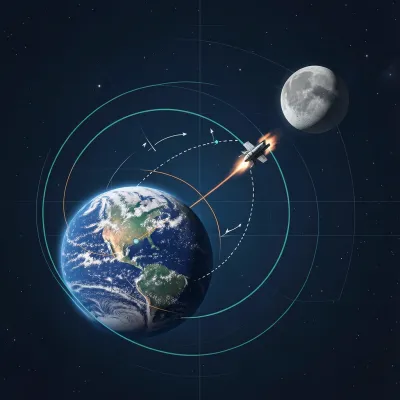
*Orbital Mechanics Made Practical* is a comprehensive technical guide designed to bridge the gap between theoretical physics and operational spacecraft engineering. The book begins by establishing a rigorous foundation in the two-body problem, utilizing Keplerian elements, state vectors, and the vis-viva equation to describe and size orbits. It emphasizes the importance of consistent units, precise timekeeping (sidereal vs. solar), and the selection of appropriate coordinate frames. By mastering these fundamentals, readers develop the intuition necessary to convert between geometric descriptions and numerical state vectors while identifying the limitations of idealized models.
The text then transitions into the practical "toolkit" of mission design, detailing various orbital maneuvers. It provides in-depth derivations and applications for Hohmann transfers, bi-elliptic strategies, and combined maneuvers that incorporate inclination and plane changes. The book also addresses complex operational scenarios, such as phasing orbits for timing adjustments and the Clohessy–Wiltshire equations for relative motion during rendezvous and docking. Beyond Earth-centered operations, it introduces patched-conic approximations and Lambert targeting to facilitate interplanetary trajectory design, demonstrating how gravity assists and powered flybys can be leveraged to optimize fuel efficiency and mission duration.
A significant portion of the book is dedicated to the real-world constraints that differentiate engineering from pure mathematics. This includes a detailed primer on perturbations—such as J2 atmospheric drag, solar radiation pressure, and third-body gravity—and their long-term effects on orbital stability. The author explores the multidisciplinary nature of mission architecture, linking delta-v budgeting to spacecraft subsystems like propulsion, power, and thermal control. Furthermore, it covers the fundamentals of navigation and orbit determination, explaining how imperfect sensor data and maneuver execution errors are managed through statistical filtering and error budgeting.
The final section focuses on the modern engineer’s workflow, highlighting the use of computational tools like GMAT, STK, and Python for verification and high-fidelity simulation. The book concludes with capstone design examples that synthesize the preceding chapters into realistic mission scenarios, such as Mars intercepts and LEO rendezvous. Throughout the text, the emphasis remains on engineering judgment: the ability to choose the right model for a specific problem, verify results through multiple methods, and build robust designs that account for the inherent uncertainties of spaceflight.
What You'll Find Inside:
- Master the fundamentals of orbital mechanics including the two-body problem, Keplerian elements, and orbital geometry to accurately describe and predict spacecraft motion.
- Learn practical maneuver techniques such as Hohmann transfers, bi-elliptic transfers, plane changes, and phasing strategies to efficiently change orbits.
- Understand relative motion and rendezvous using Clohessy-Wiltshire equations for spacecraft proximity operations and docking.
- Explore interplanetary trajectory design using patched conics, Lambert targeting, and gravity assists for missions beyond Earth orbit.
- Apply engineering judgment through delta-v budgeting, spacecraft constraints analysis, and verification with tools like GMAT, STK, and Python workflows.
Who's It For:
This book is designed for undergraduate and graduate students in aerospace engineering, as well as practicing engineers working in space mission design, operations, or analysis. It assumes familiarity with algebra, trigonometry, and vectors, with calculus concepts developed as needed. Readers will benefit most if they seek to move beyond theoretical understanding to practical application of orbital mechanics for real mission design and validation. The focus on engineering judgment makes it particularly valuable for those who need to defend their designs against real-world constraints.
Author:
Published By:
Date Published:
May 3, 2026
Type:
Nonfiction
Language:
English
Word Count:
57,825 words
Reading Time:
4 hours 3 minutes
Sample:
Order:
Order Orbital Mechanics Made Practical (Hardcover) on MixCache.com:
Buy NowPrint copy is made to order and ships worldwide. Includes the ebook free, ready to read instantly.
$5 account credit for all new MixCache.com accounts, usable toward any ebook purchase!*