
Browse by Category
Fiction
- Action & Adventure
- African American
- Anthologies
- Children's Fiction
- Classics
- Comics & Graphic Novels
- Coming of Age
- Contemporary
- Cultural & Regional
- Drama
- Erotica
- Fantasy
- General
- Historical Fiction
- Horror
- Humor & Satire
- Literary Fiction
- Mystery, Thriller & Suspense
- Poetry
- Religious & Inspirational
- Romance
- Science Fiction
- Short Stories
- War & Military
- Westerns
- Women's Fiction
- Young Adult
Non-Fiction
- Antiques & Collectibles
- Arts & Photography
- Biographies & Memoirs
- Business & Money
- Children's Non-Fiction
-
Computers & Technology
- Artificial Intelligence
- Computer Science
- Cybersecurity & Cryptography
- Data Science & Analytics
- Databases & Big Data
- Game Development & Design
- General
- Hardware & DIY
- Mobile App Development
- Networking & Cloud Computing
- Operating Systems
- Programming
- Robotics
- Software
- Software Engineering
- User Experience (UX) & Design
- Web Development & Design
- Cooking, Food & Wine
- Crafts, Hobbies & Home
- Education & Teaching
- Engineering
- General
- Health, Fitness & Dieting
-
History
- African History
- African History - North Africa
- African History - Sub-Saharan Africa
- American History
- American History - 20th Century
- American History - Civil War
- American History - Colonial Period
- Ancient History
- Asian History
- Asian History - China
- Asian History - India
- Asian History - Japan
- Asian History - Southeast Asia
- European History
- European History - Ancient Greece
- European History - Ancient Rome
- European History - Medieval
- European History - Modern
- European History - Renaissance
- General
- Middle Eastern History
- Military History
- Military History - Aviation
- Military History - Naval
- Social & Cultural History
- World History
- Humor & Entertainment
- Industrial Technology
- Language Learning
- Law
- LGBTQ+ Non-Fiction
- Literary Criticism
- Medical Books
- Parenting & Relationships
- Philosophy
- Politics & Social Sciences
- Reference
- Religion & Spirituality
-
Science & Math
- Agricultural Sciences
- Astronomy & Space Science
- Behavioral Sciences
- Biological Sciences
- Botany & Plant Science
- Chemistry
- Earth Sciences
- Engineering - Chemical
- Engineering - Civil
- Engineering - Electrical
- Engineering - Mechanical
- Environment
- General
- Geology
- Mathematics
- Nature & Ecology
- Oceanography
- Paleontology
- Physics
- Statistics
- Self-Help
- Sports & Outdoors
- Study Aids
- Sustainability & Green Living
- Textbooks
- Transportation
- Travel
- True Crime
- Urban Planning & Development
- Veterinary Medicine
- Writing & Publishing
Jump to Section
MixCache.com Total Access
Unlimited reading and audiobooks for every book published by MixCache.com.
Included titles carry the MTA badge.
Learn more →
Gymnastics
MTA
A Concise History
About this book:
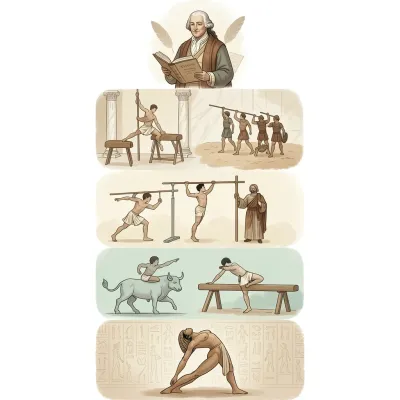
Gymnastics traces its origins to ancient civilizations where acrobatic feats served religious, military, and entertainment purposes, from Egyptian backbends and Chinese Juedixi to Minoan bull-leaping and Indian mallakhamb. In Ancient Greece, gymnastics became a cornerstone of education, linking physical training with intellectual development in the gymnasia and palaestrae, while the Roman Empire shifted focus toward military utility and spectacles, leading to a decline in formal physical culture. The Middle Ages saw organized gymnastics wane, though labor, knightly training, and traveling acrobats kept rudimentary movement traditions alive. The Renaissance revived interest in the classical ideal of a sound mind in a sound body, with educators like Vittorino da Feltre and scholars such as Hieronymus Mercurialis advocating systematic physical activity, setting the stage for modern gymnastics.
The Enlightenment produced Johann Christoph Friedrich GutsMuths, whose 1793 textbook “Gymnastik für die Jugend” introduced progressive exercises, apparatus like climbing ropes and balance beams, and a holistic vision of physical education. Friedrich Ludwig Jahn then transformed gymnastics into a nationalistic movement in early‑19th‑century Germany, inventing the parallel bars, horizontal bar, rings, and pommel horse and linking physical strength to German unity through the Turner societies. Simultaneously, Per Henrik Ling in Sweden developed a scientific, therapeutic system emphasizing posture, medical gymnastics, and pedagogical precision, which spread across Europe and influenced school curricula. These German and Swedish traditions diffused widely, with German Turnvereine fostering national pride and Swedish methods shaping health‑focused physical education, laying the groundwork for gymnastics’ global reach.
In the United States, German immigrants established Turnvereine that introduced apparatus and structured training, while the YMCA blended German and Swedish approaches to bring gymnastics to broad communities. The late 19th century saw the birth of competitive gymnastics, first through Turnfeste displays and then via the European Gymnastics Federation (later the FIG), which standardized rules and apparatus. Gymnastics debuted at the 1896 Olympics, initially dominated by German athletes, and gradually evolved into specialized artistic events. Women’s participation began with a team event in 1928 and expanded to individual medals by 1952, with icons like Larisa Latynina, Nadia Comăneci, and Simone Biles pushing technical and artistic boundaries. New disciplines emerged—rhythmic gymnastics (apparatus‑based dance), trampolining and tumbling (high‑flying acrobatics), acrobatic gymnastics (partner balances and throws), and aerobic gymnastics (high‑energy choreography)—each governed by the FIG’s evolving Code of Points.
The Cold War turned gymnastics into a ideological battleground, with Soviet and Eastern Bloc teams showcasing state‑sponsored excellence and Western nations responding with heightened investment. Technological advances—spring‑loaded floors, fiberglass bars, vaulting tables, video analysis, and safety foam pits—enabled ever‑more difficult routines while raising concerns about athlete welfare, judging transparency, and the pressures of professionalism and media. Today gymnastics is a global, professional sport grappling with inclusivity, athlete safety, and the balance between difficulty and artistry, while looking toward innovations such as VR training, AI‑assisted judging, and adaptive programs to ensure its enduring appeal as a celebration of human strength, grace, and movement.
What You'll Find Inside:
- Gymnastics traces its roots to ancient civilizations such as Egypt, China, India, Greece, and Rome, where acrobatic and physical training served religious, military, and cultural purposes.
- Modern gymnastics was shaped by pioneers like GutsMuths (pedagogical focus), Friedrich Jahn (nationalistic Turner movement), and Per Henrik Ling (Swedish health‑centered system), laying the groundwork for structured physical education.
- The sport evolved from informal displays to organized competition, culminating in Olympic inclusion and the creation of the Fédération Internationale de Gymnastique (FIG) to standardize rules and govern international events.
- Gymnastics diversified into distinct disciplines—artistic, rhythmic, trampoline & tumbling, acrobatic, and aerobic—each emphasizing different blends of strength, grace, coordination, and artistic expression.
- Today the sport faces challenges around safety, scoring transparency, and athlete welfare, while looking to the future through technological innovation, inclusivity, and holistic athlete development.
Who's It For:
This book is suited for students of sports history, physical education, and kinesiology; gymnastics coaches, athletes, and judges seeking contextual background; and general readers interested in the evolution of sport and physical culture. Anyone looking for a clear, well‑researched narrative of gymnastics’ development—from its ancient origins to contemporary challenges and future directions—will find it valuable.
Table of Contents:
- Introduction
- Chapter 1: Ancient Origins: From Acrobats to Athletes
- Chapter 2: Gymnastics in Ancient Greece: A Foundation for Sport
- Chapter 3: The Roman Empire: Decline and Transformation of Gymnastic Arts
- Chapter 4: The Middle Ages: A Dormant Period for Formal Gymnastics
- Chapter 5: The Renaissance: A Reawakening of Physical Culture
- Chapter 6: GutsMuths and the Philanthropinum: Early Modern Gymnastics
- Chapter 7: Friedrich Jahn and the Turners: Nationalistic Roots of German Gymnastics
- Chapter 8: Per Henrik Ling and Swedish Gymnastics: A Focus on Health and Education
- Chapter 9: The Spread of Gymnastics: Europe Embraces the New Discipline
- Chapter 10: Early American Gymnastics: From German Immigrants to YMCA
- Chapter 11: The Birth of Competitive Gymnastics: From Demonstrations to Meets
- Chapter 12: The Olympic Games and Gymnastics: Inclusion and Early Development
- Chapter 13: The FIG: International Governance and Standardisation
- Chapter 14: Women in Gymnastics: Breaking Barriers and Pushing Boundaries
- Chapter 15: Artistic Gymnastics: The Evolution of Apparatus and Routines
- Chapter 16: Rhythmic Gymnastics: Grace, Elegance, and Expression
- Chapter 17: Trampolining and Tumbling: The High-Flying Disciplines
- Chapter 18: Acrobatic Gymnastics: Partner Work and Dynamic Displays
- Chapter 19: Aerobic Gymnastics: Fitness Meets Choreography
- Chapter 20: The Cold War Era: Geopolitics and Gymnastic Rivalries
- Chapter 21: Iconic Gymnasts and Memorable Moments
- Chapter 22: Technological Advancements: Equipment, Training, and Judging
- Chapter 23: The Modern Era: Professionalism, Media, and Global Reach
- Chapter 24: Challenges and Controversies: Safety, Scoring, and Athlete Welfare
- Chapter 25: The Future of Gymnastics: Innovation, Inclusivity, and Enduring Appeal
Author:
Published By:
Date Published:
July 13, 2026
Type:
Nonfiction
Language:
English
Word Count:
34,720 words
Reading Time:
2 hours 26 minutes
Sample:
MixCache.com Total Access
Get unlimited access to this book + all books published by MixCache.com for $11.99/month
Subscribe to MTAOr purchase this book individually below
Order:
Buy the Gymnastics ebook on MixCache.com:
Buy Now
Full ebook will be available immediately
- read online or download as a PDF file.
$5 account credit for all new MixCache.com accounts, usable toward any ebook purchase!*





Ratings & Reviews
Ask Questions About This Book
Have a question about the content? Ask our AI assistant!
Start by asking a question about "Gymnastics"
Example: "Does this book mention William Shakespeare?"
Thinking...