
Browse by Category
Fiction
- Action & Adventure
- African American
- Anthologies
- Children's Fiction
- Classics
- Comics & Graphic Novels
- Coming of Age
- Contemporary
- Cultural & Regional
- Drama
- Erotica
- Fantasy
- General
- Historical Fiction
- Horror
- Humor & Satire
- Literary Fiction
- Mystery, Thriller & Suspense
- Poetry
- Religious & Inspirational
- Romance
- Science Fiction
- Short Stories
- War & Military
- Westerns
- Women's Fiction
- Young Adult
Non-Fiction
- Antiques & Collectibles
- Arts & Photography
- Biographies & Memoirs
- Business & Money
- Children's Non-Fiction
-
Computers & Technology
- Artificial Intelligence
- Computer Science
- Cybersecurity & Cryptography
- Data Science & Analytics
- Databases & Big Data
- Game Development & Design
- General
- Hardware & DIY
- Mobile App Development
- Networking & Cloud Computing
- Operating Systems
- Programming
- Robotics
- Software
- Software Engineering
- User Experience (UX) & Design
- Web Development & Design
- Cooking, Food & Wine
- Crafts, Hobbies & Home
- Education & Teaching
- Engineering
- General
- Health, Fitness & Dieting
-
History
- African History
- African History - North Africa
- African History - Sub-Saharan Africa
- American History
- American History - 20th Century
- American History - Civil War
- American History - Colonial Period
- Ancient History
- Asian History
- Asian History - China
- Asian History - India
- Asian History - Japan
- Asian History - Southeast Asia
- European History
- European History - Ancient Greece
- European History - Ancient Rome
- European History - Medieval
- European History - Modern
- European History - Renaissance
- General
- Middle Eastern History
- Military History
- Military History - Aviation
- Military History - Naval
- Social & Cultural History
- World History
- Humor & Entertainment
- Industrial Technology
- Language Learning
- Law
- LGBTQ+ Non-Fiction
- Literary Criticism
- Medical Books
- Parenting & Relationships
- Philosophy
- Politics & Social Sciences
- Reference
- Religion & Spirituality
-
Science & Math
- Agricultural Sciences
- Astronomy & Space Science
- Behavioral Sciences
- Biological Sciences
- Botany & Plant Science
- Chemistry
- Earth Sciences
- Engineering - Chemical
- Engineering - Civil
- Engineering - Electrical
- Engineering - Mechanical
- Environment
- General
- Geology
- Mathematics
- Nature & Ecology
- Oceanography
- Paleontology
- Physics
- Statistics
- Self-Help
- Sports & Outdoors
- Study Aids
- Sustainability & Green Living
- Textbooks
- Transportation
- Travel
- True Crime
- Urban Planning & Development
- Veterinary Medicine
- Writing & Publishing
Jump to Section
MixCache.com Total Access
Unlimited reading and audiobooks for every book published by MixCache.com.
Included titles carry the MTA badge.
Learn more →
The Untold Story of the Trans-Siberian Railway
MTA
Engineering, Adventure, and Geopolitics
About this book:
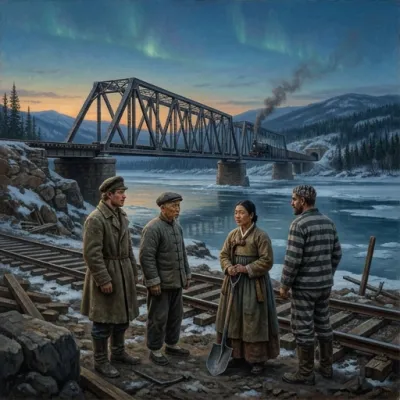
The Trans-Siberian Railway originated in the late‑19th‑century ambition of the Russian Empire to bind its vast Siberian frontier to European Russia and the Pacific coast, a project championed by Tsar Alexander III and finance minister Sergei Witte as both an economic engine and a geopolitical lever. Massive surveying expeditions mapped daunting terrain—taiga, permafrost, and mighty rivers—before construction began in 1891 with a ceremonial first spike at Vladivostok. Built largely by manual labor under brutal conditions, the line demanded enormous human sacrifice: tens of thousands of peasants, exiles, convicts, and migrant workers from China and Korea endured disease, malnutrition, extreme weather, and dangerous work to lay track, erect bridges, and tunnel through rock.
Engineering triumphs defined the railway’s progress: monumental steel truss bridges over the Ob, Yenisei, and Amur rivers; the Circum‑Baikal line with its tunnels and viaducts; innovative solutions for permafrost and swampy ground; and the use of steam, later electric and diesel locomotives. Logistics proved equally vital, as steel, timber, and supplies were hauled across thousands of kilometers of undeveloped territory by river barges, horse‑drawn sleds, and, in winter, an “ice railway” across Lake Baikal. The railway spurred the growth of towns such as Novosibirsk, Omsk, and Vladivostok, turning Siberian outposts into industrial and cultural hubs while reshaping Russia’s demographic and economic landscape.
Geopolitically, the Trans‑Siberian became a flashpoint in imperial rivalry, prompting British apprehension, French financial support, German commercial interest, and Japanese alarm that culminated in the Russo‑Japanese War, where the line’s limited capacity exposed Russia’s logistical frailties. During World War I and the Russian Civil War the railway was sabotaged, seized by competing factions, and fell into ruin, only to be rebuilt and modernized under the Soviet Union: double‑tracking, electrification, and the creation of branch lines turned it into the backbone of Soviet industrialization and wartime logistics, enabling the evacuation of factories, the transport of Lend‑Lease aid, and the rapid redeployment of troops in World War II. In the Cold War it served as a strategic artery for troop movements, nuclear‑related shipments, and Soviet economic integration, while the parallel Baikal‑Amur Mainline (BAM) added redundancy and access to northern resources.
After the Soviet collapse, the Trans‑Siberian adapted to a market economy, becoming a crucial “Eurasian Land Bridge” for high‑value container traffic between Asia and Europe, offering faster transit than traditional sea routes. It continues to carry millions of passengers and hundreds of millions of tons of freight, supporting regional development, tourism, and cultural exchange, while facing ongoing challenges of permafrost degradation, maintenance of aging infrastructure, competition from alternative corridors, and the need for investment in digital signaling, high‑speed prospects, and environmental stewardship. Ultimately, the railway endures as a symbol of Russian ambition, resilience, and human ingenuity—a steel ribbon that has repeatedly reshaped continents, empires, and the lives of those who built, rode, and worked along it.
What You'll Find Inside:
- The Trans-Siberian Railway was driven by Russian imperial ambition and served as a strategic geopolitical instrument, influencing conflicts from the Russo-Japanese War to the Cold War.
- Its construction overcame immense engineering challenges—bridging major rivers, tunneling through mountains, and stabilizing permafrost—using largely manual labor and innovative solutions.
- The railway's human cost was staggering, with tens of thousands of laborers enduring brutal conditions, disease, and sacrifice, shaping Siberia's demographic and social landscape.
- Beyond transport, the line became a vital economic artery, unlocking Siberia's resources, fostering city growth, and evolving into a modern Eurasian Land Bridge for global container trade.
- The book explores the railway's cultural legacy, environmental footprint, technological evolution from steam to high-speed prospects, and its enduring role in Russian identity and adventure tourism.
Who's It For:
This book is ideal for history buffs, engineering enthusiasts, and geopolitics scholars seeking a comprehensive, interdisciplinary account of one of the world's most significant infrastructure projects. It also appeals to readers interested in human stories of adventure and resilience, as well as travelers and cultural studies aficionados curious about the Trans-Siberian's impact on literature, tourism, and Siberian society.
Table of Contents:
- Introduction
- Chapter 1 The Grand Vision: Russia's Imperial Ambition
- Chapter 2 Surveying the Wild East: Early Expeditions and Challenges
- Chapter 3 From Paper to Picks: Inauguration and Initial Construction
- Chapter 4 The Human Cost: Labor, Conditions, and Sacrifices
- Chapter 5 Engineering Marvels: Bridging Rivers and Taming Terrain
- Chapter 6 Supplying the Steel: Logistics of a Continental Project
- Chapter 7 Life on the Line: Railway Towns and Frontier Development
- Chapter 8 Geopolitical Chessboard: The Railway and International Relations
- Chapter 9 The Russo-Japanese War: A Test of the Railway's Capacity
- Chapter 10 Revolution and Ruin: The Railway Amidst Upheaval
- Chapter 11 Rebuilding and Modernization: The Soviet Era
- Chapter 12 World War II: The Railway as a Lifeline
- Chapter 13 The Cold War and Strategic Importance
- Chapter 14 The Baikal-Amur Mainline (BAM): A Parallel Epic
- Chapter 15 Beyond the Rails: Cultural Impact and Literary Reflections
- Chapter 16 Passengers and Cargo: Evolution of Service
- Chapter 17 Technological Advancements: From Steam to High-Speed
- Chapter 18 Economic Engine: Trade Routes and Regional Development
- Chapter 19 Environmental Footprint: Impact on Siberia's Wilderness
- Chapter 20 Global Connections: The Railway as a Transcontinental Link
- Chapter 21 Modern Challenges: Maintenance, Competition, and Investment
- Chapter 22 Tourism and Adventure: Experiencing the Legendary Route
- Chapter 23 The Future of the Line: Expansion and Geopolitical Shifts
- Chapter 24 Personal Journeys: Stories from Travelers and Workers
- Chapter 25 The Enduring Legacy: A Symbol of Russian Ambition and Resilience
Author:
Published By:
Date Published:
July 13, 2026
Type:
Nonfiction
Language:
English
Word Count:
38,874 words
Reading Time:
2 hours 43 minutes
Sample:
MixCache.com Total Access
Get unlimited access to this book + all books published by MixCache.com for $11.99/month
Subscribe to MTAOr purchase this book individually below
Order:
Buy the The Untold Story of the Trans-Siberian Railway ebook on MixCache.com:
Buy Now
Full ebook will be available immediately
- read online or download as a PDF file.
$5 account credit for all new MixCache.com accounts, usable toward any ebook purchase!*


Ratings & Reviews
Ask Questions About This Book
Have a question about the content? Ask our AI assistant!
Start by asking a question about "The Untold Story of the Trans-Siberian Railway"
Example: "Does this book mention William Shakespeare?"
Thinking...