Browse by Category
Fiction
- Action & Adventure
- African American
- Anthologies
- Children's Fiction
- Classics
- Comics & Graphic Novels
- Coming of Age
- Contemporary
- Cultural & Regional
- Drama
- Erotica
- Fantasy
- General
- Historical Fiction
- Horror
- Humor & Satire
- Literary Fiction
- Mystery, Thriller & Suspense
- Poetry
- Religious & Inspirational
- Romance
- Science Fiction
- Short Stories
- War & Military
- Westerns
- Women's Fiction
- Young Adult
Non-Fiction
- Antiques & Collectibles
- Arts & Photography
- Biographies & Memoirs
- Business & Money
- Children's Non-Fiction
-
Computers & Technology
- Artificial Intelligence
- Computer Science
- Cybersecurity & Cryptography
- Data Science & Analytics
- Databases & Big Data
- Game Development & Design
- General
- Hardware & DIY
- Mobile App Development
- Networking & Cloud Computing
- Operating Systems
- Programming
- Robotics
- Software
- Software Engineering
- User Experience (UX) & Design
- Web Development & Design
- Cooking, Food & Wine
- Crafts, Hobbies & Home
- Education & Teaching
- Engineering
- General
- Health, Fitness & Dieting
-
History
- African History
- African History - North Africa
- African History - Sub-Saharan Africa
- American History
- American History - 20th Century
- American History - Civil War
- American History - Colonial Period
- Ancient History
- Asian History
- Asian History - China
- Asian History - India
- Asian History - Japan
- Asian History - Southeast Asia
- European History
- European History - Ancient Greece
- European History - Ancient Rome
- European History - Medieval
- European History - Modern
- European History - Renaissance
- General
- Middle Eastern History
- Military History
- Military History - Aviation
- Military History - Naval
- Social & Cultural History
- World History
- Humor & Entertainment
- Industrial Technology
- Language Learning
- Law
- LGBTQ+ Non-Fiction
- Literary Criticism
- Medical Books
- Parenting & Relationships
- Philosophy
- Politics & Social Sciences
- Reference
- Religion & Spirituality
-
Science & Math
- Agricultural Sciences
- Astronomy & Space Science
- Behavioral Sciences
- Biological Sciences
- Botany & Plant Science
- Chemistry
- Earth Sciences
- Engineering - Chemical
- Engineering - Civil
- Engineering - Electrical
- Engineering - Mechanical
- Environment
- General
- Geology
- Mathematics
- Nature & Ecology
- Oceanography
- Paleontology
- Physics
- Statistics
- Self-Help
- Sports & Outdoors
- Study Aids
- Sustainability & Green Living
- Textbooks
- Transportation
- Travel
- True Crime
- Urban Planning & Development
- Veterinary Medicine
- Writing & Publishing
Jump to Section
MixCache.com Total Access
Unlimited reading and audiobooks for every book published by MixCache.com.
Included titles carry the MTA badge.
Learn more →
The Anglo-Zulu War
MTA
A History
About this book:
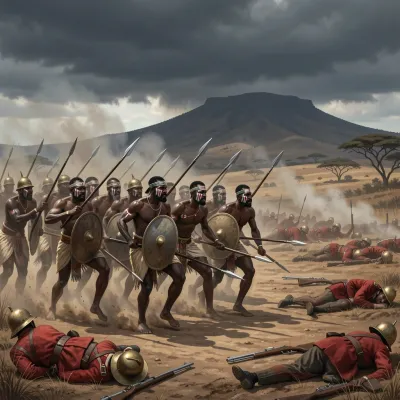
The Anglo-Zulu War of 1879 was a brutal collision between British imperial ambitions and the fiercely independent Zulu Kingdom. The conflict was ignited by Sir Bartle Frere, the British High Commissioner, who issued an ultimatum to King Cetshwayo demanding the dismantling of the Zulu military system, a condition no sovereign could accept. The war began with a confident British invasion of Zululand, a campaign that quickly met with a catastrophic defeat at the Battle of Isandlwana, where a technologically superior British force was overwhelmed by the disciplined Zulu *impi* using their classic "horns of the bull" formation. This shocking victory for the Zulus, followed by the heroic British defense of Rorke's Drift, defined the war's dramatic opening and shattered the myth of European invincibility in Africa.
The war then entered a prolonged and bloody phase characterized by sieges and sharp skirmishes. The British, reeling from Isandlwana, received massive reinforcements and adopted far more cautious tactics. Battles like Khambula and Gingindlovu demonstrated the devastating effectiveness of concentrated British firepower from fortified positions, turning the tide decisively against the Zulu. A methodical advance on the Zulu capital culminated in the Battle of Ulundi in July 1879, where the British formed a massive, impregnable square and annihilated the main Zulu army. The burning of Ulundi and the subsequent capture of King Cetshwayo marked the definitive end of organized Zulu resistance and the fall of the independent Zulu Kingdom.
The aftermath of the war was tragic for the Zulu people. The British "settlement," devised by Sir Garnet Wolseley, deliberately fragmented Zululand into thirteen chiefdoms, a policy intended to prevent a resurgence of centralized power. Instead, this artificial division ignited a decade of brutal civil war between rival factions, causing far more suffering and destabilization than the initial conflict. The unrest eventually led to the formal British annexation of Zululand in 1887, extinguishing all hope of Zulu sovereignty. The war's legacy, therefore, was not just a British military victory but the imposition of a flawed colonial order that fostered internal strife and deep, lasting wounds.
For the British, the war was a profound shock that forced a re-evaluation of colonial military tactics and imperial policy. The initial disaster at Isandlwana and the subsequent hard-fought victory became potent symbols in British memory—one of humiliation, the other of heroic redemption, epitomized by the stand at Rorke's Drift. For the Zulu, however, the war is remembered as a heroic if ultimately tragic struggle for independence. Isandlwana remains a source of immense pride as a triumph against a mighty empire, while the war as a whole is seen as a defining moment of resistance and resilience in the face of overwhelming colonial power. The clash of these two vastly different military cultures—the industrial firepower of the British against the disciplined *assegai* and shield of the Zulu—continues to resonate, shaping historical memory and national identity in both Britain and South Africa.
What You'll Find Inside:
- The fundamental clash between British imperial confederation plans and Zulu sovereignty under King Cetshwayo that made war inevitable by 1879
- The shocking British defeat at Isandlwana where Zulu impi overwhelmed a technologically superior force, shattering myths of European invincibility
- The legendary defense of Rorke's Drift that provided a crucial morale boost for Britain following the Isandlwana disaster
- How British tactical adaptations at Khambula and Ulundi turned technological superiority into decisive victories against Zulu forces
- The war's complex legacy including the destruction of the Zulu Kingdom, civil war from British fragmentation policies, and lasting impacts on colonial Africa
Who's It For:
This book is ideal for history students, military history enthusiasts, and general readers interested in 19th-century colonial conflicts. It will particularly benefit those studying British imperial history, African history, or the dynamics of cultural encounter and resistance. Readers seeking a balanced, comprehensive account that covers both strategic military operations and the human experiences of soldiers and warriors on both sides will find this work valuable.
Table of Contents:
- Introduction
- Chapter 1 The Seeds of Conflict: British Imperialism and Zulu Sovereignty
- Chapter 2 Zululand Before the Storm: Society, Culture, and Military Organization
- Chapter 3 The British Empire's Reach: Colonial Ambitions in Southern Africa
- Chapter 4 Sir Bartle Frere and the Road to War
- Chapter 5 The Ultimatum: An Unacceptable Demand
- Chapter 6 Mobilization: British Forces Prepare for Invasion
- Chapter 7 Cetshwayo's Kingdom: Defiance and Preparation
- Chapter 8 The Invasion Begins: Crossing the Thukela
- Chapter 9 Isandlwana: A Catastrophic Defeat
- Chapter 10 Rorke's Drift: A Desperate Stand
- Chapter 11 The Aftermath of Disaster: Shockwaves Across the Empire
- Chapter 12 Reinforcements Arrive: Lord Chelmsford's Second Chance
- Chapter 13 The Zulu Response: Reorganizing and Resisting
- Chapter 14 Skirmishes and Sieges: The War Continues
- Chapter 15 The Battle of Khambula: A Turning Point
- Chapter 16 The Relief of Eshowe: Breaking the Siege
- Chapter 17 The Advance on Ulundi: Chelmsford's Final Push
- Chapter 18 The Battle of Ulundi: The Fall of the Zulu Kingdom
- Chapter 19 Cetshwayo's Capture: The End of an Era
- Chapter 20 The Settlement of Zululand: Imposing British Order
- Chapter 21 The Legacy of the War: British Perspectives and Consequences
- Chapter 22 The Zulu Perspective: Resilience and Resistance
- Chapter 23 Key Figures: Leaders and Warriors of the Conflict
- Chapter 24 Weapons and Tactics: A Clash of Military Cultures
- Chapter 25 Remembering the Anglo-Zulu War: History, Myth, and Memory
Author:
Published By:
Date Published:
July 9, 2026
Type:
Nonfiction
Language:
English
Word Count:
38,447 words
Reading Time:
2 hours 42 minutes
Sample:
Order:
Order The Anglo-Zulu War (Hardcover) on MixCache.com:
Buy NowPrint copy is made to order and ships worldwide. Includes the ebook free, ready to read instantly.
$5 account credit for all new MixCache.com accounts, usable toward any ebook purchase!*