
Browse by Category
Fiction
- Action & Adventure
- African American
- Anthologies
- Children's Fiction
- Classics
- Comics & Graphic Novels
- Coming of Age
- Contemporary
- Cultural & Regional
- Drama
- Erotica
- Fantasy
- General
- Historical Fiction
- Horror
- Humor & Satire
- Literary Fiction
- Mystery, Thriller & Suspense
- Poetry
- Religious & Inspirational
- Romance
- Science Fiction
- Short Stories
- War & Military
- Westerns
- Women's Fiction
- Young Adult
Non-Fiction
- Antiques & Collectibles
- Arts & Photography
- Biographies & Memoirs
- Business & Money
- Children's Non-Fiction
-
Computers & Technology
- Artificial Intelligence
- Computer Science
- Cybersecurity & Cryptography
- Data Science & Analytics
- Databases & Big Data
- Game Development & Design
- General
- Hardware & DIY
- Mobile App Development
- Networking & Cloud Computing
- Operating Systems
- Programming
- Robotics
- Software
- Software Engineering
- User Experience (UX) & Design
- Web Development & Design
- Cooking, Food & Wine
- Crafts, Hobbies & Home
- Education & Teaching
- Engineering
- General
- Health, Fitness & Dieting
-
History
- African History
- African History - North Africa
- African History - Sub-Saharan Africa
- American History
- American History - 20th Century
- American History - Civil War
- American History - Colonial Period
- Ancient History
- Asian History
- Asian History - China
- Asian History - India
- Asian History - Japan
- Asian History - Southeast Asia
- European History
- European History - Ancient Greece
- European History - Ancient Rome
- European History - Medieval
- European History - Modern
- European History - Renaissance
- General
- Middle Eastern History
- Military History
- Military History - Aviation
- Military History - Naval
- Social & Cultural History
- World History
- Humor & Entertainment
- Industrial Technology
- Language Learning
- Law
- LGBTQ+ Non-Fiction
- Literary Criticism
- Medical Books
- Parenting & Relationships
- Philosophy
- Politics & Social Sciences
- Reference
- Religion & Spirituality
-
Science & Math
- Agricultural Sciences
- Astronomy & Space Science
- Behavioral Sciences
- Biological Sciences
- Botany & Plant Science
- Chemistry
- Earth Sciences
- Engineering - Chemical
- Engineering - Civil
- Engineering - Electrical
- Engineering - Mechanical
- Environment
- General
- Geology
- Mathematics
- Nature & Ecology
- Oceanography
- Paleontology
- Physics
- Statistics
- Self-Help
- Sports & Outdoors
- Study Aids
- Sustainability & Green Living
- Textbooks
- Transportation
- Travel
- True Crime
- Urban Planning & Development
- Veterinary Medicine
- Writing & Publishing
Jump to Section

Want unlimited access to all books published by MixCache.com (plus their audiobooks)? Try MixCache.com Total Access. Look for the MTA badge on book covers to identify included titles.
Access to infinite ebooks: Don't see the book you want? Suggest it and we'll create it (free!) for you from scratch with our powerful AI book writer. Then read it with MTA - besides profiting from any sales it makes!
Mountains Under Threat: Climate Change, Glacial Retreat, and the Future of Alpine Landscapes
MTA
Scientific evidence, regional impacts, and adaptation strategies for mountain environments
About this book:
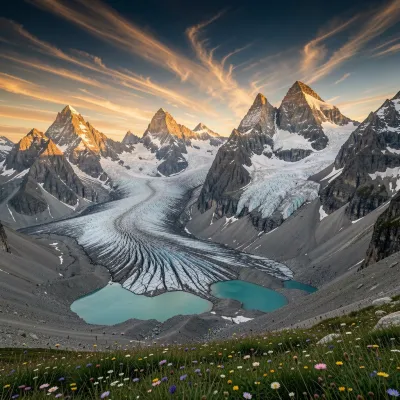
The book examines the profound impacts of climate change on mountain environments, emphasizing the destabilization of the cryosphere—glaciers, permafrost, and snowpack—as its central theme. Scientific evidence underscores accelerated warming, glacial retreat, and permafrost degradation, which are reshaping hydrological cycles, amplifying natural hazards (e.g., rockfalls, GLOFs), and altering ecosystems. These changes disrupt seasonal patterns, threatening water security downstream, destabilizing infrastructure, and endangering communities reliant on mountain resources. The text highlights how these transformations necessitate urgent adaptation in areas like tourism, agriculture, and hazard management while linking regional case studies (Alps, Himalaya, Andes, East Africa, polar ranges) to global processes.
Human and ecological systems are deeply intertwined with these shifts, as cultural heritage, livelihoods, and biodiversity face mounting pressures. Traditional knowledge and seasonal rhythms are disrupted, while species migrate upslope, facing extinction risks in "summit traps." Health, infrastructure, and recreation sectors are also affected, with hazards escalating and access to mountains becoming more precarious. The book explores how communities and professionals adapt through monitoring, technology, and evolving practices, while addressing ethical concerns like equity and conservation in a changing landscape. Polar and tropical mountain regions demonstrate unique vulnerabilities, underscoring the global scope of the crisis.
Policy and planning emerge as crucial responses, requiring integrated approaches to mitigate climate drivers and adapt to unavoidable impacts. Solutions include hazard mapping, resilient infrastructure, transboundary water cooperation, and financing mechanisms like insurance and climate funds. The text stresses the need for "just transitions" to ensure vulnerable communities are supported amid shifting economies and environmental conditions. Innovation in engineering, remote sensing, and citizen science plays a role in enhancing resilience, while ethical frameworks address fairness and access.
The concluding chapters project scenarios from 2030 to 2100, highlighting divergent futures based on emission trajectories. Aggressive mitigation could stabilize changes and allow adaptation, while high-emission pathways risk irreversible glacial loss, ecosystem collapse, and social instability. The book emphasizes that the mountains’ fate hinges on global climate action and proactive, collaborative efforts to safeguard both natural and human systems. Ultimately, it frames the alpine crisis as a test of humanity’s ability to respond to interconnected environmental and social challenges, urging urgent, equitable solutions to preserve these vital landscapes.
What You'll Find Inside:
- Glaciers are retreating at an unprecedented rate worldwide, with significant implications for water resources, natural hazards, and mountain ecosystems.
- Thawing permafrost is destabilizing slopes, increasing rockfall and landslide risks, and threatening infrastructure in high-altitude environments.
- Changes in snowpack and hydrology are altering water availability and timing, affecting downstream communities, agriculture, and hydropower generation.
- Mountain biodiversity is under severe stress as species shift upslope, face habitat loss, and encounter novel ecological assemblages.
- Adaptation strategies for climbers, guides, and policymakers are essential to manage escalating risks and build resilience in a rapidly changing alpine world.
Who's It For:
This book is ideal for climbers, mountaineers, and mountain guides seeking to understand and adapt to the evolving risks posed by climate change in alpine environments. It also serves as a valuable resource for policymakers, land managers, and environmental scientists involved in mountain conservation, hazard management, and climate adaptation planning. Additionally, it appeals to anyone interested in the intersection of climate science, outdoor recreation, and sustainable development in mountain regions.
Author:
Published By:
Date Published:
June 14, 2026
Type:
Nonfiction
Language:
English
Word Count:
46,064 words
Reading Time:
3 hours 14 minutes
Sample:
MixCache.com Total Access
Get unlimited access to this book + all books published by MixCache.com for $11.99/month
Subscribe to MTAOr purchase this book individually below
Order:
Buy the Mountains Under Threat: Climate Change, Glacial Retreat, and the Future of Alpine Landscapes ebook on MixCache.com:
Buy Now
Full ebook will be available immediately
- read online or download as a PDF file.
$5 account credit for all new MixCache.com accounts, usable toward any ebook purchase!*



Ratings & Reviews
Ask Questions About This Book
Have a question about the content? Ask our AI assistant!
Start by asking a question about "Mountains Under Threat: Climate Change, Glacial Retreat, and the Future of Alpine Landscapes"
Example: "Does this book mention William Shakespeare?"
Thinking...