
Browse by Category
Fiction
- Action & Adventure
- African American
- Anthologies
- Children's Fiction
- Classics
- Comics & Graphic Novels
- Coming of Age
- Contemporary
- Cultural & Regional
- Drama
- Erotica
- Fantasy
- General
- Historical Fiction
- Horror
- Humor & Satire
- Literary Fiction
- Mystery, Thriller & Suspense
- Poetry
- Religious & Inspirational
- Romance
- Science Fiction
- Short Stories
- War & Military
- Westerns
- Women's Fiction
- Young Adult
Non-Fiction
- Antiques & Collectibles
- Arts & Photography
- Biographies & Memoirs
- Business & Money
- Children's Non-Fiction
-
Computers & Technology
- Artificial Intelligence
- Computer Science
- Cybersecurity & Cryptography
- Data Science & Analytics
- Databases & Big Data
- Game Development & Design
- General
- Hardware & DIY
- Mobile App Development
- Networking & Cloud Computing
- Operating Systems
- Programming
- Robotics
- Software
- Software Engineering
- User Experience (UX) & Design
- Web Development & Design
- Cooking, Food & Wine
- Crafts, Hobbies & Home
- Education & Teaching
- Engineering
- General
- Health, Fitness & Dieting
-
History
- African History
- African History - North Africa
- African History - Sub-Saharan Africa
- American History
- American History - 20th Century
- American History - Civil War
- American History - Colonial Period
- Ancient History
- Asian History
- Asian History - China
- Asian History - India
- Asian History - Japan
- Asian History - Southeast Asia
- European History
- European History - Ancient Greece
- European History - Ancient Rome
- European History - Medieval
- European History - Modern
- European History - Renaissance
- General
- Middle Eastern History
- Military History
- Military History - Aviation
- Military History - Naval
- Social & Cultural History
- World History
- Humor & Entertainment
- Industrial Technology
- Language Learning
- Law
- LGBTQ+ Non-Fiction
- Literary Criticism
- Medical Books
- Parenting & Relationships
- Philosophy
- Politics & Social Sciences
- Reference
- Religion & Spirituality
-
Science & Math
- Agricultural Sciences
- Astronomy & Space Science
- Behavioral Sciences
- Biological Sciences
- Botany & Plant Science
- Chemistry
- Earth Sciences
- Engineering - Chemical
- Engineering - Civil
- Engineering - Electrical
- Engineering - Mechanical
- Environment
- General
- Geology
- Mathematics
- Nature & Ecology
- Oceanography
- Paleontology
- Physics
- Statistics
- Self-Help
- Sports & Outdoors
- Study Aids
- Sustainability & Green Living
- Textbooks
- Transportation
- Travel
- True Crime
- Urban Planning & Development
- Veterinary Medicine
- Writing & Publishing
Jump to Section
MixCache.com Total Access
Unlimited reading and audiobooks for every book published by MixCache.com.
Included titles carry the MTA badge.
Learn more →
The Secret Life of Trees
MTA
How Forests Communicate and Survive Through Underground Networks
About this book:
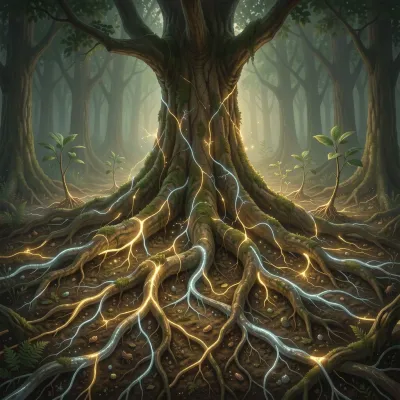
The Secret Life of Trees reveals that forests function as interconnected superorganisms through vast subterranean networks known as the Wood Wide Web. This web is built primarily from mycorrhizal fungi that form symbiotic partnerships with tree roots, exchanging carbohydrates for water and nutrients while creating pathways for communication. Trees send chemical signals—such as warning compounds during insect attacks or drought—through these fungal hyphae, and emerging research shows they also transmit electrical impulses that can travel across the network, enabling rapid, coordinated responses to threats. Root systems, root grafts, and the rhizosphere further facilitate direct connections and microbial interactions that sustain this underground economy of resource sharing and information exchange.
Through these networks, forests display remarkable cooperative behaviors: older “Mother Trees” transfer carbon, water, and nutrients to shaded saplings and stressed neighbors; kin recognition leads to preferential support of related individuals; and inter‑species resource exchange stabilizes mixed forests. The web also underpins collective defense, hydraulic redistribution during drought, and the storage of ecological memory that helps trees remember past pests and climate stresses. Bacteria, fungi, and other soil microbes contribute to nutrient cycling, disease suppression, and plant signaling, turning the soil into a dynamic, communicative medium that enhances forest resilience and adaptability.
Human activities—clear‑cutting, soil compaction, pollution, monoculture plantations, and climate change—disrupt these delicate networks, impairing water and nutrient sharing, weakening defense signaling, and reducing biodiversity. Conservation efforts now focus on protecting mother trees, minimizing soil disturbance, promoting above‑ and below‑ground diversity, using mycorrhizal inoculation in restoration, and preserving ancient forests that serve as living libraries of underground intelligence. Ultimately, the book argues that recognizing the forest’s hidden cooperation offers profound lessons for sustainable management, climate resilience, and a deeper philosophical understanding of interdependence, memory, and collective survival in nature and human societies.
What You'll Find Inside:
- Discover the intricate Wood Wide Web, an underground network enabling forests to communicate, share resources, and survive as interconnected superorganisms.
- Explore how mycorrhizal fungi and soil bacteria act as architects and facilitators of subterranean communication, nutrient exchange, and symbiotic relationships.
- Learn how trees use chemical signals, electrical impulses, and hydraulic systems to warn neighbors of threats, distribute water, and protect their kin.
- Understand the critical role of Mother Trees and the nurturing of saplings, highlighting kin recognition and intergenerational resource sharing.
- Examine the impact of human activity and climate change on underground networks, alongside conservation strategies to preserve these vital ecosystems.
Who's It For:
This book is for environmental scientists, educators, conservationists, and general readers interested in ecology, forestry, and sustainability. It will especially appeal to those seeking to understand the interconnectedness of natural systems and the urgent need to protect them. Readers exploring the implications of climate change, sustainable land management, and holistic ecosystem health will find valuable insights here. Ideal for anyone curious about the hidden intelligence of forests and its relevance to modern environmental challenges.
Table of Contents:
- Introduction: The Hidden World Beneath Our Feet
- Chapter 1: The Wood Wide Web: An Introduction to Mycorrhizal Networks
- Chapter 2: Fungal Partners: The Architects of Underground Communication
- Chapter 3: Root Systems: The Foundation of Forest Connectivity
- Chapter 4: Chemical Signals: The Language of Trees
- Chapter 5: Nutrient Exchange: A Subterranean Marketplace
- Chapter 6: Water Distribution: Sharing Resources in Times of Need
- Chapter 7: Defense Mechanisms: Warning Signals and Chemical Warfare
- Chapter 8: Kin Recognition: Do Trees Favor Their Own?
- Chapter 9: The Mother Tree: Central Hubs of Forest Intelligence
- Chapter 10: Saplings and Success: Nurturing the Next Generation
- Chapter 11: Inter-species Communication: Beyond the Same Kind
- Chapter 12: The Role of Bacteria: Unsung Heroes of Soil Communication
- Chapter 13: Gaseous Exchange: A Breath of Fresh Air, Underground Style
- Chapter 14: Electrical Signals: The Nervous System of the Forest
- Chapter 15: Memory in Trees: Remembering Pests and Droughts
- Chapter 16: Forest Resilience: How Networks Aid Survival
- Chapter 17: Climate Change and the Underground Network: A Growing Challenge
- Chapter 18: Human Impact: Disrupting the Delicate Balance
- Chapter 19: Conservation Efforts: Protecting the Unseen
- Chapter 20: The Urban Forest: Communication in Concrete Jungles
- Chapter 21: Ancient Forests: Wisdom from Millennia of Connection
- Chapter 22: The Future of Forestry: Learning from Nature's Design
- Chapter 23: Beyond Trees: Similar Networks in Other Ecosystems
- Chapter 24: New Discoveries: The Ever-Evolving Science of Forest Communication
- Chapter 25: The Philosophical Forest: What Trees Can Teach Us About Life
Author:
Published By:
Date Published:
July 13, 2026
Type:
Nonfiction
Language:
English
Word Count:
39,121 words
Reading Time:
2 hours 44 minutes
Sample:
MixCache.com Total Access
Get unlimited access to this book + all books published by MixCache.com for $11.99/month
Subscribe to MTAOr purchase this book individually below
Order:
Buy the The Secret Life of Trees ebook on MixCache.com:
Buy Now
Full ebook will be available immediately
- read online or download as a PDF file.
$5 account credit for all new MixCache.com accounts, usable toward any ebook purchase!*




Ratings & Reviews
Ask Questions About This Book
Have a question about the content? Ask our AI assistant!
Start by asking a question about "The Secret Life of Trees"
Example: "Does this book mention William Shakespeare?"
Thinking...