
Browse by Category
Fiction
- Action & Adventure
- African American
- Anthologies
- Children's Fiction
- Classics
- Comics & Graphic Novels
- Coming of Age
- Contemporary
- Cultural & Regional
- Drama
- Erotica
- Fantasy
- General
- Historical Fiction
- Horror
- Humor & Satire
- Literary Fiction
- Mystery, Thriller & Suspense
- Poetry
- Religious & Inspirational
- Romance
- Science Fiction
- Short Stories
- War & Military
- Westerns
- Women's Fiction
- Young Adult
Non-Fiction
- Antiques & Collectibles
- Arts & Photography
- Biographies & Memoirs
- Business & Money
- Children's Non-Fiction
-
Computers & Technology
- Artificial Intelligence
- Computer Science
- Cybersecurity & Cryptography
- Data Science & Analytics
- Databases & Big Data
- Game Development & Design
- General
- Hardware & DIY
- Mobile App Development
- Networking & Cloud Computing
- Operating Systems
- Programming
- Robotics
- Software
- Software Engineering
- User Experience (UX) & Design
- Web Development & Design
- Cooking, Food & Wine
- Crafts, Hobbies & Home
- Education & Teaching
- Engineering
- General
- Health, Fitness & Dieting
-
History
- African History
- African History - North Africa
- African History - Sub-Saharan Africa
- American History
- American History - 20th Century
- American History - Civil War
- American History - Colonial Period
- Ancient History
- Asian History
- Asian History - China
- Asian History - India
- Asian History - Japan
- Asian History - Southeast Asia
- European History
- European History - Ancient Greece
- European History - Ancient Rome
- European History - Medieval
- European History - Modern
- European History - Renaissance
- General
- Middle Eastern History
- Military History
- Military History - Aviation
- Military History - Naval
- Social & Cultural History
- World History
- Humor & Entertainment
- Industrial Technology
- Language Learning
- Law
- LGBTQ+ Non-Fiction
- Literary Criticism
- Medical Books
- Parenting & Relationships
- Philosophy
- Politics & Social Sciences
- Reference
- Religion & Spirituality
-
Science & Math
- Agricultural Sciences
- Astronomy & Space Science
- Behavioral Sciences
- Biological Sciences
- Botany & Plant Science
- Chemistry
- Earth Sciences
- Engineering - Chemical
- Engineering - Civil
- Engineering - Electrical
- Engineering - Mechanical
- Environment
- General
- Geology
- Mathematics
- Nature & Ecology
- Oceanography
- Paleontology
- Physics
- Statistics
- Self-Help
- Sports & Outdoors
- Study Aids
- Sustainability & Green Living
- Textbooks
- Transportation
- Travel
- True Crime
- Urban Planning & Development
- Veterinary Medicine
- Writing & Publishing
Jump to Section

Want unlimited access to all books published by MixCache.com (plus their audiobooks)? Try MixCache.com Total Access. Look for the MTA badge on book covers to identify included titles.
Access to infinite ebooks: Don't see the book you want? Suggest it and we'll create it (free!) for you from scratch with our powerful AI book writer. Then read it with MTA - besides profiting from any sales it makes!
Rome's Eternal Threads: From Republic Roads to Contemporary Capital
MTA
Continuity and change in Rome from antiquity through modern governance
About this book:
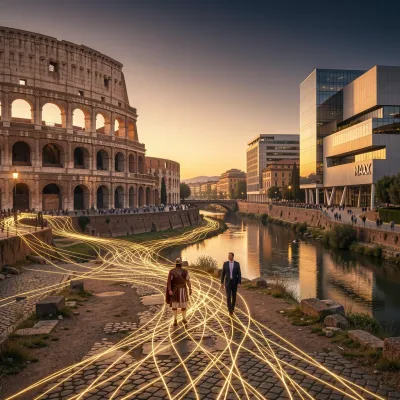
Rome's endurance stems not from static preservation but from continuous adaptation, where each generation actively stitches old infrastructure, religious practices, and civic identities to new needs. The book traces three interconnected threads: infrastructure (roads, aqueducts, sewers) that organized space and power; religion (from pagan processions to papal stewardship) that shaped sacred geography and urban form; and civic identity (negotiated through guilds, neighborhoods, and migration) that constantly redefined who belongs. From the Seven Hills and Tiber guiding early settlement to the Cloaca Maxima and Via Appia enabling republican expansion, these systems created enduring frameworks later reinterpreted—such as aqueduct channels becoming medieval property boundaries or pagan temples transformed into Christian churches via spolia.
This adaptive continuity persisted through major transformations. Renaissance popes used straight avenues and obelisks to connect basilicas, asserting papal authority through classical revival, while Baroque piazzas became theatrical spaces for religious and civic spectacle. The 1870 unification triggered demolition and grand boulevards to imprint a secular national identity, countered by Fascist era efforts to erase medieval layers in favor of monumental imperial vistas like Via dei Fori Imperiali. Post-war reconstruction addressed housing crises through peripheral suburbs, and the GRA and metro systems reconfigured mobility while constantly negotiating with archaeological layers. Throughout, heritage policy evolved from casual spolia to the Soprintendenza’s preventive archaeology, turning excavations into acts of governance that balance progress with preservation.
Today, Rome faces 21st-century pressures: mass tourism commodifying authenticity, migration challenging traditional notions of romanitas, and climate change threatening ancient stone and infrastructure. Yet the city’s resilience lies in its ongoing negotiation—integrating archaeological finds into metro stations as underground museums, adapting green infrastructure from ancient models, and fostering participatory planning that includes immigrant communities in shaping neighborhoods. Rome’s eternity is maintained not by freezing the past but through daily decisions of engineers, clergy, residents, and officials who, like their ancestors, bind old stones to new functions, ensuring the capital remains contemporary precisely because it refuses to abandon its layered history. The city endures as a living palimpsest where every street, fountain, and ruin participates in an unbroken chain of civic performance.
What You'll Find Inside:
- Explores how infrastructure like roads, aqueducts, and sewers has served as a continuous thread from ancient Rome to modern times, shaping urban governance and daily life.
- Traces the evolution of religious influence in Rome, from pagan temples and processions to Christian catacombs and the Vatican's role as a spiritual and diplomatic center.
- Examines the shifting nature of civic identity through the lens of medieval neighborhoods, Renaissance urban design, and contemporary multicultural communities.
- Highlights the development of archaeological and heritage policy, including the role of the Soprintendenza, and the challenges of balancing preservation with modern urban development.
- Addresses the modern challenges of climate change, tourism, and migration, emphasizing Rome's need to balance historical preservation with contemporary sustainability and inclusivity.
Who's It For:
This book is for urban planners, historians, archaeologists, heritage policy makers, and students interested in the intersection of historical conservation and modern urban development. It also appeals to general readers fascinated by how Rome's ancient legacy informs its contemporary challenges, particularly in managing cultural heritage, migration, and climate resilience in a global capital.
Author:
Published By:
Date Published:
June 10, 2026
Type:
Nonfiction
Language:
English
Word Count:
58,205 words
Reading Time:
4 hours 5 minutes
Sample:
MixCache.com Total Access
Get unlimited access to this book + all books published by MixCache.com for $11.99/month
Subscribe to MTAOr purchase this book individually below
Order:
Buy the Rome's Eternal Threads: From Republic Roads to Contemporary Capital ebook on MixCache.com:
Buy Now
Full ebook will be available immediately
- read online or download as a PDF file.
$5 account credit for all new MixCache.com accounts, usable toward any ebook purchase!*




Ratings & Reviews
Ask Questions About This Book
Have a question about the content? Ask our AI assistant!
Start by asking a question about "Rome's Eternal Threads: From Republic Roads to Contemporary Capital"
Example: "Does this book mention William Shakespeare?"
Thinking...