
Browse by Category
Fiction
- Action & Adventure
- African American
- Anthologies
- Children's Fiction
- Classics
- Comics & Graphic Novels
- Coming of Age
- Contemporary
- Cultural & Regional
- Drama
- Erotica
- Fantasy
- General
- Historical Fiction
- Horror
- Humor & Satire
- Literary Fiction
- Mystery, Thriller & Suspense
- Poetry
- Religious & Inspirational
- Romance
- Science Fiction
- Short Stories
- War & Military
- Westerns
- Women's Fiction
- Young Adult
Non-Fiction
- Antiques & Collectibles
- Arts & Photography
- Biographies & Memoirs
- Business & Money
- Children's Non-Fiction
-
Computers & Technology
- Artificial Intelligence
- Computer Science
- Cybersecurity & Cryptography
- Data Science & Analytics
- Databases & Big Data
- Game Development & Design
- General
- Hardware & DIY
- Mobile App Development
- Networking & Cloud Computing
- Operating Systems
- Programming
- Robotics
- Software
- Software Engineering
- User Experience (UX) & Design
- Web Development & Design
- Cooking, Food & Wine
- Crafts, Hobbies & Home
- Education & Teaching
- Engineering
- General
- Health, Fitness & Dieting
-
History
- African History
- African History - North Africa
- African History - Sub-Saharan Africa
- American History
- American History - 20th Century
- American History - Civil War
- American History - Colonial Period
- Ancient History
- Asian History
- Asian History - China
- Asian History - India
- Asian History - Japan
- Asian History - Southeast Asia
- European History
- European History - Ancient Greece
- European History - Ancient Rome
- European History - Medieval
- European History - Modern
- European History - Renaissance
- General
- Middle Eastern History
- Military History
- Military History - Aviation
- Military History - Naval
- Social & Cultural History
- World History
- Humor & Entertainment
- Industrial Technology
- Language Learning
- Law
- LGBTQ+ Non-Fiction
- Literary Criticism
- Medical Books
- Parenting & Relationships
- Philosophy
- Politics & Social Sciences
- Reference
- Religion & Spirituality
-
Science & Math
- Agricultural Sciences
- Astronomy & Space Science
- Behavioral Sciences
- Biological Sciences
- Botany & Plant Science
- Chemistry
- Earth Sciences
- Engineering - Chemical
- Engineering - Civil
- Engineering - Electrical
- Engineering - Mechanical
- Environment
- General
- Geology
- Mathematics
- Nature & Ecology
- Oceanography
- Paleontology
- Physics
- Statistics
- Self-Help
- Sports & Outdoors
- Study Aids
- Sustainability & Green Living
- Textbooks
- Transportation
- Travel
- True Crime
- Urban Planning & Development
- Veterinary Medicine
- Writing & Publishing
Jump to Section

Want unlimited access to all books published by MixCache.com (plus their audiobooks)? Try MixCache.com Total Access. Look for the MTA badge on book covers to identify included titles.
Access to infinite ebooks: Don't see the book you want? Suggest it and we'll create it (free!) for you from scratch with our powerful AI book writer. Then read it with MTA - besides profiting from any sales it makes!
Paris in Revolt: Boulevards, Barricades, and the Making of Modern France
MTA
Cultural revolutions, urban planning, and political power in Paris since 1789
About this book:
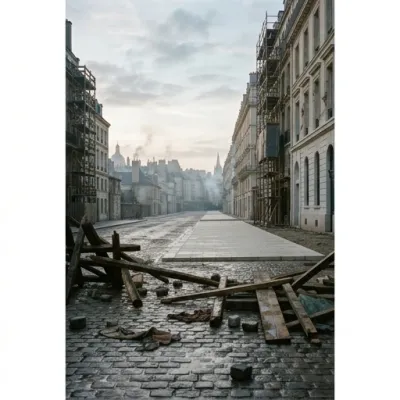
In *Paris in Revolt*, the city of Paris emerges as a living stage where political conflict, urban planning, and cultural expression have converged to shape modern France. The book traces this history from the revolutionary streets of 1789 through the barricades of 1830 and 1848, the imperial renovations of Haussmann, the trauma of the Commune, and into the twentieth and twenty-first centuries. Central to the narrative is the dialectic between the boulevard—a symbol of state order, circulation, and spectacle—and the barricade, which represents interruption, popular assembly, and the claim of the people on public space. Together, these two architectures form a durable dialogue about who belongs in the city and how power is negotiated through its streets, squares, and monuments.
The book’s chronological journey reveals how each regime used urban design to assert authority: Napoleon III and Haussmann carved wide avenues to prevent insurrection, while the Third Republic built civic monuments and parks to forge a unifying national memory. Yet the streets also remained sites of resistance, from the working-class faubourgs of the June Days to the student barricades of May ’68, and later to the occupations of Nuit Debout and the Yellow Vests. The author shows that cultural figures like Baudelaire, Hugo, and Zola read the city’s transformations as texts, while postcolonial migrations and economic shifts redefined the periphery. The banlieues, grands ensembles, and the Périphérique emerged as new frontiers of identity and protest.
The final sections bring the story to the present, examining how climate politics, the COVID-19 pandemic, and the “fifteen-minute city” ideal are reshaping Paris once again. The book argues that public space in Paris has always been both the means and the message of French modernity—that the city’s material fabric authorizes certain movements and forecloses others. By blending political history, architectural analysis, and cultural biography, the author offers a guided walk through more than two centuries of transformation, demonstrating how form shapes feeling and how streets structure power. Paris in Revolt is ultimately a study of how a city’s stones and spaces become a permanent record of the nation’s struggles and aspirations.
What You'll Find Inside:
- The book traces how Parisian protest tactics evolved from the improvised barricades of 1789 to modern movements like Nuit Debout and the Gilets Jaunes, showing the continual dialogue between street form and political power.
- Baron Haussmann’s 19th‑century renovation reengineered Paris with broad boulevards, monumental architecture, and modern infrastructure, serving hygienic, aesthetic, and strategic goals of state control.
- Writers and artists such as Baudelaire, Hugo, and Zola interpreted the changing city, turning boulevards, arcades, and department stores into cultural texts that shaped public perception of modernity and social inequality.
- Post‑war immigration and the expansion of the banlieues created a multicultural periphery that challenged traditional French identity and fostered new grassroots political and cultural movements.
- Recent urban policies promoting cycling, pedestrian zones, and the “fifteen‑minute city” illustrate Paris’s ongoing effort to reconcile ecological imperatives, public health, and the reclamation of public space from car dominance.
Who's It For:
Paris in Revolt is written for general readers and students of European history who want a guided walk through more than two centuries of transformation. It will also appeal to scholars of urban studies, political science, cultural studies, and French studies interested in how public space shapes power, protest, and national identity. Anyone curious about the interplay of boulevards, barricades, and the making of modern France will find the book both informative and engaging.
Author:
Published By:
Date Published:
June 8, 2026
Type:
Nonfiction
Language:
English
Word Count:
41,756 words
Reading Time:
2 hours 55 minutes
Sample:
MixCache.com Total Access
Get unlimited access to this book + all books published by MixCache.com for $11.99/month
Subscribe to MTAOr purchase this book individually below
Order:
Buy the Paris in Revolt: Boulevards, Barricades, and the Making of Modern France ebook on MixCache.com:
Buy Now
Full ebook will be available immediately
- read online or download as a PDF file.
$5 account credit for all new MixCache.com accounts, usable toward any ebook purchase!*





Ratings & Reviews
Ask Questions About This Book
Have a question about the content? Ask our AI assistant!
Start by asking a question about "Paris in Revolt: Boulevards, Barricades, and the Making of Modern France"
Example: "Does this book mention William Shakespeare?"
Thinking...