Browse by Category
Fiction
- Action & Adventure
- African American
- Anthologies
- Children's Fiction
- Classics
- Comics & Graphic Novels
- Coming of Age
- Contemporary
- Cultural & Regional
- Drama
- Erotica
- Fantasy
- General
- Historical Fiction
- Horror
- Humor & Satire
- Literary Fiction
- Mystery, Thriller & Suspense
- Poetry
- Religious & Inspirational
- Romance
- Science Fiction
- Short Stories
- War & Military
- Westerns
- Women's Fiction
- Young Adult
Non-Fiction
- Antiques & Collectibles
- Arts & Photography
- Biographies & Memoirs
- Business & Money
- Children's Non-Fiction
-
Computers & Technology
- Artificial Intelligence
- Computer Science
- Cybersecurity & Cryptography
- Data Science & Analytics
- Databases & Big Data
- Game Development & Design
- General
- Hardware & DIY
- Mobile App Development
- Networking & Cloud Computing
- Operating Systems
- Programming
- Robotics
- Software
- Software Engineering
- User Experience (UX) & Design
- Web Development & Design
- Cooking, Food & Wine
- Crafts, Hobbies & Home
- Education & Teaching
- Engineering
- General
- Health, Fitness & Dieting
-
History
- African History
- African History - North Africa
- African History - Sub-Saharan Africa
- American History
- American History - 20th Century
- American History - Civil War
- American History - Colonial Period
- Ancient History
- Asian History
- Asian History - China
- Asian History - India
- Asian History - Japan
- Asian History - Southeast Asia
- European History
- European History - Ancient Greece
- European History - Ancient Rome
- European History - Medieval
- European History - Modern
- European History - Renaissance
- General
- Middle Eastern History
- Military History
- Military History - Aviation
- Military History - Naval
- Social & Cultural History
- World History
- Humor & Entertainment
- Industrial Technology
- Language Learning
- Law
- LGBTQ+ Non-Fiction
- Literary Criticism
- Medical Books
- Parenting & Relationships
- Philosophy
- Politics & Social Sciences
- Reference
- Religion & Spirituality
-
Science & Math
- Agricultural Sciences
- Astronomy & Space Science
- Behavioral Sciences
- Biological Sciences
- Botany & Plant Science
- Chemistry
- Earth Sciences
- Engineering - Chemical
- Engineering - Civil
- Engineering - Electrical
- Engineering - Mechanical
- Environment
- General
- Geology
- Mathematics
- Nature & Ecology
- Oceanography
- Paleontology
- Physics
- Statistics
- Self-Help
- Sports & Outdoors
- Study Aids
- Sustainability & Green Living
- Textbooks
- Transportation
- Travel
- True Crime
- Urban Planning & Development
- Veterinary Medicine
- Writing & Publishing
Jump to Section
MixCache.com Total Access
Unlimited reading and audiobooks for every book published by MixCache.com.
Included titles carry the MTA badge.
Learn more →The History of Glass
About this book:



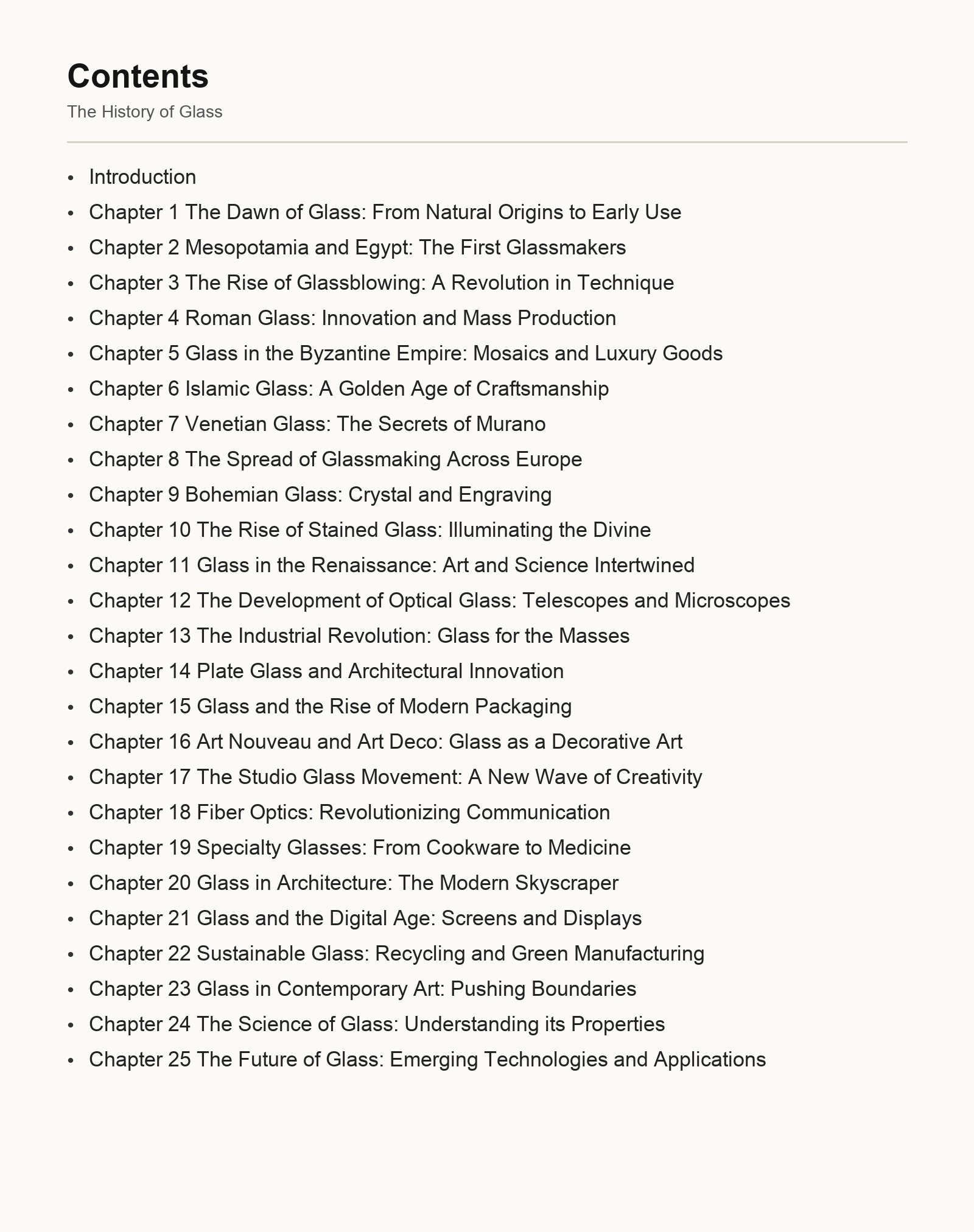
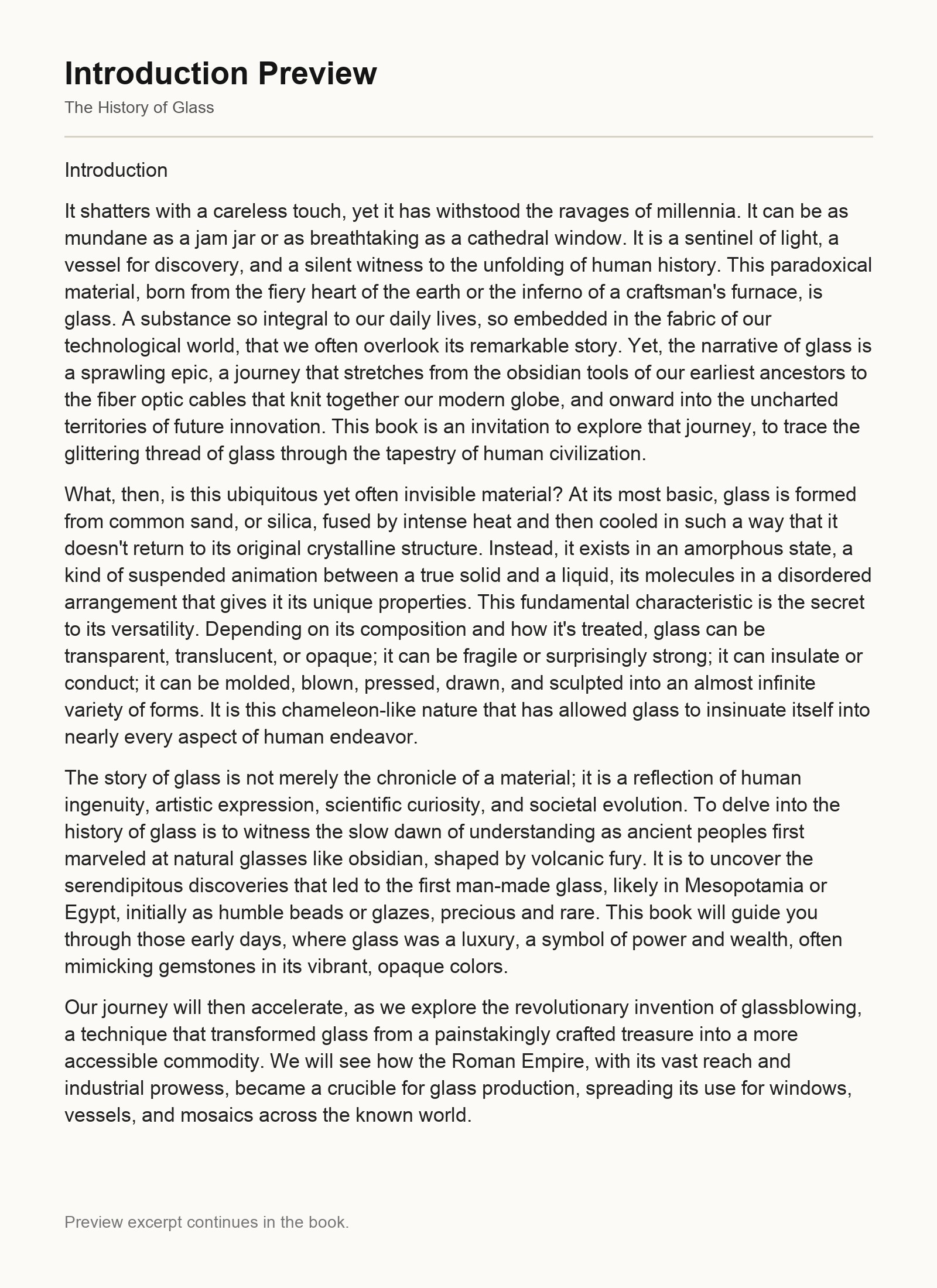
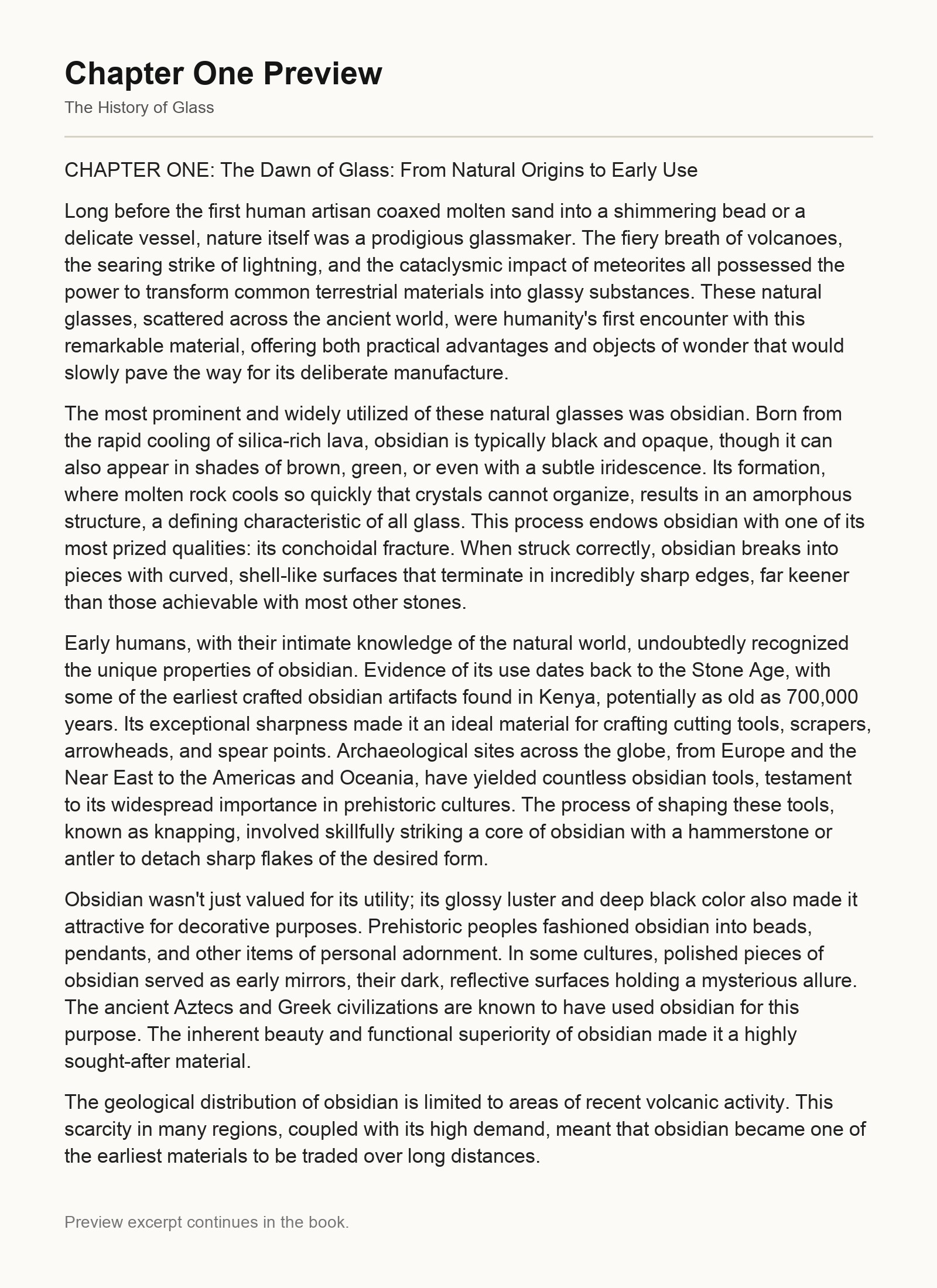
From the first shimmering obsidian beads shaped by Stone Age hands to the ultra‑thin fibers that now carry the world’s data at light speed, this book traces the complete story of glass across millennia and continents. Readers will discover how early peoples harnessed natural glasses like obsidian, fulgurites, and tektites for tools, ornaments, and ritual objects, and how the accidental fusion of sand and ash gave rise to the first man‑made glass in Mesopotamia and Egypt. Each chapter builds a vivid picture of the material’s evolution, revealing the cultural, technological, and artistic forces that transformed a rare luxury into a cornerstone of daily life.
You will walk through the revolutionary invention of glassblowing in the Levant, witness how the Roman Empire turned glass into a mass‑produced commodity, and explore the dazzling achievements of Byzantine mosaics, Islamic lustreware, and the closely guarded secrets of Venetian Murano. The narrative follows glass as it spreads across Europe, inspiring Bohemian crystal, the luminous stained‑glass windows of Gothic cathedrals, and the inventive glassware of the Renaissance—where artists and scientists alike used lenses, mirrors, and laboratory vessels to reshape our view of the cosmos and the microscopic world.
The book details the industrial breakthroughs that brought glass to the masses: the rise of pressed glass, the mechanical bottle machine, and the development of plate glass that enabled skyscrapers and shop fronts to become transparent screens of light. It examines glass’s pivotal role in modern packaging, from the Mason jar to the Coca‑Cola contour bottle, and its emergence as a high‑art medium in the Art Nouveau and Art Deco movements, where creators like Tiffany, Lalique, and Daum turned molten glass into sculptural masterpieces. Later chapters illuminate the Studio Glass Movement, the birth of fiber optics, and the rise of specialty glasses that protect our eyes, strengthen our cookware, and heal our bodies.
Beyond history, readers will gain insight into the very science that makes glass so versatile—its amorphous structure, optical properties, thermal behavior, and chemical durability—while also learning about contemporary innovations such as smart glass, flexible substrates, bio‑implant materials, and sustainable manufacturing practices. The final chapters look ahead to emerging technologies, from quantum‑ready optical fibers to load‑bearing glass façades, showing how this ancient material continues to drive future breakthroughs in communication, energy, medicine, art, and architecture. By the end of the journey, you will see glass not merely as a passive substance but as an active protagonist in the story of human ingenuity.
What You'll Find Inside:
- The revolutionary invention of glassblowing in the 1st century BCE that transformed glass from a painstakingly crafted luxury into a mass-produced material, democratizing its use across society and enabling everything from everyday vessels to architectural windows.
- Glass as a continuous intersection of art, science, and technology—from Byzantine mosaics and Islamic lustreware to Renaissance optical lenses, Industrial Revolution manufacturing, and modern fiber optics that revolutionized global communication.
- The cultural significance of glass across civilizations, including Mesopotamian and Egyptian luxury beads, Venetian cristallo secrets, Bohemian crystal engraving, and the spiritual illumination of stained glass in medieval cathedrals that transformed sacred spaces with light.
- Glass's evolution through pivotal technological shifts: from hand-crafted artifacts to automated bottle machines, plate glass enabling modern skyscrapers, and specialty glasses transforming fields like medicine (bioactive implants), cookware (borosilicate), and digital displays.
- The material's enduring versatility and sustainability—highlighting its infinite recyclability, adaptive properties (from heat-resistant cookware to light-responsive smart glass), and emerging innovations like quantum technologies and structural glass architecture.
Who's It For:
This book is ideal for history enthusiasts, art lovers, and science readers seeking to understand how a single material has shaped human civilization across millennia. It will particularly benefit students and professionals in fields like materials science, art history, architecture, and engineering who appreciate the interdisciplinary connections between technological innovation and cultural expression. General readers curious about the hidden stories behind everyday objects will also find this comprehensive yet accessible narrative engaging and enlightening.
Table of Contents:
-
Introduction
-
Chapter 1 The Dawn of Glass: From Natural Origins to Early Use
-
Chapter 2 Mesopotamia and Egypt: The First Glassmakers
-
Chapter 3 The Rise of Glassblowing: A Revolution in Technique
-
Chapter 4 Roman Glass: Innovation and Mass Production
-
Chapter 5 Glass in the Byzantine Empire: Mosaics and Luxury Goods
-
Chapter 6 Islamic Glass: A Golden Age of Craftsmanship
-
Chapter 7 Venetian Glass: The Secrets of Murano
-
Chapter 8 The Spread of Glassmaking Across Europe
-
Chapter 9 Bohemian Glass: Crystal and Engraving
-
Chapter 10 The Rise of Stained Glass: Illuminating the Divine
-
Chapter 11 Glass in the Renaissance: Art and Science Intertwined
-
Chapter 12 The Development of Optical Glass: Telescopes and Microscopes
-
Chapter 13 The Industrial Revolution: Glass for the Masses
-
Chapter 14 Plate Glass and Architectural Innovation
-
Chapter 15 Glass and the Rise of Modern Packaging
-
Chapter 16 Art Nouveau and Art Deco: Glass as a Decorative Art
-
Chapter 17 The Studio Glass Movement: A New Wave of Creativity
-
Chapter 18 Fiber Optics: Revolutionizing Communication
-
Chapter 19 Specialty Glasses: From Cookware to Medicine
-
Chapter 20 Glass in Architecture: The Modern Skyscraper
-
Chapter 21 Glass and the Digital Age: Screens and Displays
-
Chapter 22 Sustainable Glass: Recycling and Green Manufacturing
-
Chapter 23 Glass in Contemporary Art: Pushing Boundaries
-
Chapter 24 The Science of Glass: Understanding its Properties
-
Chapter 25 The Future of Glass: Emerging Technologies and Applications
Author:
Published By:
Date Published:
May 28, 2026
Type:
Nonfiction
Language:
English
Also Available In:
Word Count:
50,184 words
Reading Time:
3 hours 31 minutes
Sample:
Order:
Order The History of Glass (Hardcover) on MixCache.com:
Buy NowPrint copy is made to order and ships worldwide. Includes the ebook free, ready to read instantly.
$5 account credit for all new MixCache.com accounts, usable toward any ebook purchase!*