Browse by Category
Fiction
- Action & Adventure
- African American
- Anthologies
- Children's Fiction
- Classics
- Comics & Graphic Novels
- Coming of Age
- Contemporary
- Cultural & Regional
- Drama
- Erotica
- Fantasy
- General
- Historical Fiction
- Horror
- Humor & Satire
- Literary Fiction
- Mystery, Thriller & Suspense
- Poetry
- Religious & Inspirational
- Romance
- Science Fiction
- Short Stories
- War & Military
- Westerns
- Women's Fiction
- Young Adult
Non-Fiction
- Antiques & Collectibles
- Arts & Photography
- Biographies & Memoirs
- Business & Money
- Children's Non-Fiction
-
Computers & Technology
- Artificial Intelligence
- Computer Science
- Cybersecurity & Cryptography
- Data Science & Analytics
- Databases & Big Data
- Game Development & Design
- General
- Hardware & DIY
- Mobile App Development
- Networking & Cloud Computing
- Operating Systems
- Programming
- Robotics
- Software
- Software Engineering
- User Experience (UX) & Design
- Web Development & Design
- Cooking, Food & Wine
- Crafts, Hobbies & Home
- Education & Teaching
- Engineering
- General
- Health, Fitness & Dieting
-
History
- African History
- African History - North Africa
- African History - Sub-Saharan Africa
- American History
- American History - 20th Century
- American History - Civil War
- American History - Colonial Period
- Ancient History
- Asian History
- Asian History - China
- Asian History - India
- Asian History - Japan
- Asian History - Southeast Asia
- European History
- European History - Ancient Greece
- European History - Ancient Rome
- European History - Medieval
- European History - Modern
- European History - Renaissance
- General
- Middle Eastern History
- Military History
- Military History - Aviation
- Military History - Naval
- Social & Cultural History
- World History
- Humor & Entertainment
- Industrial Technology
- Language Learning
- Law
- LGBTQ+ Non-Fiction
- Literary Criticism
- Medical Books
- Parenting & Relationships
- Philosophy
- Politics & Social Sciences
- Reference
- Religion & Spirituality
-
Science & Math
- Agricultural Sciences
- Astronomy & Space Science
- Behavioral Sciences
- Biological Sciences
- Botany & Plant Science
- Chemistry
- Earth Sciences
- Engineering - Chemical
- Engineering - Civil
- Engineering - Electrical
- Engineering - Mechanical
- Environment
- General
- Geology
- Mathematics
- Nature & Ecology
- Oceanography
- Paleontology
- Physics
- Statistics
- Self-Help
- Sports & Outdoors
- Study Aids
- Sustainability & Green Living
- Textbooks
- Transportation
- Travel
- True Crime
- Urban Planning & Development
- Veterinary Medicine
- Writing & Publishing
Jump to Section
MixCache.com Total Access
Unlimited reading and audiobooks for every book published by MixCache.com.
Included titles carry the MTA badge.
Learn more →
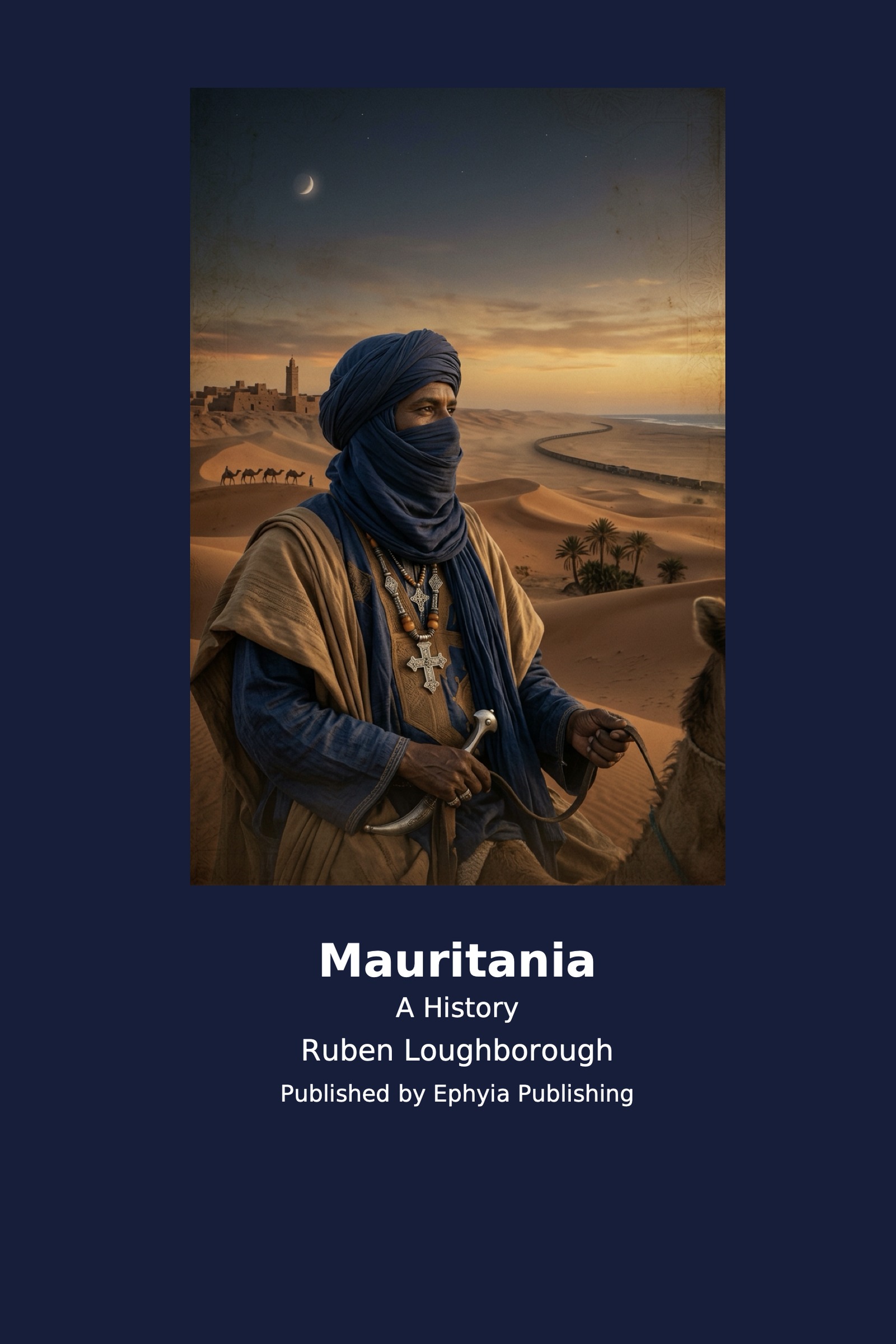
Mauritania
A History
About this book:
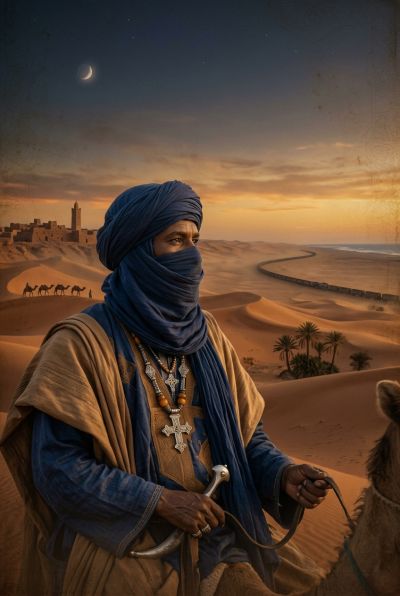
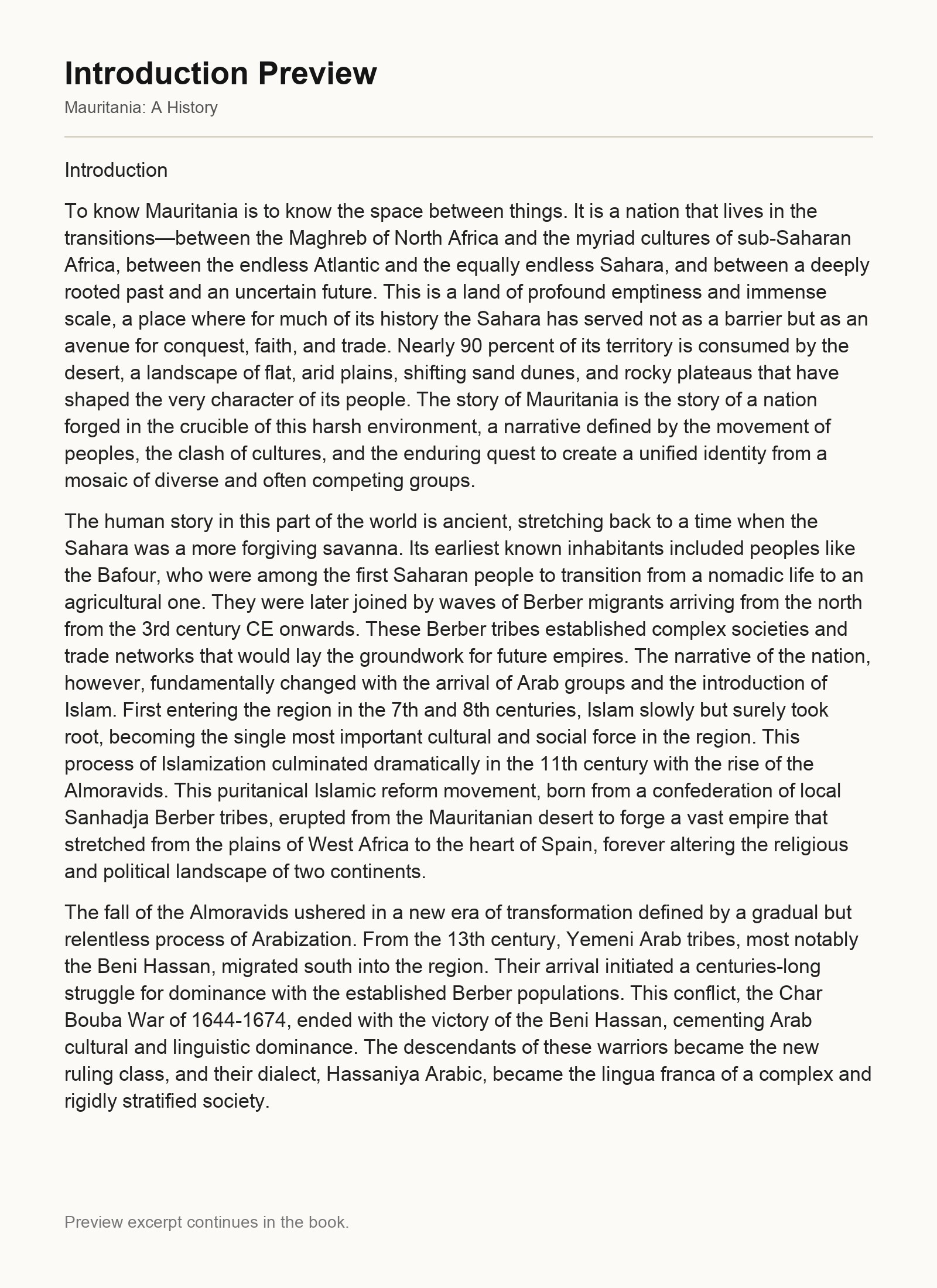
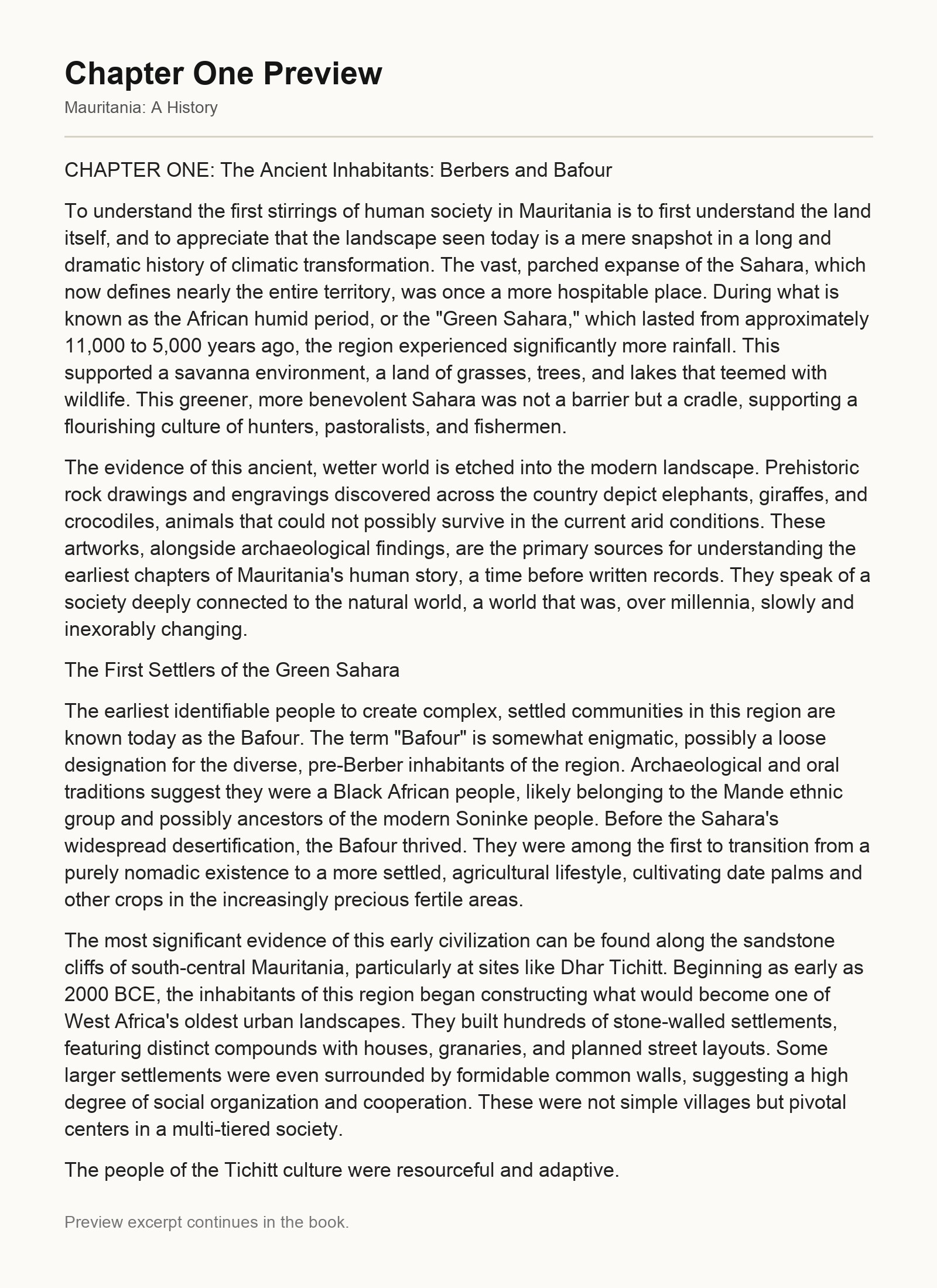
Mauritania: A History offers a sweeping narrative that traces the nation’s story from the verdant savannas of the prehistoric Sahara to the tumultuous politics of the twenty‑first century. Readers will walk alongside the early Bafour farmers and Berber traders who first shaped the desert’s social fabric, witness the rise of the Almoravid empire that spread Islam across Africa and into Spain, and follow the centuries‑long Arabization driven by the Beni Hassan warriors whose victory forged the Moorish hierarchy that still echoes today. The book reveals how geography—vast dunes, scarce water, and the ever‑shifting edge of the Sahara—has dictated patterns of migration, trade, and conflict, making the environment itself a central character in Mauritania’s destiny.
Through detailed chapters on the pre‑colonial emirates of Trarza, Brakna, Adrar, and Tagant, the reader gains insight into a world where power rested on tribute, raiding, and control of the lucrative gum arabic trade, and where the delicate balance between the warrior Hassan and the scholarly Zawaya defined society for generations. The narrative then turns to the era of European contact, showing how French colonial rule was imposed not through overwhelming force but by exploiting internal divisions, and how the brief period of French administration left a legacy of indirect rule, economic dependence, and a troubled relationship with slavery that persisted long after legal abolition.
The heart of the work lies in its examination of Mauritania’s post‑independence struggle: the ambitious nation‑building of Moktar Ould Daddah, the costly Western Sahara adventure that bankrupted the state, and the relentcycle of military coups that turned the army into the ultimate arbiter of power. Readers will experience the tension between Arab and African identities, the brutal ethnic cleansing of 1989, and the enduring battle against hereditary slavery—a system that, despite formal abolitions, continues to shape lives and politics. The book also illuminates recent transformations, from the disappointing oil boom to the discovery of massive offshore gas fields that could rewrite the nation’s economic future, and the rise of Islamist extremism that forced Mauritania to become an unexpected security linchpin in the Sahel.
By the final chapters, the reader will have a nuanced understanding of how Mauritania’s contemporary challenges—youth unemployment, climate change, regional insecurity, and the promise of gas wealth—are rooted in deep historical patterns. The narrative does not merely list events; it invites the reader to feel the weight of a society constantly negotiating between desert isolation and global currents, between authoritarian legacy and democratic aspiration, and between the exploitation of its peoples and the hope for a more inclusive future. For anyone seeking to comprehend a nation that lives at the crossroads of civilizations, this book provides the essential context and the human stories behind the headlines.
What You'll Find Inside:
- Covers Mauritania's deepest history from prehistoric Green Sahara settlements through the Almoravid Empire's trans-Saharan expansion across North Africa and Spain
- Details the Beni Hassan Arabization process, the Char Bouba War (1644-1674), and the resulting Moorish social hierarchy that defined society for centuries
- Examines French colonial rule, independence under Moktar Ould Daddah, and the pattern of coups and military rule from 1978 through 2008
- Addresses the persistent legacy of slavery, the 1989 ethnic cleansing and expulsion of Black Mauritanians, and ongoing struggles to forge national unity
- Analyzes economic foundations from gum arabic trade and iron ore mining to offshore gas discoveries, alongside security challenges from Western Sahara conflict to Islamic extremism
Who's It For:
This work is ideal for students and scholars of African history, particularly those focused on Saharan societies, colonial legacies, and post-independence state formation; professionals in international development, diplomacy, and security fields working on the Sahel region; and general readers seeking to understand Mauritania's unique position as a cultural bridge between Arab North Africa and sub-Saharan Africa.
Table of Contents:
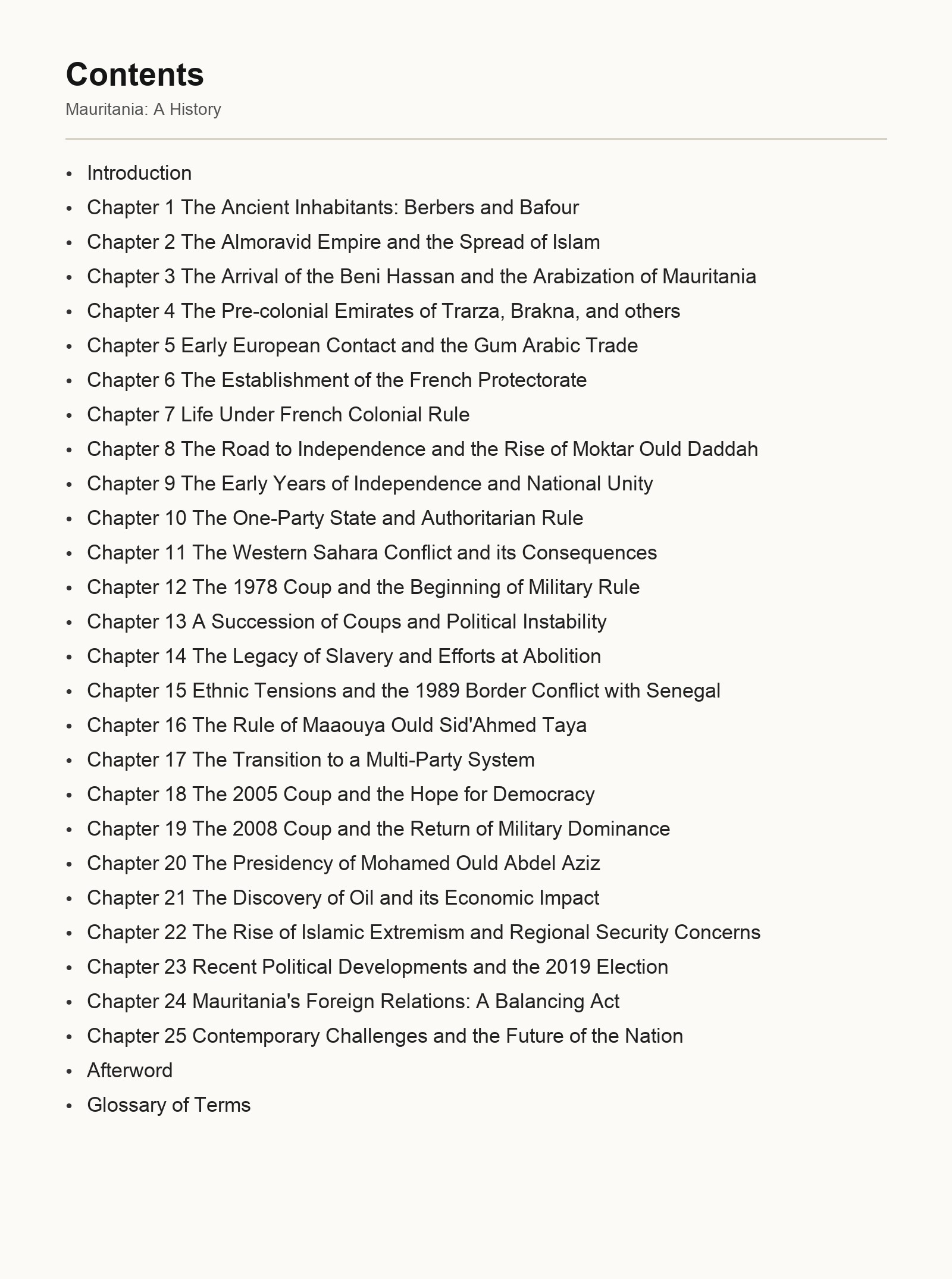
- Introduction
- Chapter 1 The Ancient Inhabitants: Berbers and Bafour
- Chapter 2 The Almoravid Empire and the Spread of Islam
- Chapter 3 The Arrival of the Beni Hassan and the Arabization of Mauritania
- Chapter 4 The Pre-colonial Emirates of Trarza, Brakna, and others
- Chapter 5 Early European Contact and the Gum Arabic Trade
- Chapter 6 The Establishment of the French Protectorate
- Chapter 7 Life Under French Colonial Rule
- Chapter 8 The Road to Independence and the Rise of Moktar Ould Daddah
- Chapter 9 The Early Years of Independence and National Unity
- Chapter 10 The One-Party State and Authoritarian Rule
- Chapter 11 The Western Sahara Conflict and its Consequences
- Chapter 12 The 1978 Coup and the Beginning of Military Rule
- Chapter 13 A Succession of Coups and Political Instability
- Chapter 14 The Legacy of Slavery and Efforts at Abolition
- Chapter 15 Ethnic Tensions and the 1989 Border Conflict with Senegal
- Chapter 16 The Rule of Maaouya Ould Sid'Ahmed Taya
- Chapter 17 The Transition to a Multi-Party System
- Chapter 18 The 2005 Coup and the Hope for Democracy
- Chapter 19 The 2008 Coup and the Return of Military Dominance
- Chapter 20 The Presidency of Mohamed Ould Abdel Aziz
- Chapter 21 The Discovery of Oil and its Economic Impact
- Chapter 22 The Rise of Islamic Extremism and Regional Security Concerns
- Chapter 23 Recent Political Developments and the 2019 Election
- Chapter 24 Mauritania's Foreign Relations: A Balancing Act
- Chapter 25 Contemporary Challenges and the Future of the Nation
- Afterword
- Glossary of Terms
Author:
Published By:
Date Published:
May 27, 2026
Type:
Nonfiction
Language:
English
Also Available In:
Word Count:
47,243 words
Reading Time:
3 hours 19 minutes
Sample:
Order:
Order Mauritania (Paperback) on MixCache.com:
Buy NowPrint copy is made to order and ships worldwide. Includes the ebook free, ready to read instantly.
$5 account credit for all new MixCache.com accounts, usable toward any ebook purchase!*