Browse by Category
Fiction
- Action & Adventure
- African American
- Anthologies
- Children's Fiction
- Classics
- Comics & Graphic Novels
- Coming of Age
- Contemporary
- Cultural & Regional
- Drama
- Erotica
- Fantasy
- General
- Historical Fiction
- Horror
- Humor & Satire
- Literary Fiction
- Mystery, Thriller & Suspense
- Poetry
- Religious & Inspirational
- Romance
- Science Fiction
- Short Stories
- War & Military
- Westerns
- Women's Fiction
- Young Adult
Non-Fiction
- Antiques & Collectibles
- Arts & Photography
- Biographies & Memoirs
- Business & Money
- Children's Non-Fiction
-
Computers & Technology
- Artificial Intelligence
- Computer Science
- Cybersecurity & Cryptography
- Data Science & Analytics
- Databases & Big Data
- Game Development & Design
- General
- Hardware & DIY
- Mobile App Development
- Networking & Cloud Computing
- Operating Systems
- Programming
- Robotics
- Software
- Software Engineering
- User Experience (UX) & Design
- Web Development & Design
- Cooking, Food & Wine
- Crafts, Hobbies & Home
- Education & Teaching
- Engineering
- General
- Health, Fitness & Dieting
-
History
- African History
- African History - North Africa
- African History - Sub-Saharan Africa
- American History
- American History - 20th Century
- American History - Civil War
- American History - Colonial Period
- Ancient History
- Asian History
- Asian History - China
- Asian History - India
- Asian History - Japan
- Asian History - Southeast Asia
- European History
- European History - Ancient Greece
- European History - Ancient Rome
- European History - Medieval
- European History - Modern
- European History - Renaissance
- General
- Middle Eastern History
- Military History
- Military History - Aviation
- Military History - Naval
- Social & Cultural History
- World History
- Humor & Entertainment
- Industrial Technology
- Language Learning
- Law
- LGBTQ+ Non-Fiction
- Literary Criticism
- Medical Books
- Parenting & Relationships
- Philosophy
- Politics & Social Sciences
- Reference
- Religion & Spirituality
-
Science & Math
- Agricultural Sciences
- Astronomy & Space Science
- Behavioral Sciences
- Biological Sciences
- Botany & Plant Science
- Chemistry
- Earth Sciences
- Engineering - Chemical
- Engineering - Civil
- Engineering - Electrical
- Engineering - Mechanical
- Environment
- General
- Geology
- Mathematics
- Nature & Ecology
- Oceanography
- Paleontology
- Physics
- Statistics
- Self-Help
- Sports & Outdoors
- Study Aids
- Sustainability & Green Living
- Textbooks
- Transportation
- Travel
- True Crime
- Urban Planning & Development
- Veterinary Medicine
- Writing & Publishing
Jump to Section
MixCache.com Total Access
Unlimited reading and audiobooks for every book published by MixCache.com.
Included titles carry the MTA badge.
Learn more →A History of Chechnya
About this book:

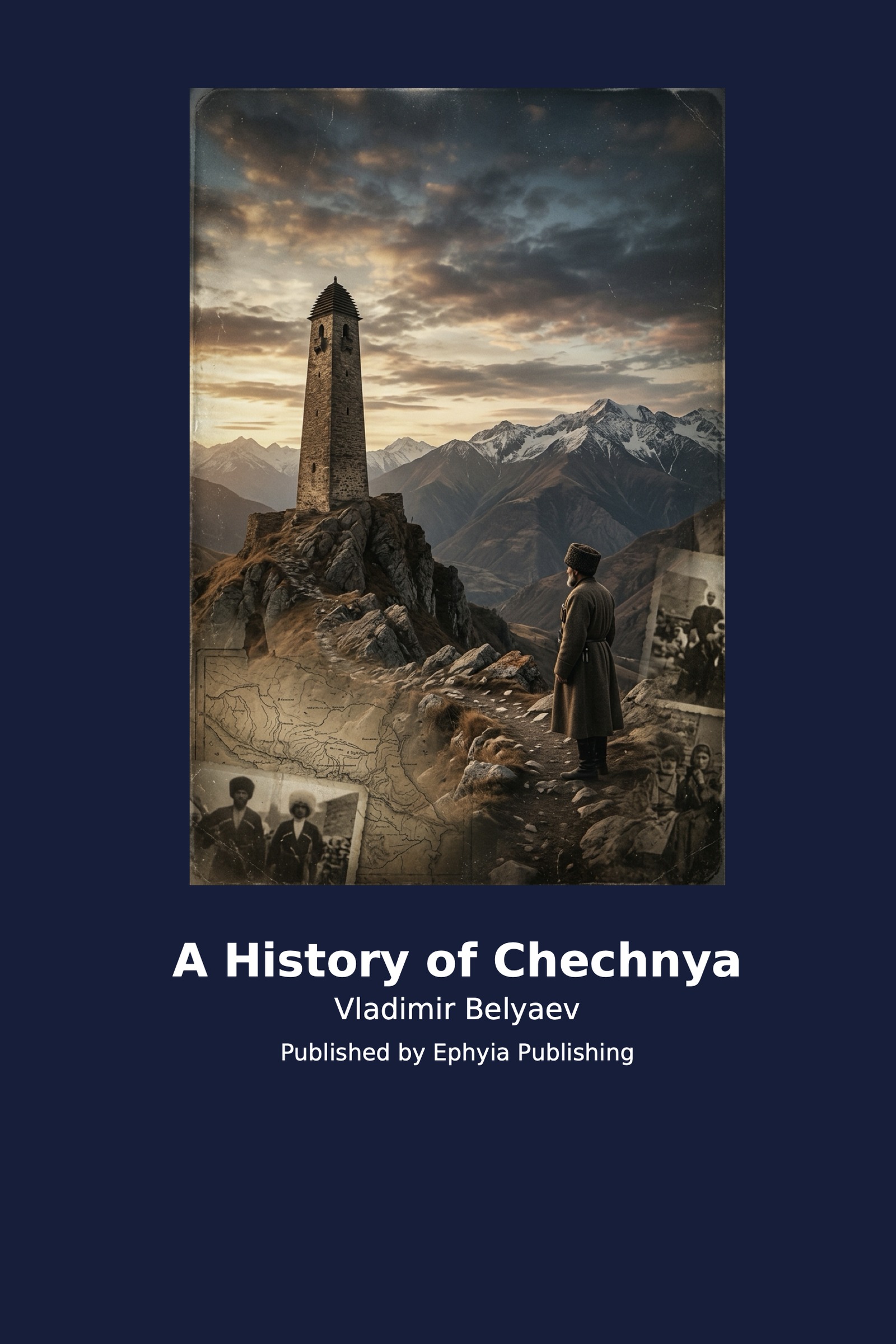
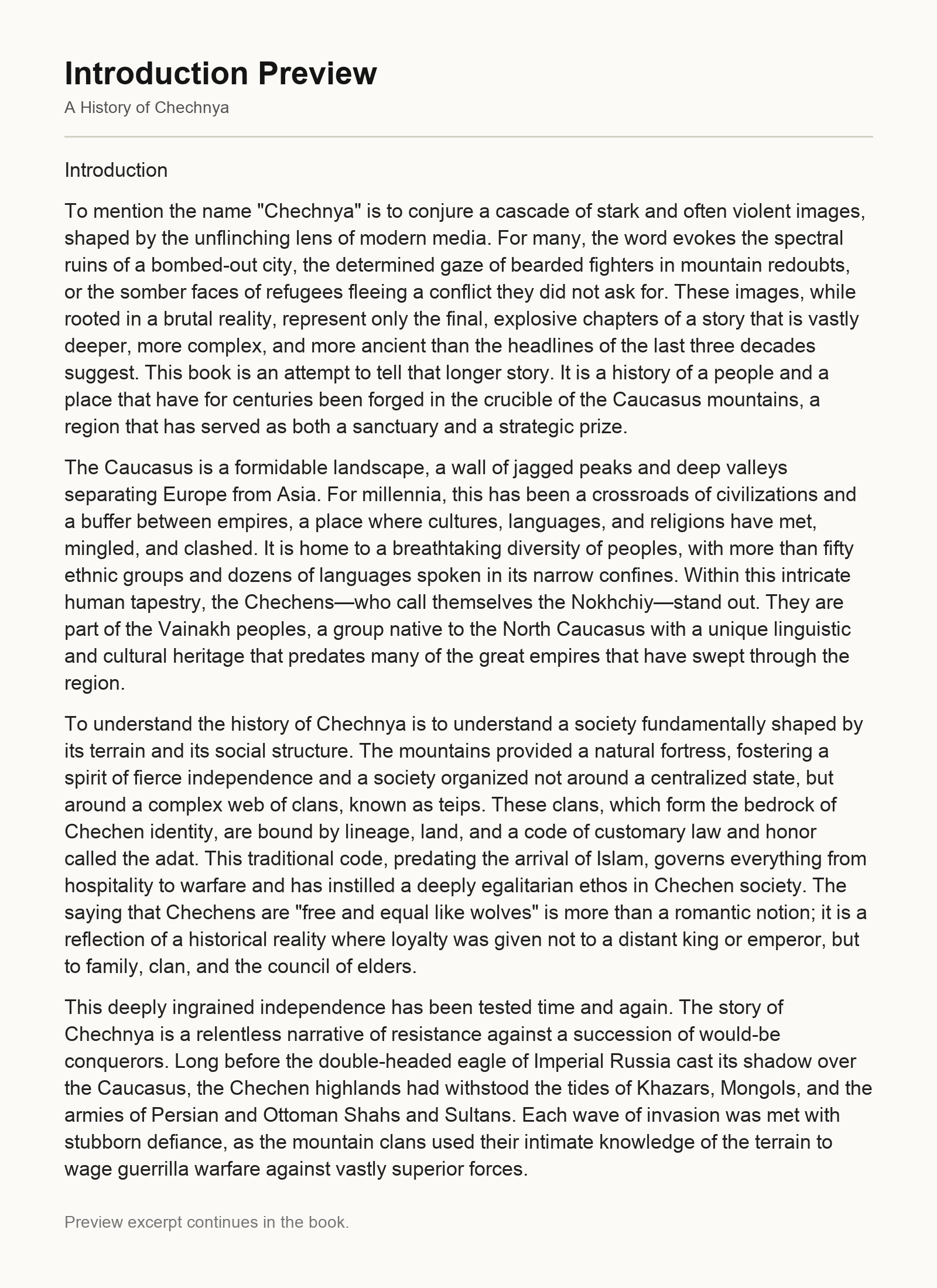
A History of Chechnya offers readers a sweeping journey through the tumultuous past of a people whose identity has been forged in the rugged Caucasus mountains. From the ancient Vainakh clans and their customary law of adat, through centuries of resistance against Khazars, Arabs, Mongols, and Timur, the book reveals how geography and a fiercely egalitarian social structure shaped a culture of independence that repeatedly defied empire. Readers will understand how these early foundations laid the groundwork for later struggles against Russian expansion, setting the stage for the legendary holy wars of Sheikh Mansur and Imam Shamil.
The narrative then follows the painful encounter with Imperial Russia, detailing the construction of the Caucasus Fortified Line, the Cossack frontier, and the brutal tactics of generals like Yermolov that turned the mountains into a theater of guerrilla warfare. It explores the gradual Islamization of Chechnya through Sufi brotherhoods, showing how the Naqshbandiyya and Qadiriyya orders intertwined with adat to create a unique “People’s Islam.” Readers will see how these religious and cultural forces provided both spiritual resilience and a framework for resistance as Russian power grew.
Moving into the twentieth century, the book chronicles the Soviet era’s promises and betrayals: the brief taste of independence after the 1917 revolution, the horrors of Operation Lentil—the 1944 deportation that scattered Chechens to Central Asia—and the painful return under Khrushchev’s thaw. It examines life under Soviet rule, where clan networks and secret Sufi circles preserved identity despite repression, and how the memory of deportation became a living wound that fueled later nationalist aspirations.
The latter sections bring the reader into the modern age, covering the dissolution of the USSR, Dzhokhar Dudayev’s declaration of independence, the two devastating Chechen wars, and the rise of the Kadyrov regime. Readers will gain insight into the complex interplay of nationalism, radical Islam, Russian “Chechenization,” and the reconstruction of Grozny as both a symbol of victory and a tool of control. The book concludes with an examination of twenty‑first‑century Chechnya—its society, culture, and enduring contradictions—offering a nuanced portrait of a nation still grappling with the legacy of freedom, fear, and survival.
What You'll Find Inside:
- Traces Chechnya's 40,000-year history from ancient Vainakh roots through repeated invasions by Khazars, Arabs, Mongols, and Timurids that forged their fiercely independent clan-based society.
- Details how Islamic Sufi brotherhoods merged with traditional adat customs to create a unique Chechen identity that fueled centuries of resistance against Russian imperial expansion.
- Examines the traumatic 1944 Stalin-era deportation (Operation Lentil) where up to a third of the Chechen nation perished in Central Asia, and their painful return during Khrushchev's thaw.
- Covers both Chechen wars (1994-1996 and 1999-2009), including the siege of Grozny, rise of radicalism, and complex legacies of leaders like Dudayev, Maskhadov, Basayev, and the Kadyrovs.
- Analyzes 21st century Chechnya - its reconstruction under Moscow's patronage, the Kadyrov regime's authoritarian rule, human rights abuses, and fragmented identity between loyalists, diaspora nationalists, and jihadist insurgents.
Who's It For:
This book is essential for students and scholars of Caucasus studies, Russian history, or post-Soviet politics seeking deep historical context. It will particularly benefit readers interested in ethnic conflicts, nationalism, independence movements, and human rights issues in authoritarian regimes. General readers fascinated by stories of cultural resilience against overwhelming odds, or anyone seeking to understand the historical roots of contemporary Chechen-Russian relations, will find this comprehensive narrative both informative and compelling.
Table of Contents:
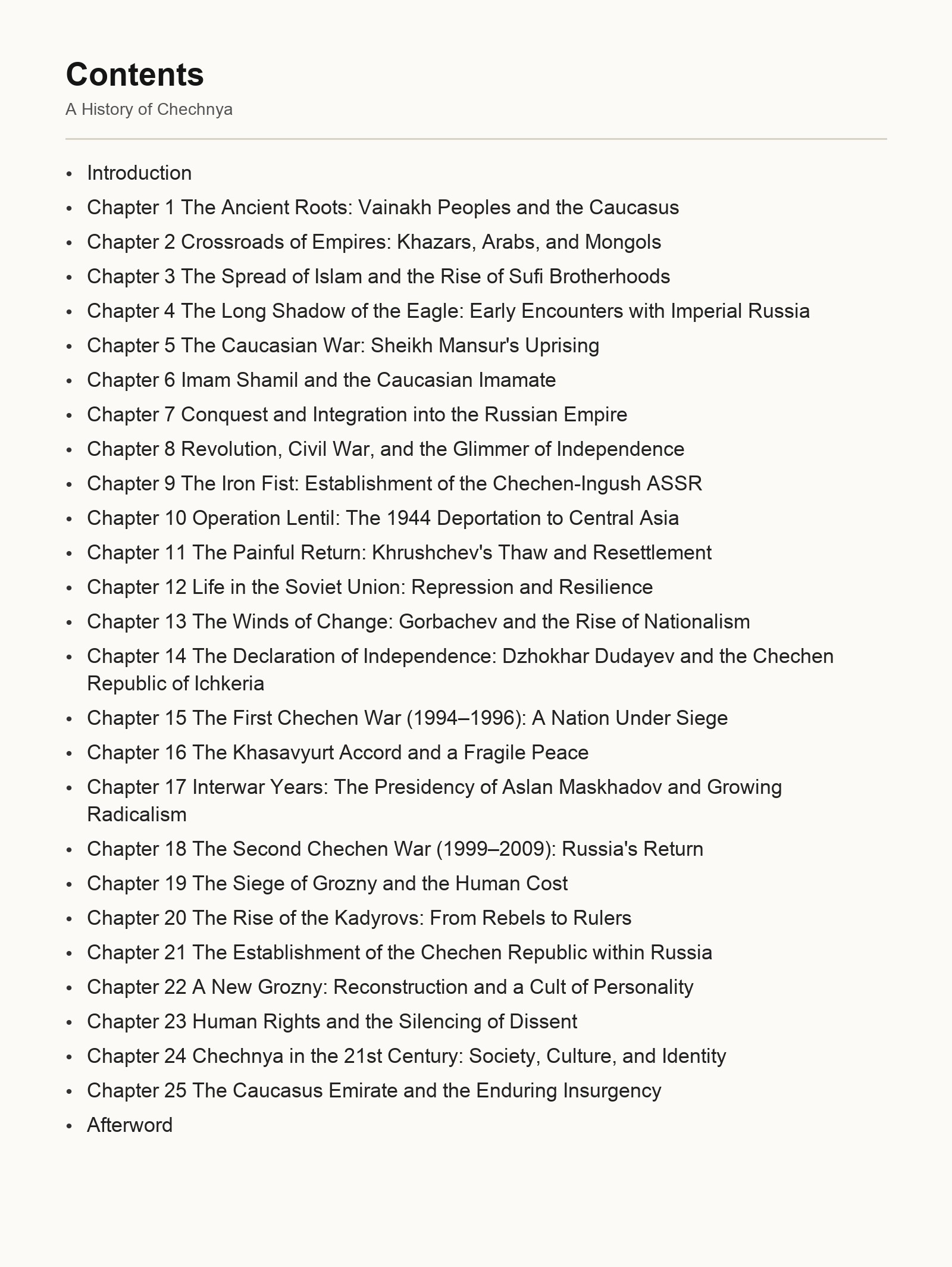
- Introduction
- Chapter 1 The Ancient Roots: Vainakh Peoples and the Caucasus
- Chapter 2 Crossroads of Empires: Khazars, Arabs, and Mongols
- Chapter 3 The Spread of Islam and the Rise of Sufi Brotherhoods
- Chapter 4 The Long Shadow of the Eagle: Early Encounters with Imperial Russia
- Chapter 5 The Caucasian War: Sheikh Mansur's Uprising
- Chapter 6 Imam Shamil and the Caucasian Imamate.
- Chapter 7 Conquest and Integration into the Russian Empire.
- Chapter 8 Revolution, Civil War, and the Glimmer of Independence
- Chapter 9 The Iron Fist: Establishment of the Chechen-Ingush ASSR.
- Chapter 10 Operation Lentil: The 1944 Deportation to Central Asia.
- Chapter 11 The Painful Return: Khrushchev's Thaw and Resettlement.
- Chapter 12 Life in the Soviet Union: Repression and Resilience
- Chapter 13 The Winds of Change: Gorbachev and the Rise of Nationalism
- Chapter 14 The Declaration of Independence: Dzhokhar Dudayev and the Chechen Republic of Ichkeria.
- Chapter 15 The First Chechen War (1994–1996): A Nation Under Siege.
- Chapter 16 The Khasavyurt Accord and a Fragile Peace
- Chapter 17 Interwar Years: The Presidency of Aslan Maskhadov and Growing Radicalism.
- Chapter 18 The Second Chechen War (1999–2009): Russia's Return.
- Chapter 19 The Siege of Grozny and the Human Cost
- Chapter 20 The Rise of the Kadyrovs: From Rebels to Rulers
- Chapter 21 The Establishment of the Chechen Republic within Russia
- Chapter 22 A New Grozny: Reconstruction and a Cult of Personality
- Chapter 23 Human Rights and the Silencing of Dissent
- Chapter 24 Chechnya in the 21st Century: Society, Culture, and Identity
- Chapter 25 The Caucasus Emirate and the Enduring Insurgency.
- Afterword
Author:
Published By:
Date Published:
May 27, 2026
Type:
Nonfiction
Language:
English
Also Available In:
Word Count:
48,897 words
Reading Time:
3 hours 25 minutes
Sample:
Order:
Order A History of Chechnya (Hardcover) on MixCache.com:
Buy NowPrint copy is made to order and ships worldwide. Includes the ebook free, ready to read instantly.
$5 account credit for all new MixCache.com accounts, usable toward any ebook purchase!*