Browse by Category
Fiction
- Action & Adventure
- African American
- Anthologies
- Children's Fiction
- Classics
- Comics & Graphic Novels
- Coming of Age
- Contemporary
- Cultural & Regional
- Drama
- Erotica
- Fantasy
- General
- Historical Fiction
- Horror
- Humor & Satire
- Literary Fiction
- Mystery, Thriller & Suspense
- Poetry
- Religious & Inspirational
- Romance
- Science Fiction
- Short Stories
- War & Military
- Westerns
- Women's Fiction
- Young Adult
Non-Fiction
- Antiques & Collectibles
- Arts & Photography
- Biographies & Memoirs
- Business & Money
- Children's Non-Fiction
-
Computers & Technology
- Artificial Intelligence
- Computer Science
- Cybersecurity & Cryptography
- Data Science & Analytics
- Databases & Big Data
- Game Development & Design
- General
- Hardware & DIY
- Mobile App Development
- Networking & Cloud Computing
- Operating Systems
- Programming
- Robotics
- Software
- Software Engineering
- User Experience (UX) & Design
- Web Development & Design
- Cooking, Food & Wine
- Crafts, Hobbies & Home
- Education & Teaching
- Engineering
- General
- Health, Fitness & Dieting
-
History
- African History
- African History - North Africa
- African History - Sub-Saharan Africa
- American History
- American History - 20th Century
- American History - Civil War
- American History - Colonial Period
- Ancient History
- Asian History
- Asian History - China
- Asian History - India
- Asian History - Japan
- Asian History - Southeast Asia
- European History
- European History - Ancient Greece
- European History - Ancient Rome
- European History - Medieval
- European History - Modern
- European History - Renaissance
- General
- Middle Eastern History
- Military History
- Military History - Aviation
- Military History - Naval
- Social & Cultural History
- World History
- Humor & Entertainment
- Industrial Technology
- Language Learning
- Law
- LGBTQ+ Non-Fiction
- Literary Criticism
- Medical Books
- Parenting & Relationships
- Philosophy
- Politics & Social Sciences
- Reference
- Religion & Spirituality
-
Science & Math
- Agricultural Sciences
- Astronomy & Space Science
- Behavioral Sciences
- Biological Sciences
- Botany & Plant Science
- Chemistry
- Earth Sciences
- Engineering - Chemical
- Engineering - Civil
- Engineering - Electrical
- Engineering - Mechanical
- Environment
- General
- Geology
- Mathematics
- Nature & Ecology
- Oceanography
- Paleontology
- Physics
- Statistics
- Self-Help
- Sports & Outdoors
- Study Aids
- Sustainability & Green Living
- Textbooks
- Transportation
- Travel
- True Crime
- Urban Planning & Development
- Veterinary Medicine
- Writing & Publishing
Jump to Section
MixCache.com Total Access
Unlimited reading and audiobooks for every book published by MixCache.com.
Included titles carry the MTA badge.
Learn more →A History of Cholera
About this book:



A History of Cholera takes readers on a sweeping journey from the disease’s ancient whispers in the Ganges Delta to its modern resurgence in the twenty‑first century. Across twenty‑five detailed chapters, the book traces each of the seven recorded pandemics, showing how the bacterium rode the currents of empire, trade, war, and migration to strike continents with terrifying speed. Readers will follow the footsteps of pioneering thinkers—John Snow’s map of the Broad Street pump, Filippo Pacini’s microscopic glimpse of the vibrion, and Robert Koch’s isolation of Vibrio cholerae—as they overturned centuries‑old miasma dogma and laid the foundations of epidemiology and bacteriology.
Beyond the timeline of outbreaks, the narrative reveals the human drama behind the science: the fierce debates over contagion versus bad air, the desperate self‑experiments of skeptics, and the heroic field work that turned a simple mixture of salt, sugar, and water into oral rehydration therapy—a cure that has saved tens of millions of lives. The book also examines how cholera exposed the fault lines of society, sparking riots, shaping urban sanitation projects, and influencing the outcomes of wars from the Crimean conflict to the World Wars, where the pathogen was both a consequence of breakdown and, in some cases, a deliberate weapon.
Readers will gain insight into the disease’s lasting social and economic toll, learning how epidemics have devastated economies, shattered families, and deepened inequality, from the nineteenth‑century slums of London to the cholera‑ravaged refugee camps of Goma and Haiti. The text connects these historical lessons to today’s challenges, exploring how climate change, El Niño cycles, urbanization, and conflict create new breeding grounds for Vibrio cholerae, and how modern tools—genomic surveillance, oral cholera vaccines, and real‑time data mapping—are being deployed to anticipate and contain outbreaks.
Finally, the book outlines the global roadmap to eliminate cholera as a public health threat, emphasizing the critical role of clean water, sanitation, and hygiene (WASH) as the ultimate defense. It explains why eradication is biologically impossible but elimination—zero deaths and no large‑scale epidemics—is an achievable goal that hinges on political will, sustained investment, and community‑driven solutions. By the end, readers will not only understand cholera’s past but also grasp the urgent, interconnected strategies that could finally consign this ancient plague to history, offering a sobering yet hopeful perspective on humanity’s capacity to overcome one of its oldest adversaries.
What You'll Find Inside:
- Traces cholera's journey from ancient Visuchika in Sanskrit texts through seven devastating global pandemics that reshaped societies worldwide.
- Details pivotal scientific breakthroughs: John Snow's Broad Street Pump investigation, Filippo Pacini's microscopic identification of Vibrio cholerae, and Robert Koch's bacterial isolation confirmation.
- Explores how the miasma theory hampered effective responses while accidental sanitary engineering (like London's sewers) inadvertently combated the waterborne disease.
- Chronicles life-saving innovations from Oral Rehydration Therapy to modern vaccines, emphasizing Water, Sanitation, and Hygiene (WASH) as the ultimate solution.
- Analyzes modern challenges including climate change, conflict, and inequality that continue to fuel outbreaks despite available medical interventions.
Who's It For:
Public health professionals, medical historians, epidemiology students, and global policy makers will find this book essential for understanding cholera's profound impact on human society. It also appeals to general readers interested in how disease intersects with urban development, scientific progress, and social inequality, offering valuable insights for anyone working to combat infectious diseases in the modern world.
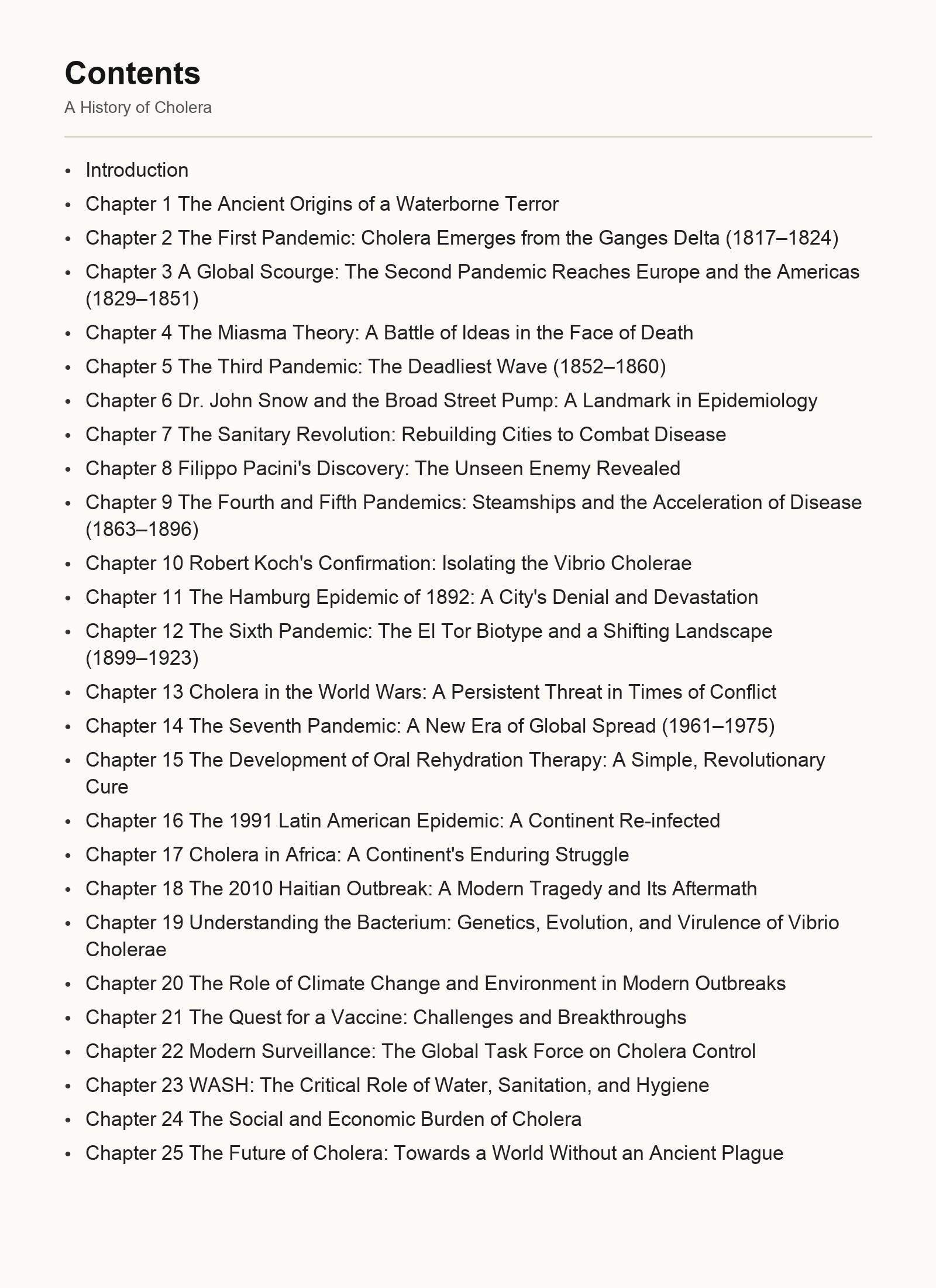
Table of Contents:
- Introduction
- Chapter 1 The Ancient Origins of a Waterborne Terror
- Chapter 2 The First Pandemic: Cholera Emerges from the Ganges Delta (1817–1824)
- Chapter 3 A Global Scourge: The Second Pandemic Reaches Europe and the Americas (1829–1851)
- Chapter 4 The Miasma Theory: A Battle of Ideas in the Face of Death
- Chapter 5 The Third Pandemic: The Deadliest Wave (1852–1860)
- Chapter 6 Dr. John Snow and the Broad Street Pump: A Landmark in Epidemiology
- Chapter 7 The Sanitary Revolution: Rebuilding Cities to Combat Disease
- Chapter 8 Filippo Pacini's Discovery: The Unseen Enemy Revealed
- Chapter 9 The Fourth and Fifth Pandemics: Steamships and the Acceleration of Disease (1863–1896)
- Chapter 10 Robert Koch's Confirmation: Isolating the Vibrio Cholerae
- Chapter 11 The Hamburg Epidemic of 1892: A City's Denial and Devastation
- Chapter 12 The Sixth Pandemic: The El Tor Biotype and a Shifting Landscape (1899–1923)
- Chapter 13 Cholera in the World Wars: A Persistent Threat in Times of Conflict
- Chapter 14 The Seventh Pandemic: A New Era of Global Spread (1961–1975)
- Chapter 15 The Development of Oral Rehydration Therapy: A Simple, Revolutionary Cure
- Chapter 16 The 1991 Latin American Epidemic: A Continent Re-infected
- Chapter 17 Cholera in Africa: A Continent's Enduring Struggle
- Chapter 18 The 2010 Haitian Outbreak: A Modern Tragedy and Its Aftermath
- Chapter 19 Understanding the Bacterium: Genetics, Evolution, and Virulence of Vibrio Cholerae
- Chapter 20 The Role of Climate Change and Environment in Modern Outbreaks
- Chapter 21 The Quest for a Vaccine: Challenges and Breakthroughs
- Chapter 22 Modern Surveillance: The Global Task Force on Cholera Control
- Chapter 23 WASH: The Critical Role of Water, Sanitation, and Hygiene
- Chapter 24 The Social and Economic Burden of Cholera
- Chapter 25 The Future of Cholera: Towards a World Without an Ancient Plague
Author:
Published By:
Date Published:
May 27, 2026
Type:
Nonfiction
Language:
English
Also Available In:
Word Count:
37,690 words
Reading Time:
2 hours 38 minutes
Sample:
Order:
Order A History of Cholera (Paperback) on MixCache.com:
Buy NowPrint copy is made to order and ships worldwide. Includes the ebook free, ready to read instantly.
$5 account credit for all new MixCache.com accounts, usable toward any ebook purchase!*