Browse by Category
Fiction
- Action & Adventure
- African American
- Anthologies
- Children's Fiction
- Classics
- Comics & Graphic Novels
- Coming of Age
- Contemporary
- Cultural & Regional
- Drama
- Erotica
- Fantasy
- General
- Historical Fiction
- Horror
- Humor & Satire
- Literary Fiction
- Mystery, Thriller & Suspense
- Poetry
- Religious & Inspirational
- Romance
- Science Fiction
- Short Stories
- War & Military
- Westerns
- Women's Fiction
- Young Adult
Non-Fiction
- Antiques & Collectibles
- Arts & Photography
- Biographies & Memoirs
- Business & Money
- Children's Non-Fiction
-
Computers & Technology
- Artificial Intelligence
- Computer Science
- Cybersecurity & Cryptography
- Data Science & Analytics
- Databases & Big Data
- Game Development & Design
- General
- Hardware & DIY
- Mobile App Development
- Networking & Cloud Computing
- Operating Systems
- Programming
- Robotics
- Software
- Software Engineering
- User Experience (UX) & Design
- Web Development & Design
- Cooking, Food & Wine
- Crafts, Hobbies & Home
- Education & Teaching
- Engineering
- General
- Health, Fitness & Dieting
-
History
- African History
- African History - North Africa
- African History - Sub-Saharan Africa
- American History
- American History - 20th Century
- American History - Civil War
- American History - Colonial Period
- Ancient History
- Asian History
- Asian History - China
- Asian History - India
- Asian History - Japan
- Asian History - Southeast Asia
- European History
- European History - Ancient Greece
- European History - Ancient Rome
- European History - Medieval
- European History - Modern
- European History - Renaissance
- General
- Middle Eastern History
- Military History
- Military History - Aviation
- Military History - Naval
- Social & Cultural History
- World History
- Humor & Entertainment
- Industrial Technology
- Language Learning
- Law
- LGBTQ+ Non-Fiction
- Literary Criticism
- Medical Books
- Parenting & Relationships
- Philosophy
- Politics & Social Sciences
- Reference
- Religion & Spirituality
-
Science & Math
- Agricultural Sciences
- Astronomy & Space Science
- Behavioral Sciences
- Biological Sciences
- Botany & Plant Science
- Chemistry
- Earth Sciences
- Engineering - Chemical
- Engineering - Civil
- Engineering - Electrical
- Engineering - Mechanical
- Environment
- General
- Geology
- Mathematics
- Nature & Ecology
- Oceanography
- Paleontology
- Physics
- Statistics
- Self-Help
- Sports & Outdoors
- Study Aids
- Sustainability & Green Living
- Textbooks
- Transportation
- Travel
- True Crime
- Urban Planning & Development
- Veterinary Medicine
- Writing & Publishing
Jump to Section
MixCache.com Total Access
Unlimited reading and audiobooks for every book published by MixCache.com.
Included titles carry the MTA badge.
Learn more →
A History of Disaster Relief
Humanity's Recovery From Catastrophe, Since the Dawn of Time
About this book:
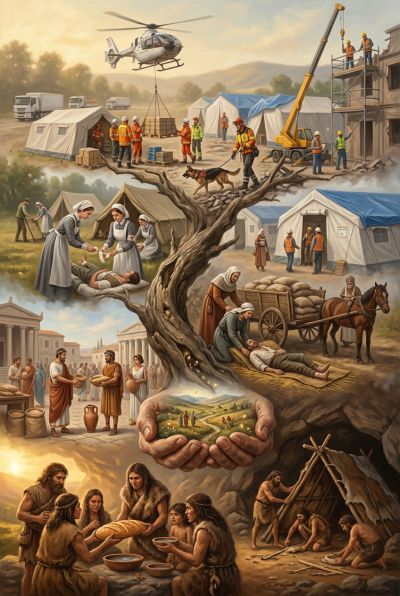


A History of Disaster Relief invites readers on an expansive journey through time, tracing how humans have confronted and recovered from catastrophe from the earliest hunter‑gatherer bands to the hyper‑connected world of today. Each chapter reveals the evolving motives behind aid—survival instinct, religious duty, state power, humanitarian idealism, and political calculation—showing how disaster response has always been woven into the broader fabric of society, culture, and technology. By following this chronicle, readers gain a deep appreciation for the continuity of compassion and ingenuity that has repeatedly pulled communities back from the brink.
The book begins with the primal strategies of mobility and cooperation that kept Paleolithic groups alive, then moves to the first organized efforts of river‑valley civilizations where granaries, irrigation works, and urban planning emerged as early forms of risk reduction. It examines how Greece and Rome blended divine interpretation with pragmatic measures such as grain dole, firefighting corps, and imperial relief funds, before exploring the Middle Ages where monasteries, Islamic waqfs, and Christian almsgiving formed the backbone of care. The narrative highlights pivotal turning points like the Black Death, which forced the birth of quarantine and reshaped labor relations, and the Enlightenment, which reframed aid as a secular duty rooted in reason and natural rights.
Readers will witness the dramatic transformation wrought by the Industrial Revolution, as new workplace hazards, urban squalor, and epidemic disease spurred mutual aid societies, factory legislation, and the first glimpses of state‑run public health. The birth of the Red Cross and the Geneva Conventions marks the dawn of modern international humanitarianism, a theme that expands through the World Wars, the Great Depression’s New Deal, and the postwar creation of the United Nations system. Subsequent chapters unpack the Cold War’s politicization of aid, the rise of NGOs, and the technological leap in early warning, logistics, and communication that has revolutionized how relief is conceived and delivered.
Beyond institutions and inventions, the book delves into the human dimension of disaster: the psychological trauma and resilience of survivors, the staggering economic toll and the financial tools devised to meet it, and the powerful role of media in shaping public perception and donor response. Through vivid case studies—from the Galveston hurricane to the Bhola cyclone, the Armenian earthquake to the digital‑age mobilization after Haiti—readers see how each catastrophe has taught hard lessons about vulnerability, coordination, and the need for proactive risk reduction. The final sections look ahead to emerging innovations like AI‑driven forecasting, forecast‑based financing, and community‑led resilience, underscoring that understanding the past is essential for building a safer, more solidarity‑driven future.
What You'll Find Inside:
- Traces disaster relief from prehistoric communal cooperation through ancient state granaries to modern international humanitarian systems
- Examines the constant interplay between altruistic motives and political/economic interests in shaping disaster response
- Details how technological innovations (satellites, communication, logistics) revolutionized early warning and aid delivery
- Explores psychological trauma, community resilience, and the growing importance of mental health in recovery
- Chronicles the shift from reactive relief to proactive risk reduction, preparedness, and 'building back better' approaches
Who's It For:
This comprehensive historical analysis is ideal for students and scholars of disaster management, humanitarian studies, and history; professionals working in NGOs, government emergency agencies, and international organizations; policymakers seeking to understand the evolution of relief systems; and general readers interested in how humanity has responded to catastrophes from prehistoric times to the digital age.
Table of Contents:
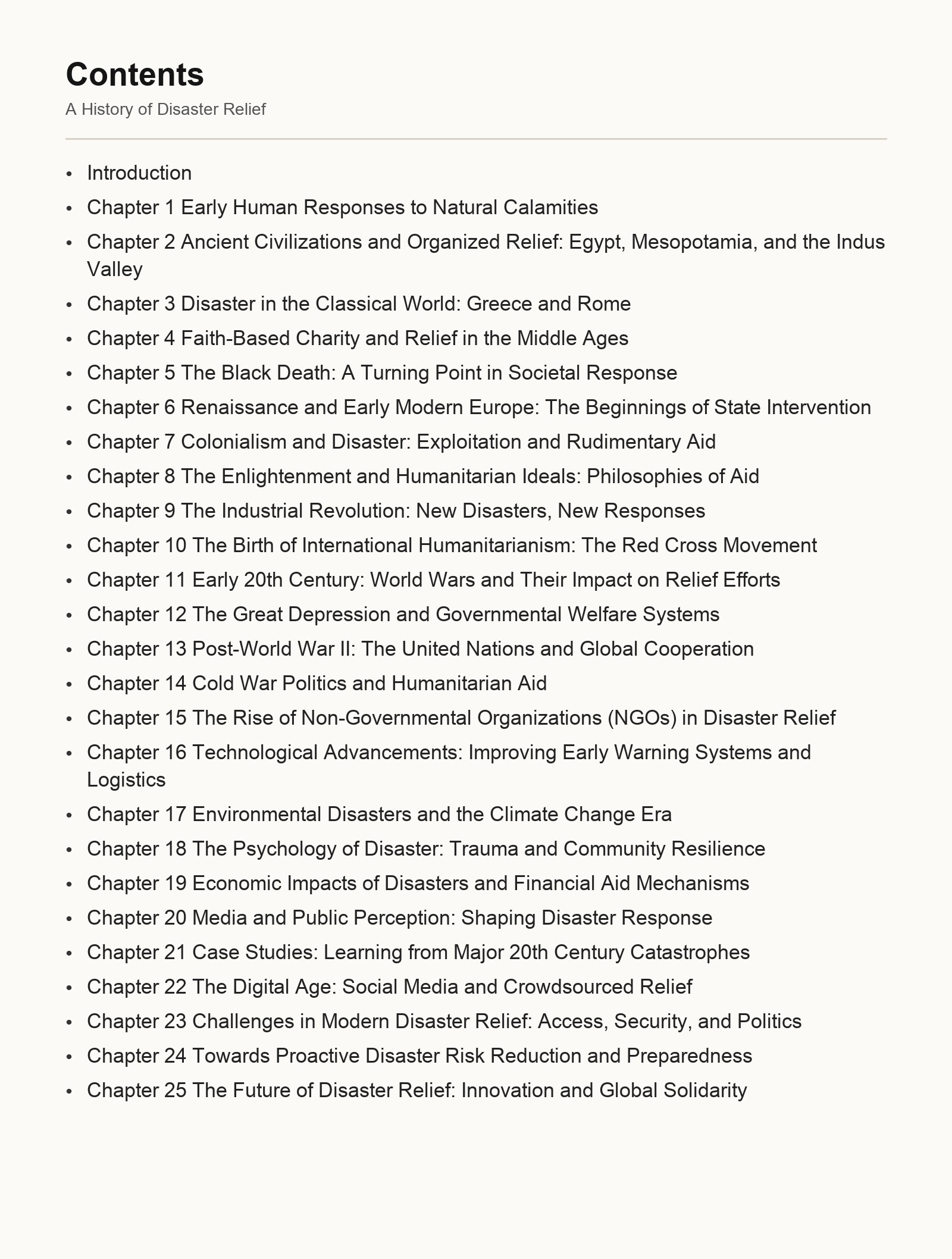
- Introduction
- Chapter 1 Early Human Responses to Natural Calamities
- Chapter 2 Ancient Civilizations and Organized Relief: Egypt, Mesopotamia, and the Indus Valley
- Chapter 3 Disaster in the Classical World: Greece and Rome
- Chapter 4 Faith-Based Charity and Relief in the Middle Ages
- Chapter 5 The Black Death: A Turning Point in Societal Response
- Chapter 6 Renaissance and Early Modern Europe: The Beginnings of State Intervention
- Chapter 7 Colonialism and Disaster: Exploitation and Rudimentary Aid
- Chapter 8 The Enlightenment and Humanitarian Ideals: Philosophies of Aid
- Chapter 9 The Industrial Revolution: New Disasters, New Responses
- Chapter 10 The Birth of International Humanitarianism: The Red Cross Movement
- Chapter 11 Early 20th Century: World Wars and Their Impact on Relief Efforts
- Chapter 12 The Great Depression and Governmental Welfare Systems
- Chapter 13 Post-World War II: The United Nations and Global Cooperation
- Chapter 14 Cold War Politics and Humanitarian Aid
- Chapter 15 The Rise of Non-Governmental Organizations (NGOs) in Disaster Relief
- Chapter 16 Technological Advancements: Improving Early Warning Systems and Logistics
- Chapter 17 Environmental Disasters and the Climate Change Era
- Chapter 18 The Psychology of Disaster: Trauma and Community Resilience
- Chapter 19 Economic Impacts of Disasters and Financial Aid Mechanisms
- Chapter 20 Media and Public Perception: Shaping Disaster Response
- Chapter 21 Case Studies: Learning from Major 20th Century Catastrophes
- Chapter 22 The Digital Age: Social Media and Crowdsourced Relief
- Chapter 23 Challenges in Modern Disaster Relief: Access, Security, and Politics
- Chapter 24 Towards Proactive Disaster Risk Reduction and Preparedness
- Chapter 25 The Future of Disaster Relief: Innovation and Global Solidarity
Author:
Published By:
Date Published:
May 27, 2026
Type:
Nonfiction
Language:
English
Also Available In:
Word Count:
48,511 words
Reading Time:
3 hours 24 minutes
Sample:
Order:
Order A History of Disaster Relief (Hardcover) on MixCache.com:
Buy NowPrint copy is made to order and ships worldwide. Includes the ebook free, ready to read instantly.
$5 account credit for all new MixCache.com accounts, usable toward any ebook purchase!*