
Browse by Category
Fiction
- Action & Adventure
- African American
- Anthologies
- Children's Fiction
- Classics
- Comics & Graphic Novels
- Coming of Age
- Contemporary
- Cultural & Regional
- Drama
- Erotica
- Fantasy
- General
- Historical Fiction
- Horror
- Humor & Satire
- Literary Fiction
- Mystery, Thriller & Suspense
- Poetry
- Religious & Inspirational
- Romance
- Science Fiction
- Short Stories
- War & Military
- Westerns
- Women's Fiction
- Young Adult
Non-Fiction
- Antiques & Collectibles
- Arts & Photography
- Biographies & Memoirs
- Business & Money
- Children's Non-Fiction
-
Computers & Technology
- Artificial Intelligence
- Computer Science
- Cybersecurity & Cryptography
- Data Science & Analytics
- Databases & Big Data
- Game Development & Design
- General
- Hardware & DIY
- Mobile App Development
- Networking & Cloud Computing
- Operating Systems
- Programming
- Robotics
- Software
- Software Engineering
- User Experience (UX) & Design
- Web Development & Design
- Cooking, Food & Wine
- Crafts, Hobbies & Home
- Education & Teaching
- Engineering
- General
- Health, Fitness & Dieting
-
History
- African History
- African History - North Africa
- African History - Sub-Saharan Africa
- American History
- American History - 20th Century
- American History - Civil War
- American History - Colonial Period
- Ancient History
- Asian History
- Asian History - China
- Asian History - India
- Asian History - Japan
- Asian History - Southeast Asia
- European History
- European History - Ancient Greece
- European History - Ancient Rome
- European History - Medieval
- European History - Modern
- European History - Renaissance
- General
- Middle Eastern History
- Military History
- Military History - Aviation
- Military History - Naval
- Social & Cultural History
- World History
- Humor & Entertainment
- Industrial Technology
- Language Learning
- Law
- LGBTQ+ Non-Fiction
- Literary Criticism
- Medical Books
- Parenting & Relationships
- Philosophy
- Politics & Social Sciences
- Reference
- Religion & Spirituality
-
Science & Math
- Agricultural Sciences
- Astronomy & Space Science
- Behavioral Sciences
- Biological Sciences
- Botany & Plant Science
- Chemistry
- Earth Sciences
- Engineering - Chemical
- Engineering - Civil
- Engineering - Electrical
- Engineering - Mechanical
- Environment
- General
- Geology
- Mathematics
- Nature & Ecology
- Oceanography
- Paleontology
- Physics
- Statistics
- Self-Help
- Sports & Outdoors
- Study Aids
- Sustainability & Green Living
- Textbooks
- Transportation
- Travel
- True Crime
- Urban Planning & Development
- Veterinary Medicine
- Writing & Publishing
Jump to Section
MixCache.com Total Access
Unlimited reading and audiobooks for every book published by MixCache.com.
Included titles carry the MTA badge.
Learn more →A Concise History of Humanity
About this book:
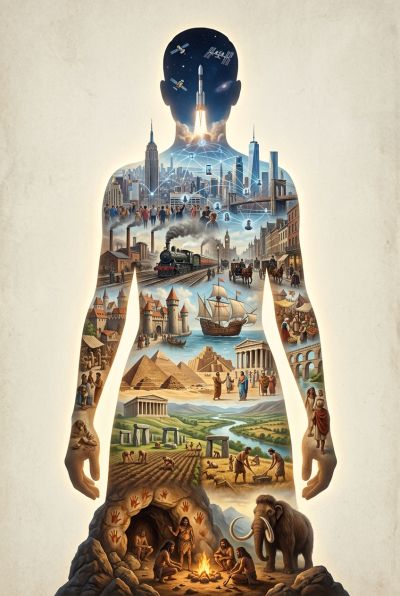
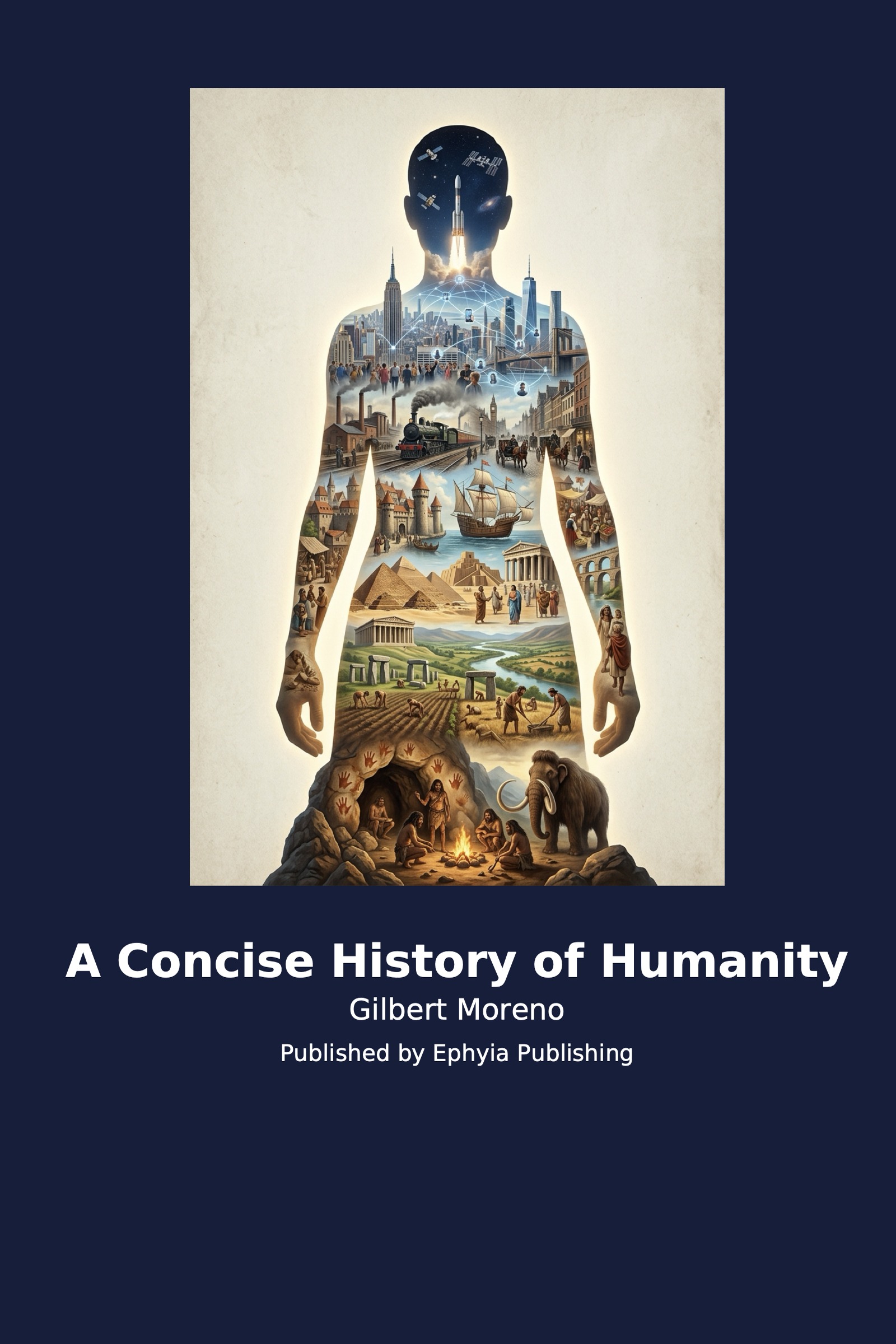
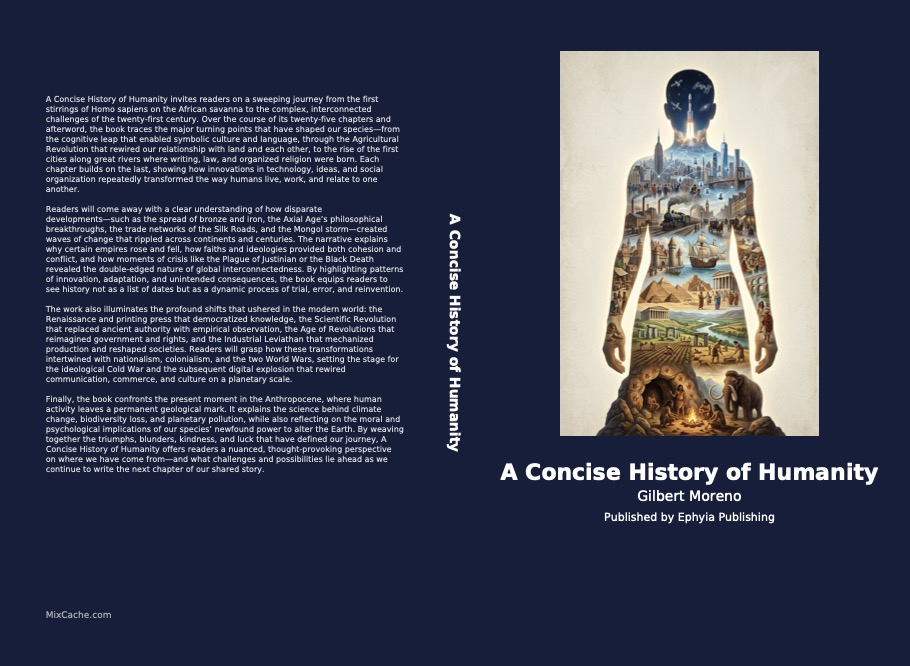
A Concise History of Humanity invites readers on a sweeping journey from the first stirrings of Homo sapiens on the African savanna to the complex, interconnected challenges of the twenty‑first century. Over the course of its twenty‑five chapters and afterword, the book traces the major turning points that have shaped our species—from the cognitive leap that enabled symbolic culture and language, through the Agricultural Revolution that rewired our relationship with land and each other, to the rise of the first cities along great rivers where writing, law, and organized religion were born. Each chapter builds on the last, showing how innovations in technology, ideas, and social organization repeatedly transformed the way humans live, work, and relate to one another.
Readers will come away with a clear understanding of how disparate developments—such as the spread of bronze and iron, the Axial Age’s philosophical breakthroughs, the trade networks of the Silk Roads, and the Mongol storm—created waves of change that rippled across continents and centuries. The narrative explains why certain empires rose and fell, how faiths and ideologies provided both cohesion and conflict, and how moments of crisis like the Plague of Justinian or the Black Death revealed the double‑edged nature of global interconnectedness. By highlighting patterns of innovation, adaptation, and unintended consequences, the book equips readers to see history not as a list of dates but as a dynamic process of trial, error, and reinvention.
The work also illuminates the profound shifts that ushered in the modern world: the Renaissance and printing press that democratized knowledge, the Scientific Revolution that replaced ancient authority with empirical observation, the Age of Revolutions that reimagined government and rights, and the Industrial Leviathan that mechanized production and reshaped societies. Readers will grasp how these transformations intertwined with nationalism, colonialism, and the two World Wars, setting the stage for the ideological Cold War and the subsequent digital explosion that rewired communication, commerce, and culture on a planetary scale.
Finally, the book confronts the present moment in the Anthropocene, where human activity leaves a permanent geological mark. It explains the science behind climate change, biodiversity loss, and planetary pollution, while also reflecting on the moral and psychological implications of our species’ newfound power to alter the Earth. By weaving together the triumphs, blunders, kindness, and luck that have defined our journey, A Concise History of Humanity offers readers a nuanced, thought‑provoking perspective on where we have come from—and what challenges and possibilities lie ahead as we continue to write the next chapter of our shared story.
What You'll Find Inside:
- The Agricultural Revolution enabled permanent settlements and population growth but introduced social hierarchies, disease, and decreased individual health and freedom compared to hunter-gatherer lifestyles.
- During the Axial Age (800-200 BCE), parallel philosophical and religious breakthroughs in Greece, India, China, and the Middle East created ethical and spiritual frameworks that still guide billions of people today.
- The Silk Roads formed the first major globalized network, enabling exchange of goods, ideas, and technologies between East and West for over a millennium while also spreading devastating pandemics like the Plague of Justinian.
- The Industrial Revolution mechanized production and transformed societies, creating unprecedented wealth and technological power while generating new social classes, urban challenges, and the foundation for modern climate change.
- We now live in the Anthropocene Age, where human activity has become a geological force altering planetary systems, presenting interconnected challenges of climate change, biodiversity loss, and resource depletion requiring unprecedented global cooperation.
Who's It For:
This book is ideal for curious readers seeking a broad understanding of human history without getting lost in excessive detail. It will particularly benefit students, lifelong learners, and anyone interested in how major historical patterns - from agriculture to industrialization to digital connectivity - have shaped our present world. Readers looking to understand current global challenges like climate change and technological disruption through a deep historical lens will find valuable perspective here. The concise yet comprehensive approach makes it accessible to educated general readers who want to grasp the big picture of our species' journey.
Table of Contents:
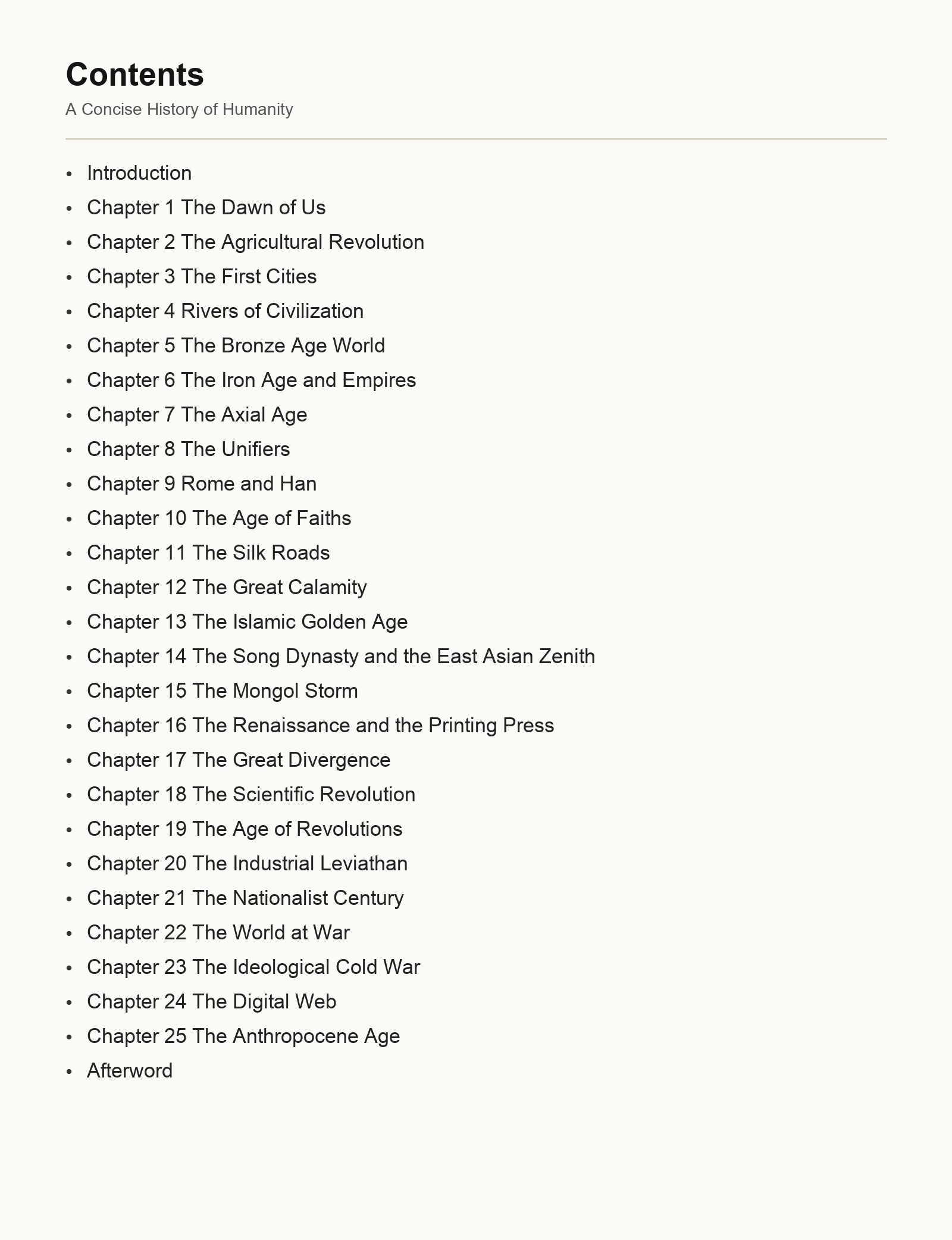
- Introduction
- Chapter 1 The Dawn of Us
- Chapter 2 The Agricultural Revolution
- Chapter 3 The First Cities
- Chapter 4 Rivers of Civilization
- Chapter 5 The Bronze Age World
- Chapter 6 The Iron Age and Empires
- Chapter 7 The Axial Age
- Chapter 8 The Unifiers
- Chapter 9 Rome and Han
- Chapter 10 The Age of Faiths
- Chapter 11 The Silk Roads
- Chapter 12 The Great Calamity
- Chapter 13 The Islamic Golden Age
- Chapter 14 The Song Dynasty and the East Asian Zenith
- Chapter 15 The Mongol Storm
- Chapter 16 The Renaissance and the Printing Press
- Chapter 17 The Great Divergence
- Chapter 18 The Scientific Revolution
- Chapter 19 The Age of Revolutions
- Chapter 20 The Industrial Leviathan
- Chapter 21 The Nationalist Century
- Chapter 22 The World at War
- Chapter 23 The Ideological Cold War
- Chapter 24 The Digital Web
- Chapter 25 The Anthropocene Age
- Afterword
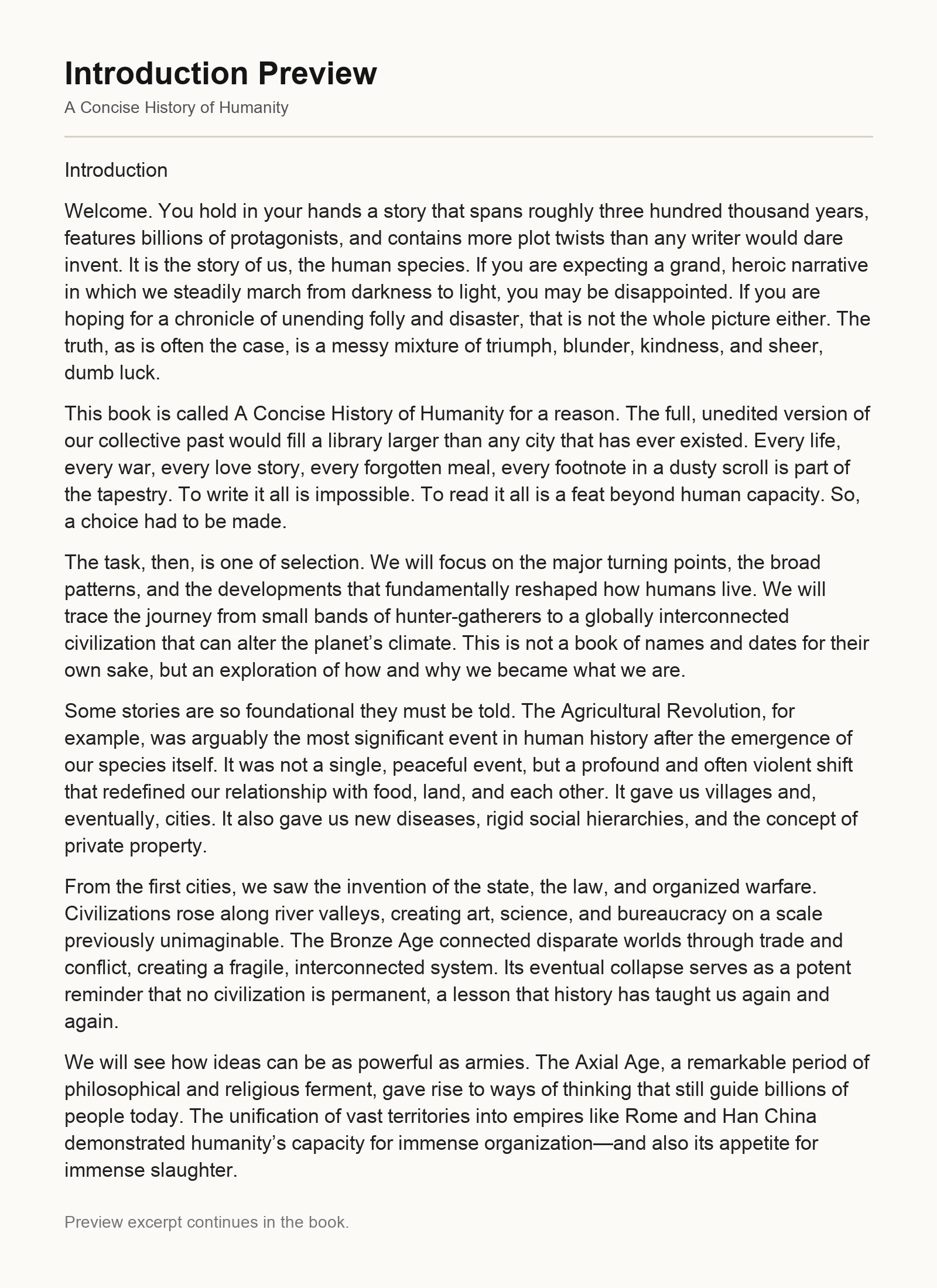
Welcome. You hold in your hands a story that spans roughly three hundred thousand years, features billions of protagonists, and contains more plot twists than any writer would dare invent. It is the story of us, the human species. If you are expecting a grand, heroic narrative in which we steadily march from darkness to light, you may be disappointed. If you are hoping for a chronicle of unending folly and disaster, that is not the whole picture either. The truth, as is often the case, is a messy mixture of triumph, blunder, kindness, and sheer, dumb luck.
This book is called A Concise History of Humanity for a reason. The full, unedited version of our collective past would fill a library larger than any city that has ever existed. Every life, every war, every love story, every forgotten meal, every footnote in a dusty scroll is part of the tapestry. To write it all is impossible. To read it all is a feat beyond human capacity. So, a choice had to be made.
The task, then, is one of selection. We will focus on the major turning points, the broad patterns, and the developments that fundamentally reshaped how humans live. We will trace the journey from small bands of hunter-gatherers to a globally interconnected civilization that can alter the planet’s climate. This is not a book of names and dates for their own sake, but an exploration of how and why we became what we are.
Some stories are so foundational they must be told. The Agricultural Revolution, for example, was arguably the most significant event in human history after the emergence of our species itself. It was not a single, peaceful event, but a profound and often violent shift that redefined our relationship with food, land, and each other. It gave us villages and, eventually, cities. It also gave us new diseases, rigid social hierarchies, and the concept of private property.
From the first cities, we saw the invention of the state, the law, and organized warfare. Civilizations rose along river valleys, creating art, science, and bureaucracy on a scale previously unimaginable. The Bronze Age connected disparate worlds through trade and conflict, creating a fragile, interconnected system. Its eventual collapse serves as a potent reminder that no civilization is permanent, a lesson that history has taught us again and again.
We will see how ideas can be as powerful as armies. The Axial Age, a remarkable period of philosophical and religious ferment, gave rise to ways of thinking that still guide billions of people today. The unification of vast territories into empires like Rome and Han China demonstrated humanity’s capacity for immense organization—and also its appetite for immense slaughter. Faiths spread across continents, building communities and sparking conflicts that have endured for millennia.
The flow of goods and ideas along routes like the Silk Roads showed that no culture develops in a vacuum. The devastating plagues that followed demonstrated the deadly price of interconnectedness. The Islamic Golden Age and the scientific flourishing in Song Dynasty China showcased human ingenuity at its peak, while the Mongol storm proved that organized chaos could, for a time, conquer the world.
A pivot in the story occurs in the second millennium. The Renaissance and the printing press in Europe began a new conversation. This helped set the stage for the Scientific Revolution and the "Great Divergence," a period where parts of the world raced ahead in technology and economic power, while others did not. The consequences of this era still shape global politics and economies today.
The Industrial Revolution fundamentally transformed human life, replacing muscle with machine and rural life with urban landscapes at a speed that left many reeling. The nationalist fervor of the 19th century, built on the new ideas of identity and statehood, led directly to the industrialized slaughter of the World Wars, a demonstration of technological progress in the service of human conflict.
The second half of the 20th century presented humanity with a new kind of struggle, an ideological Cold War fought in the shadows of nuclear annihilation. The peace that followed, such as it was, gave way to the dizzying speed of the Digital Web, shrinking our world once again. Now, we stand at a new threshold.
We have reached a point where our actions leave a permanent mark on the geological record. We call this the Anthropocene Age—an era defined by humanity itself. Our species, which began as a fragile collection of primates on a vast and indifferent planet, has become the dominant force shaping its future. The story we have lived so far is astonishing. The story we are about to write is yet to be determined.
This book, therefore, is an invitation. It is a chance to see the long arc of our journey, with all its brilliance and its blunders. It is a chance to understand the forces that have shaped our societies, our beliefs, and our very selves. We begin not with a bang, nor with a divine command, but with a quiet emergence in an African sun. The journey starts now.
Author:
Published By:
Date Published:
May 26, 2026
Type:
Nonfiction
Language:
English
Also Available In:
Word Count:
64,291 words
Reading Time:
4 hours 30 minutes
Sample:
Order:
Buy the A Concise History of Humanity ebook on MixCache.com:
Buy NowThe full ebook will be available immediately to read instantly on any device.
$5 account credit for all new MixCache.com accounts, usable toward any ebook purchase!*


Ratings & Reviews
Ask Questions About This Book
Have a question about the content? Ask our AI assistant!
Start by asking a question about "A Concise History of Humanity"
Example: "Does this book mention William Shakespeare?"
Thinking...