
Browse by Category
Fiction
- Action & Adventure
- African American
- Anthologies
- Children's Fiction
- Classics
- Comics & Graphic Novels
- Coming of Age
- Contemporary
- Cultural & Regional
- Drama
- Erotica
- Fantasy
- General
- Historical Fiction
- Horror
- Humor & Satire
- Literary Fiction
- Mystery, Thriller & Suspense
- Poetry
- Religious & Inspirational
- Romance
- Science Fiction
- Short Stories
- War & Military
- Westerns
- Women's Fiction
- Young Adult
Non-Fiction
- Antiques & Collectibles
- Arts & Photography
- Biographies & Memoirs
- Business & Money
- Children's Non-Fiction
-
Computers & Technology
- Artificial Intelligence
- Computer Science
- Cybersecurity & Cryptography
- Data Science & Analytics
- Databases & Big Data
- Game Development & Design
- General
- Hardware & DIY
- Mobile App Development
- Networking & Cloud Computing
- Operating Systems
- Programming
- Robotics
- Software
- Software Engineering
- User Experience (UX) & Design
- Web Development & Design
- Cooking, Food & Wine
- Crafts, Hobbies & Home
- Education & Teaching
- Engineering
- General
- Health, Fitness & Dieting
-
History
- African History
- African History - North Africa
- African History - Sub-Saharan Africa
- American History
- American History - 20th Century
- American History - Civil War
- American History - Colonial Period
- Ancient History
- Asian History
- Asian History - China
- Asian History - India
- Asian History - Japan
- Asian History - Southeast Asia
- European History
- European History - Ancient Greece
- European History - Ancient Rome
- European History - Medieval
- European History - Modern
- European History - Renaissance
- General
- Middle Eastern History
- Military History
- Military History - Aviation
- Military History - Naval
- Social & Cultural History
- World History
- Humor & Entertainment
- Industrial Technology
- Language Learning
- Law
- LGBTQ+ Non-Fiction
- Literary Criticism
- Medical Books
- Parenting & Relationships
- Philosophy
- Politics & Social Sciences
- Reference
- Religion & Spirituality
-
Science & Math
- Agricultural Sciences
- Astronomy & Space Science
- Behavioral Sciences
- Biological Sciences
- Botany & Plant Science
- Chemistry
- Earth Sciences
- Engineering - Chemical
- Engineering - Civil
- Engineering - Electrical
- Engineering - Mechanical
- Environment
- General
- Geology
- Mathematics
- Nature & Ecology
- Oceanography
- Paleontology
- Physics
- Statistics
- Self-Help
- Sports & Outdoors
- Study Aids
- Sustainability & Green Living
- Textbooks
- Transportation
- Travel
- True Crime
- Urban Planning & Development
- Veterinary Medicine
- Writing & Publishing
Jump to Section
MixCache.com Total Access
Unlimited reading and audiobooks for every book published by MixCache.com.
Included titles carry the MTA badge.
Learn more →
The Life of the Ancients
How Ordinary People Lived Beneath Pharaohs, Emperors, and Kings
About this book:
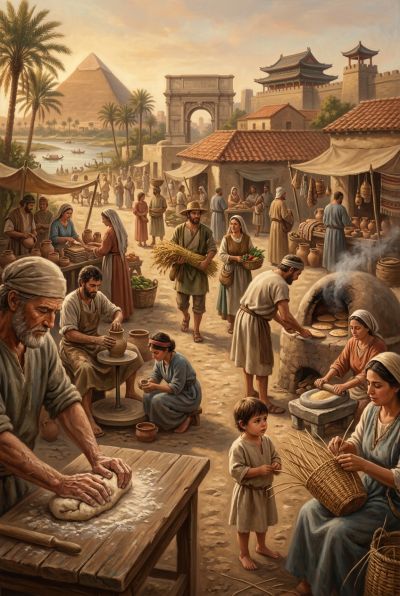
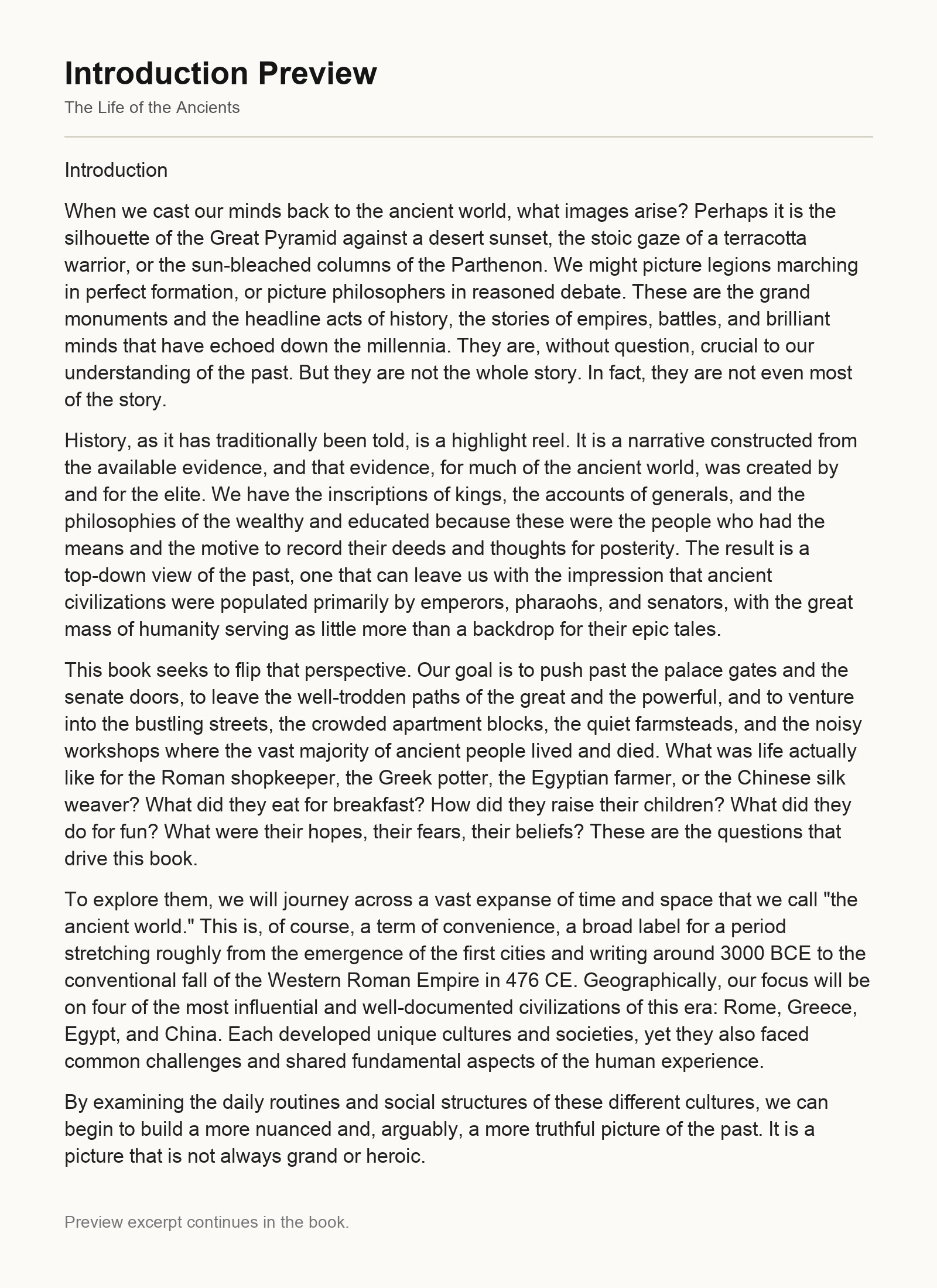
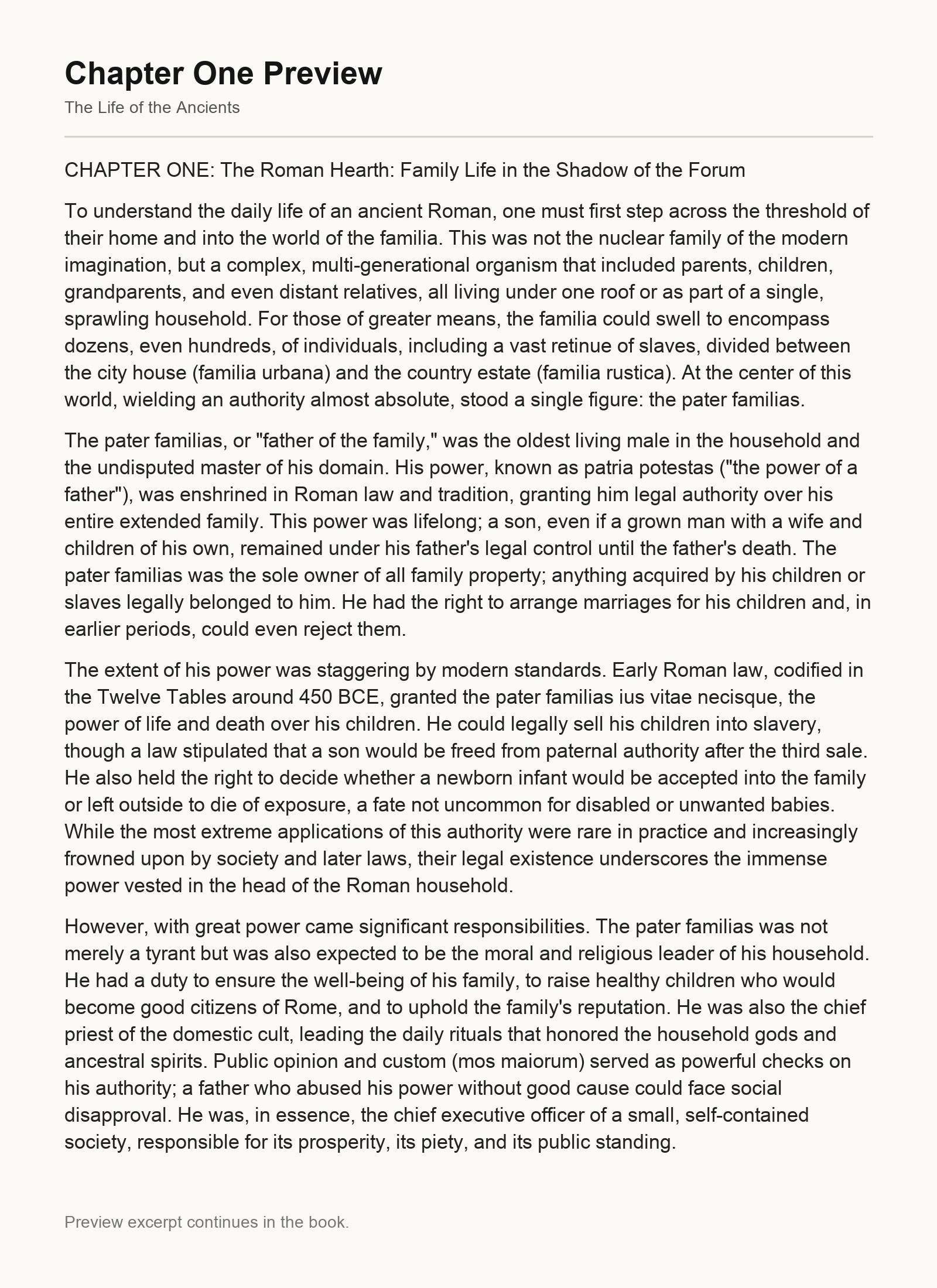
Step into the bustling streets, quiet workshops, and modest homes of the ancient world and discover what daily life truly looked like for the people who built empires but rarely appeared in their histories. This book moves beyond kings and battles to explore the routines, beliefs, and struggles of ordinary Romans, Greeks, Egyptians, and Han Chinese—from the moment a child was accepted into the family to the final rites that prepared a soul for the afterlife. Readers will walk alongside a Roman shopkeeper as he queues for his grain dole, watch a Greek potter shape clay on his wheel, feel the rhythm of an Egyptian farmer’s year dictated by the Nile’s flood, and share the hopes and anxieties of a Han Dynasty tiller bound to the land by taxes and corvée labor.
Each chapter opens a window onto a different facet of antiquity: the authority of the pater familias and the domestic rituals that bound a Roman household; the stark divide between the Athenian agora and the secluded oikos where women managed cloth, food, and child-rearing; the inventive labor of state‑sponsored builders at Deir el‑Medina who carved royal tombs while receiving grain rations and striking for fair pay; the disciplined life of a legionary who spent nights constructing fortified camps and days marching distant frontiers; and the vibrant public spectacles of bread and circuses that kept urban masses fed, entertained, and politically quiet. Through these vivid portraits, the book reveals how family, work, religion, law, and leisure intertwined to shape individual experience across continents and centuries.
Readers will also encounter the intellectual and spiritual worlds that gave meaning to daily grind. They will sit in the garden of Epicurus, learning how friendship and simple pleasures were pursued as a path to tranquility, and stand on the Stoa Poikile where Zeno taught citizens to focus only on what lay within their control. The pages follow the journeys of scribes who mastered hieroglyphs on ostraca, priests who tended divine statues in temple sanctuaries, and philosophers who debated virtue in the Agora while artisans produced the pots, textiles, and metalwork that sustained city life. By examining funerary amulets, household shrines, and festive processions, the book shows how magic, medicine, and myth were woven into the ordinary quest for health, protection, and hope.
Beyond personal stories, the work connects the intimate details of ancient life to the enduring foundations of our own world. Readers will see how the Greek alphabet lives in every letter they write, how Roman aqueducts and sewers echo in modern public health, how the Han civil service examination inspired merit‑based bureaucracies worldwide, and how staples like bread, wine, olive oil, millet, and rice trace their origins to the fields and kitchens of antiquity. The final chapters invite reflection on the sensory symphony of ancient cities—the clamor of markets, the stench of waste, the scent of incense—and on how the struggles, innovations, and ideas of those long‑gone peoples continue to resonate in our language, laws, food, and built environment. This is an invitation to understand the past not as a distant spectacle but as a living legacy that shapes the ground beneath our feet.
What You'll Find Inside:
- The structure and authority of the Roman familia under the pater familias, including legal power over family members
- How ancient Egyptians' lives were governed by the Nile's annual flood cycle and its agricultural seasons
- The contrasting public and private spheres in ancient Greece, particularly the male-dominated Agora and female-confined oikos
- The rigorous education and career paths for elite boys in different civilizations (scribes in Egypt, philosophers in Greece, officials in China)
- How imperial projects like the Great Wall and Roman aqueducts relied on the labor of ordinary people, often at great human cost
Who's It For:
This book is ideal for general readers interested in social history who want to understand daily life in ancient civilizations from the perspective of ordinary people rather than just elite narratives. It will appeal to history enthusiasts, students, and anyone curious about how ancient societies functioned at the grassroots level, covering topics like family life, work, religion, and social structures across Rome, Greece, Egypt, and China.
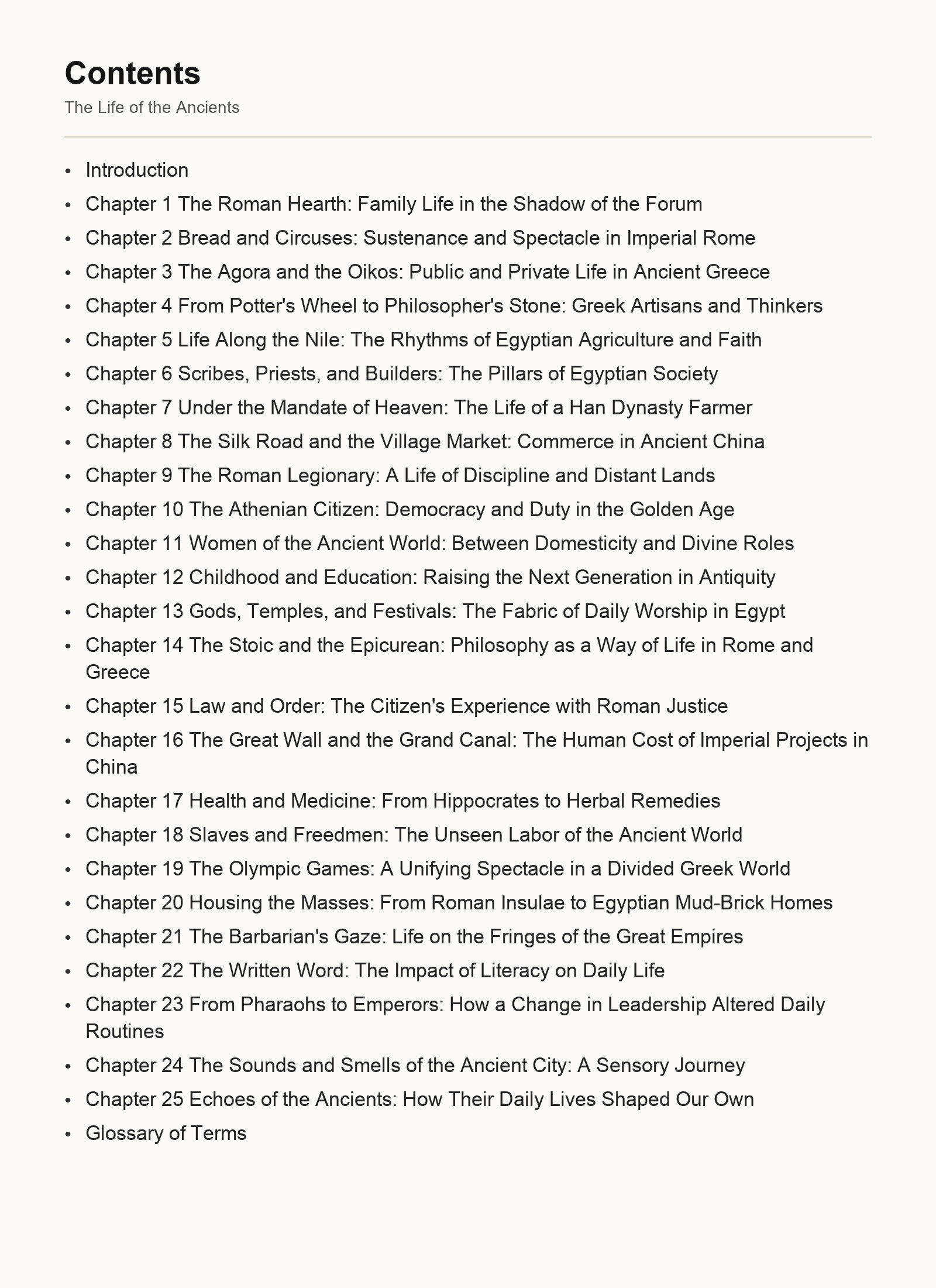
Table of Contents:
- Introduction
- Chapter 1 The Roman Hearth: Family Life in the Shadow of the Forum
- Chapter 2 Bread and Circuses: Sustenance and Spectacle in Imperial Rome
- Chapter 3 The Agora and the Oikos: Public and Private Life in Ancient Greece
- Chapter 4 From Potter's Wheel to Philosopher's Stone: Greek Artisans and Thinkers
- Chapter 5 Life Along the Nile: The Rhythms of Egyptian Agriculture and Faith
- Chapter 6 Scribes, Priests, and Builders: The Pillars of Egyptian Society
- Chapter 7 Under the Mandate of Heaven: The Life of a Han Dynasty Farmer
- Chapter 8 The Silk Road and the Village Market: Commerce in Ancient China
- Chapter 9 The Roman Legionary: A Life of Discipline and Distant Lands
- Chapter 10 The Athenian Citizen: Democracy and Duty in the Golden Age
- Chapter 11 Women of the Ancient World: Between Domesticity and Divine Roles
- Chapter 12 Childhood and Education: Raising the Next Generation in Antiquity
- Chapter 13 Gods, Temples, and Festivals: The Fabric of Daily Worship in Egypt
- Chapter 14 The Stoic and the Epicurean: Philosophy as a Way of Life in Rome and Greece
- Chapter 15 Law and Order: The Citizen's Experience with Roman Justice
- Chapter 16 The Great Wall and the Grand Canal: The Human Cost of Imperial Projects in China
- Chapter 17 Health and Medicine: From Hippocrates to Herbal Remedies
- Chapter 18 Slaves and Freedmen: The Unseen Labor of the Ancient World
- Chapter 19 The Olympic Games: A Unifying Spectacle in a Divided Greek World
- Chapter 20 Housing the Masses: From Roman Insulae to Egyptian Mud-Brick Homes
- Chapter 21 The Barbarian's Gaze: Life on the Fringes of the Great Empires
- Chapter 22 The Written Word: The Impact of Literacy on Daily Life
- Chapter 23 From Pharaohs to Emperors: How a Change in Leadership Altered Daily Routines
- Chapter 24 The Sounds and Smells of the Ancient City: A Sensory Journey
- Chapter 25 Echoes of the Ancients: How Their Daily Lives Shaped Our Own
- Glossary of Terms
Author:
Published By:
Date Published:
May 26, 2026
Type:
Nonfiction
Language:
English
Also Available In:
Word Count:
56,995 words
Reading Time:
3 hours 59 minutes
Sample:
Order:
Buy the The Life of the Ancients ebook on MixCache.com:
Buy NowThe full ebook will be available immediately to read instantly on any device.
$5 account credit for all new MixCache.com accounts, usable toward any ebook purchase!*



Ratings & Reviews
Ask Questions About This Book
Have a question about the content? Ask our AI assistant!
Start by asking a question about "The Life of the Ancients"
Example: "Does this book mention William Shakespeare?"
Thinking...