
Browse by Category
Fiction
- Action & Adventure
- African American
- Anthologies
- Children's Fiction
- Classics
- Comics & Graphic Novels
- Coming of Age
- Contemporary
- Cultural & Regional
- Drama
- Erotica
- Fantasy
- General
- Historical Fiction
- Horror
- Humor & Satire
- Literary Fiction
- Mystery, Thriller & Suspense
- Poetry
- Religious & Inspirational
- Romance
- Science Fiction
- Short Stories
- War & Military
- Westerns
- Women's Fiction
- Young Adult
Non-Fiction
- Antiques & Collectibles
- Arts & Photography
- Biographies & Memoirs
- Business & Money
- Children's Non-Fiction
-
Computers & Technology
- Artificial Intelligence
- Computer Science
- Cybersecurity & Cryptography
- Data Science & Analytics
- Databases & Big Data
- Game Development & Design
- General
- Hardware & DIY
- Mobile App Development
- Networking & Cloud Computing
- Operating Systems
- Programming
- Robotics
- Software
- Software Engineering
- User Experience (UX) & Design
- Web Development & Design
- Cooking, Food & Wine
- Crafts, Hobbies & Home
- Education & Teaching
- Engineering
- General
- Health, Fitness & Dieting
-
History
- African History
- African History - North Africa
- African History - Sub-Saharan Africa
- American History
- American History - 20th Century
- American History - Civil War
- American History - Colonial Period
- Ancient History
- Asian History
- Asian History - China
- Asian History - India
- Asian History - Japan
- Asian History - Southeast Asia
- European History
- European History - Ancient Greece
- European History - Ancient Rome
- European History - Medieval
- European History - Modern
- European History - Renaissance
- General
- Middle Eastern History
- Military History
- Military History - Aviation
- Military History - Naval
- Social & Cultural History
- World History
- Humor & Entertainment
- Industrial Technology
- Language Learning
- Law
- LGBTQ+ Non-Fiction
- Literary Criticism
- Medical Books
- Parenting & Relationships
- Philosophy
- Politics & Social Sciences
- Reference
- Religion & Spirituality
-
Science & Math
- Agricultural Sciences
- Astronomy & Space Science
- Behavioral Sciences
- Biological Sciences
- Botany & Plant Science
- Chemistry
- Earth Sciences
- Engineering - Chemical
- Engineering - Civil
- Engineering - Electrical
- Engineering - Mechanical
- Environment
- General
- Geology
- Mathematics
- Nature & Ecology
- Oceanography
- Paleontology
- Physics
- Statistics
- Self-Help
- Sports & Outdoors
- Study Aids
- Sustainability & Green Living
- Textbooks
- Transportation
- Travel
- True Crime
- Urban Planning & Development
- Veterinary Medicine
- Writing & Publishing
Jump to Section
MixCache.com Total Access
Unlimited reading and audiobooks for every book published by MixCache.com.
Included titles carry the MTA badge.
Learn more →A History of Materials Science
About this book:

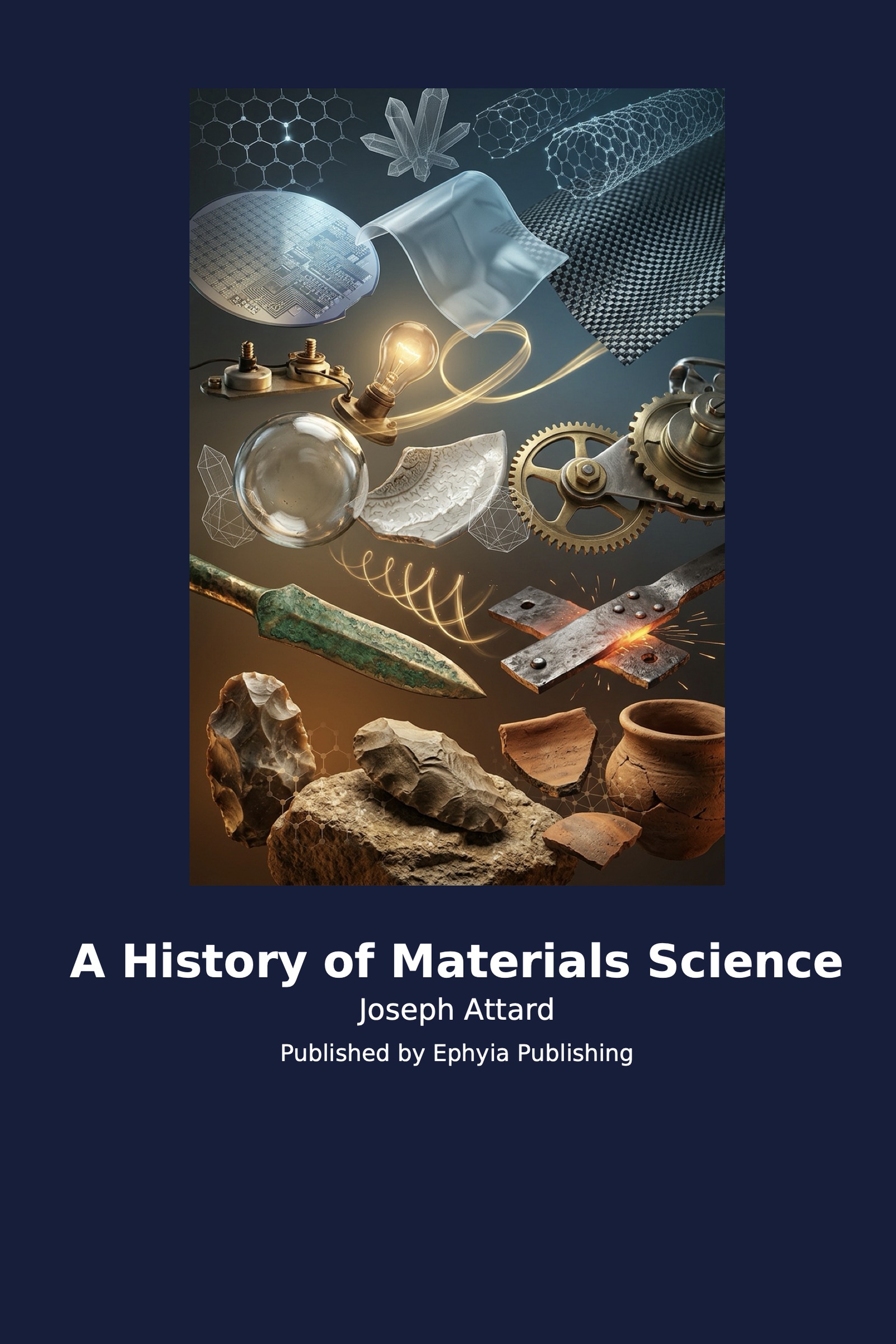
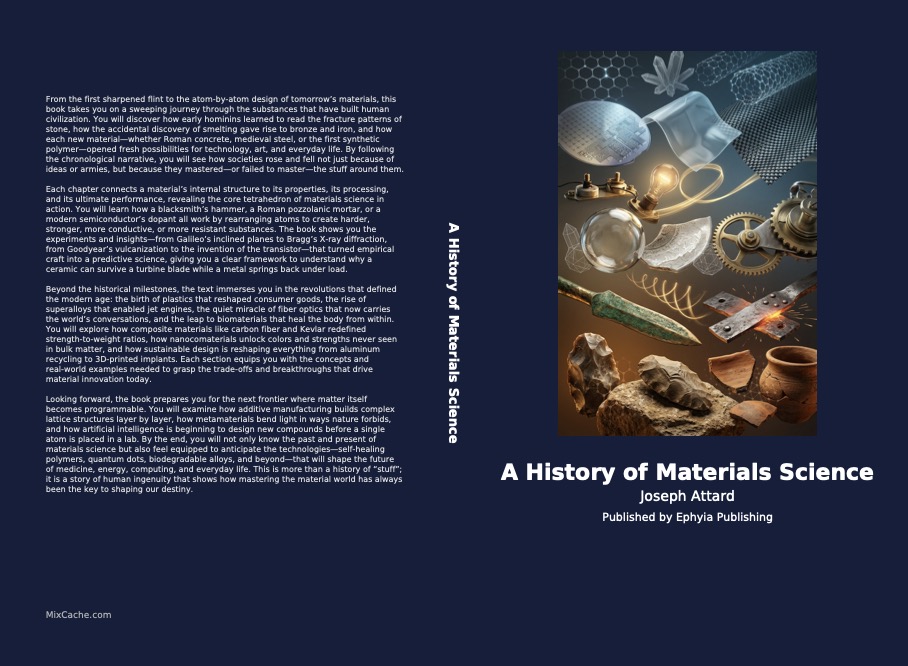
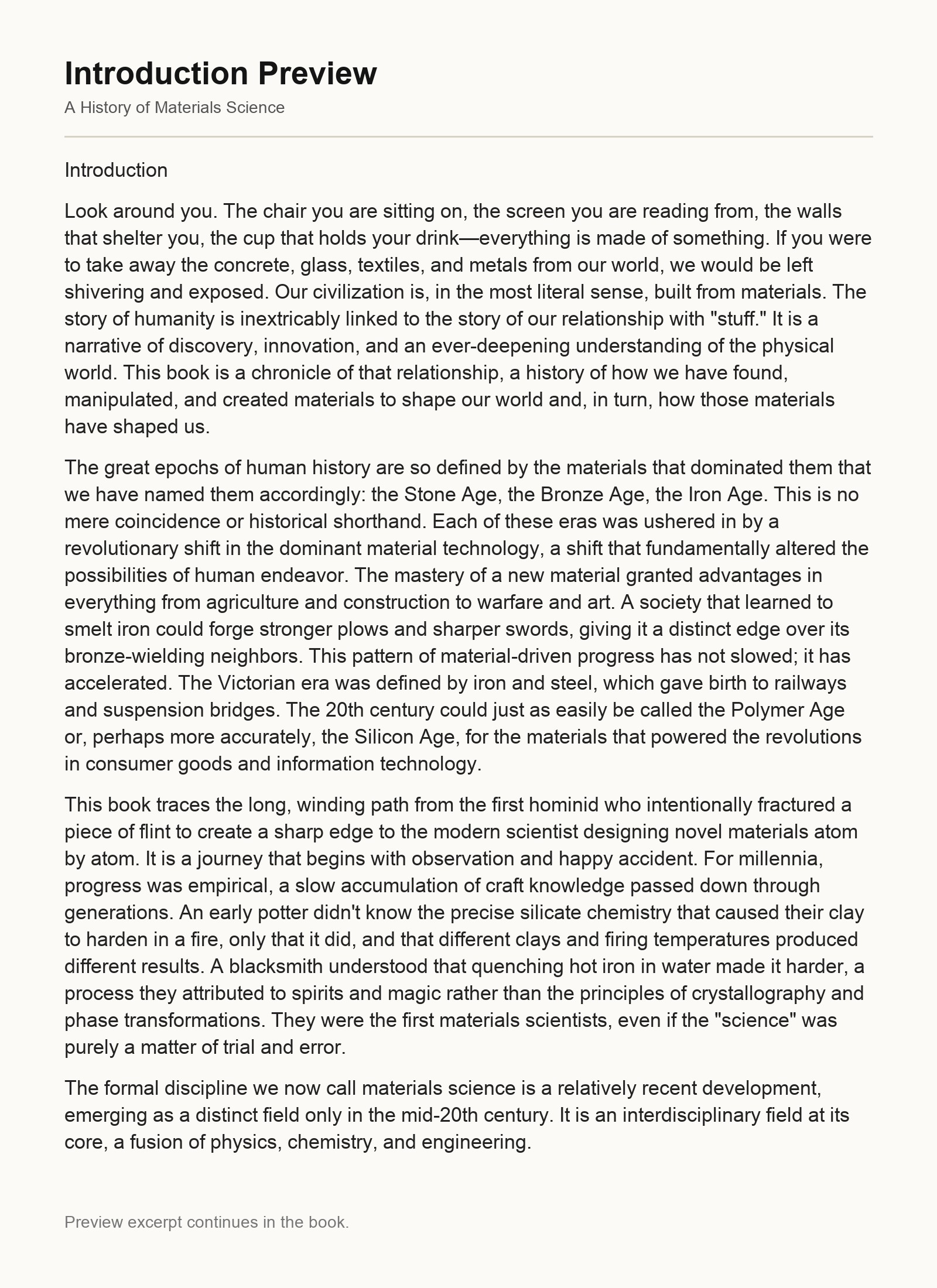
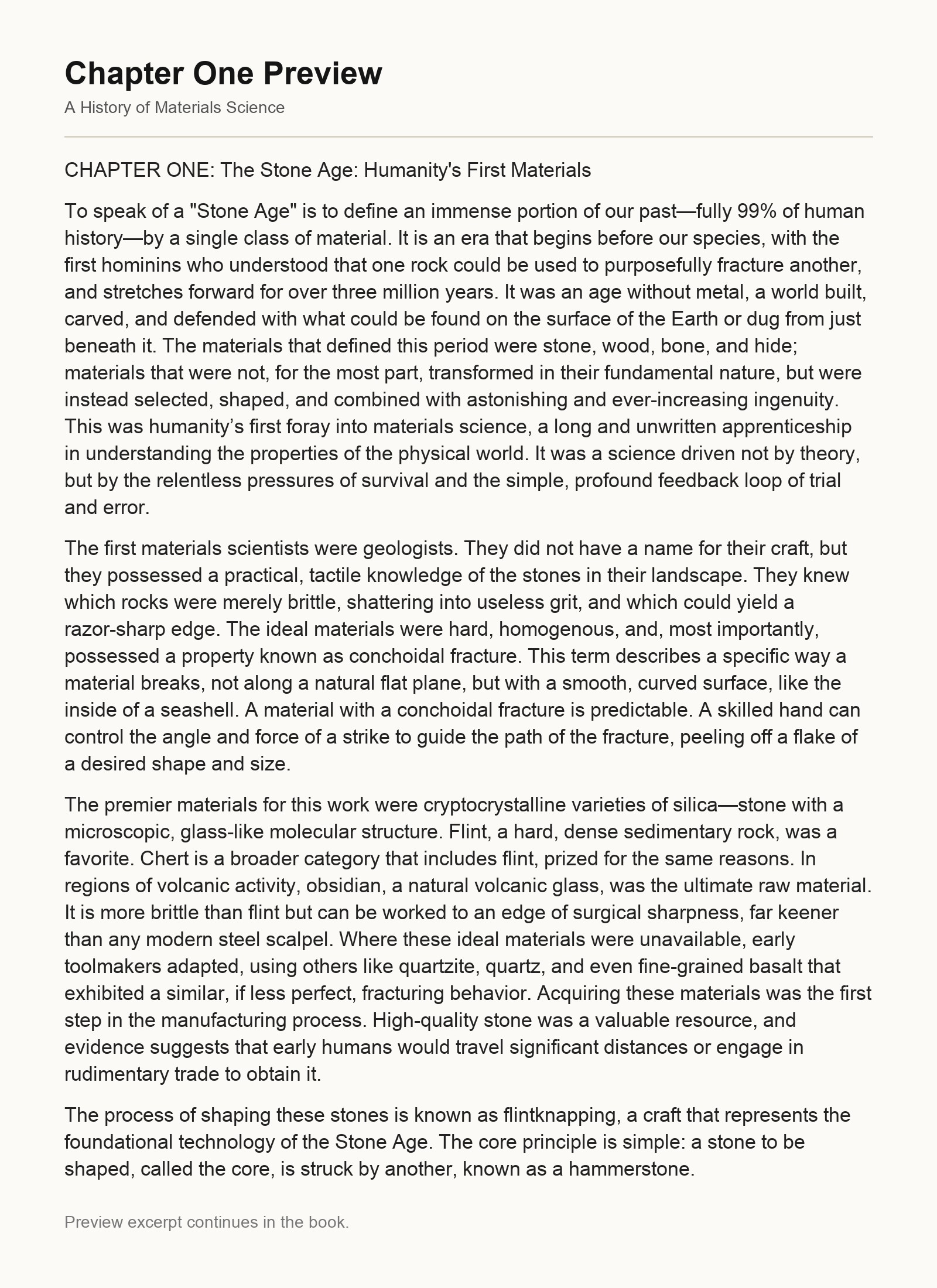
From the first sharpened flint to the atom‑by‑atom design of tomorrow’s materials, this book takes you on a sweeping journey through the substances that have built human civilization. You will discover how early hominins learned to read the fracture patterns of stone, how the accidental discovery of smelting gave rise to bronze and iron, and how each new material—whether Roman concrete, medieval steel, or the first synthetic polymer—opened fresh possibilities for technology, art, and everyday life. By following the chronological narrative, you will see how societies rose and fell not just because of ideas or armies, but because they mastered—or failed to master—the stuff around them.
Each chapter connects a material’s internal structure to its properties, its processing, and its ultimate performance, revealing the core tetrahedron of materials science in action. You will learn how a blacksmith’s hammer, a Roman pozzolanic mortar, or a modern semiconductor’s dopant all work by rearranging atoms to create harder, stronger, more conductive, or more resistant substances. The book shows you the experiments and insights—from Galileo’s inclined planes to Bragg’s X‑ray diffraction, from Goodyear’s vulcanization to the invention of the transistor—that turned empirical craft into a predictive science, giving you a clear framework to understand why a ceramic can survive a turbine blade while a metal springs back under load.
Beyond the historical milestones, the text immerses you in the revolutions that defined the modern age: the birth of plastics that reshaped consumer goods, the rise of superalloys that enabled jet engines, the quiet miracle of fiber optics that now carries the world’s conversations, and the leap to biomaterials that heal the body from within. You will explore how composite materials like carbon fiber and Kevlar redefined strength‑to‑weight ratios, how nanocomaterials unlock colors and strengths never seen in bulk matter, and how sustainable design is reshaping everything from aluminum recycling to 3D‑printed implants. Each section equips you with the concepts and real‑world examples needed to grasp the trade‑offs and breakthroughs that drive material innovation today.
Looking forward, the book prepares you for the next frontier where matter itself becomes programmable. You will examine how additive manufacturing builds complex lattice structures layer by layer, how metamaterials bend light in ways nature forbids, and how artificial intelligence is beginning to design new compounds before a single atom is placed in a lab. By the end, you will not only know the past and present of materials science but also feel equipped to anticipate the technologies—self‑healing polymers, quantum dots, biodegradable alloys, and beyond—that will shape the future of medicine, energy, computing, and everyday life. This is more than a history of “stuff”; it is a story of human ingenuity that shows how mastering the material world has always been the key to shaping our destiny.
What You'll Find Inside:
- Trace the evolution of materials from Stone Age tools to modern nanomaterials, showing how each material age defined human civilization
- Explore the development of metallurgy from early copper smelting to advanced superalloys and stainless steel
- Discover the revolution in polymer science from natural rubber to Bakelite, Nylon, and modern plastics
- Understand the birth of semiconductor materials and how they enabled the digital revolution
- Examine cutting-edge frontiers including biomaterials, nanocomposites, and sustainable materials engineering
Who's It For:
This book is ideal for students, educators, and general readers with an interest in the history of science and technology. It will particularly benefit those studying materials science, engineering, or industrial design who want to understand how material innovations have driven human progress throughout history. The accessible yet comprehensive approach makes it valuable for both newcomers to the field and professionals seeking broader historical context.
Table of Contents:
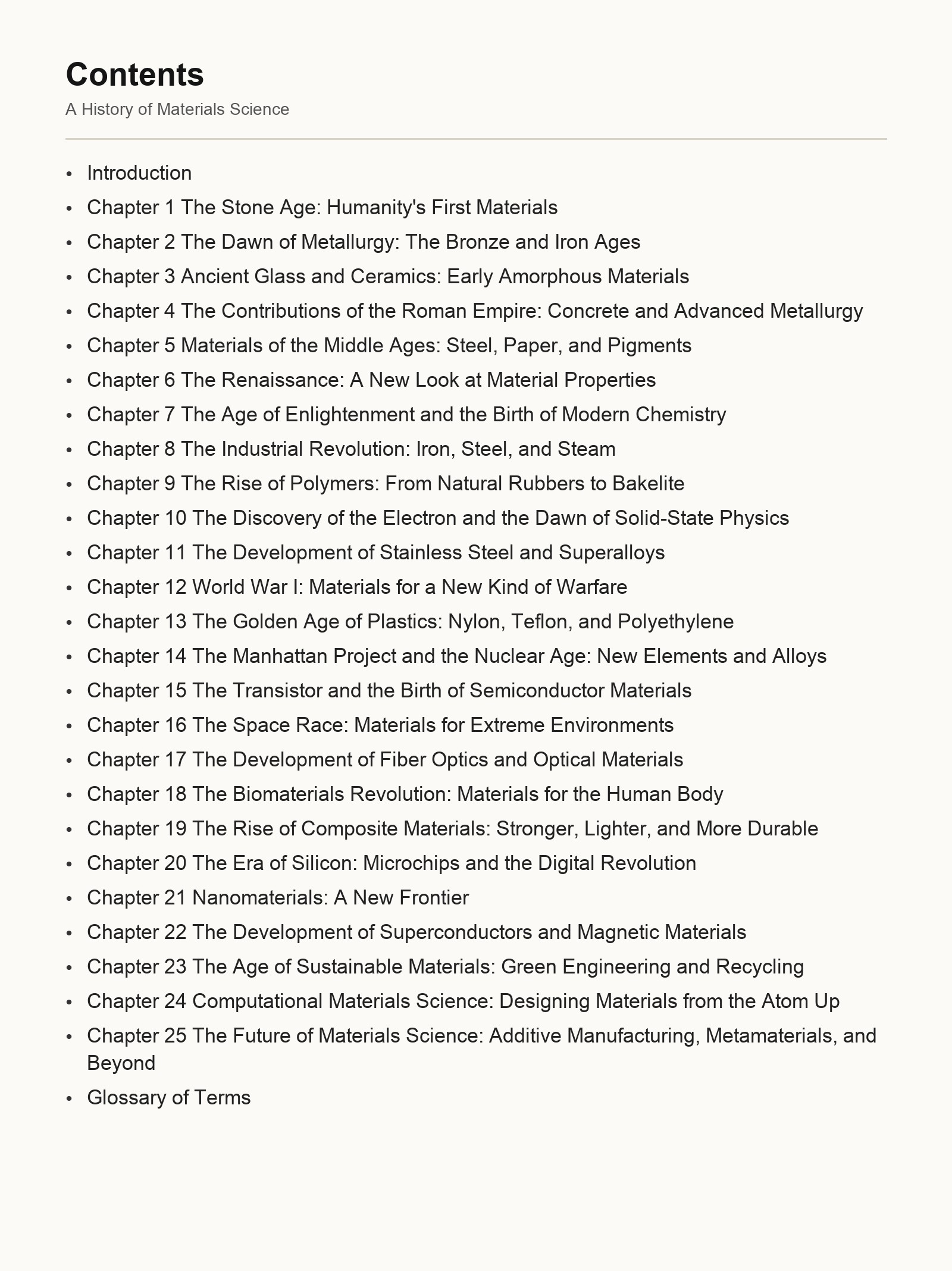
- Introduction
- Chapter 1 The Stone Age: Humanity's First Materials
- Chapter 2 The Dawn of Metallurgy: The Bronze and Iron Ages
- Chapter 3 Ancient Glass and Ceramics: Early Amorphous Materials
- Chapter 4 The Contributions of the Roman Empire: Concrete and Advanced Metallurgy
- Chapter 5 Materials of the Middle Ages: Steel, Paper, and Pigments
- Chapter 6 The Renaissance: A New Look at Material Properties
- Chapter 7 The Age of Enlightenment and the Birth of Modern Chemistry
- Chapter 8 The Industrial Revolution: Iron, Steel, and Steam
- Chapter 9 The Rise of Polymers: From Natural Rubbers to Bakelite
- Chapter 10 The Discovery of the Electron and the Dawn of Solid-State Physics
- Chapter 11 The Development of Stainless Steel and Superalloys
- Chapter 12 World War I: Materials for a New Kind of Warfare
- Chapter 13 The Golden Age of Plastics: Nylon, Teflon, and Polyethylene
- Chapter 14 The Manhattan Project and the Nuclear Age: New Elements and Alloys
- Chapter 15 The Transistor and the Birth of Semiconductor Materials
- Chapter 16 The Space Race: Materials for Extreme Environments
- Chapter 17 The Development of Fiber Optics and Optical Materials
- Chapter 18 The Biomaterials Revolution: Materials for the Human Body
- Chapter 19 The Rise of Composite Materials: Stronger, Lighter, and More Durable
- Chapter 20 The Era of Silicon: Microchips and the Digital Revolution
- Chapter 21 Nanomaterials: A New Frontier
- Chapter 22 The Development of Superconductors and Magnetic Materials
- Chapter 23 The Age of Sustainable Materials: Green Engineering and Recycling
- Chapter 24 Computational Materials Science: Designing Materials from the Atom Up
- Chapter 25 The Future of Materials Science: Additive Manufacturing, Metamaterials, and Beyond
- Glossary of Terms
Author:
Published By:
Date Published:
May 25, 2026
Type:
Nonfiction
Language:
English
Word Count:
61,347 words
Reading Time:
4 hours 18 minutes
Sample:
Order:
Order A History of Materials Science (Hardcover) on MixCache.com:
Buy NowPrint copy is made to order and ships worldwide. Includes the ebook free, ready to read instantly.
$5 account credit for all new MixCache.com accounts, usable toward any ebook purchase!*


