
Browse by Category
Fiction
- Action & Adventure
- African American
- Anthologies
- Children's Fiction
- Classics
- Comics & Graphic Novels
- Coming of Age
- Contemporary
- Cultural & Regional
- Drama
- Erotica
- Fantasy
- General
- Historical Fiction
- Horror
- Humor & Satire
- Literary Fiction
- Mystery, Thriller & Suspense
- Poetry
- Religious & Inspirational
- Romance
- Science Fiction
- Short Stories
- War & Military
- Westerns
- Women's Fiction
- Young Adult
Non-Fiction
- Antiques & Collectibles
- Arts & Photography
- Biographies & Memoirs
- Business & Money
- Children's Non-Fiction
-
Computers & Technology
- Artificial Intelligence
- Computer Science
- Cybersecurity & Cryptography
- Data Science & Analytics
- Databases & Big Data
- Game Development & Design
- General
- Hardware & DIY
- Mobile App Development
- Networking & Cloud Computing
- Operating Systems
- Programming
- Robotics
- Software
- Software Engineering
- User Experience (UX) & Design
- Web Development & Design
- Cooking, Food & Wine
- Crafts, Hobbies & Home
- Education & Teaching
- Engineering
- General
- Health, Fitness & Dieting
-
History
- African History
- African History - North Africa
- African History - Sub-Saharan Africa
- American History
- American History - 20th Century
- American History - Civil War
- American History - Colonial Period
- Ancient History
- Asian History
- Asian History - China
- Asian History - India
- Asian History - Japan
- Asian History - Southeast Asia
- European History
- European History - Ancient Greece
- European History - Ancient Rome
- European History - Medieval
- European History - Modern
- European History - Renaissance
- General
- Middle Eastern History
- Military History
- Military History - Aviation
- Military History - Naval
- Social & Cultural History
- World History
- Humor & Entertainment
- Industrial Technology
- Language Learning
- Law
- LGBTQ+ Non-Fiction
- Literary Criticism
- Medical Books
- Parenting & Relationships
- Philosophy
- Politics & Social Sciences
- Reference
- Religion & Spirituality
-
Science & Math
- Agricultural Sciences
- Astronomy & Space Science
- Behavioral Sciences
- Biological Sciences
- Botany & Plant Science
- Chemistry
- Earth Sciences
- Engineering - Chemical
- Engineering - Civil
- Engineering - Electrical
- Engineering - Mechanical
- Environment
- General
- Geology
- Mathematics
- Nature & Ecology
- Oceanography
- Paleontology
- Physics
- Statistics
- Self-Help
- Sports & Outdoors
- Study Aids
- Sustainability & Green Living
- Textbooks
- Transportation
- Travel
- True Crime
- Urban Planning & Development
- Veterinary Medicine
- Writing & Publishing
Jump to Section
MixCache.com Total Access
Unlimited reading and audiobooks for every book published by MixCache.com.
Included titles carry the MTA badge.
Learn more →A History of the Sea
About this book:
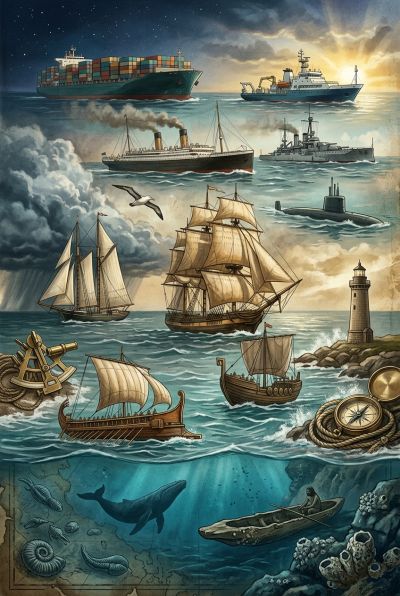
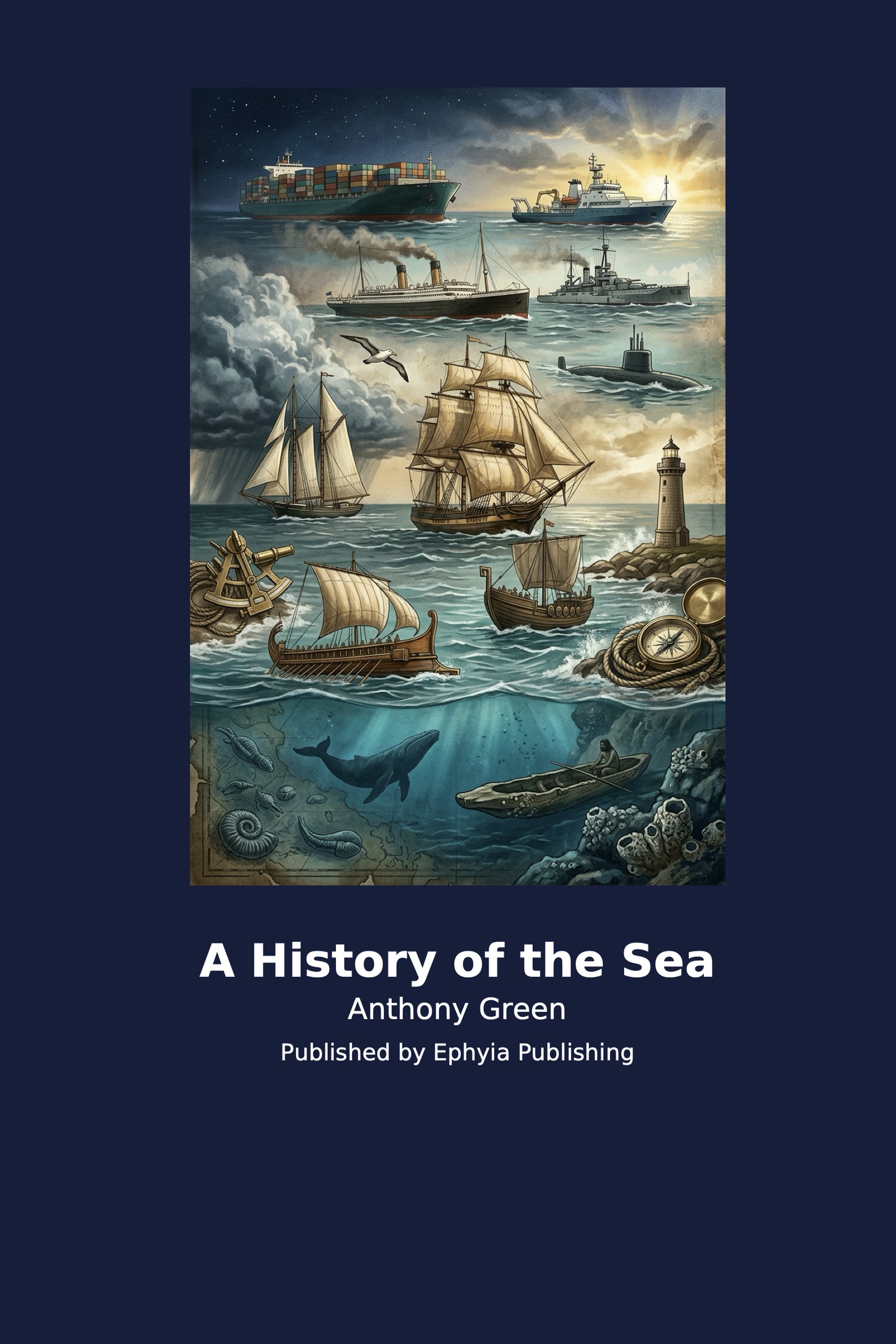
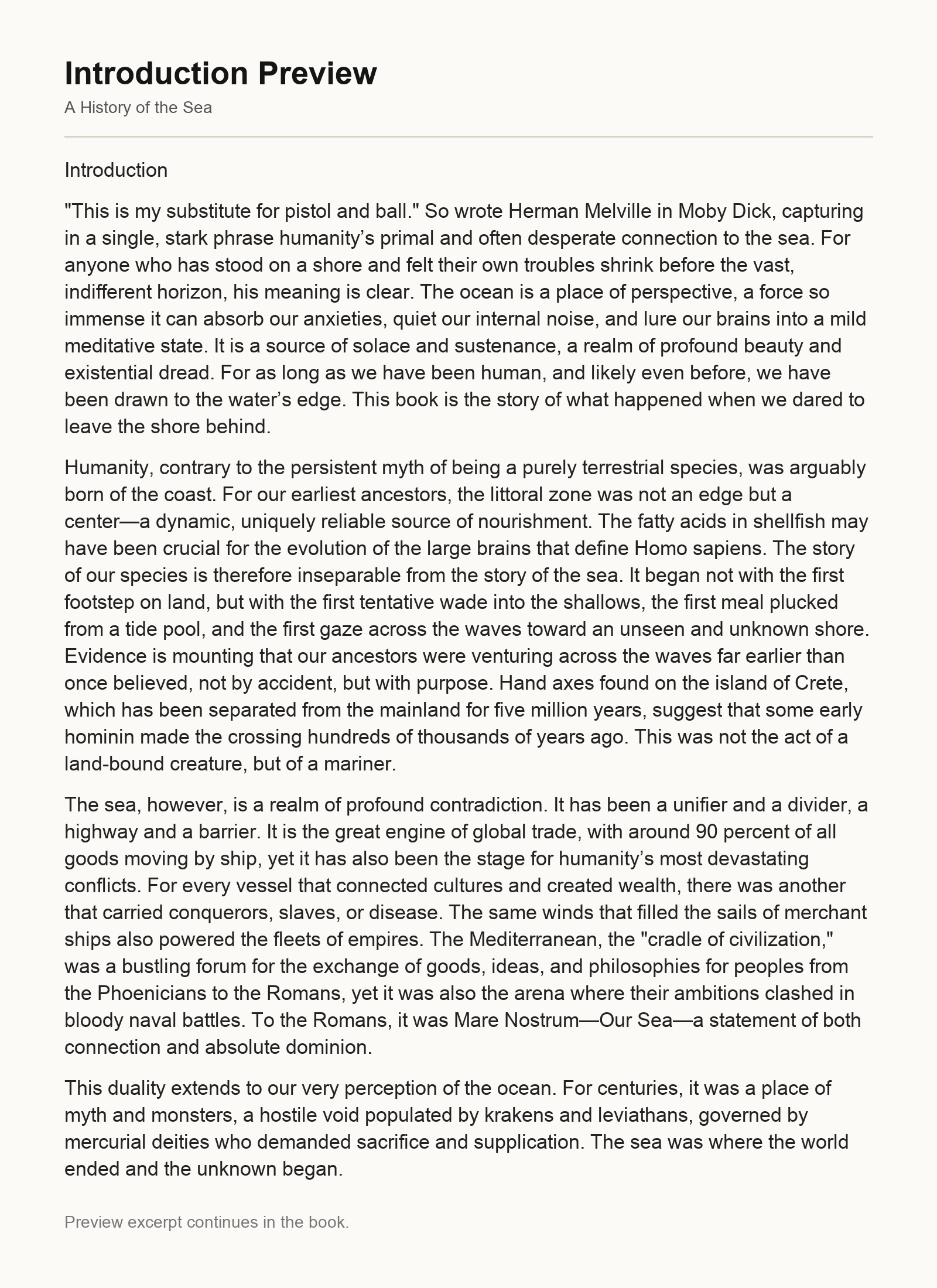
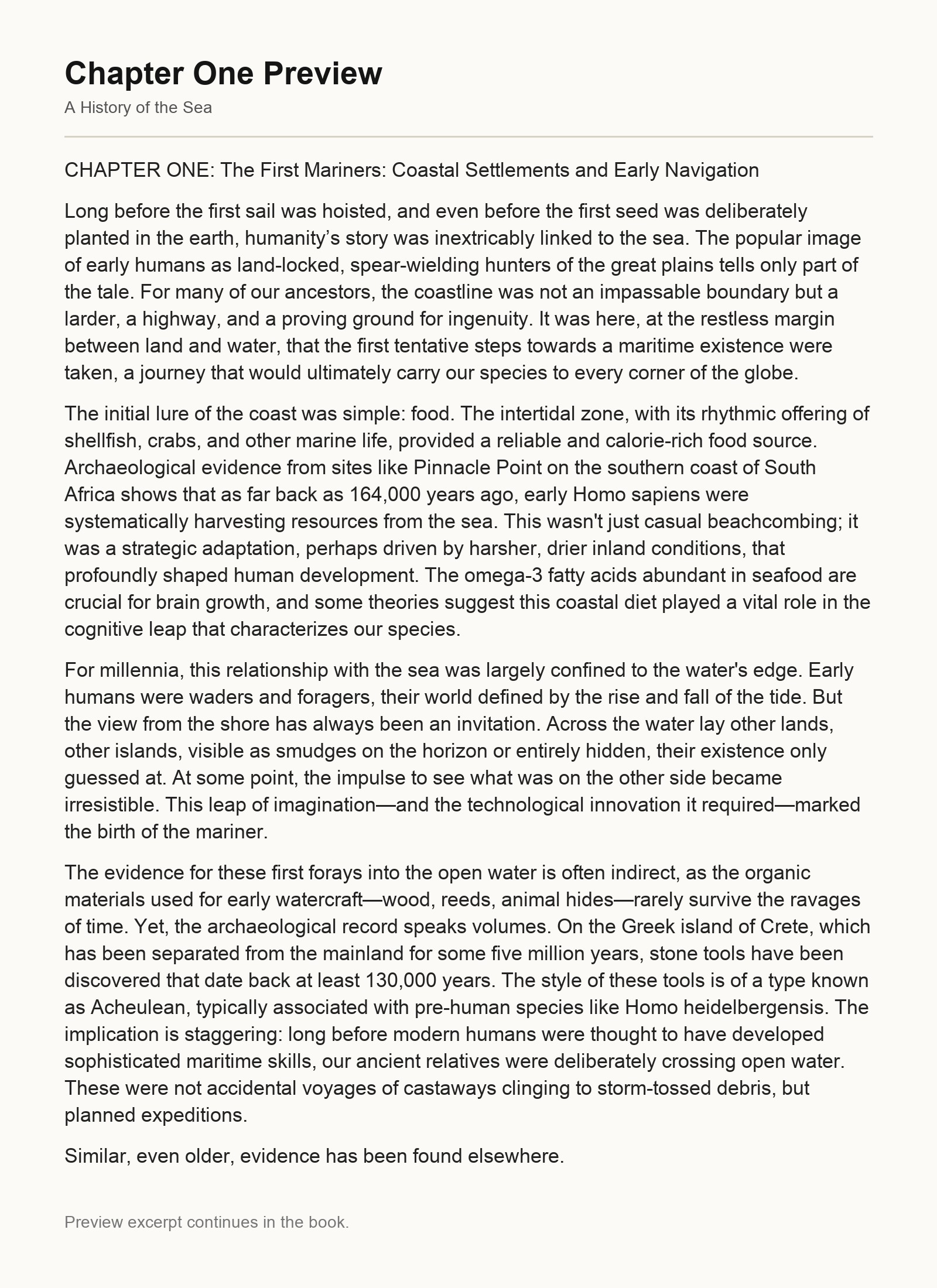
From the first tentative wade into shallow waters to the nuclear-powered vessels that patrol the depths today, humanity's story has always been intertwined with the sea. "A History of the Sea" by Anthony Green offers readers a sweeping, deeply researched journey through this relationship, revealing how the ocean has not merely been a backdrop to human history but a driving force behind our greatest achievements, darkest tragedies, and most profound transformations. This is not a narrow naval chronicle but a comprehensive exploration of how seafaring has shaped civilizations, economies, cultures, and the very course of our species.
Readers will voyage through time with the earliest mariners who crossed open water millennia before historians once believed possible, following the coastal migrations that peopled Australia and the Americas. They'll walk the bustling quays of ancient Egyptian and Mesopotamian ports, sail with the Minoan thalassocracy and Phoenician merchants who spread the alphabet across the Mediterranean, and ride the monsoon winds that fueled a thousand years of Indian Ocean trade connecting Africa, Arabia, India, and Southeast Asia. The book brings to life the daring Polynesian navigators who settled the vast Pacific using only stars and waves, the Viking longship crews who reached North America centuries before Columbus, and the monumental Chinese Treasure Fleets of the Ming Dynasty that projected power from East Africa to the Spice Islands.
The narrative then turns to the eras that forged our modern world: the Age of Discovery that stitched together isolated maritime spheres and triggered the Columbian Exchange, the fierce competition for spices that saw Portuguese and Dutch empires rise through naval force and monopolistic control, and the centuries-long arms race that transformed wooden walls of oak into ironclads and dreadnoughts. Readers will experience the brutal realities of the transatlantic slave trade, the scientific voyages of Cook and Bougainville that began to chart the planet in earnest, and the revolutionary shift from sail to steam that made global trade predictable and predictable. The book details how World War I and II redefined naval power—from the clash of dreadnoughts at Jutland to the aircraft carrier dominance in the Pacific—and how a simple steel shipping container ultimately revolutionized the global economy in ways few could have imagined.
In confronting the present, the book does not shy from the sea's most pressing challenges. Readers will gain insight into the silent warfare of Cold War nuclear submarines, the ongoing struggle to govern the oceans through the Law of the Sea Convention, and the industrial-scale exploitation that has devastated fish stocks and damaged fragile ecosystems. They'll understand how climate change is altering the ocean's fundamental chemistry—warming its waters, raising its levels, and increasing its acidity—with consequences that threaten coastal communities worldwide. The narrative extends to the twenty-first century, examining new geopolitical flashpoints in the thawing Arctic and the contested South China Sea, alongside emerging efforts to protect the high seas through marine protected areas and international treaties.
Above all, this is a human history. Readers will encounter the individuals whose lives were defined by the ocean: the nameless millions who toiled on fishing boats and slave ships, the explorers who pushed beyond known horizons, the naval architects who sought an edge in unending technological races, the pirates who created renegade societies on the high seas, and the scientists who first began to comprehend the ocean's vast complexity. By weaving together threads of commerce, conflict, exploration, and cultural exchange, "A History of the Sea" reveals how our relationship with the blue heart of our planet has always been, and remains, the story of us—marked by profound connection, relentless ingenuity, and an enduring struggle to balance ambition with stewardship in the face of an ocean that is both our greatest resource and our most vital responsibility.
What You'll Find Inside:
- The evolution of human seafaring from early coastal settlements and dugout canoes to nuclear-powered vessels and global container shipping
- How the sea served as both unifier and divider throughout history - enabling trade and cultural exchange while also facilitating conflict, conquest, and exploitation
- Key technological innovations that transformed maritime capabilities including celestial navigation, steam power, and the shipping container
- Major historical turning points shaped by the ocean including the Columbian Exchange, Age of Discovery, and naval conflicts of the World Wars
- Contemporary challenges facing the oceans including climate change, overfishing, pollution, and 21st century geopolitical tensions
Who's It For:
This book is ideal for general readers with an interest in world history, maritime affairs, or environmental studies who want to understand how the ocean has shaped human civilization from ancient times to the present. It will particularly appeal to those seeking a comprehensive yet accessible narrative that connects technological, economic, and cultural developments across centuries of seafaring history.
Table of Contents:
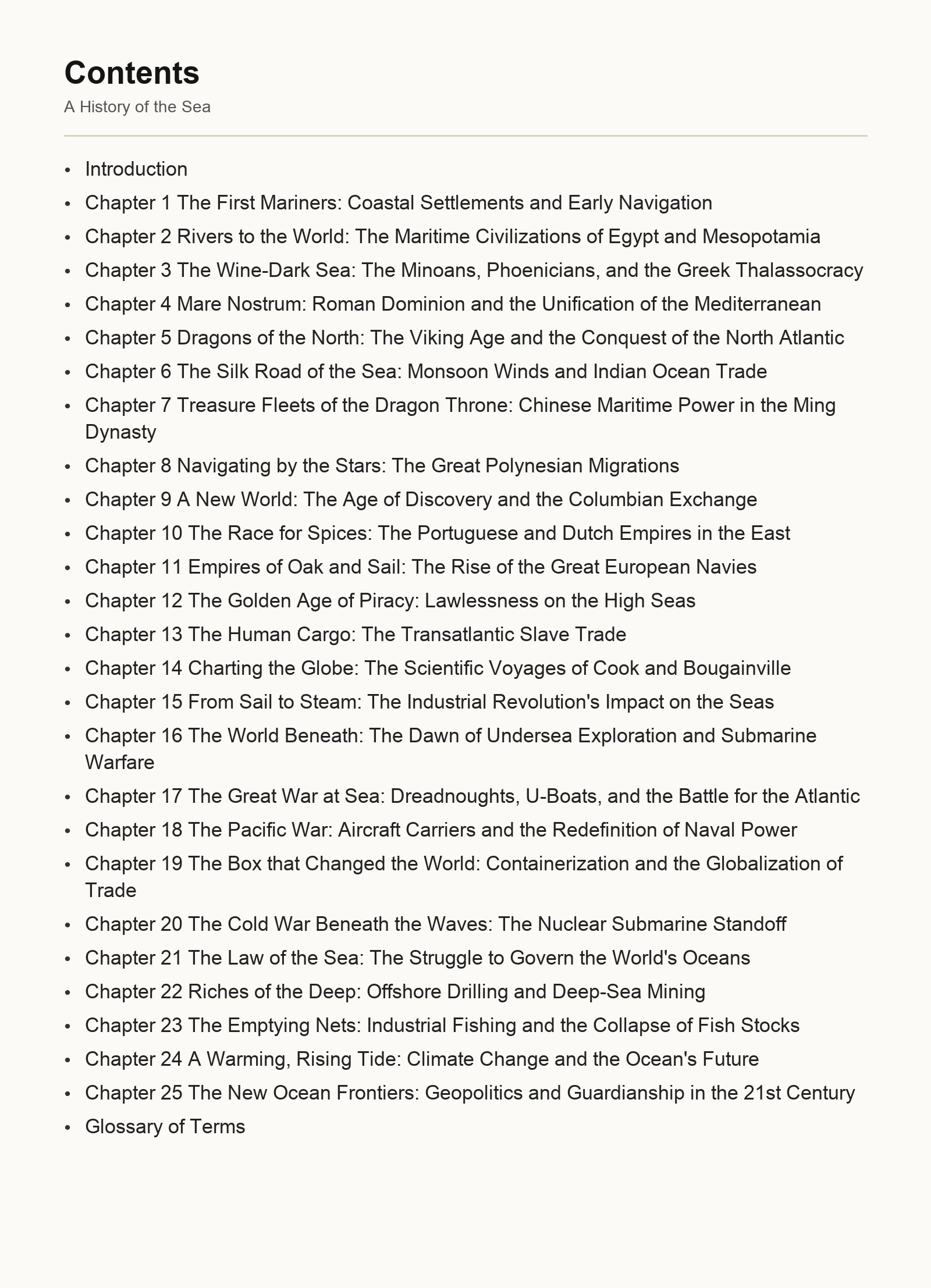
- Introduction
- Chapter 1 The First Mariners: Coastal Settlements and Early Navigation
- Chapter 2 Rivers to the World: The Maritime Civilizations of Egypt and Mesopotamia
- Chapter 3 The Wine-Dark Sea: The Minoans, Phoenicians, and the Greek Thalassocracy
- Chapter 4 Mare Nostrum: Roman Dominion and the Unification of the Mediterranean
- Chapter 5 Dragons of the North: The Viking Age and the Conquest of the North Atlantic
- Chapter 6 The Silk Road of the Sea: Monsoon Winds and Indian Ocean Trade
- Chapter 7 Treasure Fleets of the Dragon Throne: Chinese Maritime Power in the Ming Dynasty
- Chapter 8 Navigating by the Stars: The Great Polynesian Migrations
- Chapter 9 A New World: The Age of Discovery and the Columbian Exchange
- Chapter 10 The Race for Spices: The Portuguese and Dutch Empires in the East
- Chapter 11 Empires of Oak and Sail: The Rise of the Great European Navies
- Chapter 12 The Golden Age of Piracy: Lawlessness on the High Seas
- Chapter 13 The Human Cargo: The Transatlantic Slave Trade
- Chapter 14 Charting the Globe: The Scientific Voyages of Cook and Bougainville
- Chapter 15 From Sail to Steam: The Industrial Revolution's Impact on the Seas
- Chapter 16 The World Beneath: The Dawn of Undersea Exploration and Submarine Warfare
- Chapter 17 The Great War at Sea: Dreadnoughts, U-Boats, and the Battle for the Atlantic
- Chapter 18 The Pacific War: Aircraft Carriers and the Redefinition of Naval Power
- Chapter 19 The Box that Changed the World: Containerization and the Globalization of Trade
- Chapter 20 The Cold War Beneath the Waves: The Nuclear Submarine Standoff
- Chapter 21 The Law of the Sea: The Struggle to Govern the World's Oceans
- Chapter 22 Riches of the Deep: Offshore Drilling and Deep-Sea Mining
- Chapter 23 The Emptying Nets: Industrial Fishing and the Collapse of Fish Stocks
- Chapter 24 A Warming, Rising Tide: Climate Change and the Ocean's Future
- Chapter 25 The New Ocean Frontiers: Geopolitics and Guardianship in the 21st Century
- Glossary of Terms
Author:
Published By:
Date Published:
May 25, 2026
Type:
Nonfiction
Language:
English
Also Available In:
Word Count:
54,389 words
Reading Time:
3 hours 49 minutes
Sample:
Order:
Order A History of the Sea (Hardcover) on MixCache.com:
Buy NowPrint copy is made to order and ships worldwide. Includes the ebook free, ready to read instantly.
$5 account credit for all new MixCache.com accounts, usable toward any ebook purchase!*

 Includes Audiobook


