
Browse by Category
Fiction
- Action & Adventure
- African American
- Anthologies
- Children's Fiction
- Classics
- Comics & Graphic Novels
- Coming of Age
- Contemporary
- Cultural & Regional
- Drama
- Erotica
- Fantasy
- General
- Historical Fiction
- Horror
- Humor & Satire
- Literary Fiction
- Mystery, Thriller & Suspense
- Poetry
- Religious & Inspirational
- Romance
- Science Fiction
- Short Stories
- War & Military
- Westerns
- Women's Fiction
- Young Adult
Non-Fiction
- Antiques & Collectibles
- Arts & Photography
- Biographies & Memoirs
- Business & Money
- Children's Non-Fiction
-
Computers & Technology
- Artificial Intelligence
- Computer Science
- Cybersecurity & Cryptography
- Data Science & Analytics
- Databases & Big Data
- Game Development & Design
- General
- Hardware & DIY
- Mobile App Development
- Networking & Cloud Computing
- Operating Systems
- Programming
- Robotics
- Software
- Software Engineering
- User Experience (UX) & Design
- Web Development & Design
- Cooking, Food & Wine
- Crafts, Hobbies & Home
- Education & Teaching
- Engineering
- General
- Health, Fitness & Dieting
-
History
- African History
- African History - North Africa
- African History - Sub-Saharan Africa
- American History
- American History - 20th Century
- American History - Civil War
- American History - Colonial Period
- Ancient History
- Asian History
- Asian History - China
- Asian History - India
- Asian History - Japan
- Asian History - Southeast Asia
- European History
- European History - Ancient Greece
- European History - Ancient Rome
- European History - Medieval
- European History - Modern
- European History - Renaissance
- General
- Middle Eastern History
- Military History
- Military History - Aviation
- Military History - Naval
- Social & Cultural History
- World History
- Humor & Entertainment
- Industrial Technology
- Language Learning
- Law
- LGBTQ+ Non-Fiction
- Literary Criticism
- Medical Books
- Parenting & Relationships
- Philosophy
- Politics & Social Sciences
- Reference
- Religion & Spirituality
-
Science & Math
- Agricultural Sciences
- Astronomy & Space Science
- Behavioral Sciences
- Biological Sciences
- Botany & Plant Science
- Chemistry
- Earth Sciences
- Engineering - Chemical
- Engineering - Civil
- Engineering - Electrical
- Engineering - Mechanical
- Environment
- General
- Geology
- Mathematics
- Nature & Ecology
- Oceanography
- Paleontology
- Physics
- Statistics
- Self-Help
- Sports & Outdoors
- Study Aids
- Sustainability & Green Living
- Textbooks
- Transportation
- Travel
- True Crime
- Urban Planning & Development
- Veterinary Medicine
- Writing & Publishing
Jump to Section
MixCache.com Total Access
Unlimited reading and audiobooks for every book published by MixCache.com.
Included titles carry the MTA badge.
Learn more →A History of Benin
About this book:
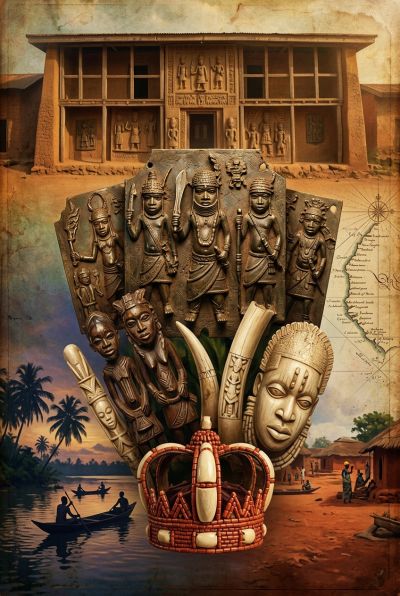
A History of Benin invites readers on a sweeping journey through the forces that have shaped one of West Africa’s most intriguing nations. From the early Gbe‑speaking migrations and the rival kingdoms of Allada and Whydah, to the violent birth of the Fon people on the Abomey plateau, the book traces how a small inland state evolved into a militaristic empire that dominated the Slave Coast for centuries. Readers will encounter the vivid legends that founded Dahomey, the ingenious administrative systems that turned every citizen into a soldier, and the cultural symbols that still echo in Benin today.
The narrative delves deep into the inner workings of pre‑colonial Dahomey society, revealing a highly centralized bureaucracy, the dual male‑female power structure of the king and the Kpojito, and the rigid social hierarchy that placed the king at the apex of both spiritual and temporal authority. It explores the rise of the legendary Dahomey Amazons, their training, battlefield tactics, and their dual role as royal protectors and agents of the slave trade. Readers will also discover the artistic legacy of the kingdom—bas‑reliefs, iron statues, textiles, and the Vodun religion—that served as both propaganda and a living archive of the Fon worldview.
As the story moves into the nineteenth century, the book examines how Dahomey’s reliance on the transatlantic slave trade created a gun‑slave cycle that fueled endless warfare, and how the kingdom’s confrontation with European powers culminated in the Franco‑Dahomean Wars. It details King Béhanzin’s fierce resistance, the burning of Abomey, and the eventual establishment of the French Colony of Dahomey, showing how colonial rule re‑drew borders, imposed forced labor, and introduced new economic and religious dynamics that still influence the nation.
The latter chapters chart the turbulent path to independence, the early years of coups and regional rivalry, and the dramatic shift to Marxist‑Leninist rule under Mathieu Kérékou. Readers will experience the internal contradictions of that era, the failed mercenary coup of 1977, and the economic collapse that led to the historic National Conference of 1990—a peaceful, civilian‑led transition that dismantled dictatorship without a single shot. The book follows the subsequent democratic experiments, the peaceful transfers of power, and the recent challenges of democratic backsliding, offering a nuanced view of Benin’s political evolution.
By the end of the volume, readers will have gained a comprehensive understanding of how pre‑colonial statecraft, the trauma of the slave trade, colonial exploitation, ideological experiments, and popular movements have intertwined to forge modern Benin. They will appreciate the nation’s cultural resilience—from the enduring Vodun traditions and the return of looted royal artifacts to the lively festivals and contemporary struggles—providing a compelling case study of how a small African nation continues to negotiate its past while shaping its future on the continent.
What You'll Find Inside:
- Early kingdoms and Fon society formation: Traces pre-colonial societies including Allada, Whydah, and the Bariba kingdoms, detailing the Aja migrations, the schism in Allada's royal family, and the founding of Dahomey on the Abomey plateau through the fusion of Aja settlers and Gedevi people.
- Dahomey's militaristic state and the Amazons: Examines the kingdom's centralized bureaucracy, annual customs (Xwetanu), and the elite female warrior corps known as the Dahomey Amazons (Mino), covering their origins, training, battlefield roles, and cultural significance as both royal protectors and instruments of conquest.
- Transatlantic slave trade and economic transformation: Analyzes Dahomey's role as a major slave trade supplier, the gun-slave cycle linking captive acquisition to firearms imports, the function of ports like Ouidah under the Yovogan official, and the eventual shift to palm oil trade under British abolition pressure.
- French colonial conquest and administration: Details the Franco-Dahomean Wars, King Béhanzin's resistance, the establishment of the French colony with its extractive economy (head tax, forced labor, railway construction), and the imposition of French legal and administrative systems that reshaped society and geography.
- Post-independence trajectory: Chronicles independence in 1960, the tumultuous first decade of coups, Mathieu Kérékou's rise and Marxist-Leninist era, the 1990 National Conference democratic transition, and Benin's 21st-century challenges including economic dependence, political stability, and democratic backsliding under President Talon.
Who's It For:
This book is ideal for students and scholars of African history, particularly those focusing on West Africa, colonialism, and post-colonial transitions. It offers valuable insights for readers interested in military history (including the Dahomey Amazons), the economics of the slave trade, and unique political experiments like Benin's Marxist-Leninist period and pioneering democratic transition via the 1990 National Conference. General readers seeking to understand Benin's complex historical journey from pre-colonial kingdoms to modern challenges will also find it accessible and informative.
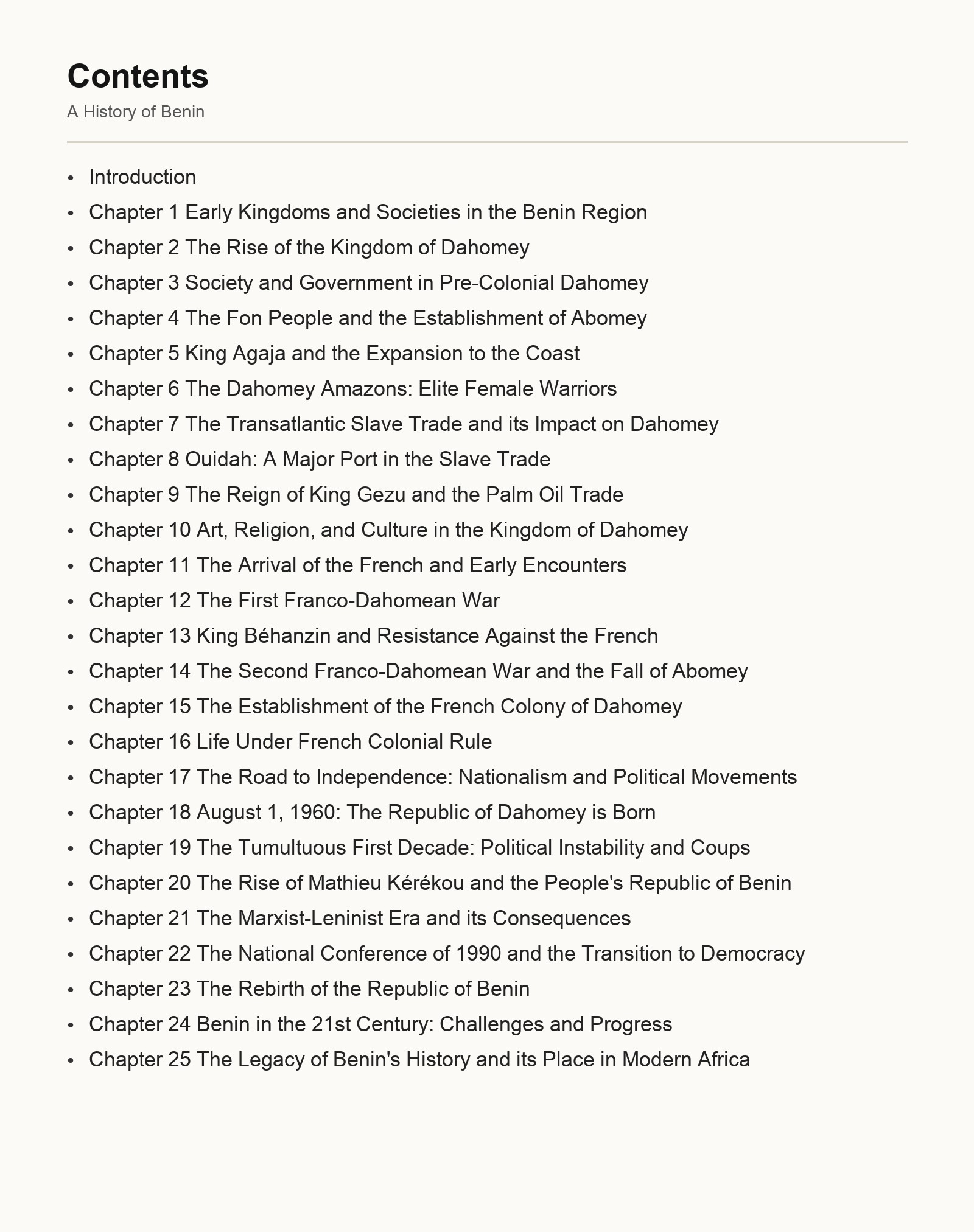
Table of Contents:
- Introduction
- Chapter 1 Early Kingdoms and Societies in the Benin Region
- Chapter 2 The Rise of the Kingdom of Dahomey
- Chapter 3 Society and Government in Pre-Colonial Dahomey
- Chapter 4 The Fon People and the Establishment of Abomey
- Chapter 5 King Agaja and the Expansion to the Coast
- Chapter 6 The Dahomey Amazons: Elite Female Warriors
- Chapter 7 The Transatlantic Slave Trade and its Impact on Dahomey
- Chapter 8 Ouidah: A Major Port in the Slave Trade
- Chapter 9 The Reign of King Gezu and the Palm Oil Trade
- Chapter 10 Art, Religion, and Culture in the Kingdom of Dahomey
- Chapter 11 The Arrival of the French and Early Encounters
- Chapter 12 The First Franco-Dahomean War
- Chapter 13 King Béhanzin and Resistance Against the French
- Chapter 14 The Second Franco-Dahomean War and the Fall of Abomey
- Chapter 15 The Establishment of the French Colony of Dahomey.
- Chapter 16 Life Under French Colonial Rule
- Chapter 17 The Road to Independence: Nationalism and Political Movements
- Chapter 18 August 1, 1960: The Republic of Dahomey is Born.
- Chapter 19 The Tumultuous First Decade: Political Instability and Coups.
- Chapter 20 The Rise of Mathieu Kérékou and the People's Republic of Benin
- Chapter 21 The Marxist-Leninist Era and its Consequences
- Chapter 22 The National Conference of 1990 and the Transition to Democracy
- Chapter 23 The Rebirth of the Republic of Benin.
- Chapter 24 Benin in the 21st Century: Challenges and Progress
- Chapter 25 The Legacy of Benin's History and its Place in Modern Africa
Author:
Published By:
Date Published:
May 25, 2026
Type:
Nonfiction
Language:
English
Also Available In:
Word Count:
38,552 words
Reading Time:
2 hours 42 minutes
Sample:
Order:
Buy the A History of Benin ebook on MixCache.com:
Buy NowThe full ebook will be available immediately to read instantly on any device.
$5 account credit for all new MixCache.com accounts, usable toward any ebook purchase!*


Ratings & Reviews
Ask Questions About This Book
Have a question about the content? Ask our AI assistant!
Start by asking a question about "A History of Benin"
Example: "Does this book mention William Shakespeare?"
Thinking...