Browse by Category
Fiction
- Action & Adventure
- African American
- Anthologies
- Children's Fiction
- Classics
- Comics & Graphic Novels
- Coming of Age
- Contemporary
- Cultural & Regional
- Drama
- Erotica
- Fantasy
- General
- Historical Fiction
- Horror
- Humor & Satire
- Literary Fiction
- Mystery, Thriller & Suspense
- Poetry
- Religious & Inspirational
- Romance
- Science Fiction
- Short Stories
- War & Military
- Westerns
- Women's Fiction
- Young Adult
Non-Fiction
- Antiques & Collectibles
- Arts & Photography
- Biographies & Memoirs
- Business & Money
- Children's Non-Fiction
-
Computers & Technology
- Artificial Intelligence
- Computer Science
- Cybersecurity & Cryptography
- Data Science & Analytics
- Databases & Big Data
- Game Development & Design
- General
- Hardware & DIY
- Mobile App Development
- Networking & Cloud Computing
- Operating Systems
- Programming
- Robotics
- Software
- Software Engineering
- User Experience (UX) & Design
- Web Development & Design
- Cooking, Food & Wine
- Crafts, Hobbies & Home
- Education & Teaching
- Engineering
- General
- Health, Fitness & Dieting
-
History
- African History
- African History - North Africa
- African History - Sub-Saharan Africa
- American History
- American History - 20th Century
- American History - Civil War
- American History - Colonial Period
- Ancient History
- Asian History
- Asian History - China
- Asian History - India
- Asian History - Japan
- Asian History - Southeast Asia
- European History
- European History - Ancient Greece
- European History - Ancient Rome
- European History - Medieval
- European History - Modern
- European History - Renaissance
- General
- Middle Eastern History
- Military History
- Military History - Aviation
- Military History - Naval
- Social & Cultural History
- World History
- Humor & Entertainment
- Industrial Technology
- Language Learning
- Law
- LGBTQ+ Non-Fiction
- Literary Criticism
- Medical Books
- Parenting & Relationships
- Philosophy
- Politics & Social Sciences
- Reference
- Religion & Spirituality
-
Science & Math
- Agricultural Sciences
- Astronomy & Space Science
- Behavioral Sciences
- Biological Sciences
- Botany & Plant Science
- Chemistry
- Earth Sciences
- Engineering - Chemical
- Engineering - Civil
- Engineering - Electrical
- Engineering - Mechanical
- Environment
- General
- Geology
- Mathematics
- Nature & Ecology
- Oceanography
- Paleontology
- Physics
- Statistics
- Self-Help
- Sports & Outdoors
- Study Aids
- Sustainability & Green Living
- Textbooks
- Transportation
- Travel
- True Crime
- Urban Planning & Development
- Veterinary Medicine
- Writing & Publishing
Jump to Section
MixCache.com Total Access
Unlimited reading and audiobooks for every book published by MixCache.com.
Included titles carry the MTA badge.
Learn more →
Lunacy
A chronicle of society's treatment of the mentally ill through the ages
About this book:



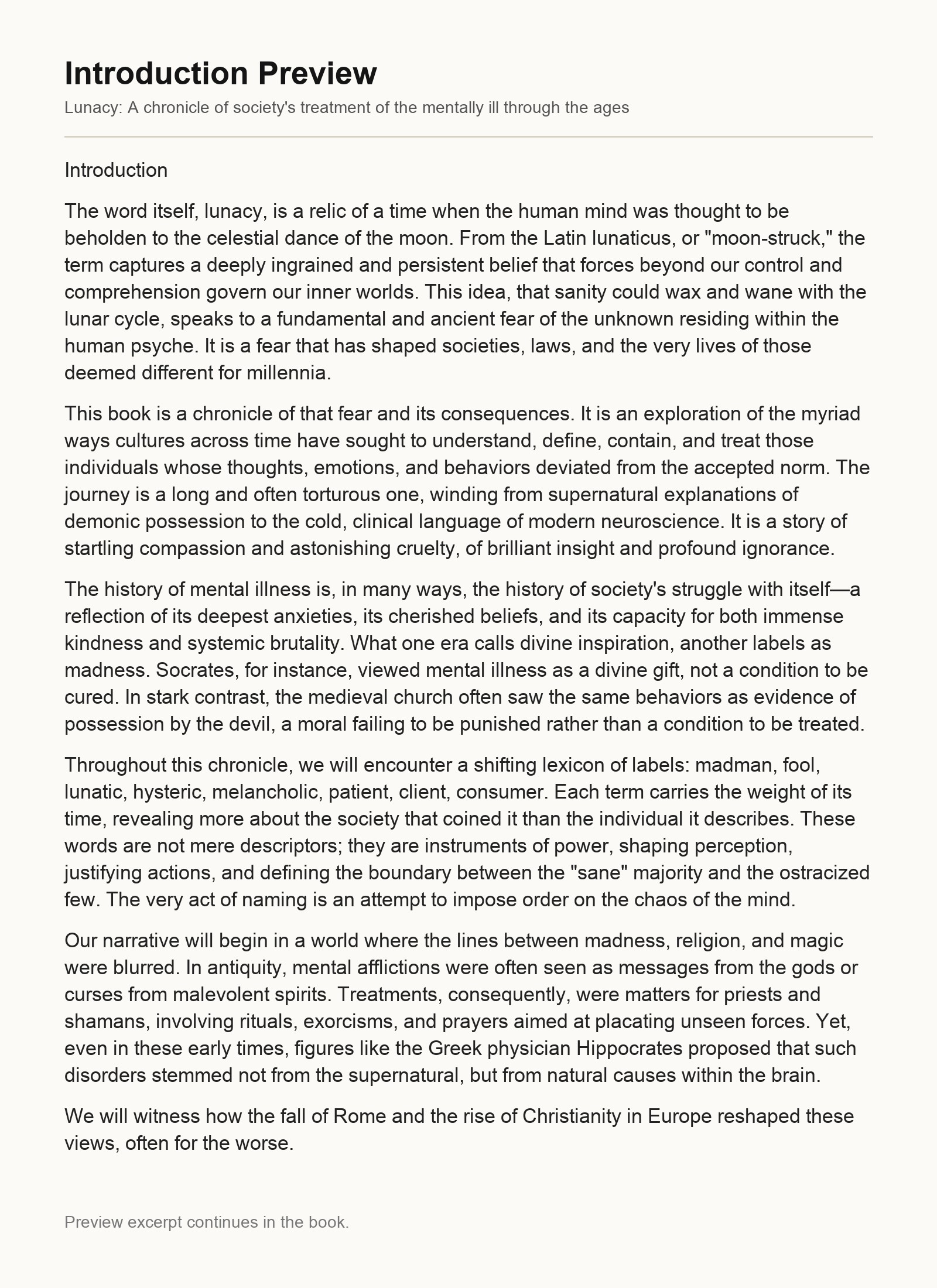
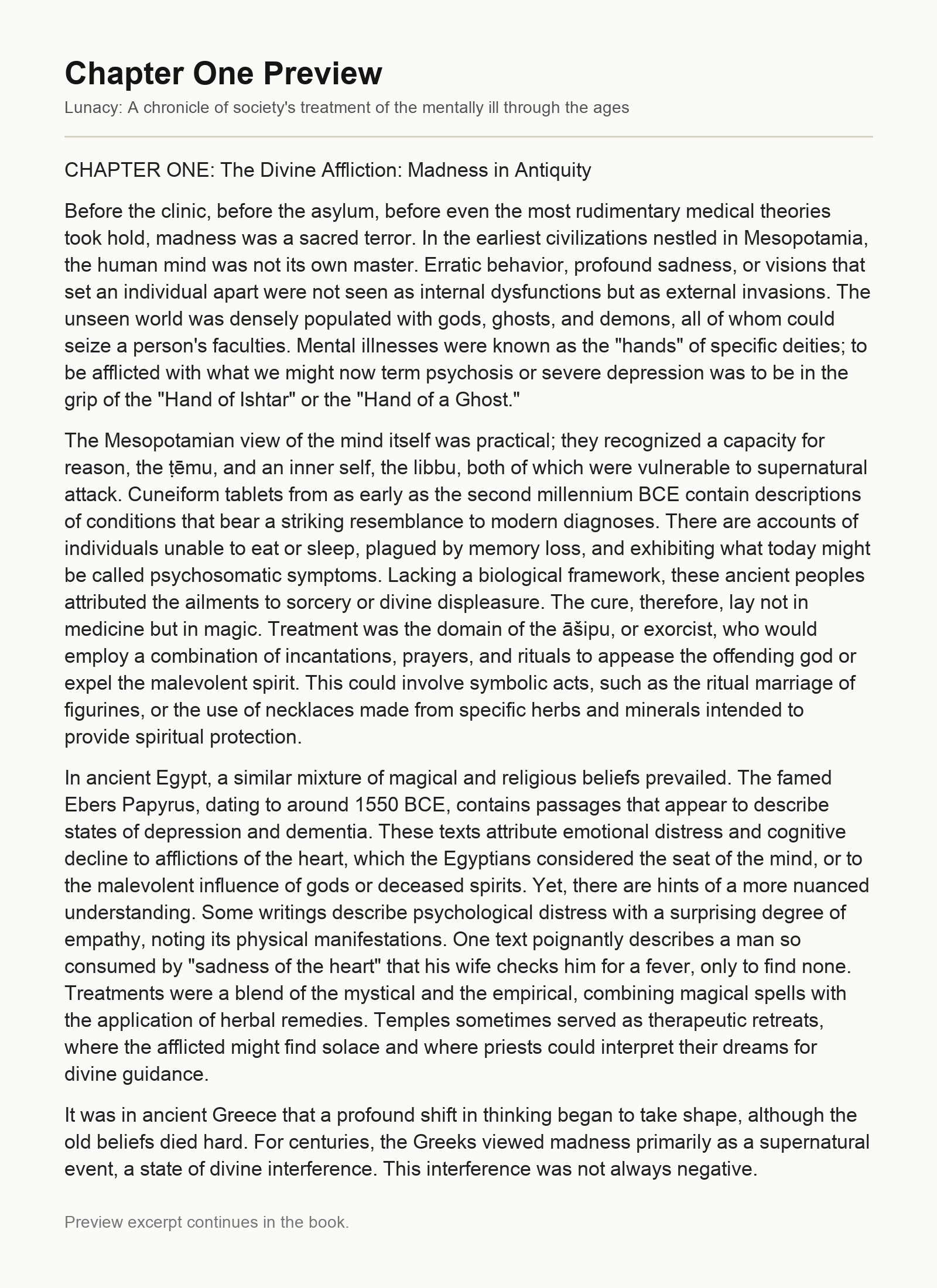
Lunacy takes readers on a sweeping journey through humanity’s attempts to understand, contain, and treat those whose minds diverge from the norm. Beginning with ancient beliefs that madness was a divine gift or demonic curse, the book shows how early physicians like Hippocrates began to seek natural explanations, laying the groundwork for a medical view of the mind that would endure for centuries. Each chapter uncovers a different era’s theories and practices—from the humoral balances of Greece and Rome, through the fear‑filled exorcisms and chains of the Middle Ages, to the rise of the asylum as both a refuge and a spectacle of horror.
Readers will witness the shifting tides of compassion and cruelty, encountering the brief but influential moral‑treatment movement that championed kindness over restraint, and then the darker turn toward scientific classification that gave rise to eugenics, forced sterilizations, and the tragic legacy of programs like Buck v. Bell. The narrative follows the profound impact of war on the psyche, the revolutionary but controversial arrival of psychoanalysis, and the desperate, often devastating, search for physical cures—from insulin coma therapy and metrazol shocks to the infamous lobotomy that promised peace at the cost of personality.
The story continues into the chemical revolution that transformed asylums with antipsychotics and antidepressants, ushering in the era of deinstitutionalization and its unintended consequences: homelessness, the revolving door of crisis, and the emergence of jails as the new de facto mental health institutions. Chapters on stigma, advocacy, and the growing crisis among children and adolescents reveal how social attitudes, legal battles, and grassroots movements have fought for rights, resources, and a more humane approach to care. Global perspectives broaden the view, showing how diverse cultures experience and treat mental distress, from traditional healing rituals to the challenges of delivering services in low‑resource settings.
Finally, Lunacy looks toward the future, exploring cutting‑edge developments in neuroscience, personalized medicine, digital phenotyping, and integrated mind‑body therapies, while confronting the ethical dilemmas these advances raise. Readers will finish with a deep understanding of how society’s fears, hopes, and failures have shaped the treatment of mental illness, and they will be equipped to reflect on what a more compassionate, inclusive future might require. This chronicle offers not just a history of madness, but a mirror to our own values and a guide for the ongoing struggle to treat the mind with dignity and care.
What You'll Find Inside:
- Trace the evolution of mental illness treatment from ancient supernatural beliefs to modern neuroscience approaches
- Examine the rise and fall of the asylum system, including the moral treatment movement and the consequences of deinstitutionalization
- Analyze how major historical events like wars, eugenics, and civil rights movements shaped mental health policy
- Explore the persistent challenges of stigma, homelessness, and the criminalization of mental illness in contemporary society
- Discover emerging holistic, technological, and global approaches that are shaping the future of mental health care
Who's It For:
This book is ideal for students and professionals in psychology, psychiatry, social work, and public health who seek a comprehensive historical understanding of mental health treatment. It will also deeply resonate with mental health advocates, policymakers, and anyone interested in how society's treatment of the mentally ill reflects broader cultural values and social justice issues. General readers fascinated by medical history or the social construction of illness will find this chronicle both enlightening and profoundly relevant to contemporary mental health challenges.
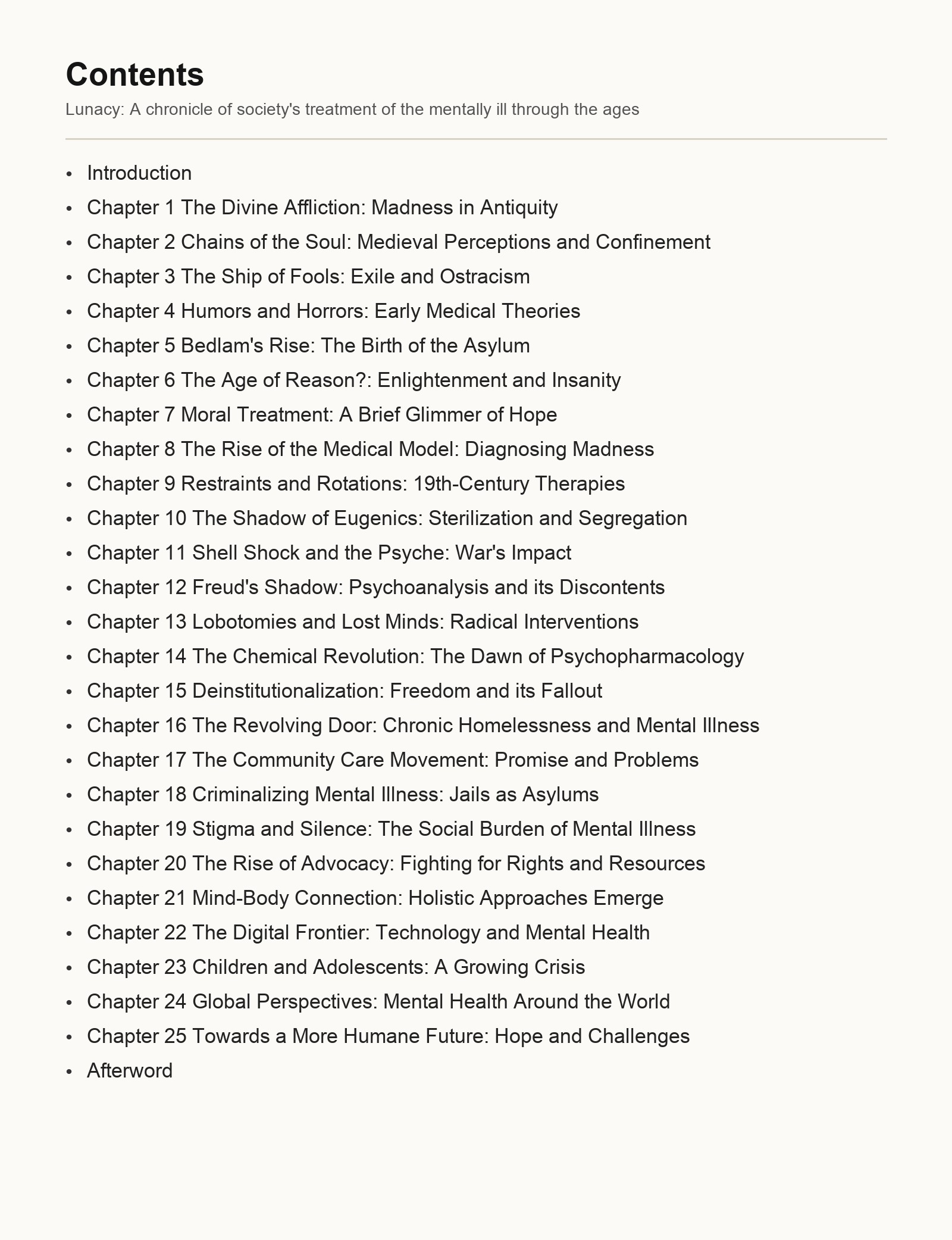
Table of Contents:
-
Introduction
-
Chapter 1 The Divine Affliction: Madness in Antiquity
-
Chapter 2 Chains of the Soul: Medieval Perceptions and Confinement
-
Chapter 3 The Ship of Fools: Exile and Ostracism
-
Chapter 4 Humors and Horrors: Early Medical Theories
-
Chapter 5 Bedlam's Rise: The Birth of the Asylum
-
Chapter 6 The Age of Reason?: Enlightenment and Insanity
-
Chapter 7 Moral Treatment: A Brief Glimmer of Hope
-
Chapter 8 The Rise of the Medical Model: Diagnosing Madness
-
Chapter 9 Restraints and Rotations: 19th-Century Therapies
-
Chapter 10 The Shadow of Eugenics: Sterilization and Segregation
-
Chapter 11 Shell Shock and the Psyche: War's Impact
-
Chapter 12 Freud's Shadow: Psychoanalysis and its Discontents
-
Chapter 13 Lobotomies and Lost Minds: Radical Interventions
-
Chapter 14 The Chemical Revolution: The Dawn of Psychopharmacology
-
Chapter 15 Deinstitutionalization: Freedom and its Fallout
-
Chapter 16 The Revolving Door: Chronic Homelessness and Mental Illness
-
Chapter 17 The Community Care Movement: Promise and Problems
-
Chapter 18 Criminalizing Mental Illness: Jails as Asylums
-
Chapter 19 Stigma and Silence: The Social Burden of Mental Illness
-
Chapter 20 The Rise of Advocacy: Fighting for Rights and Resources
-
Chapter 21 Mind-Body Connection: Holistic Approaches Emerge
-
Chapter 22 The Digital Frontier: Technology and Mental Health
-
Chapter 23 Children and Adolescents: A Growing Crisis
-
Chapter 24 Global Perspectives: Mental Health Around the World
-
Chapter 25 Towards a More Humane Future: Hope and Challenges
-
Afterword
Author:
Published By:
Date Published:
May 25, 2026
Type:
Nonfiction
Language:
English
Also Available In:
Word Count:
46,387 words
Reading Time:
3 hours 15 minutes
Sample:
Order:
Order Lunacy (Paperback) on MixCache.com:
Buy NowPrint copy is made to order and ships worldwide. Includes the ebook free, ready to read instantly.
$5 account credit for all new MixCache.com accounts, usable toward any ebook purchase!*