
Browse by Category
Fiction
- Action & Adventure
- African American
- Anthologies
- Children's Fiction
- Classics
- Comics & Graphic Novels
- Coming of Age
- Contemporary
- Cultural & Regional
- Drama
- Erotica
- Fantasy
- General
- Historical Fiction
- Horror
- Humor & Satire
- Literary Fiction
- Mystery, Thriller & Suspense
- Poetry
- Religious & Inspirational
- Romance
- Science Fiction
- Short Stories
- War & Military
- Westerns
- Women's Fiction
- Young Adult
Non-Fiction
- Antiques & Collectibles
- Arts & Photography
- Biographies & Memoirs
- Business & Money
- Children's Non-Fiction
-
Computers & Technology
- Artificial Intelligence
- Computer Science
- Cybersecurity & Cryptography
- Data Science & Analytics
- Databases & Big Data
- Game Development & Design
- General
- Hardware & DIY
- Mobile App Development
- Networking & Cloud Computing
- Operating Systems
- Programming
- Robotics
- Software
- Software Engineering
- User Experience (UX) & Design
- Web Development & Design
- Cooking, Food & Wine
- Crafts, Hobbies & Home
- Education & Teaching
- Engineering
- General
- Health, Fitness & Dieting
-
History
- African History
- African History - North Africa
- African History - Sub-Saharan Africa
- American History
- American History - 20th Century
- American History - Civil War
- American History - Colonial Period
- Ancient History
- Asian History
- Asian History - China
- Asian History - India
- Asian History - Japan
- Asian History - Southeast Asia
- European History
- European History - Ancient Greece
- European History - Ancient Rome
- European History - Medieval
- European History - Modern
- European History - Renaissance
- General
- Middle Eastern History
- Military History
- Military History - Aviation
- Military History - Naval
- Social & Cultural History
- World History
- Humor & Entertainment
- Industrial Technology
- Language Learning
- Law
- LGBTQ+ Non-Fiction
- Literary Criticism
- Medical Books
- Parenting & Relationships
- Philosophy
- Politics & Social Sciences
- Reference
- Religion & Spirituality
-
Science & Math
- Agricultural Sciences
- Astronomy & Space Science
- Behavioral Sciences
- Biological Sciences
- Botany & Plant Science
- Chemistry
- Earth Sciences
- Engineering - Chemical
- Engineering - Civil
- Engineering - Electrical
- Engineering - Mechanical
- Environment
- General
- Geology
- Mathematics
- Nature & Ecology
- Oceanography
- Paleontology
- Physics
- Statistics
- Self-Help
- Sports & Outdoors
- Study Aids
- Sustainability & Green Living
- Textbooks
- Transportation
- Travel
- True Crime
- Urban Planning & Development
- Veterinary Medicine
- Writing & Publishing
Jump to Section
MixCache.com Total Access
Unlimited reading and audiobooks for every book published by MixCache.com.
Included titles carry the MTA badge.
Learn more →A History of Bulgaria
About this book:
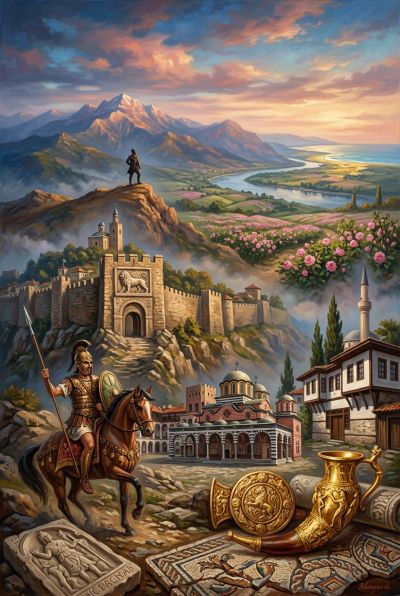
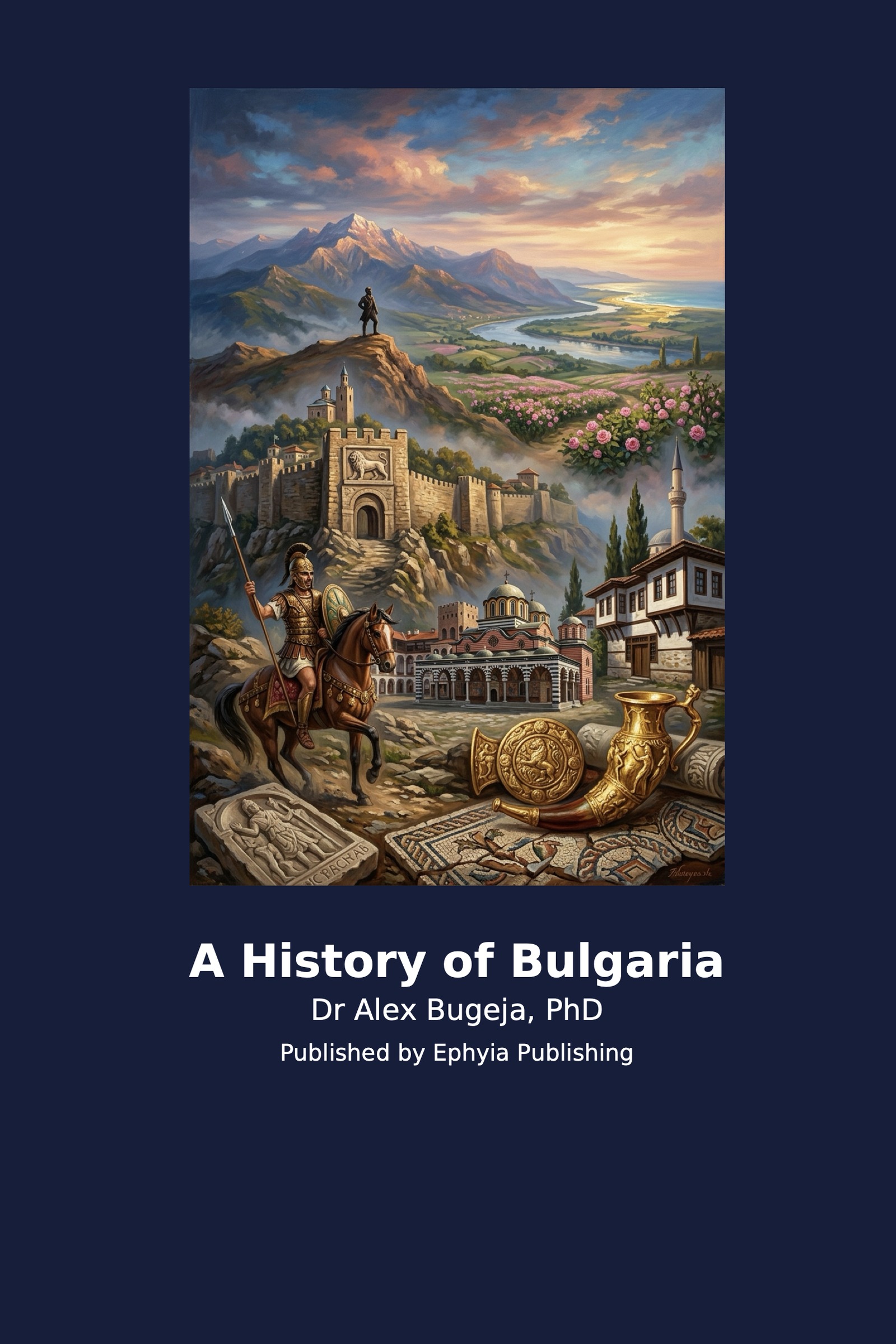
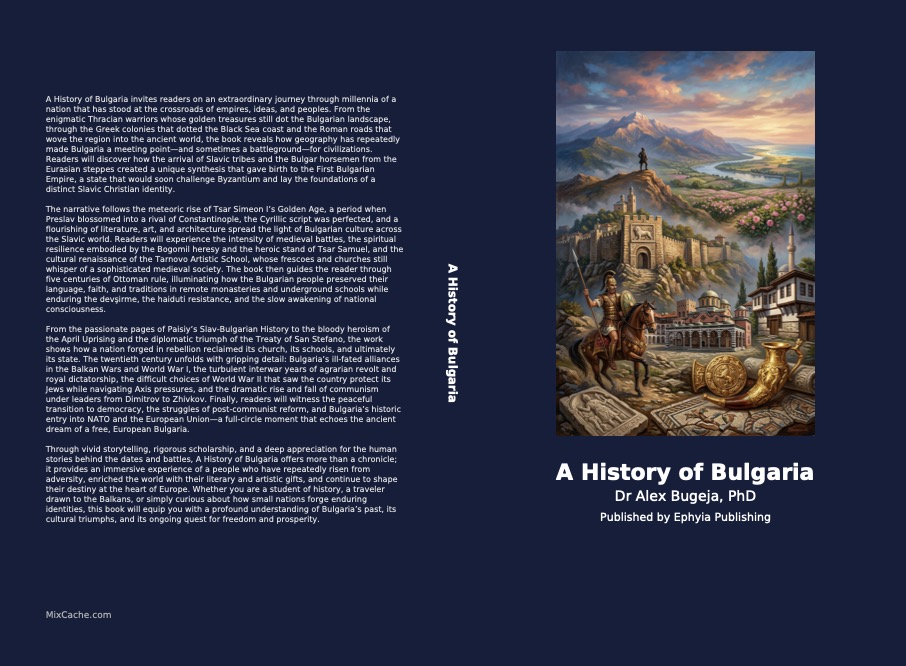
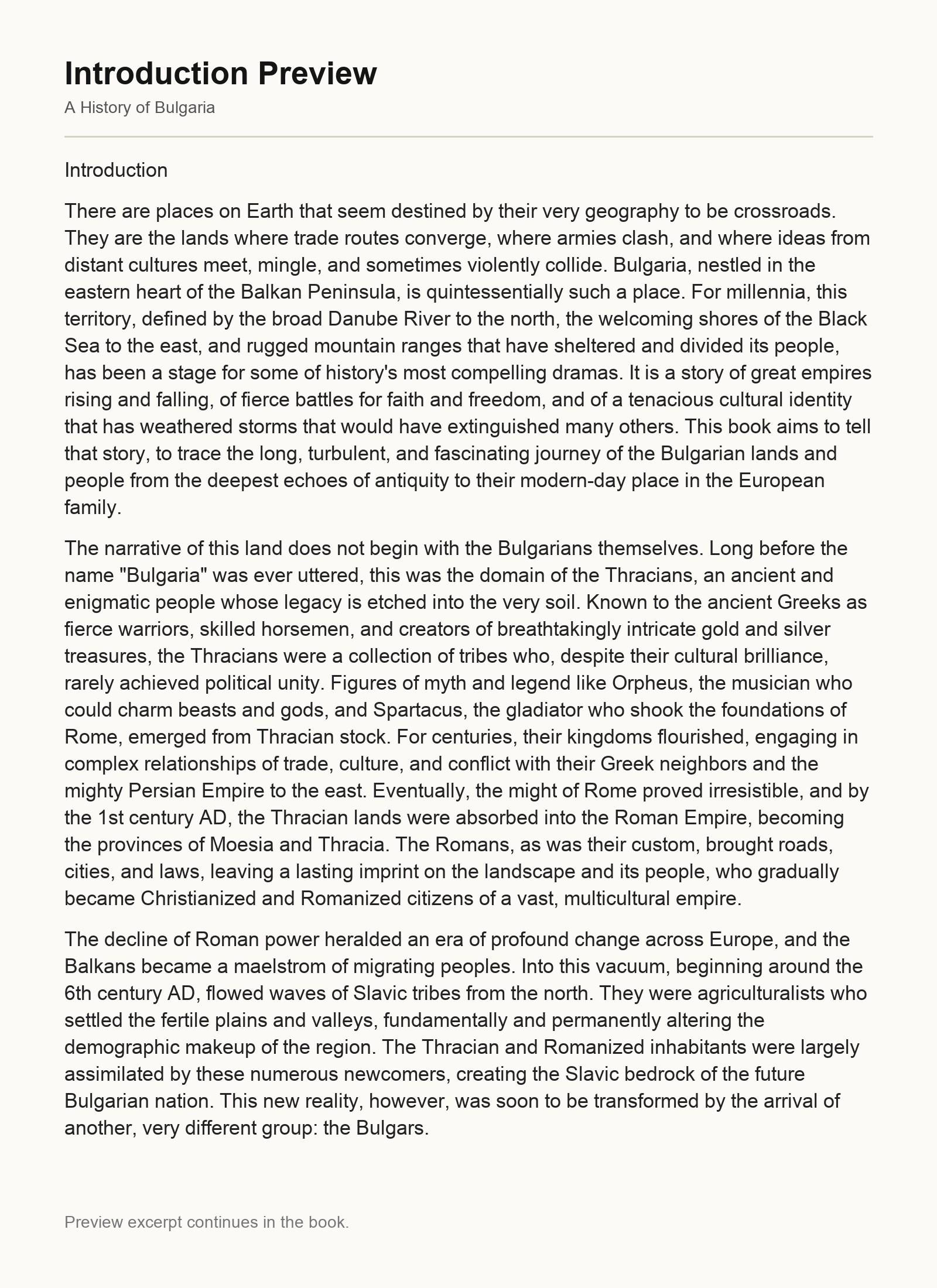
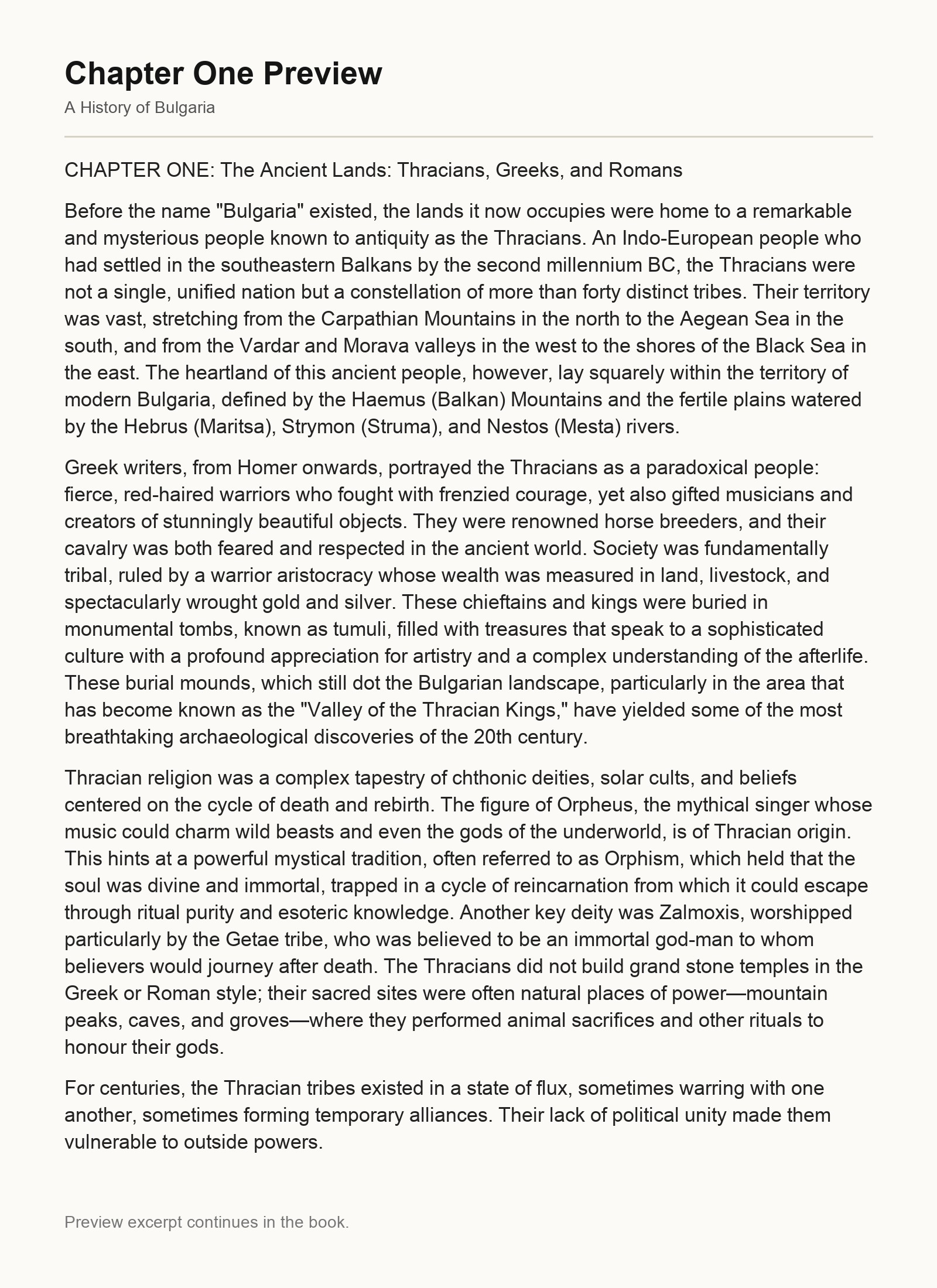
A History of Bulgaria invites readers on an extraordinary journey through millennia of a nation that has stood at the crossroads of empires, ideas, and peoples. From the enigmatic Thracian warriors whose golden treasures still dot the Bulgarian landscape, through the Greek colonies that dotted the Black Sea coast and the Roman roads that wove the region into the ancient world, the book reveals how geography has repeatedly made Bulgaria a meeting point—and sometimes a battleground—for civilizations. Readers will discover how the arrival of Slavic tribes and the Bulgar horsemen from the Eurasian steppes created a unique synthesis that gave birth to the First Bulgarian Empire, a state that would soon challenge Byzantium and lay the foundations of a distinct Slavic Christian identity.
The narrative follows the meteoric rise of Tsar Simeon I’s Golden Age, a period when Preslav blossomed into a rival of Constantinople, the Cyrillic script was perfected, and a flourishing of literature, art, and architecture spread the light of Bulgarian culture across the Slavic world. Readers will experience the intensity of medieval battles, the spiritual resilience embodied by the Bogomil heresy and the heroic stand of Tsar Samuel, and the cultural renaissance of the Tarnovo Artistic School, whose frescoes and churches still whisper of a sophisticated medieval society. The book then guides the reader through five centuries of Ottoman rule, illuminating how the Bulgarian people preserved their language, faith, and traditions in remote monasteries and underground schools while enduring the devşirme, the haiduti resistance, and the slow awakening of national consciousness.
From the passionate pages of Paisiy’s Slav‑Bulgarian History to the bloody heroism of the April Uprising and the diplomatic triumph of the Treaty of San Stefano, the work shows how a nation forged in rebellion reclaimed its church, its schools, and ultimately its state. The twentieth century unfolds with gripping detail: Bulgaria’s ill‑fated alliances in the Balkan Wars and World War I, the turbulent interwar years of agrarian revolt and royal dictatorship, the difficult choices of World War II that saw the country protect its Jews while navigating Axis pressures, and the dramatic rise and fall of communism under leaders from Dimitrov to Zhivkov. Finally, readers will witness the peaceful transition to democracy, the struggles of post‑communist reform, and Bulgaria’s historic entry into NATO and the European Union—a full‑circle moment that echoes the ancient dream of a free, European Bulgaria.
Through vivid storytelling, rigorous scholarship, and a deep appreciation for the human stories behind the dates and battles, A History of Bulgaria offers more than a chronicle; it provides an immersive experience of a people who have repeatedly risen from adversity, enriched the world with their literary and artistic gifts, and continue to shape their destiny at the heart of Europe. Whether you are a student of history, a traveler drawn to the Balkans, or simply curious about how small nations forge enduring identities, this book will equip you with a profound understanding of Bulgaria’s past, its cultural triumphs, and its ongoing quest for freedom and prosperity.
What You'll Find Inside:
- The fusion of Bulgar statecraft and Slavic culture created the First Bulgarian Empire, a powerful medieval state that became a rival to Byzantium.
- Tsar Simeon I's reign marked Bulgaria's 'Golden Age,' featuring military expansion, cultural flourishing, and the development and spread of the Cyrillic alphabet.
- Five centuries of Ottoman rule fundamentally transformed Bulgarian society while preserving national identity through religion, language, and folk traditions.
- The Bulgarian National Revival sparked independence efforts, culminating in the April Uprising, liberation from Ottoman rule, and the creation of the modern Bulgarian state.
- Bulgaria's 20th century was defined by territorial conflicts, alignment with both World Wars' opposing sides, communist rule, and eventual transition to democracy and Euro-Atlantic integration.
Who's It For:
This book would be most beneficial for students of European or Balkan history seeking a comprehensive overview, readers interested in the formation of national identities and cultural resilience, those studying the spread of Christianity and Slavic literacy (Cyrillic alphabet), anyone wanting to understand Bulgaria's unique position as a historical crossroads, and general readers looking for an engaging narrative of a nation's turbulent journey through time.
Table of Contents:
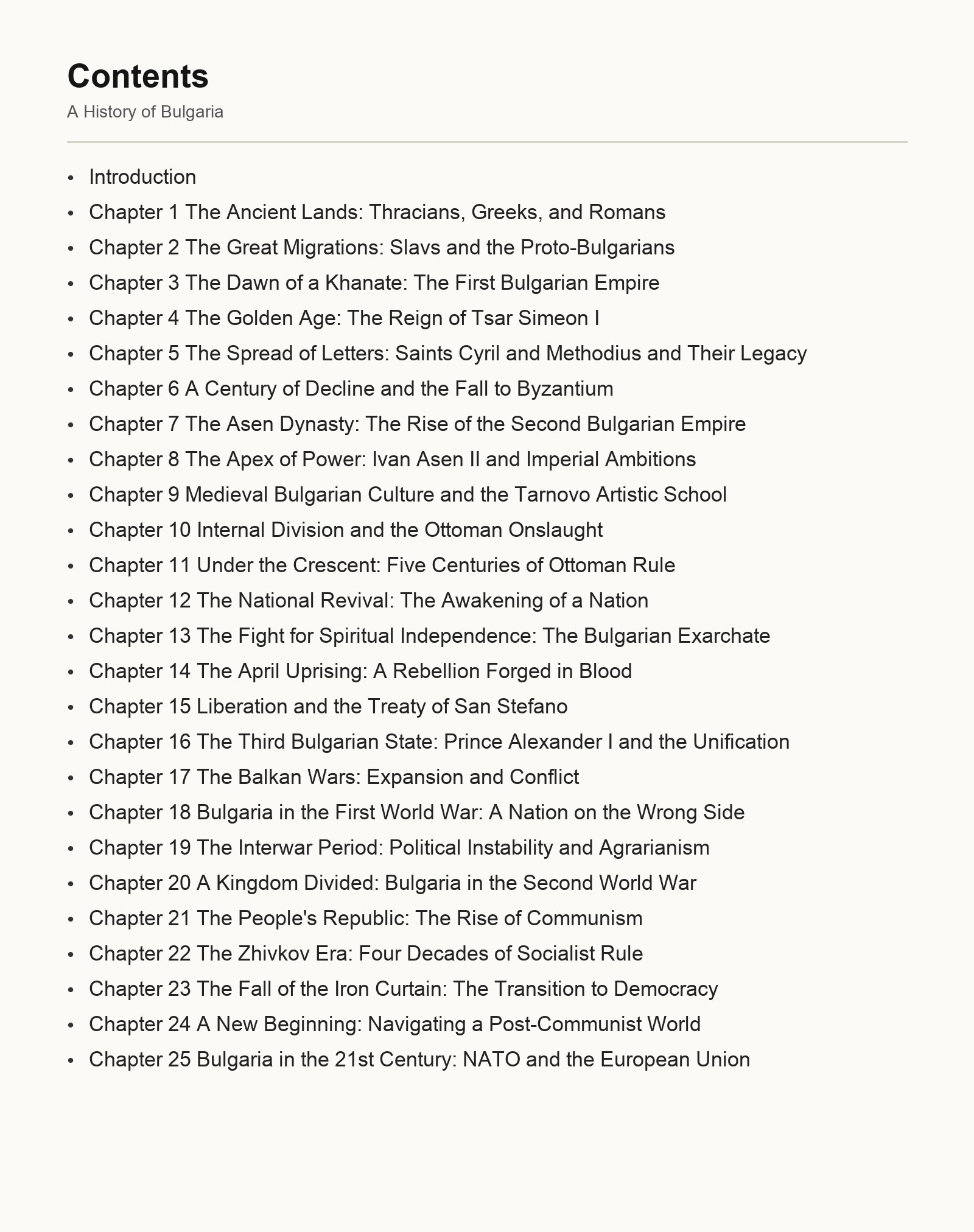
- Introduction
- Chapter 1 The Ancient Lands: Thracians, Greeks, and Romans
- Chapter 2 The Great Migrations: Slavs and the Proto-Bulgarians
- Chapter 3 The Dawn of a Khanate: The First Bulgarian Empire
- Chapter 4 The Golden Age: The Reign of Tsar Simeon I
- Chapter 5 The Spread of Letters: Saints Cyril and Methodius and Their Legacy
- Chapter 6 A Century of Decline and the Fall to Byzantium
- Chapter 7 The Asen Dynasty: The Rise of the Second Bulgarian Empire
- Chapter 8 The Apex of Power: Ivan Asen II and Imperial Ambitions
- Chapter 9 Medieval Bulgarian Culture and the Tarnovo Artistic School
- Chapter 10 Internal Division and the Ottoman Onslaught
- Chapter 11 Under the Crescent: Five Centuries of Ottoman Rule
- Chapter 12 The National Revival: The Awakening of a Nation
- Chapter 13 The Fight for Spiritual Independence: The Bulgarian Exarchate
- Chapter 14 The April Uprising: A Rebellion Forged in Blood
- Chapter 15 Liberation and the Treaty of San Stefano
- Chapter 16 The Third Bulgarian State: Prince Alexander I and the Unification
- Chapter 17 The Balkan Wars: Expansion and Conflict
- Chapter 18 Bulgaria in the First World War: A Nation on the Wrong Side
- Chapter 19 The Interwar Period: Political Instability and Agrarianism
- Chapter 20 A Kingdom Divided: Bulgaria in the Second World War
- Chapter 21 The People's Republic: The Rise of Communism
- Chapter 22 The Zhivkov Era: Four Decades of Socialist Rule
- Chapter 23 The Fall of the Iron Curtain: The Transition to Democracy
- Chapter 24 A New Beginning: Navigating a Post-Communist World
- Chapter 25 Bulgaria in the 21st Century: NATO and the European Union
Author:
Published By:
Date Published:
May 25, 2026
Type:
Nonfiction
Language:
English
Also Available In:
Word Count:
55,957 words
Reading Time:
3 hours 55 minutes
Sample:
Order:
Buy the A History of Bulgaria ebook on MixCache.com:
Buy NowThe full ebook will be available immediately to read instantly on any device.
$5 account credit for all new MixCache.com accounts, usable toward any ebook purchase!*





Ratings & Reviews
Ask Questions About This Book
Have a question about the content? Ask our AI assistant!
Start by asking a question about "A History of Bulgaria"
Example: "Does this book mention William Shakespeare?"
Thinking...