
Browse by Category
Fiction
- Action & Adventure
- African American
- Anthologies
- Children's Fiction
- Classics
- Comics & Graphic Novels
- Coming of Age
- Contemporary
- Cultural & Regional
- Drama
- Erotica
- Fantasy
- General
- Historical Fiction
- Horror
- Humor & Satire
- Literary Fiction
- Mystery, Thriller & Suspense
- Poetry
- Religious & Inspirational
- Romance
- Science Fiction
- Short Stories
- War & Military
- Westerns
- Women's Fiction
- Young Adult
Non-Fiction
- Antiques & Collectibles
- Arts & Photography
- Biographies & Memoirs
- Business & Money
- Children's Non-Fiction
-
Computers & Technology
- Artificial Intelligence
- Computer Science
- Cybersecurity & Cryptography
- Data Science & Analytics
- Databases & Big Data
- Game Development & Design
- General
- Hardware & DIY
- Mobile App Development
- Networking & Cloud Computing
- Operating Systems
- Programming
- Robotics
- Software
- Software Engineering
- User Experience (UX) & Design
- Web Development & Design
- Cooking, Food & Wine
- Crafts, Hobbies & Home
- Education & Teaching
- Engineering
- General
- Health, Fitness & Dieting
-
History
- African History
- African History - North Africa
- African History - Sub-Saharan Africa
- American History
- American History - 20th Century
- American History - Civil War
- American History - Colonial Period
- Ancient History
- Asian History
- Asian History - China
- Asian History - India
- Asian History - Japan
- Asian History - Southeast Asia
- European History
- European History - Ancient Greece
- European History - Ancient Rome
- European History - Medieval
- European History - Modern
- European History - Renaissance
- General
- Middle Eastern History
- Military History
- Military History - Aviation
- Military History - Naval
- Social & Cultural History
- World History
- Humor & Entertainment
- Industrial Technology
- Language Learning
- Law
- LGBTQ+ Non-Fiction
- Literary Criticism
- Medical Books
- Parenting & Relationships
- Philosophy
- Politics & Social Sciences
- Reference
- Religion & Spirituality
-
Science & Math
- Agricultural Sciences
- Astronomy & Space Science
- Behavioral Sciences
- Biological Sciences
- Botany & Plant Science
- Chemistry
- Earth Sciences
- Engineering - Chemical
- Engineering - Civil
- Engineering - Electrical
- Engineering - Mechanical
- Environment
- General
- Geology
- Mathematics
- Nature & Ecology
- Oceanography
- Paleontology
- Physics
- Statistics
- Self-Help
- Sports & Outdoors
- Study Aids
- Sustainability & Green Living
- Textbooks
- Transportation
- Travel
- True Crime
- Urban Planning & Development
- Veterinary Medicine
- Writing & Publishing
Jump to Section
MixCache.com Total Access
Unlimited reading and audiobooks for every book published by MixCache.com.
Included titles carry the MTA badge.
Learn more →
Zimbabwe
Portrait of an African Land
About this book:
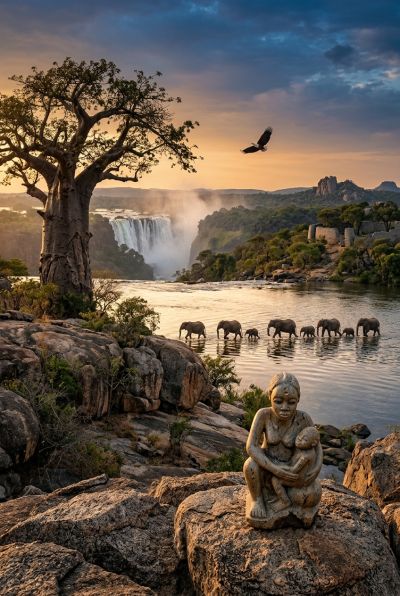
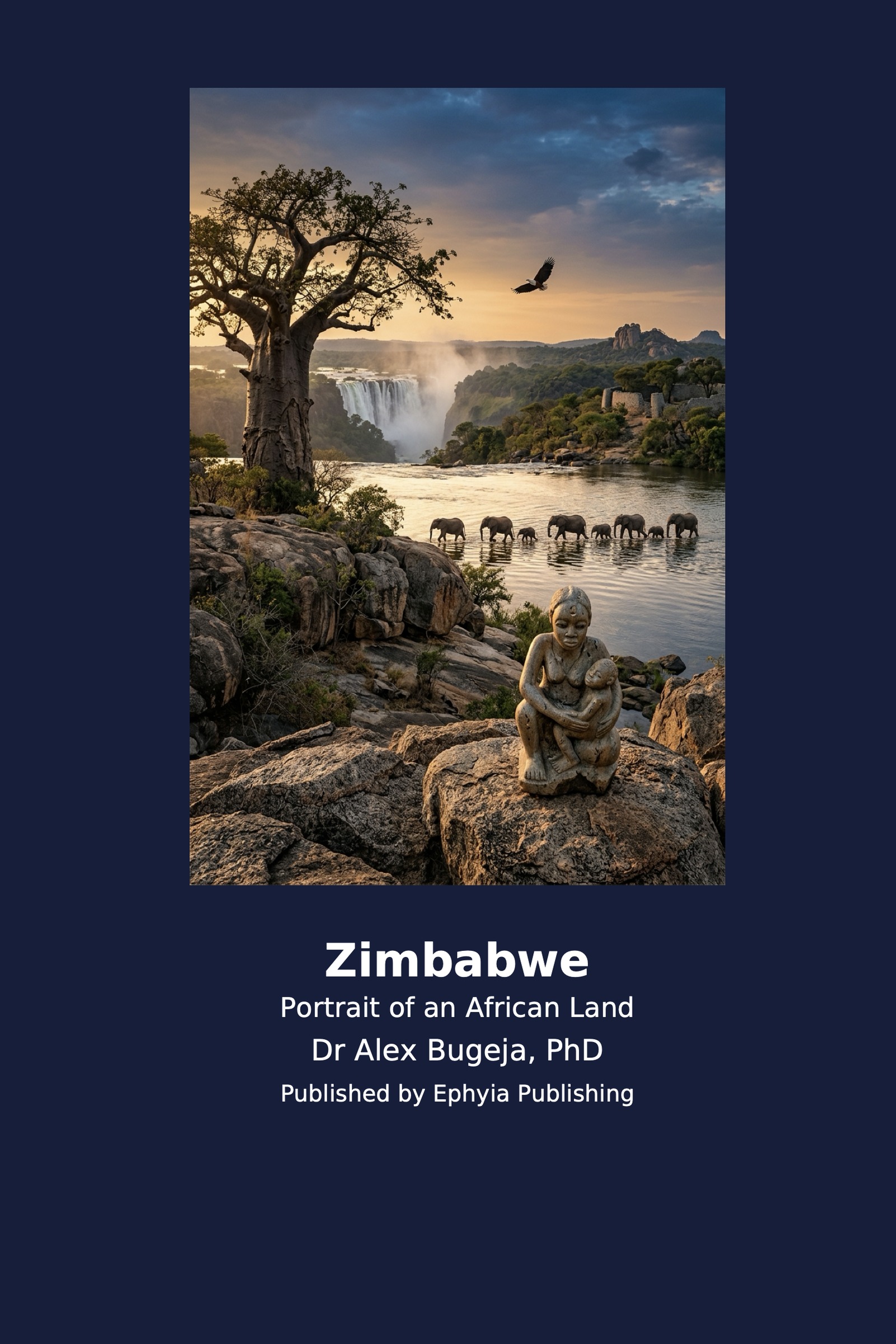
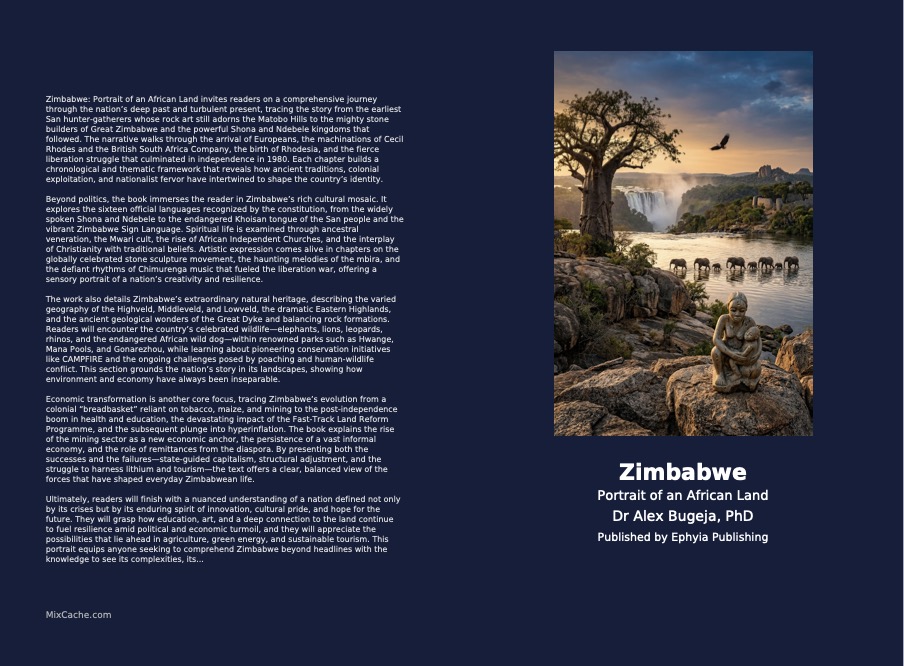
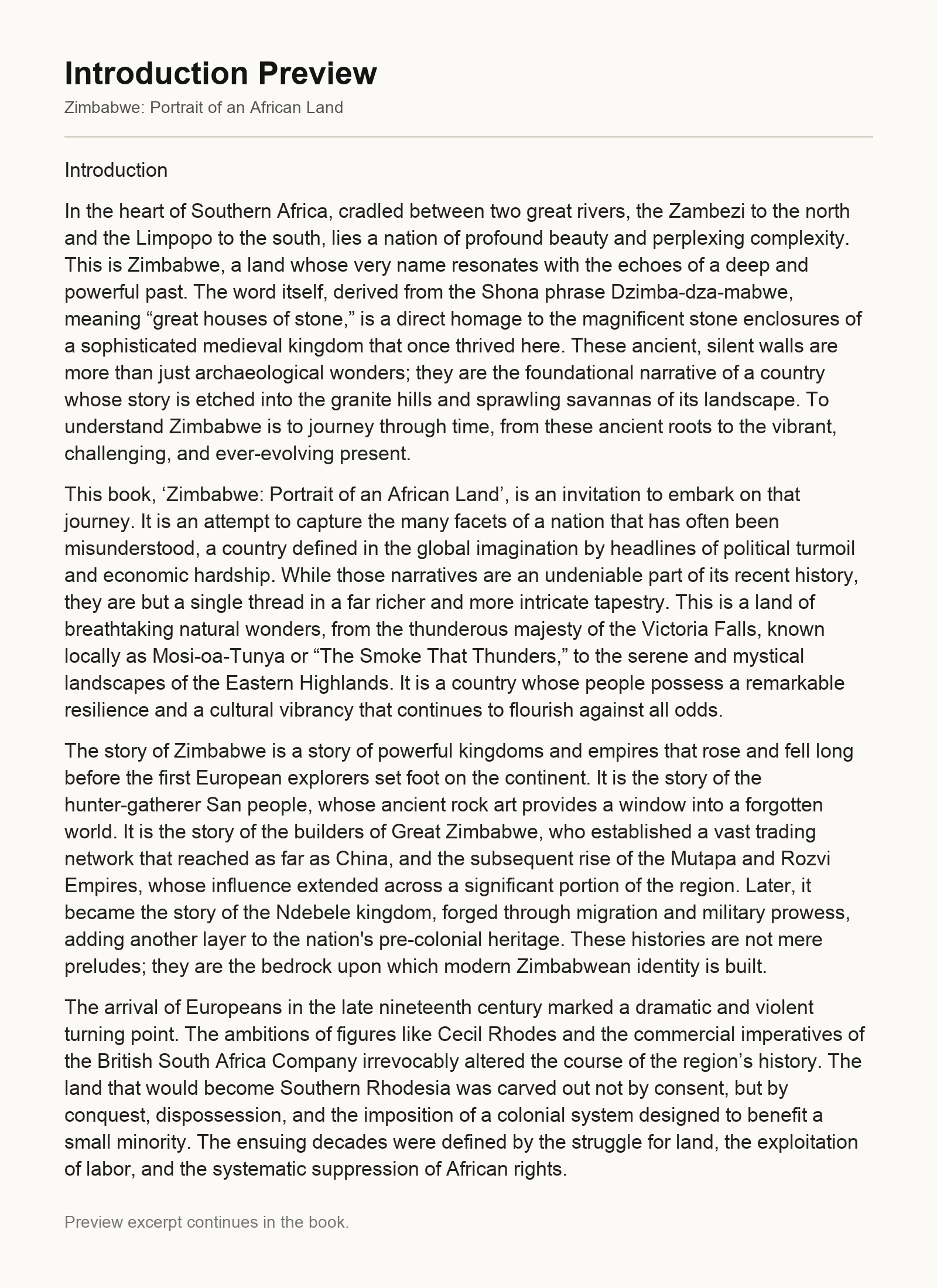
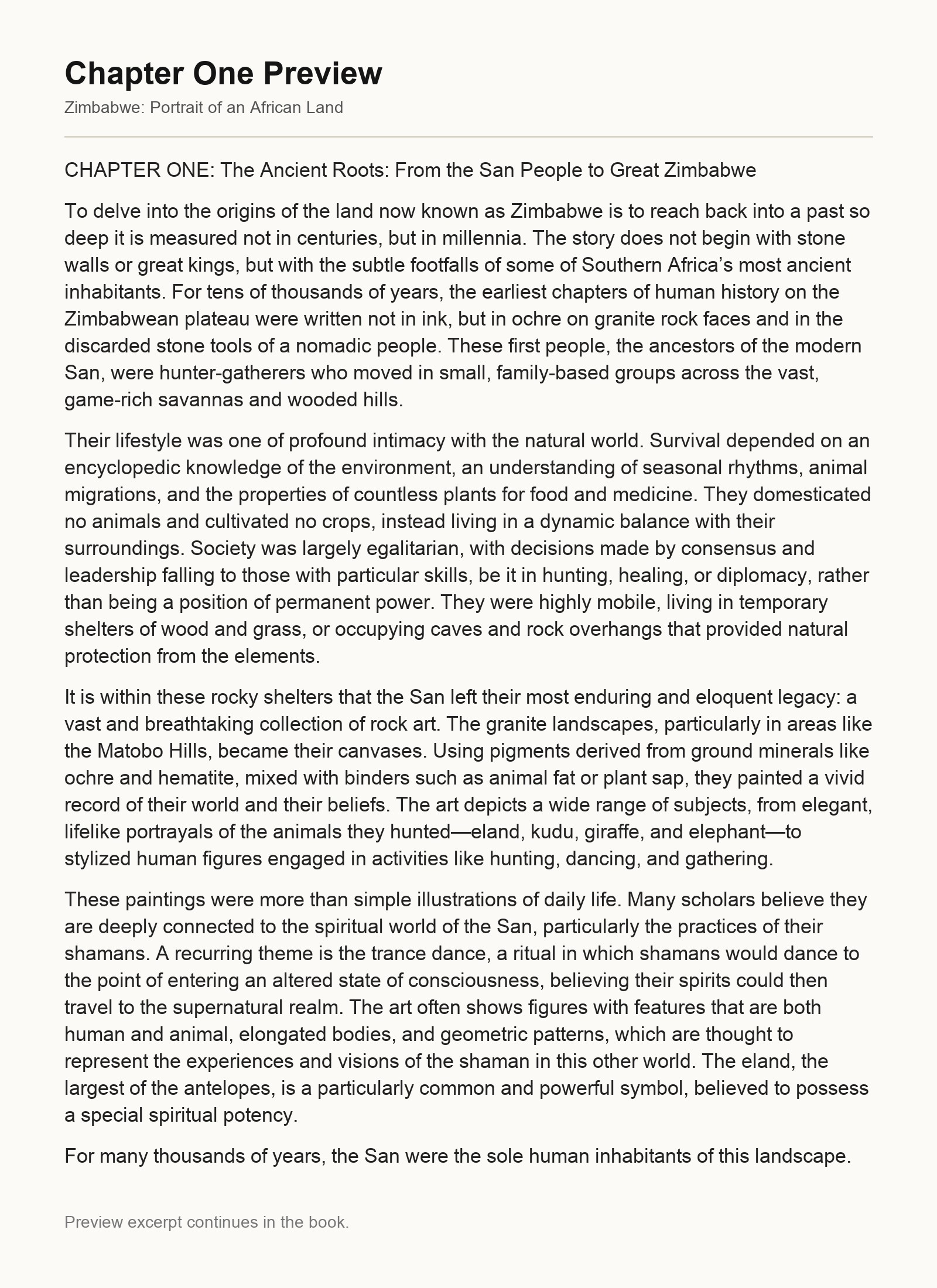
Zimbabwe: Portrait of an African Land invites readers on a comprehensive journey through the nation’s deep past and turbulent present, tracing the story from the earliest San hunter‑gatherers whose rock art still adorns the Matobo Hills to the mighty stone builders of Great Zimbabwe and the powerful Shona and Ndebele kingdoms that followed. The narrative walks through the arrival of Europeans, the machinations of Cecil Rhodes and the British South Africa Company, the birth of Rhodesia, and the fierce liberation struggle that culminated in independence in 1980. Each chapter builds a chronological and thematic framework that reveals how ancient traditions, colonial exploitation, and nationalist fervor have intertwined to shape the country’s identity.
Beyond politics, the book immerses the reader in Zimbabwe’s rich cultural mosaic. It explores the sixteen official languages recognized by the constitution, from the widely spoken Shona and Ndebele to the endangered Khoisan tongue of the San people and the vibrant Zimbabwe Sign Language. Spiritual life is examined through ancestral veneration, the Mwari cult, the rise of African Independent Churches, and the interplay of Christianity with traditional beliefs. Artistic expression comes alive in chapters on the globally celebrated stone sculpture movement, the haunting melodies of the mbira, and the defiant rhythms of Chimurenga music that fueled the liberation war, offering a sensory portrait of a nation’s creativity and resilience.
The work also details Zimbabwe’s extraordinary natural heritage, describing the varied geography of the Highveld, Middleveld, and Lowveld, the dramatic Eastern Highlands, and the ancient geological wonders of the Great Dyke and balancing rock formations. Readers will encounter the country’s celebrated wildlife—elephants, lions, leopards, rhinos, and the endangered African wild dog—within renowned parks such as Hwange, Mana Pools, and Gonarezhou, while learning about pioneering conservation initiatives like CAMPFIRE and the ongoing challenges posed by poaching and human‑wildlife conflict. This section grounds the nation’s story in its landscapes, showing how environment and economy have always been inseparable.
Economic transformation is another core focus, tracing Zimbabwe’s evolution from a colonial “breadbasket” reliant on tobacco, maize, and mining to the post‑independence boom in health and education, the devastating impact of the Fast‑Track Land Reform Programme, and the subsequent plunge into hyperinflation. The book explains the rise of the mining sector as a new economic anchor, the persistence of a vast informal economy, and the role of remittances from the diaspora. By presenting both the successes and the failures—state‑guided capitalism, structural adjustment, and the struggle to harness lithium and tourism—the text offers a clear, balanced view of the forces that have shaped everyday Zimbabwean life.
Ultimately, readers will finish with a nuanced understanding of a nation defined not only by its crises but by its enduring spirit of innovation, cultural pride, and hope for the future. They will grasp how education, art, and a deep connection to the land continue to fuel resilience amid political and economic turmoil, and they will appreciate the possibilities that lie ahead in agriculture, green energy, and sustainable tourism. This portrait equips anyone seeking to comprehend Zimbabwe beyond headlines with the knowledge to see its complexities, its struggles, and its aspirations in full.
What You'll Find Inside:
- Explores Zimbabwe's ancient foundations from San hunter-gatherers through the stone city of Great Zimbabwe to the rise of Shona and Ndebele kingdoms.
- Details the colonial period including Cecil Rhodes' ambitions, the British South Africa Company, and the violent birth of Rhodesia through land seizure and labor exploitation.
- Chronicles the liberation struggle led by ZANU and ZAPU, the Rhodesian Bush War, and the Lancaster House Agreement that birthed independent Zimbabwe in 1980.
- Examines post-independence challenges from Mugabe's early reconciliation efforts through controversial land reform, economic collapse, and political tensions to the present day.
- Highlights Zimbabwe's rich cultural mosaic including its 16 official languages, diverse spiritual beliefs, renowned stone sculpture and music traditions, and breathtaking natural heritage.
Who's It For:
This book is ideal for students, researchers, and general readers seeking a comprehensive understanding of Zimbabwe beyond superficial media portrayals. It will particularly benefit those studying African history, post-colonial politics, or development studies who need nuanced context on how ancient civilizations, colonial exploitation, liberation struggles, and post-independence governance have shaped this complex nation. Anyone interested in the interplay between geography, culture, economics, and politics in African nation-building will find valuable insights here.
Table of Contents:
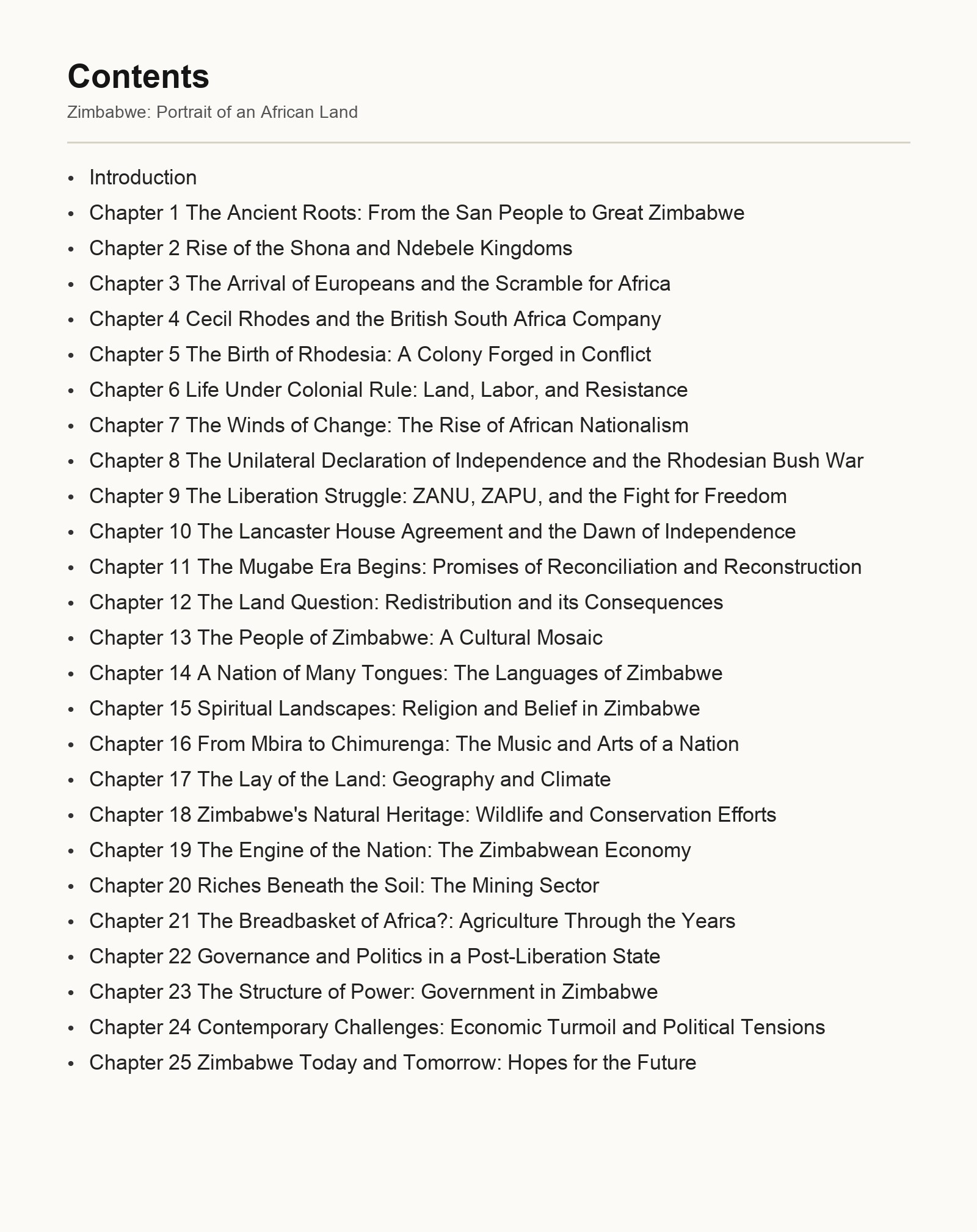
- Introduction
- Chapter 1 The Ancient Roots: From the San People to Great Zimbabwe.
- Chapter 2 Rise of the Shona and Ndebele Kingdoms.
- Chapter 3 The Arrival of Europeans and the Scramble for Africa.
- Chapter 4 Cecil Rhodes and the British South Africa Company.
- Chapter 5 The Birth of Rhodesia: A Colony Forged in Conflict.
- Chapter 6 Life Under Colonial Rule: Land, Labor, and Resistance.
- Chapter 7 The Winds of Change: The Rise of African Nationalism.
- Chapter 8 The Unilateral Declaration of Independence and the Rhodesian Bush War.
- Chapter 9 The Liberation Struggle: ZANU, ZAPU, and the Fight for Freedom.
- Chapter 10 The Lancaster House Agreement and the Dawn of Independence.
- Chapter 11 The Mugabe Era Begins: Promises of Reconciliation and Reconstruction.
- Chapter 12 The Land Question: Redistribution and its Consequences.
- Chapter 13 The People of Zimbabwe: A Cultural Mosaic.
- Chapter 14 A Nation of Many Tongues: The Languages of Zimbabwe.
- Chapter 15 Spiritual Landscapes: Religion and Belief in Zimbabwe.
- Chapter 16 From Mbira to Chimurenga: The Music and Arts of a Nation.
- Chapter 17 The Lay of the Land: Geography and Climate.
- Chapter 18 Zimbabwe's Natural Heritage: Wildlife and Conservation Efforts.
- Chapter 19 The Engine of the Nation: The Zimbabwean Economy.
- Chapter 20 Riches Beneath the Soil: The Mining Sector.
- Chapter 21 The Breadbasket of Africa?: Agriculture Through the Years.
- Chapter 22 Governance and Politics in a Post-Liberation State.
- Chapter 23 The Structure of Power: Government in Zimbabwe.
- Chapter 24 Contemporary Challenges: Economic Turmoil and Political Tensions.
- Chapter 25 Zimbabwe Today and Tomorrow: Hopes for the Future.
Author:
Published By:
Date Published:
May 25, 2026
Type:
Nonfiction
Language:
English
Also Available In:
Word Count:
48,890 words
Reading Time:
3 hours 25 minutes
Sample:
Order:
Buy the Zimbabwe ebook on MixCache.com:
Buy NowThe full ebook will be available immediately to read instantly on any device.
$5 account credit for all new MixCache.com accounts, usable toward any ebook purchase!*



Ratings & Reviews
Ask Questions About This Book
Have a question about the content? Ask our AI assistant!
Start by asking a question about "Zimbabwe"
Example: "Does this book mention William Shakespeare?"
Thinking...