Browse by Category
Fiction
- Action & Adventure
- African American
- Anthologies
- Children's Fiction
- Classics
- Comics & Graphic Novels
- Coming of Age
- Contemporary
- Cultural & Regional
- Drama
- Erotica
- Fantasy
- General
- Historical Fiction
- Horror
- Humor & Satire
- Literary Fiction
- Mystery, Thriller & Suspense
- Poetry
- Religious & Inspirational
- Romance
- Science Fiction
- Short Stories
- War & Military
- Westerns
- Women's Fiction
- Young Adult
Non-Fiction
- Antiques & Collectibles
- Arts & Photography
- Biographies & Memoirs
- Business & Money
- Children's Non-Fiction
-
Computers & Technology
- Artificial Intelligence
- Computer Science
- Cybersecurity & Cryptography
- Data Science & Analytics
- Databases & Big Data
- Game Development & Design
- General
- Hardware & DIY
- Mobile App Development
- Networking & Cloud Computing
- Operating Systems
- Programming
- Robotics
- Software
- Software Engineering
- User Experience (UX) & Design
- Web Development & Design
- Cooking, Food & Wine
- Crafts, Hobbies & Home
- Education & Teaching
- Engineering
- General
- Health, Fitness & Dieting
-
History
- African History
- African History - North Africa
- African History - Sub-Saharan Africa
- American History
- American History - 20th Century
- American History - Civil War
- American History - Colonial Period
- Ancient History
- Asian History
- Asian History - China
- Asian History - India
- Asian History - Japan
- Asian History - Southeast Asia
- European History
- European History - Ancient Greece
- European History - Ancient Rome
- European History - Medieval
- European History - Modern
- European History - Renaissance
- General
- Middle Eastern History
- Military History
- Military History - Aviation
- Military History - Naval
- Social & Cultural History
- World History
- Humor & Entertainment
- Industrial Technology
- Language Learning
- Law
- LGBTQ+ Non-Fiction
- Literary Criticism
- Medical Books
- Parenting & Relationships
- Philosophy
- Politics & Social Sciences
- Reference
- Religion & Spirituality
-
Science & Math
- Agricultural Sciences
- Astronomy & Space Science
- Behavioral Sciences
- Biological Sciences
- Botany & Plant Science
- Chemistry
- Earth Sciences
- Engineering - Chemical
- Engineering - Civil
- Engineering - Electrical
- Engineering - Mechanical
- Environment
- General
- Geology
- Mathematics
- Nature & Ecology
- Oceanography
- Paleontology
- Physics
- Statistics
- Self-Help
- Sports & Outdoors
- Study Aids
- Sustainability & Green Living
- Textbooks
- Transportation
- Travel
- True Crime
- Urban Planning & Development
- Veterinary Medicine
- Writing & Publishing
Jump to Section
MixCache.com Total Access
Unlimited reading and audiobooks for every book published by MixCache.com.
Included titles carry the MTA badge.
Learn more →A History of Haiti
About this book:



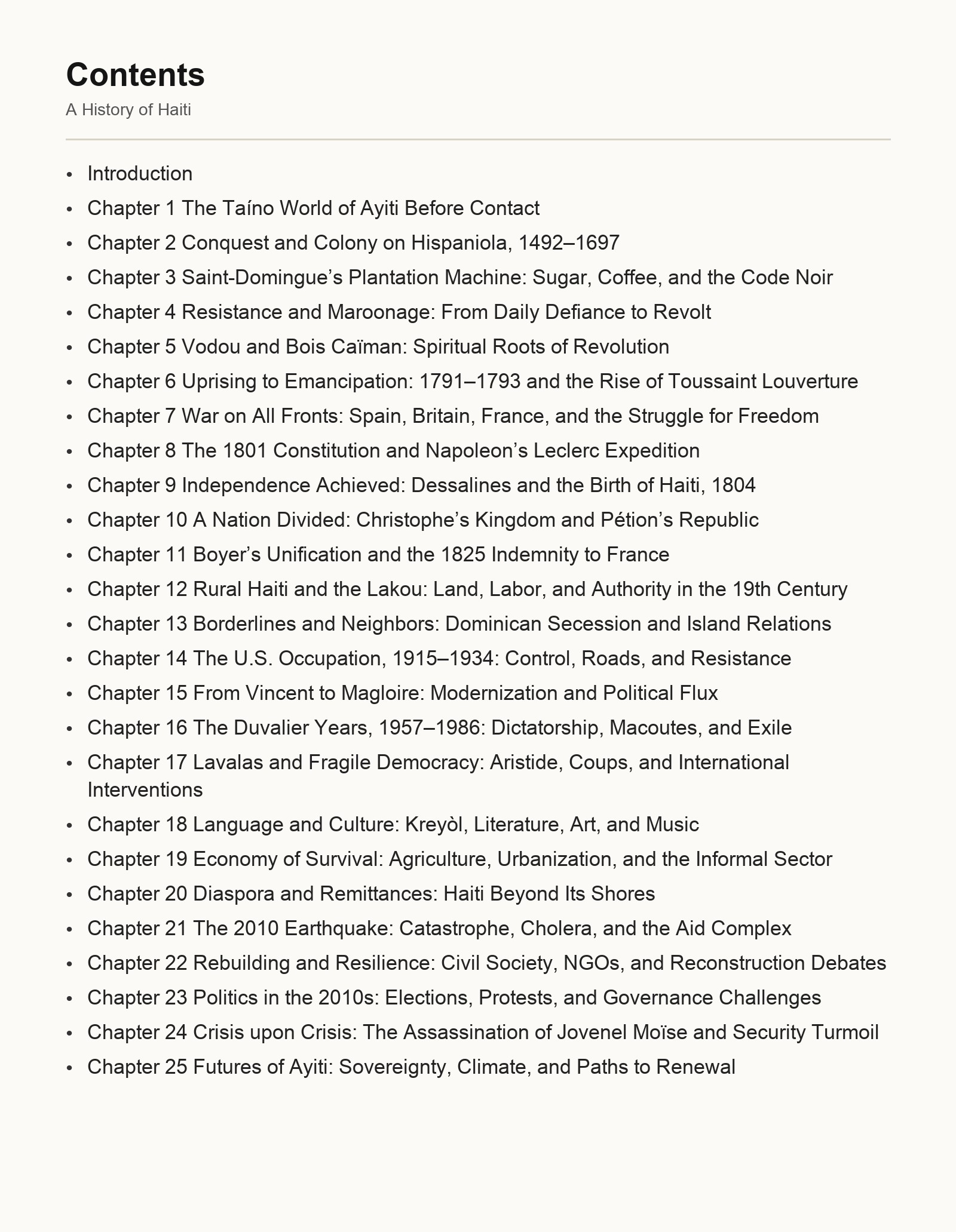
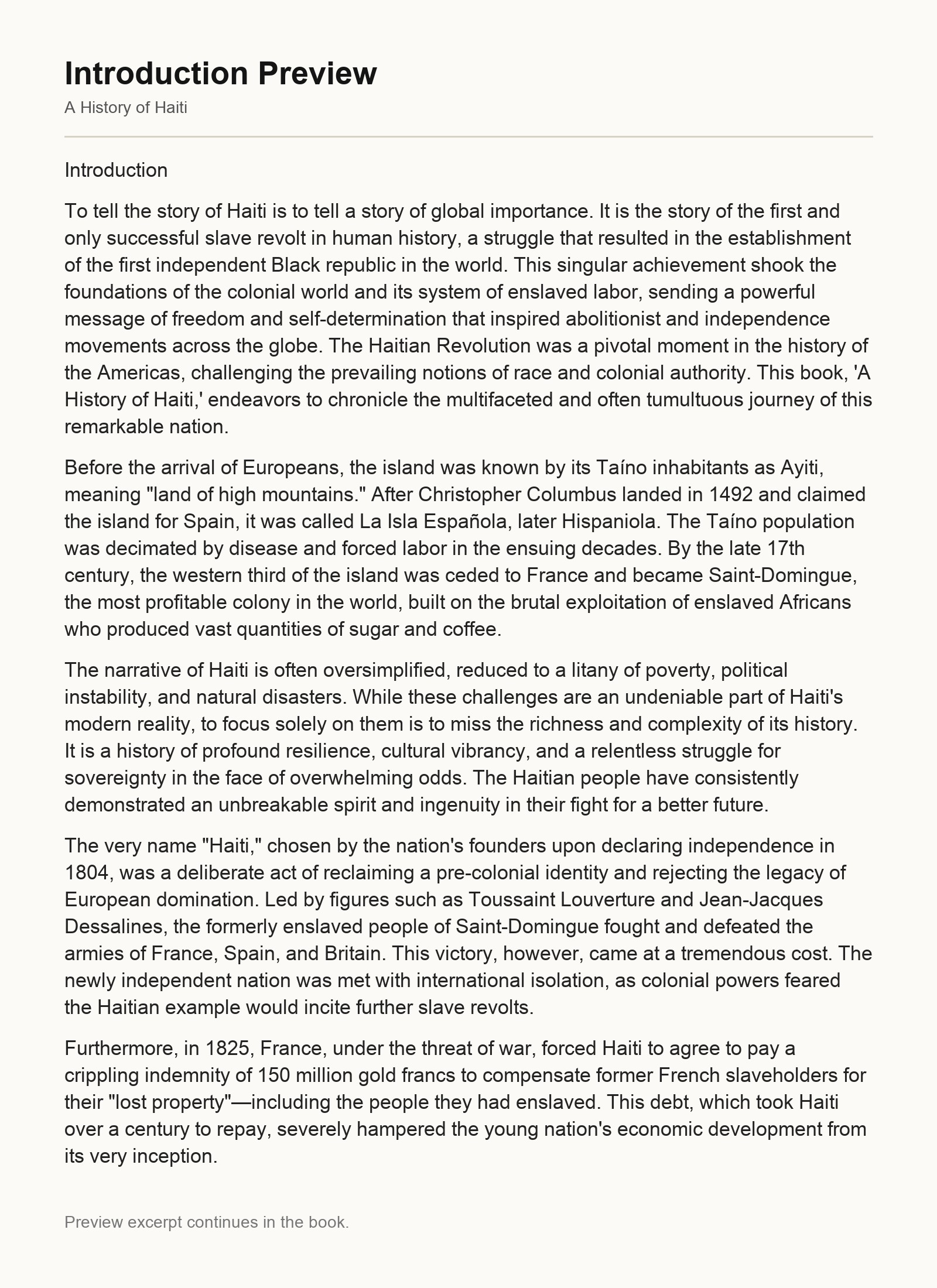
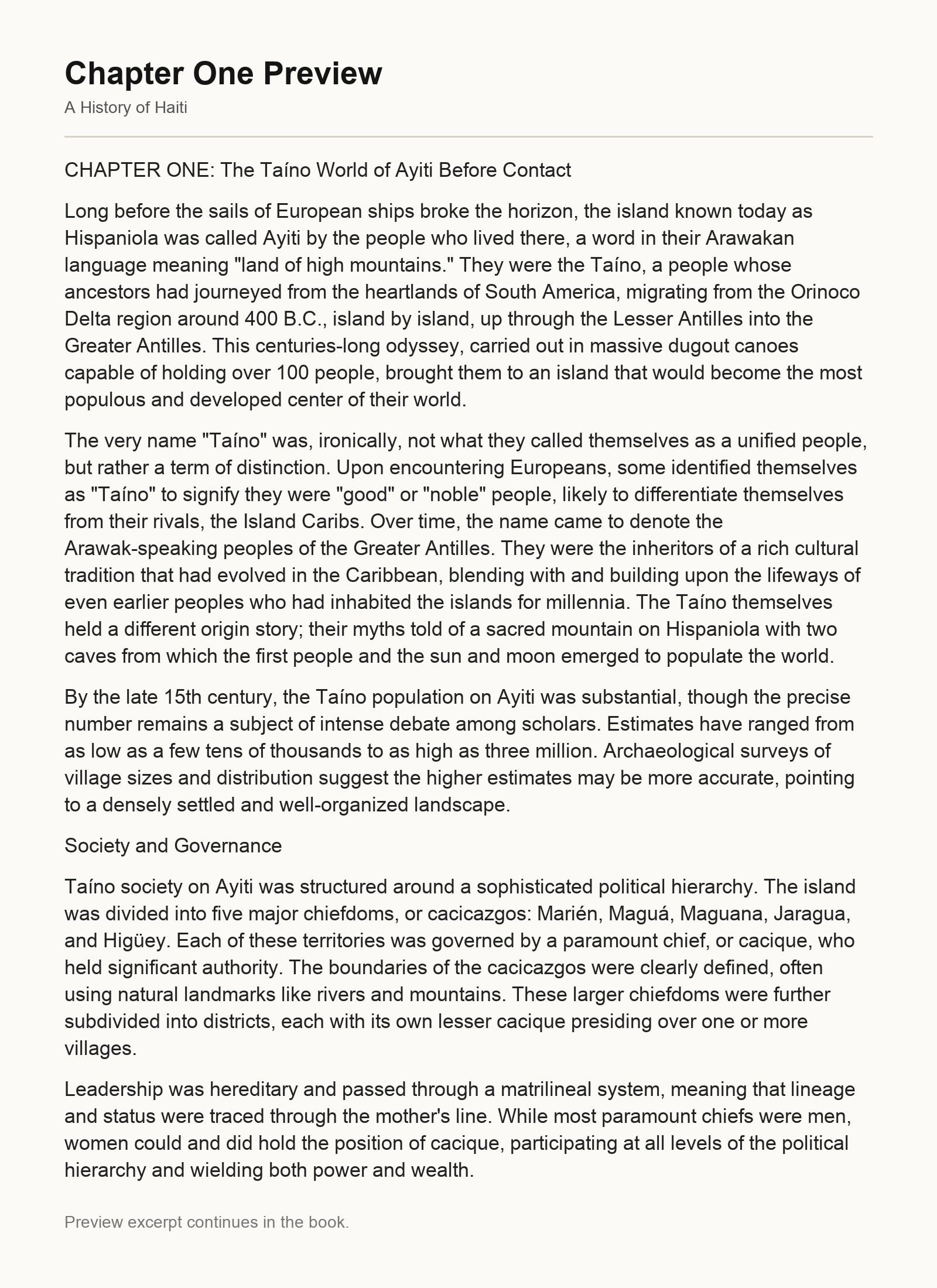
"A History of Haiti" invites readers on a sweeping journey through the island’s past, from the sophisticated Taíno chiefdoms of Ayiti to the tumultuous birth of the world’s first Black republic. Michel Moreau traces the indigenous world that thrived for centuries, the brutal encounter with European conquest, and the rise of Saint‑Domingue as a sugar‑and‑coffee powerhouse built on the backs of enslaved Africans. The narrative reveals how the plantation economy, the Code Noir, and daily acts of resistance—ranging from sabotage and marronnage to the spiritual fire of Vodou—laid the groundwork for a revolutionary upheaval that shocked the Atlantic world.
Readers will follow the dramatic arc of the Haitian Revolution, witnessing the clandestine Bois Caïman ceremony, the ferocious uprising of 1791, and the rise of Toussaint Louverture as a disciplined commander who outmaneuvered Spanish, British, and French forces. The book details the internal struggles that followed independence, from Dessalines’s imperial rule to the division between Christophe’s northern kingdom and Pétion’s southern republic, and examines the crushing 1825 indemnity to France that haunted Haiti’s finances for over a century. Each chapter illuminates the interplay of external pressure and internal agency that shaped the nation’s trajectory.
Beyond politics and economics, the work immerses the reader in Haiti’s vibrant cultural life. Sections devoted to Kreyòl language, literature, visual art, and music show how Haitians forged a distinct identity rooted in African traditions, Catholic syncretism, and a resilient spirit of creativity. Readers will discover how Vodou served not only as religion but as a revolutionary organizing force, how painters like Hector Hyppolite and writers like Jacques Roumain gave voice to the peasantry, and how rhythms from méringue to konpa and mizik rasin became the heartbeat of national expression.
The latter half of the book brings the story into the modern era, chronicling the U.S. occupation, the Duvalier dictatorship, the hopeful yet fragile Lavalas movement, the devastating 2010 earthquake and cholera outbreak, and the ongoing struggles with governance, climate vulnerability, and diaspora remittances. By weaving together military campaigns, economic policies, grassroots movements, and cultural milestones, Moreau offers a nuanced portrait of a nation that has repeatedly confronted adversity while asserting its sovereignty and cultural richness.
Ultimately, "A History of Haiti" equips readers with a deep understanding of why Haiti’s story matters to global history: the only successful slave revolt, a beacon for abolitionist movements, and a continual test of the ideals of liberty and equality. Readers will finish the book not only with factual knowledge but with an appreciation for the endurance, ingenuity, and hope that have defined the Haitian people across centuries, inspiring a fresh perspective on the challenges and possibilities that lie ahead for Ayiti and its diaspora.
What You'll Find Inside:
- The Haitian Revolution (1791-1804) as the world's first and only successful slave revolt that established the first independent Black republic, fundamentally challenging global systems of slavery and colonialism.
- The devastating impact of the 1825 'independence debt' forced upon Haiti by France, requiring payment of 150 million gold francs to former slaveholders and crippling the nation's economic development for over a century.
- The enduring cultural resilience of Haitian people through Vodou, Kreyòl language, art, music, and the lakou communal land system, which preserved African traditions and provided foundations for resistance and community survival.
- The cycle of foreign interventions and occupations (Spanish, French, British, U.S.) that repeatedly undermined Haitian sovereignty while shaping its political and economic trajectory from colonial times to the present.
- Contemporary Haiti's struggle with interconnected challenges of political instability, foreign interference, climate vulnerability, and economic dependence on diaspora remittances, while seeking paths to renewal through grassroots movements like the Montana Accord.
Who's It For:
This book is essential reading for students and scholars of Caribbean history, African diaspora studies, and post-colonial studies; policy makers and international development professionals working on Haiti; activists engaged in social justice and anti-racism movements; and any reader seeking to understand Haiti's revolutionary significance, cultural richness, and the historical roots of its contemporary challenges beyond superficial narratives of poverty and disaster.
Table of Contents:
- Introduction
- Chapter 1 The Taíno World of Ayiti Before Contact
- Chapter 2 Conquest and Colony on Hispaniola, 1492–1697
- Chapter 3 Saint-Domingue’s Plantation Machine: Sugar, Coffee, and the Code Noir
- Chapter 4 Resistance and Maroonage: From Daily Defiance to Revolt
- Chapter 5 Vodou and Bois Caïman: Spiritual Roots of Revolution
- Chapter 6 Uprising to Emancipation: 1791–1793 and the Rise of Toussaint Louverture
- Chapter 7 War on All Fronts: Spain, Britain, France, and the Struggle for Freedom
- Chapter 8 The 1801 Constitution and Napoleon’s Leclerc Expedition
- Chapter 9 Independence Achieved: Dessalines and the Birth of Haiti, 1804
- Chapter 10 A Nation Divided: Christophe’s Kingdom and Pétion’s Republic
- Chapter 11 Boyer’s Unification and the 1825 Indemnity to France
- Chapter 12 Rural Haiti and the Lakou: Land, Labor, and Authority in the 19th Century
- Chapter 13 Borderlines and Neighbors: Dominican Secession and Island Relations
- Chapter 14 The U.S. Occupation, 1915–1934: Control, Roads, and Resistance
- Chapter 15 From Vincent to Magloire: Modernization and Political Flux
- Chapter 16 The Duvalier Years, 1957–1986: Dictatorship, Macoutes, and Exile
- Chapter 17 Lavalas and Fragile Democracy: Aristide, Coups, and International Interventions
- Chapter 18 Language and Culture: Kreyòl, Literature, Art, and Music
- Chapter 19 Economy of Survival: Agriculture, Urbanization, and the Informal Sector
- Chapter 20 Diaspora and Remittances: Haiti Beyond Its Shores
- Chapter 21 The 2010 Earthquake: Catastrophe, Cholera, and the Aid Complex
- Chapter 22 Rebuilding and Resilience: Civil Society, NGOs, and Reconstruction Debates
- Chapter 23 Politics in the 2010s: Elections, Protests, and Governance Challenges
- Chapter 24 Crisis upon Crisis: The Assassination of Jovenel Moïse and Security Turmoil
- Chapter 25 Futures of Ayiti: Sovereignty, Climate, and Paths to Renewal
Author:
Published By:
Date Published:
May 24, 2026
Type:
Nonfiction
Language:
English
Word Count:
45,678 words
Reading Time:
3 hours 12 minutes
Sample:
Order:
Order A History of Haiti (Hardcover) on MixCache.com:
Buy NowPrint copy is made to order and ships worldwide. Includes the ebook free, ready to read instantly.
$5 account credit for all new MixCache.com accounts, usable toward any ebook purchase!*