Browse by Category
Fiction
- Action & Adventure
- African American
- Anthologies
- Children's Fiction
- Classics
- Comics & Graphic Novels
- Coming of Age
- Contemporary
- Cultural & Regional
- Drama
- Erotica
- Fantasy
- General
- Historical Fiction
- Horror
- Humor & Satire
- Literary Fiction
- Mystery, Thriller & Suspense
- Poetry
- Religious & Inspirational
- Romance
- Science Fiction
- Short Stories
- War & Military
- Westerns
- Women's Fiction
- Young Adult
Non-Fiction
- Antiques & Collectibles
- Arts & Photography
- Biographies & Memoirs
- Business & Money
- Children's Non-Fiction
-
Computers & Technology
- Artificial Intelligence
- Computer Science
- Cybersecurity & Cryptography
- Data Science & Analytics
- Databases & Big Data
- Game Development & Design
- General
- Hardware & DIY
- Mobile App Development
- Networking & Cloud Computing
- Operating Systems
- Programming
- Robotics
- Software
- Software Engineering
- User Experience (UX) & Design
- Web Development & Design
- Cooking, Food & Wine
- Crafts, Hobbies & Home
- Education & Teaching
- Engineering
- General
- Health, Fitness & Dieting
-
History
- African History
- African History - North Africa
- African History - Sub-Saharan Africa
- American History
- American History - 20th Century
- American History - Civil War
- American History - Colonial Period
- Ancient History
- Asian History
- Asian History - China
- Asian History - India
- Asian History - Japan
- Asian History - Southeast Asia
- European History
- European History - Ancient Greece
- European History - Ancient Rome
- European History - Medieval
- European History - Modern
- European History - Renaissance
- General
- Middle Eastern History
- Military History
- Military History - Aviation
- Military History - Naval
- Social & Cultural History
- World History
- Humor & Entertainment
- Industrial Technology
- Language Learning
- Law
- LGBTQ+ Non-Fiction
- Literary Criticism
- Medical Books
- Parenting & Relationships
- Philosophy
- Politics & Social Sciences
- Reference
- Religion & Spirituality
-
Science & Math
- Agricultural Sciences
- Astronomy & Space Science
- Behavioral Sciences
- Biological Sciences
- Botany & Plant Science
- Chemistry
- Earth Sciences
- Engineering - Chemical
- Engineering - Civil
- Engineering - Electrical
- Engineering - Mechanical
- Environment
- General
- Geology
- Mathematics
- Nature & Ecology
- Oceanography
- Paleontology
- Physics
- Statistics
- Self-Help
- Sports & Outdoors
- Study Aids
- Sustainability & Green Living
- Textbooks
- Transportation
- Travel
- True Crime
- Urban Planning & Development
- Veterinary Medicine
- Writing & Publishing
Jump to Section
MixCache.com Total Access
Unlimited reading and audiobooks for every book published by MixCache.com.
Included titles carry the MTA badge.
Learn more →
The Sea that Shaped the World
A Profile of the Mediterranean
About this book:

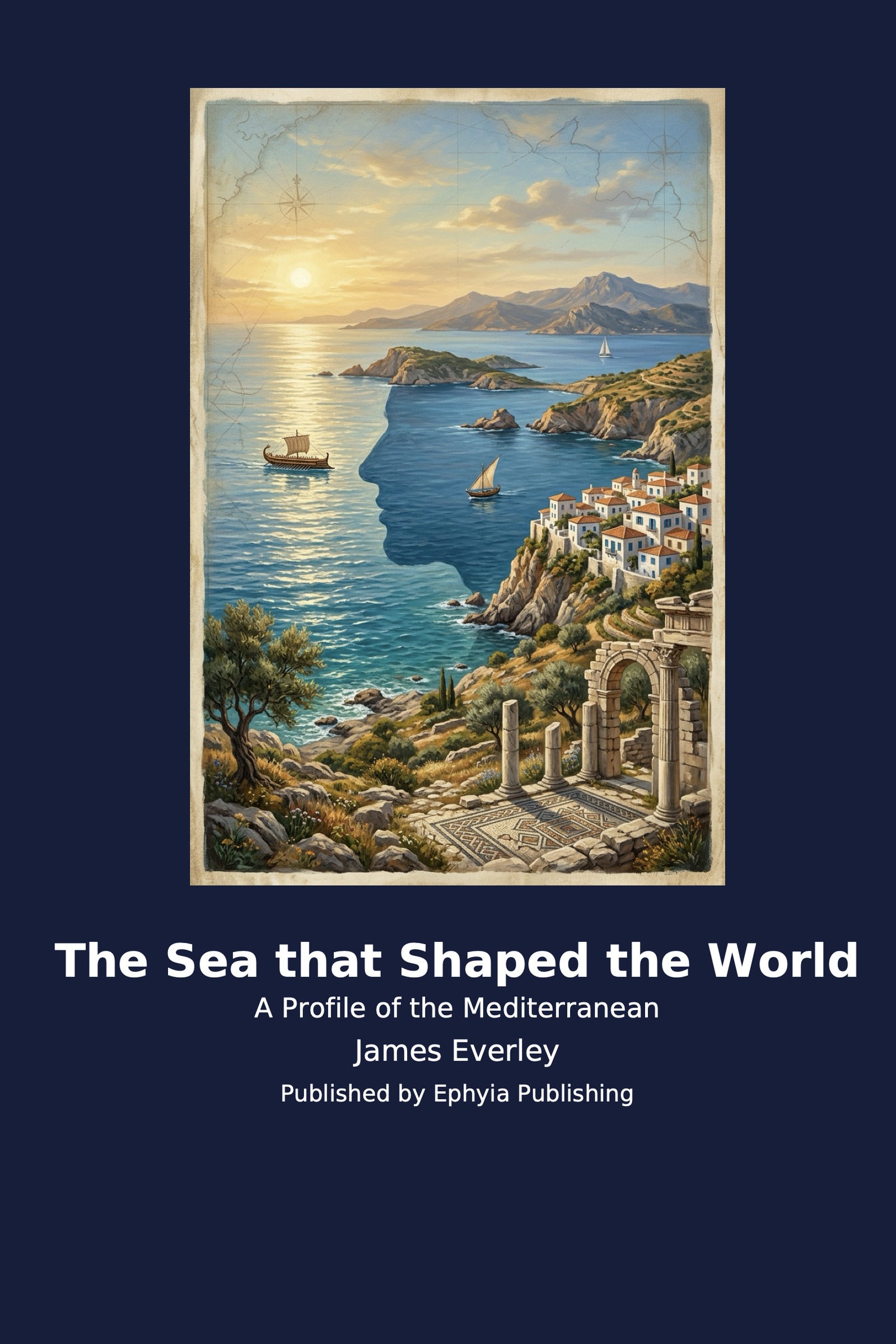
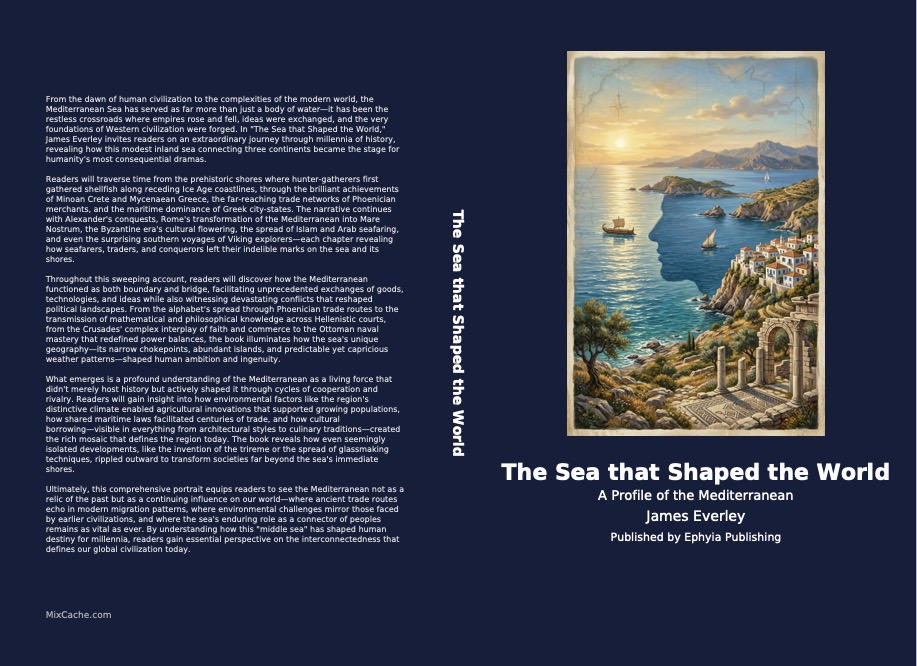
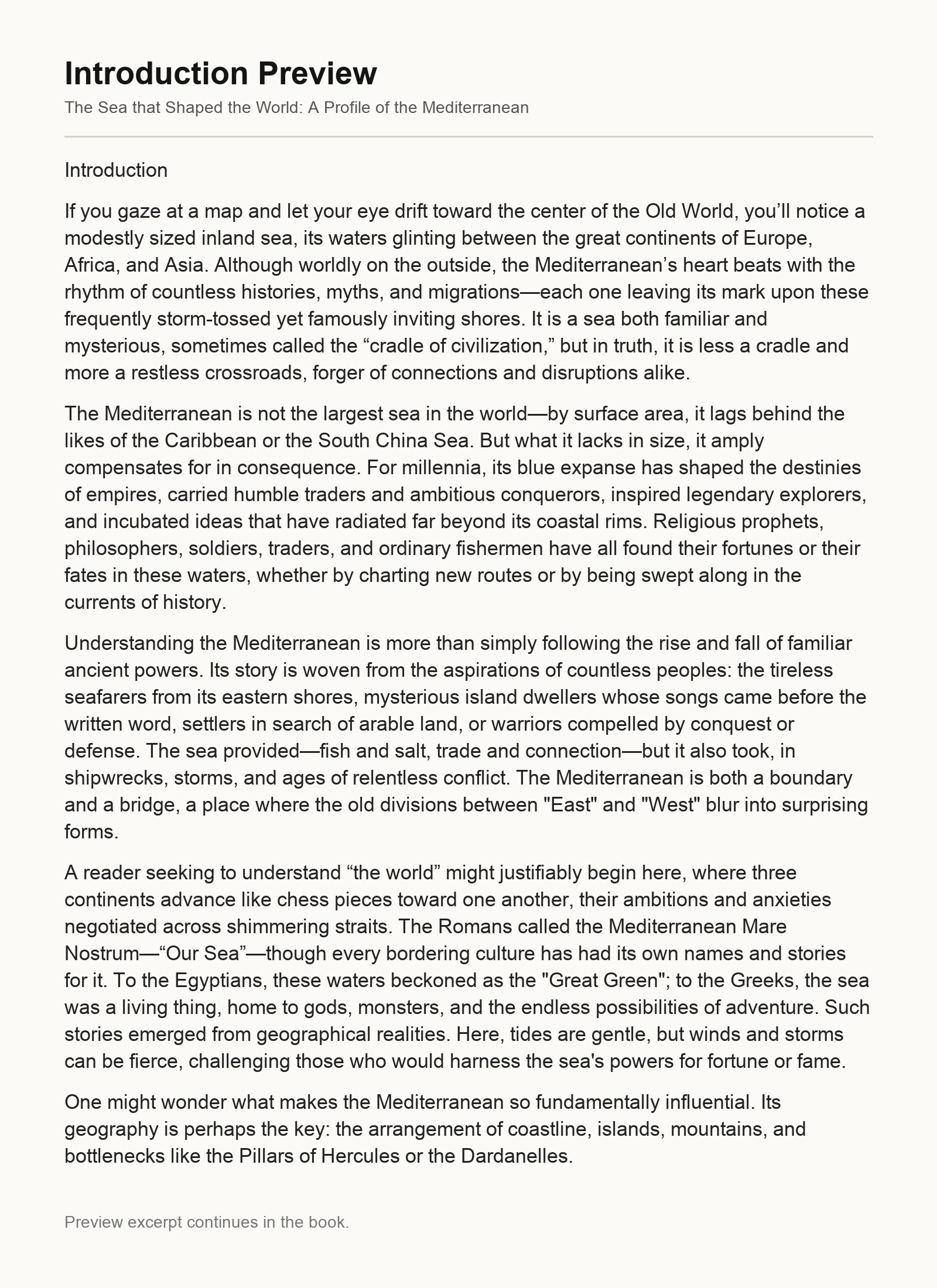
From the dawn of human civilization to the complexities of the modern world, the Mediterranean Sea has served as far more than just a body of water—it has been the restless crossroads where empires rose and fell, ideas were exchanged, and the very foundations of Western civilization were forged. In "The Sea that Shaped the World," James Everley invites readers on an extraordinary journey through millennia of history, revealing how this modest inland sea connecting three continents became the stage for humanity's most consequential dramas.
Readers will traverse time from the prehistoric shores where hunter-gatherers first gathered shellfish along receding Ice Age coastlines, through the brilliant achievements of Minoan Crete and Mycenaean Greece, the far-reaching trade networks of Phoenician merchants, and the maritime dominance of Greek city-states. The narrative continues with Alexander's conquests, Rome's transformation of the Mediterranean into Mare Nostrum, the Byzantine era's cultural flowering, the spread of Islam and Arab seafaring, and even the surprising southern voyages of Viking explorers—each chapter revealing how seafarers, traders, and conquerors left their indelible marks on the sea and its shores.
Throughout this sweeping account, readers will discover how the Mediterranean functioned as both boundary and bridge, facilitating unprecedented exchanges of goods, technologies, and ideas while also witnessing devastating conflicts that reshaped political landscapes. From the alphabet's spread through Phoenician trade routes to the transmission of mathematical and philosophical knowledge across Hellenistic courts, from the Crusades' complex interplay of faith and commerce to the Ottoman naval mastery that redefined power balances, the book illuminates how the sea's unique geography—its narrow chokepoints, abundant islands, and predictable yet capricious weather patterns—shaped human ambition and ingenuity.
What emerges is a profound understanding of the Mediterranean as a living force that didn't merely host history but actively shaped it through cycles of cooperation and rivalry. Readers will gain insight into how environmental factors like the region's distinctive climate enabled agricultural innovations that supported growing populations, how shared maritime laws facilitated centuries of trade, and how cultural borrowing—visible in everything from architectural styles to culinary traditions—created the rich mosaic that defines the region today. The book reveals how even seemingly isolated developments, like the invention of the trireme or the spread of glassmaking techniques, rippled outward to transform societies far beyond the sea's immediate shores.
Ultimately, this comprehensive portrait equips readers to see the Mediterranean not as a relic of the past but as a continuing influence on our world—where ancient trade routes echo in modern migration patterns, where environmental challenges mirror those faced by earlier civilizations, and where the sea's enduring role as a connector of peoples remains as vital as ever. By understanding how this "middle sea" has shaped human destiny for millennia, readers gain essential perspective on the interconnectedness that defines our global civilization today.
What You'll Find Inside:
- How the Mediterranean served as a crossroads connecting Europe, Africa, and Asia throughout history
- The sea's pivotal role in the rise and fall of empires from ancient Minoans to modern nations
- Patterns of trade, migration, and cultural exchange that created the Mediterranean's rich mosaic
- Environmental challenges threatening the Mediterranean ecosystem today
- Contemporary geopolitics including migration crises and regional conflicts
Who's It For:
This book is ideal for history students, scholars of Mediterranean studies, and general readers interested in how geography shapes human civilization. It will particularly benefit those seeking to understand current Mediterranean issues through deep historical context, from ancient trade routes to modern migration patterns. Readers interested in cultural anthropology, environmental studies, and international relations will find valuable insights in this comprehensive profile.
Table of Contents:
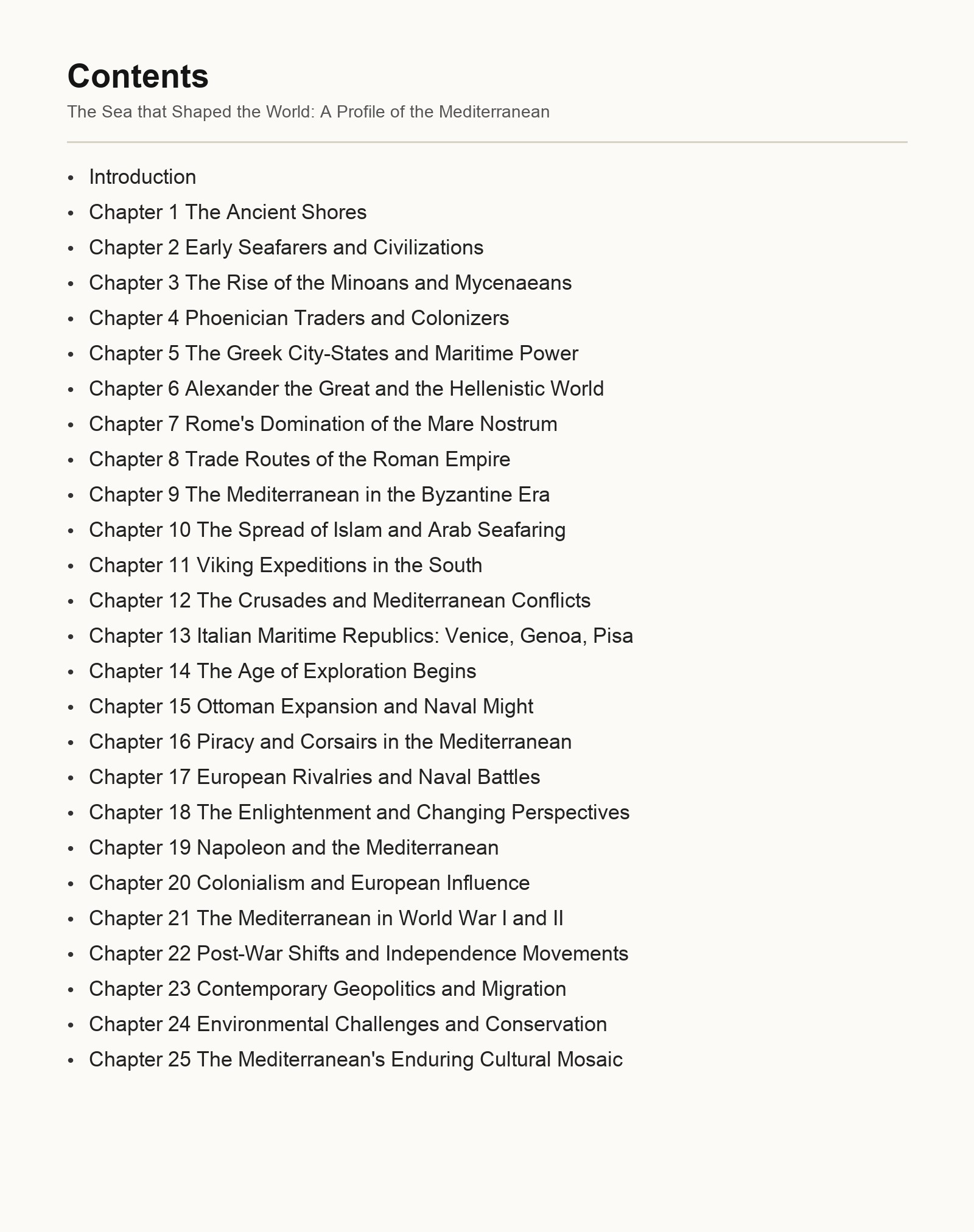
- Introduction
- Chapter 1 The Ancient Shores
- Chapter 2 Early Seafarers and Civilizations
- Chapter 3 The Rise of the Minoans and Mycenaeans
- Chapter 4 Phoenician Traders and Colonizers
- Chapter 5 The Greek City-States and Maritime Power
- Chapter 6 Alexander the Great and the Hellenistic World
- Chapter 7 Rome's Domination of the Mare Nostrum
- Chapter 8 Trade Routes of the Roman Empire
- Chapter 9 The Mediterranean in the Byzantine Era
- Chapter 10 The Spread of Islam and Arab Seafaring
- Chapter 11 Viking Expeditions in the South
- Chapter 12 The Crusades and Mediterranean Conflicts
- Chapter 13 Italian Maritime Republics: Venice, Genoa, Pisa
- Chapter 14 The Age of Exploration Begins
- Chapter 15 Ottoman Expansion and Naval Might
- Chapter 16 Piracy and Corsairs in the Mediterranean
- Chapter 17 European Rivalries and Naval Battles
- Chapter 18 The Enlightenment and Changing Perspectives
- Chapter 19 Napoleon and the Mediterranean
- Chapter 20 Colonialism and European Influence
- Chapter 21 The Mediterranean in World War I and II
- Chapter 22 Post-War Shifts and Independence Movements
- Chapter 23 Contemporary Geopolitics and Migration
- Chapter 24 Environmental Challenges and Conservation
- Chapter 25 The Mediterranean's Enduring Cultural Mosaic
Author:
Published By:
Date Published:
May 24, 2026
Type:
Nonfiction
Language:
English
Also Available In:
German, Spanish, French, Portuguese
Word Count:
72,512 words
Reading Time:
5 hours 5 minutes
Sample:
Order:
Order The Sea that Shaped the World (Hardcover) on MixCache.com:
Buy NowPrint copy is made to order and ships worldwide. Includes the ebook free, ready to read instantly.
$5 account credit for all new MixCache.com accounts, usable toward any ebook purchase!*