Browse by Category
Fiction
- Action & Adventure
- African American
- Anthologies
- Children's Fiction
- Classics
- Comics & Graphic Novels
- Coming of Age
- Contemporary
- Cultural & Regional
- Drama
- Erotica
- Fantasy
- General
- Historical Fiction
- Horror
- Humor & Satire
- Literary Fiction
- Mystery, Thriller & Suspense
- Poetry
- Religious & Inspirational
- Romance
- Science Fiction
- Short Stories
- War & Military
- Westerns
- Women's Fiction
- Young Adult
Non-Fiction
- Antiques & Collectibles
- Arts & Photography
- Biographies & Memoirs
- Business & Money
- Children's Non-Fiction
-
Computers & Technology
- Artificial Intelligence
- Computer Science
- Cybersecurity & Cryptography
- Data Science & Analytics
- Databases & Big Data
- Game Development & Design
- General
- Hardware & DIY
- Mobile App Development
- Networking & Cloud Computing
- Operating Systems
- Programming
- Robotics
- Software
- Software Engineering
- User Experience (UX) & Design
- Web Development & Design
- Cooking, Food & Wine
- Crafts, Hobbies & Home
- Education & Teaching
- Engineering
- General
- Health, Fitness & Dieting
-
History
- African History
- African History - North Africa
- African History - Sub-Saharan Africa
- American History
- American History - 20th Century
- American History - Civil War
- American History - Colonial Period
- Ancient History
- Asian History
- Asian History - China
- Asian History - India
- Asian History - Japan
- Asian History - Southeast Asia
- European History
- European History - Ancient Greece
- European History - Ancient Rome
- European History - Medieval
- European History - Modern
- European History - Renaissance
- General
- Middle Eastern History
- Military History
- Military History - Aviation
- Military History - Naval
- Social & Cultural History
- World History
- Humor & Entertainment
- Industrial Technology
- Language Learning
- Law
- LGBTQ+ Non-Fiction
- Literary Criticism
- Medical Books
- Parenting & Relationships
- Philosophy
- Politics & Social Sciences
- Reference
- Religion & Spirituality
-
Science & Math
- Agricultural Sciences
- Astronomy & Space Science
- Behavioral Sciences
- Biological Sciences
- Botany & Plant Science
- Chemistry
- Earth Sciences
- Engineering - Chemical
- Engineering - Civil
- Engineering - Electrical
- Engineering - Mechanical
- Environment
- General
- Geology
- Mathematics
- Nature & Ecology
- Oceanography
- Paleontology
- Physics
- Statistics
- Self-Help
- Sports & Outdoors
- Study Aids
- Sustainability & Green Living
- Textbooks
- Transportation
- Travel
- True Crime
- Urban Planning & Development
- Veterinary Medicine
- Writing & Publishing
Jump to Section
MixCache.com Total Access
Unlimited reading and audiobooks for every book published by MixCache.com.
Included titles carry the MTA badge.
Learn more →The Case For A Consumption Tax
About this book:



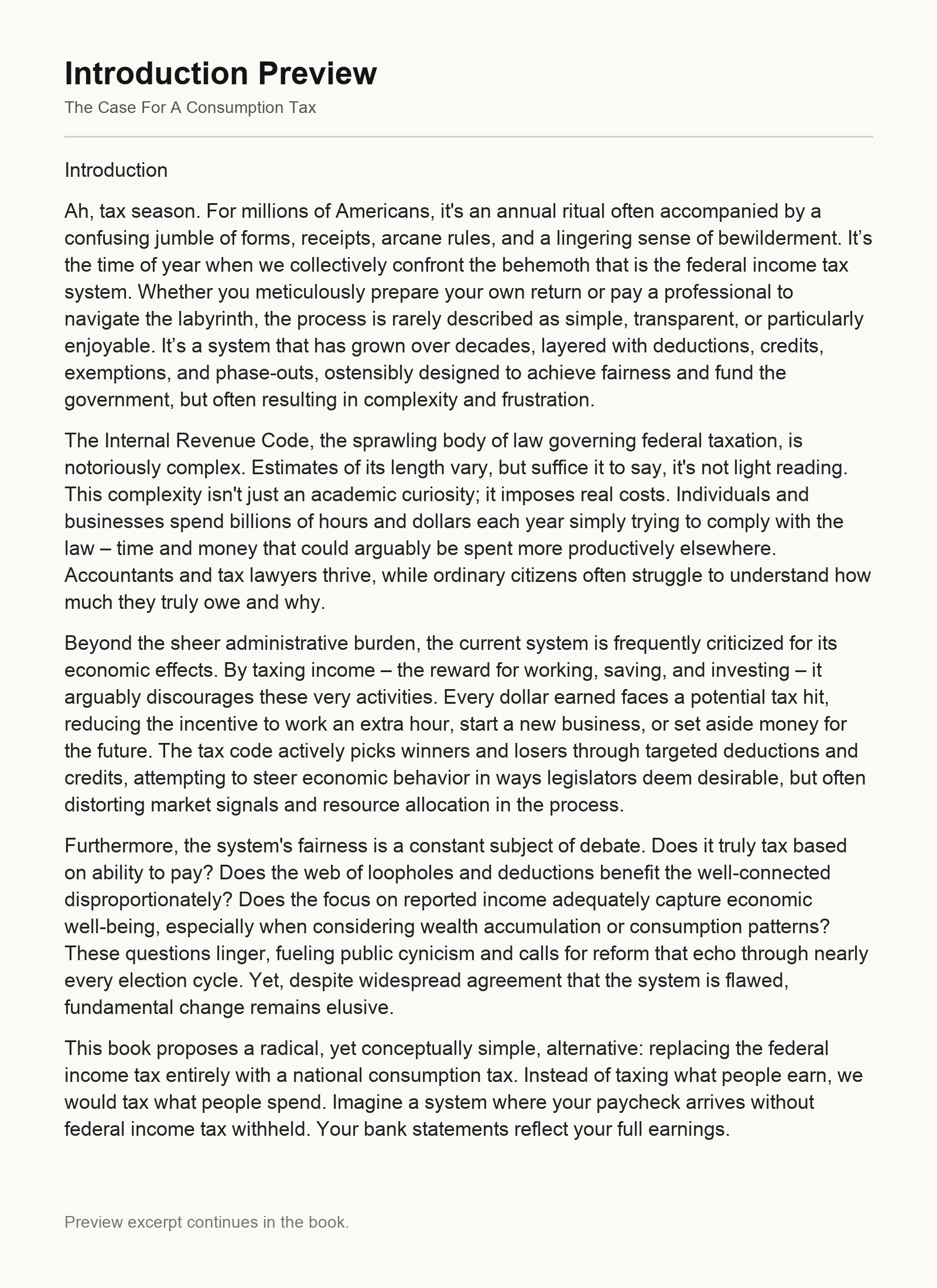
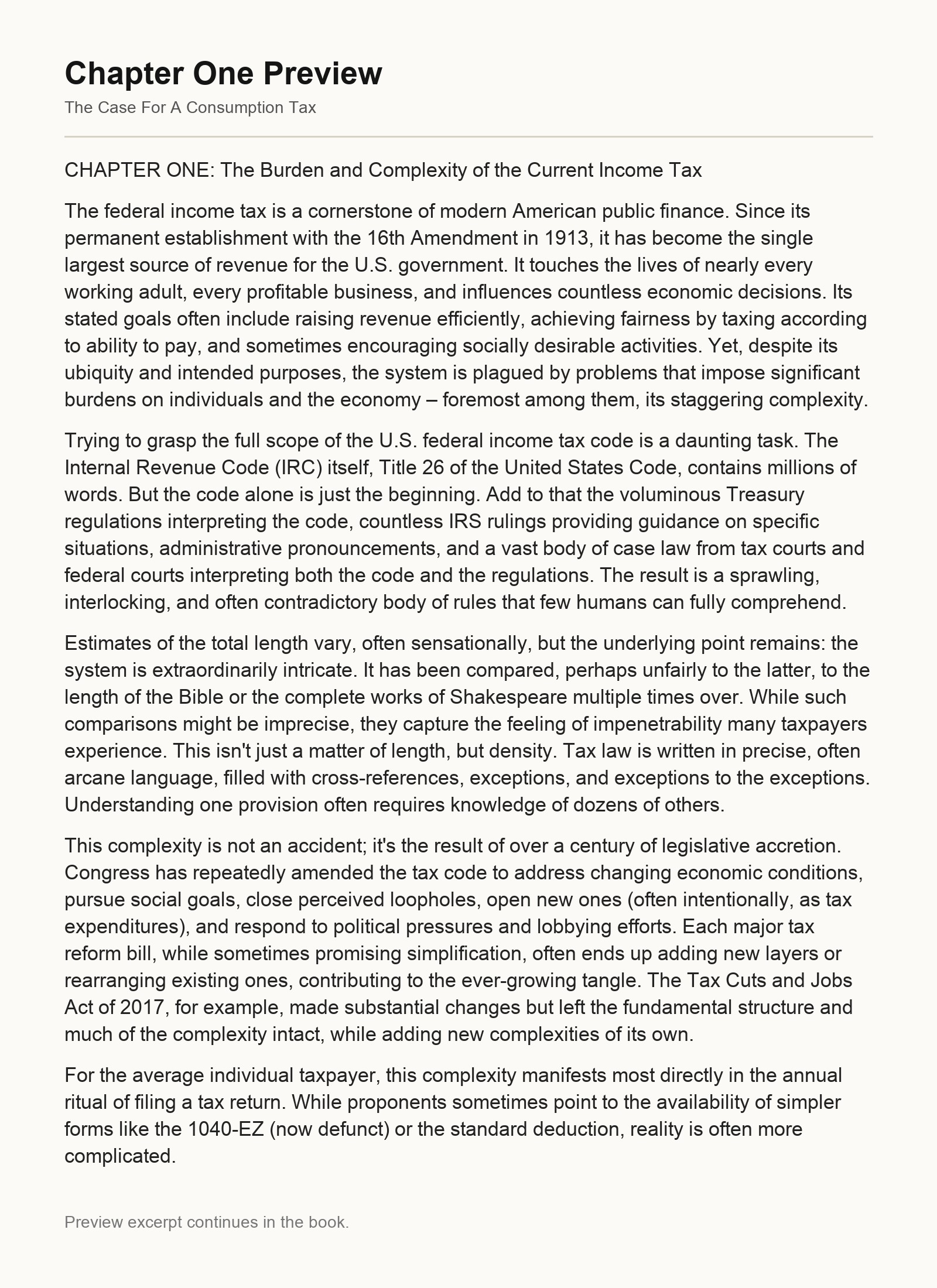
This book presents a thorough examination of replacing the federal income tax with a national consumption tax, guiding readers through the fundamental reasons why many economists and policymakers see this shift as a promising path forward. It begins by detailing the overwhelming complexity, compliance burdens, and economic distortions of the current income tax system, showing how layers of deductions, credits, and rules create costly headaches for individuals and businesses while obscuring the true cost of government. By laying out these problems in clear, accessible terms, the text sets the stage for understanding why a radical change in the tax base might be warranted.
Readers will then explore the core economic arguments that favor taxing spending rather than earning, learning how a consumption tax removes the bias against saving and investment, thereby encouraging capital formation, boosting productivity, and supporting long‑term growth. The book explains how such a system can simplify tax filing for most households, increase transparency by making the tax visible at the point of sale, and reduce the drag of complex tax planning that diverts resources from productive activities. Real‑world examples and economic models illustrate the potential for higher wages, stronger business investment, and a more efficient allocation of capital across the economy.
A major focus of the work is the fairness debate, especially the concern that consumption taxes place a heavier relative burden on lower‑income earners. The book walks readers through the design tools—such as a universal rebate tied to the poverty line, targeted exemptions, or multiple tax rates—that can transform a flat consumption tax into a progressive system. It shows how these mechanisms can protect essential spending, ensure that low‑income families pay little or no net tax, and still collect sufficient revenue from higher levels of consumption, addressing the regressivity critique head‑on while maintaining economic neutrality.
The text also provides a detailed comparison of the three primary consumption tax models under consideration: a national retail sales tax, a value‑added tax, and a consumption‑based flat tax. Readers will learn how each model works in practice, the administrative implications for businesses and individuals, the role of border adjustments in international trade, and the challenges of transitioning from the existing income tax—including the treatment of existing savings, debt, and assets. Chapters on revenue neutrality, sector‑specific impacts on housing, healthcare, and education, and lessons from other countries’ experiences give a comprehensive view of what a reformed system would look like and what trade‑offs must be managed.
By the end of the book, readers will have gained the knowledge needed to evaluate the case for a consumption tax critically and independently. They will understand the potential benefits for economic growth and simplicity, the methods for ensuring fairness and progressivity, the practical hurdles of implementation, and the ways in which such a reform could affect everything from household budgets to global competitiveness. This deep dive equips anyone interested in fiscal policy—whether skeptic, supporter, or simply curious—to engage with the debate on solid ground and to envision what a fundamentally different approach to funding the federal government might mean for America’s economic future.
What You'll Find Inside:
- The fundamental problems with the current federal income tax system: its staggering complexity, massive compliance costs, and economic distortions that discourage work, saving, and investment.
- How consumption taxes function and their primary variants: National Retail Sales Tax (NRST), Value-Added Tax (VAT), and consumption-based Flat Tax models, including their collection mechanisms and design features.
- The economic growth case: why taxing consumption rather than income removes penalties on saving and investment, thereby boosting capital formation, productivity, and long-term prosperity.
- Addressing the regressivity concern: how universal rebates (prebates) and other design elements can transform a consumption tax into a progressive system that protects low- and middle-income households.
- Critical implementation considerations: transition challenges from the current system, international lessons from VAT adoption worldwide, and impacts on key sectors like housing, healthcare, and education.
Who's It For:
This book is primarily intended for policymakers, tax professionals, economists, and informed citizens engaged in tax policy debates. It provides a comprehensive analysis suitable for those with some background in economics or public policy who want to understand the theoretical foundations, practical design considerations, and potential impacts of replacing the federal income tax with a consumption tax system in the United States.
Table of Contents:
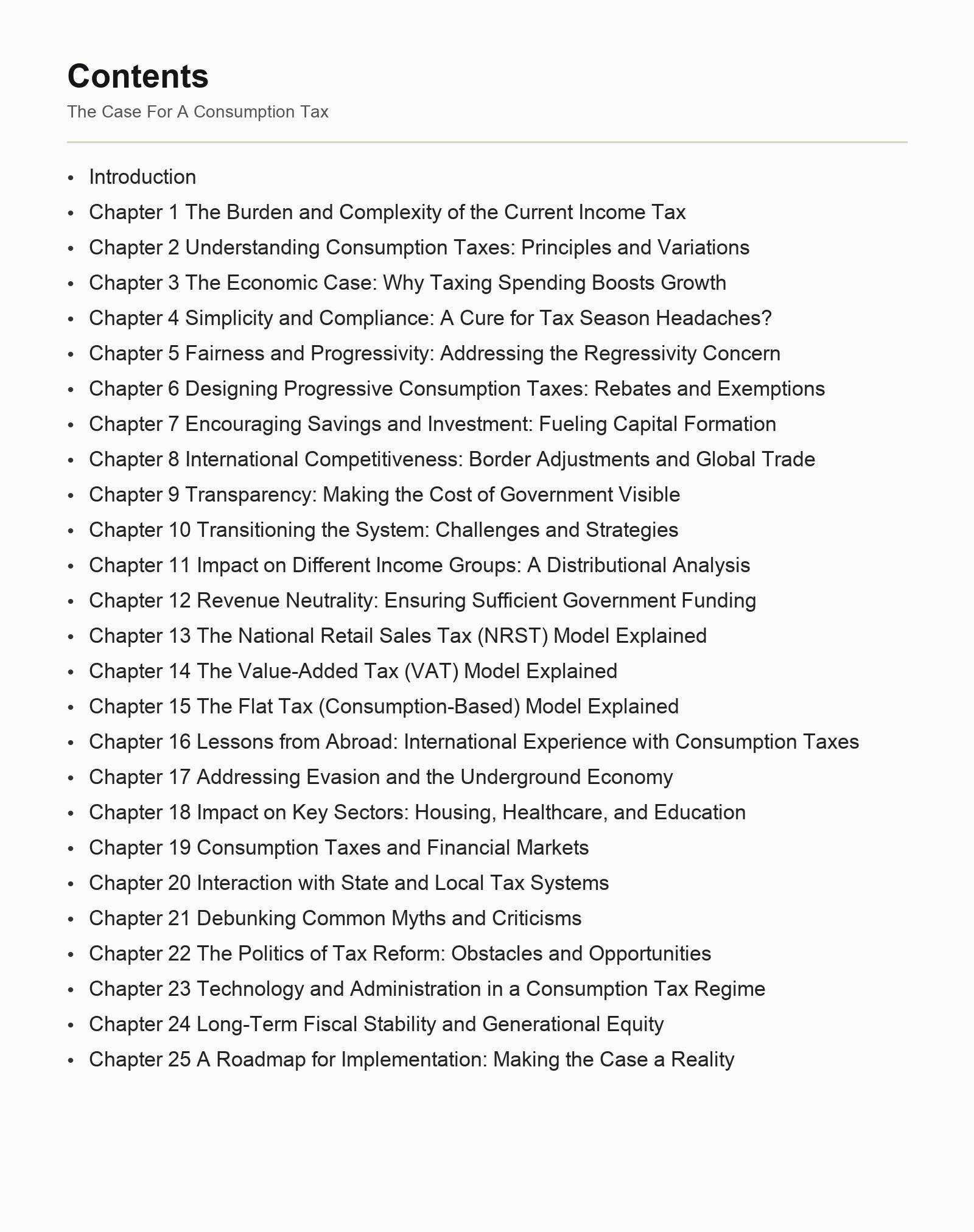
- Introduction
- Chapter 1 The Burden and Complexity of the Current Income Tax
- Chapter 2 Understanding Consumption Taxes: Principles and Variations
- Chapter 3 The Economic Case: Why Taxing Spending Boosts Growth
- Chapter 4 Simplicity and Compliance: A Cure for Tax Season Headaches?
- Chapter 5 Fairness and Progressivity: Addressing the Regressivity Concern
- Chapter 6 Designing Progressive Consumption Taxes: Rebates and Exemptions
- Chapter 7 Encouraging Savings and Investment: Fueling Capital Formation
- Chapter 8 International Competitiveness: Border Adjustments and Global Trade
- Chapter 9 Transparency: Making the Cost of Government Visible
- Chapter 10 Transitioning the System: Challenges and Strategies
- Chapter 11 Impact on Different Income Groups: A Distributional Analysis
- Chapter 12 Revenue Neutrality: Ensuring Sufficient Government Funding
- Chapter 13 The National Retail Sales Tax (NRST) Model Explained
- Chapter 14 The Value-Added Tax (VAT) Model Explained
- Chapter 15 The Flat Tax (Consumption-Based) Model Explained
- Chapter 16 Lessons from Abroad: International Experience with Consumption Taxes
- Chapter 17 Addressing Evasion and the Underground Economy
- Chapter 18 Impact on Key Sectors: Housing, Healthcare, and Education
- Chapter 19 Consumption Taxes and Financial Markets
- Chapter 20 Interaction with State and Local Tax Systems
- Chapter 21 Debunking Common Myths and Criticisms
- Chapter 22 The Politics of Tax Reform: Obstacles and Opportunities
- Chapter 23 Technology and Administration in a Consumption Tax Regime
- Chapter 24 Long-Term Fiscal Stability and Generational Equity
- Chapter 25 A Roadmap for Implementation: Making the Case a Reality
Author:
Published By:
Date Published:
May 23, 2026
Type:
Nonfiction
Language:
English
Also Available In:
Word Count:
54,384 words
Reading Time:
3 hours 49 minutes
Sample:
Order:
Order The Case For A Consumption Tax (Hardcover) on MixCache.com:
Buy NowPrint copy is made to order and ships worldwide. Includes the ebook free, ready to read instantly.
$5 account credit for all new MixCache.com accounts, usable toward any ebook purchase!*