Browse by Category
Fiction
- Action & Adventure
- African American
- Anthologies
- Children's Fiction
- Classics
- Comics & Graphic Novels
- Coming of Age
- Contemporary
- Cultural & Regional
- Drama
- Erotica
- Fantasy
- General
- Historical Fiction
- Horror
- Humor & Satire
- Literary Fiction
- Mystery, Thriller & Suspense
- Poetry
- Religious & Inspirational
- Romance
- Science Fiction
- Short Stories
- War & Military
- Westerns
- Women's Fiction
- Young Adult
Non-Fiction
- Antiques & Collectibles
- Arts & Photography
- Biographies & Memoirs
- Business & Money
- Children's Non-Fiction
-
Computers & Technology
- Artificial Intelligence
- Computer Science
- Cybersecurity & Cryptography
- Data Science & Analytics
- Databases & Big Data
- Game Development & Design
- General
- Hardware & DIY
- Mobile App Development
- Networking & Cloud Computing
- Operating Systems
- Programming
- Robotics
- Software
- Software Engineering
- User Experience (UX) & Design
- Web Development & Design
- Cooking, Food & Wine
- Crafts, Hobbies & Home
- Education & Teaching
- Engineering
- General
- Health, Fitness & Dieting
-
History
- African History
- African History - North Africa
- African History - Sub-Saharan Africa
- American History
- American History - 20th Century
- American History - Civil War
- American History - Colonial Period
- Ancient History
- Asian History
- Asian History - China
- Asian History - India
- Asian History - Japan
- Asian History - Southeast Asia
- European History
- European History - Ancient Greece
- European History - Ancient Rome
- European History - Medieval
- European History - Modern
- European History - Renaissance
- General
- Middle Eastern History
- Military History
- Military History - Aviation
- Military History - Naval
- Social & Cultural History
- World History
- Humor & Entertainment
- Industrial Technology
- Language Learning
- Law
- LGBTQ+ Non-Fiction
- Literary Criticism
- Medical Books
- Parenting & Relationships
- Philosophy
- Politics & Social Sciences
- Reference
- Religion & Spirituality
-
Science & Math
- Agricultural Sciences
- Astronomy & Space Science
- Behavioral Sciences
- Biological Sciences
- Botany & Plant Science
- Chemistry
- Earth Sciences
- Engineering - Chemical
- Engineering - Civil
- Engineering - Electrical
- Engineering - Mechanical
- Environment
- General
- Geology
- Mathematics
- Nature & Ecology
- Oceanography
- Paleontology
- Physics
- Statistics
- Self-Help
- Sports & Outdoors
- Study Aids
- Sustainability & Green Living
- Textbooks
- Transportation
- Travel
- True Crime
- Urban Planning & Development
- Veterinary Medicine
- Writing & Publishing
Jump to Section
MixCache.com Total Access
Unlimited reading and audiobooks for every book published by MixCache.com.
Included titles carry the MTA badge.
Learn more →
The Ancient History Of Malta
A History of the Maltese Islands up to the Middle Ages
About this book:
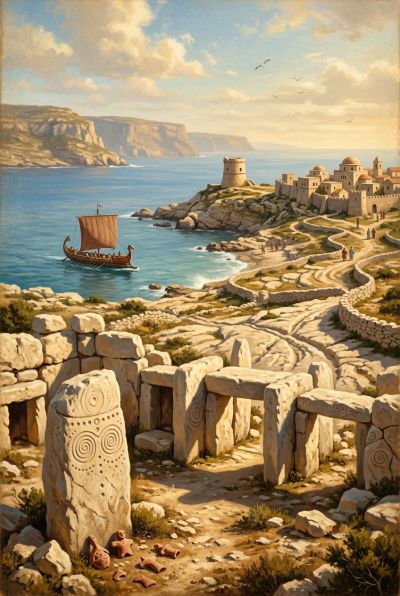
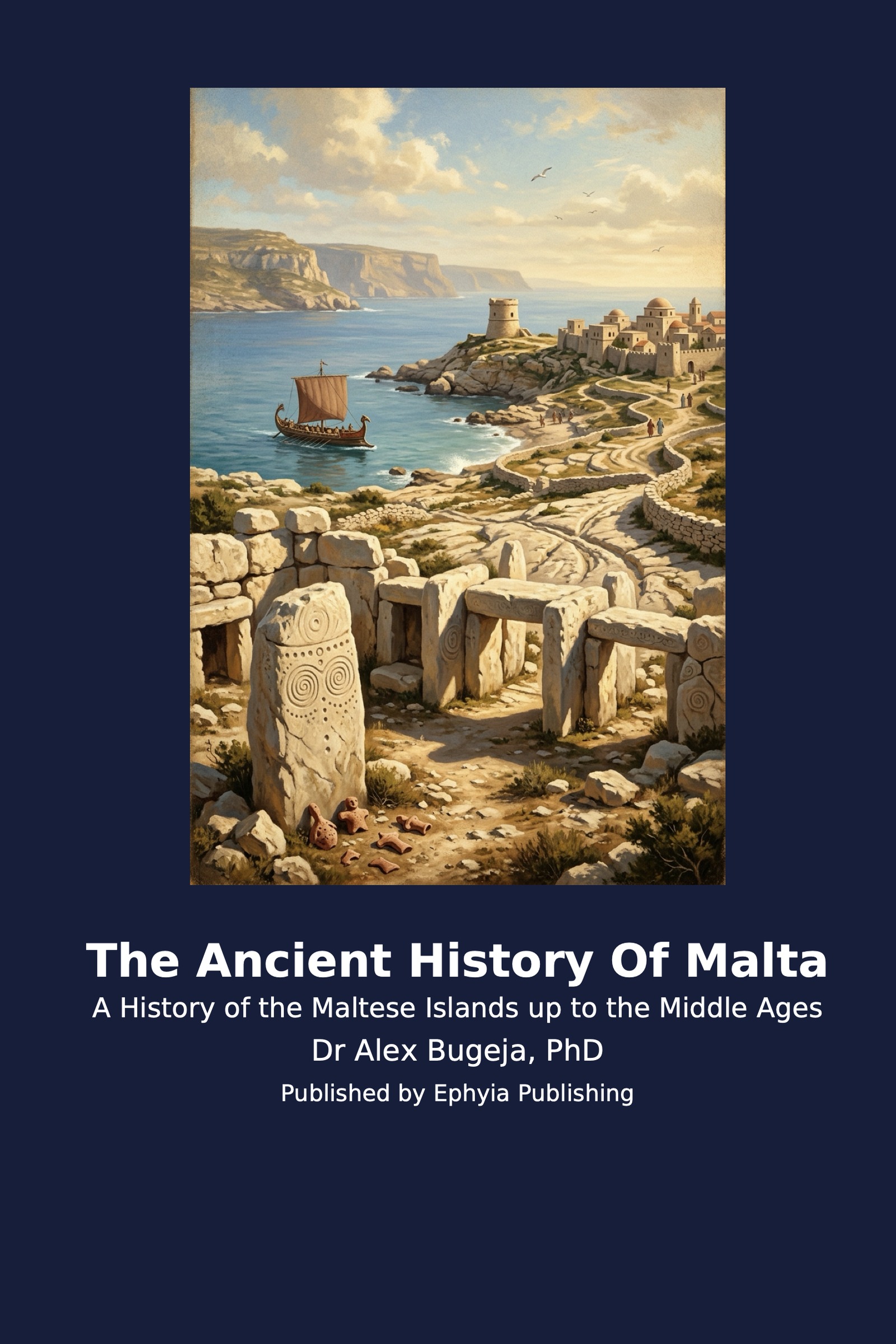
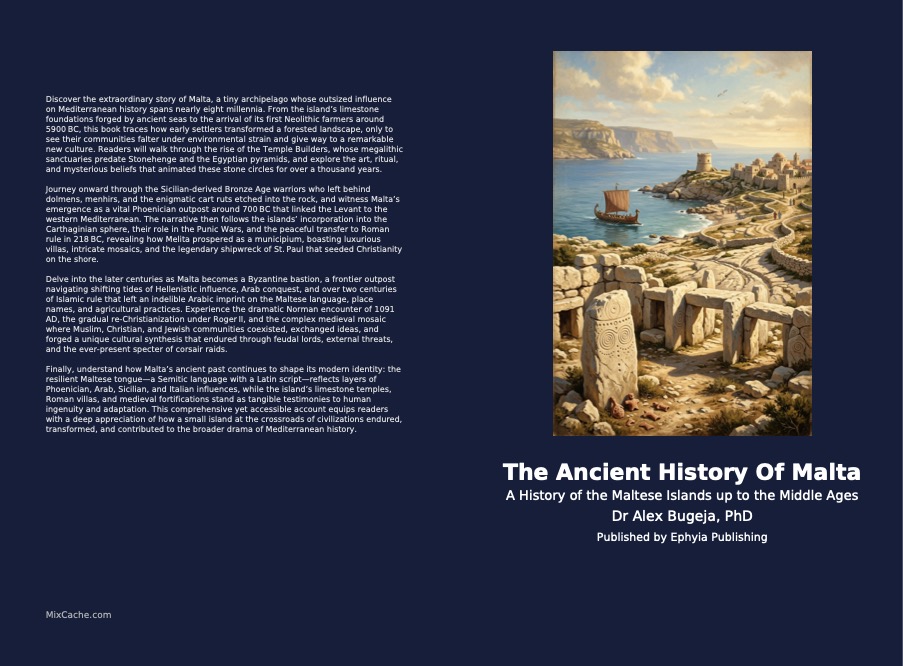
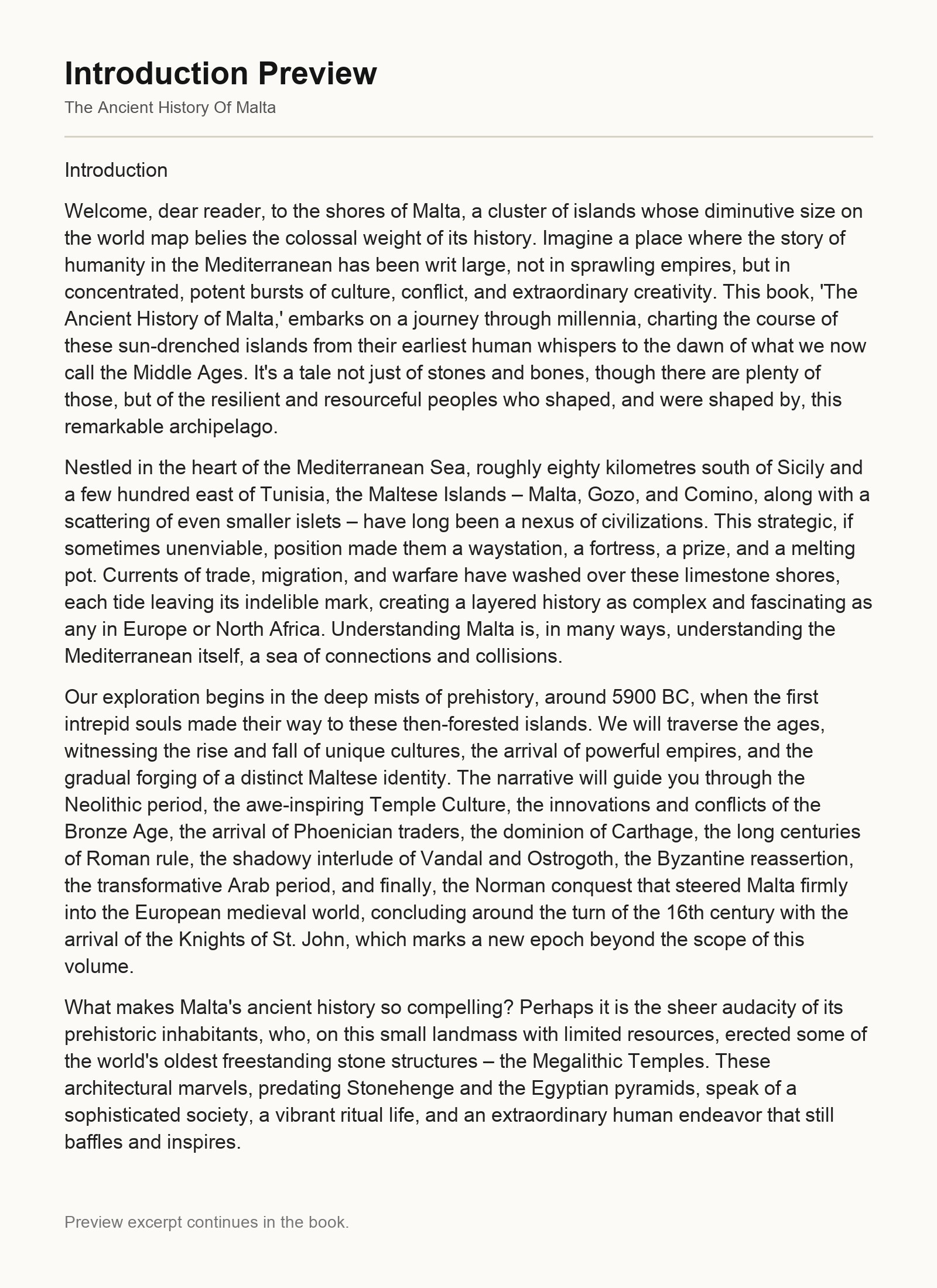
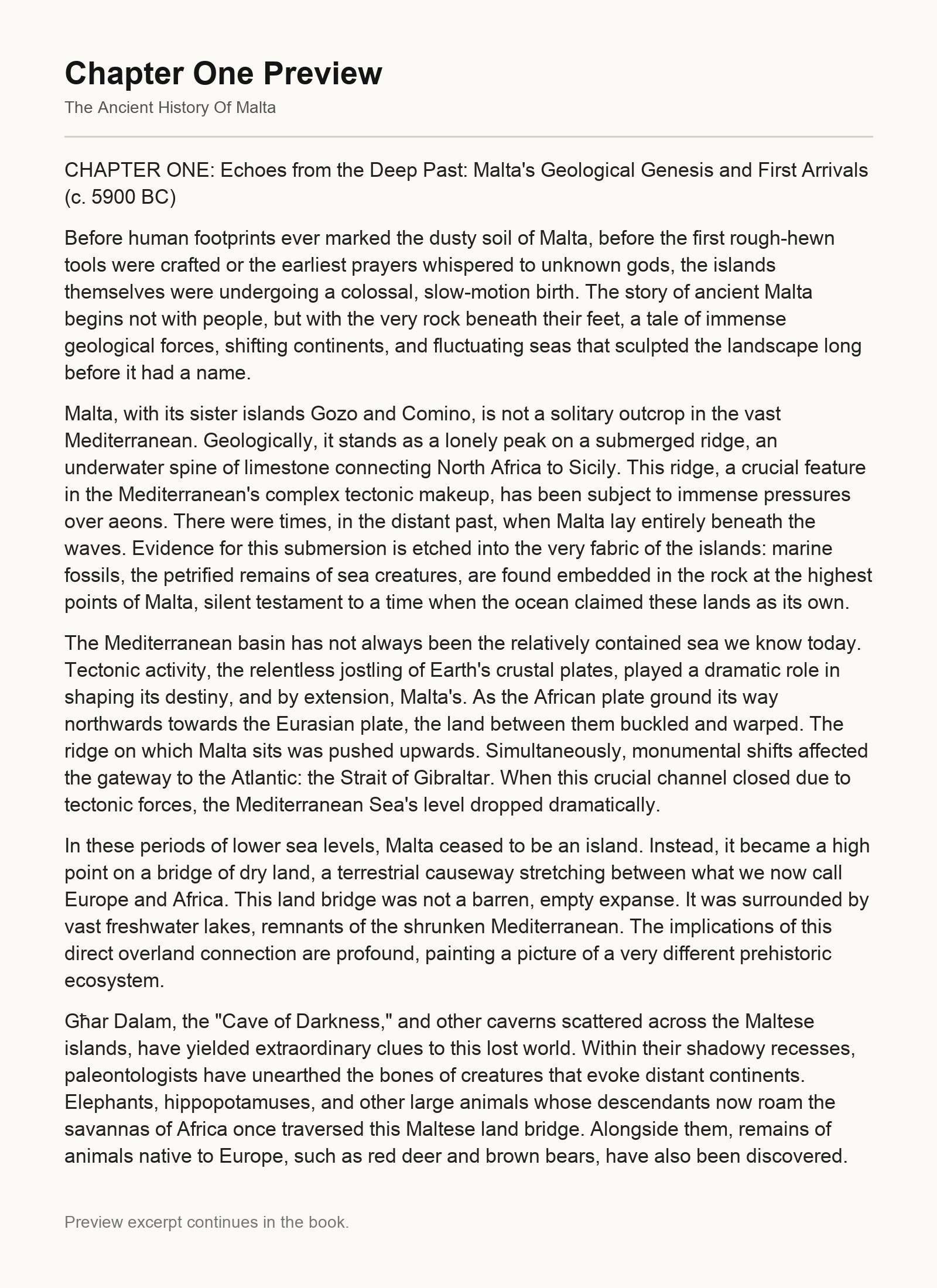
Discover the extraordinary story of Malta, a tiny archipelago whose outsized influence on Mediterranean history spans nearly eight millennia. From the island’s limestone foundations forged by ancient seas to the arrival of its first Neolithic farmers around 5900 BC, this book traces how early settlers transformed a forested landscape, only to see their communities falter under environmental strain and give way to a remarkable new culture. Readers will walk through the rise of the Temple Builders, whose megalithic sanctuaries predate Stonehenge and the Egyptian pyramids, and explore the art, ritual, and mysterious beliefs that animated these stone circles for over a thousand years.
Journey onward through the Sicilian‑derived Bronze Age warriors who left behind dolmens, menhirs, and the enigmatic cart ruts etched into the rock, and witness Malta’s emergence as a vital Phoenician outpost around 700 BC that linked the Levant to the western Mediterranean. The narrative then follows the islands’ incorporation into the Carthaginian sphere, their role in the Punic Wars, and the peaceful transfer to Roman rule in 218 BC, revealing how Melita prospered as a municipium, boasting luxurious villas, intricate mosaics, and the legendary shipwreck of St. Paul that seeded Christianity on the shore.
Delve into the later centuries as Malta becomes a Byzantine bastion, a frontier outpost navigating shifting tides of Hellenistic influence, Arab conquest, and over two centuries of Islamic rule that left an indelible Arabic imprint on the Maltese language, place names, and agricultural practices. Experience the dramatic Norman encounter of 1091 AD, the gradual re‑Christianization under Roger II, and the complex medieval mosaic where Muslim, Christian, and Jewish communities coexisted, exchanged ideas, and forged a unique cultural synthesis that endured through feudal lords, external threats, and the ever‑present specter of corsair raids.
Finally, understand how Malta’s ancient past continues to shape its modern identity: the resilient Maltese tongue—a Semitic language with a Latin script—reflects layers of Phoenician, Arab, Sicilian, and Italian influences, while the island’s limestone temples, Roman villas, and medieval fortifications stand as tangible testimonies to human ingenuity and adaptation. This comprehensive yet accessible account equips readers with a deep appreciation of how a small island at the crossroads of civilizations endured, transformed, and contributed to the broader drama of Mediterranean history.
What You'll Find Inside:
- Malta's prehistoric Temple Culture constructed some of the world's oldest freestanding stone monuments (predating Stonehenge and Egyptian pyramids), revealing extraordinary architectural skill and spiritual sophistication.
- The islands' strategic Mediterranean location made them a crossroads of civilizations, experiencing successive rule by Phoenicians, Carthaginians, Romans, Byzantines, Arabs, and Normans, each leaving enduring cultural and linguistic imprints.
- The Maltese language evolved as a unique Semitic tongue with Arabic core, heavily layered with Sicilian/Italian influences and written in Latin script, embodying the island's history of conquest and cultural synthesis.
- Environmental challenges, particularly soil degradation and prolonged drought, were pivotal in the collapse of the prehistoric Temple Culture around 2350 BC, offering timeless lessons about sustainability in fragile island ecosystems.
- Throughout millennia, Maltese communities demonstrated remarkable resilience, adapting to external powers while maintaining a distinct identity, from the Temple Builders' isolation to the medieval coexistence of Muslim and Christian populations.
Who's It For:
This book is ideal for history enthusiasts, archaeology students, and readers with Maltese heritage seeking a comprehensive yet accessible exploration of the island's ancient past. It will particularly appeal to those interested in Mediterranean civilizations, linguistic evolution, and how small island societies navigate major historical currents while maintaining cultural continuity. Both academic readers and educated general audiences will find value in its chronological narrative and thematic analysis of Malta's role as a historical crossroads.
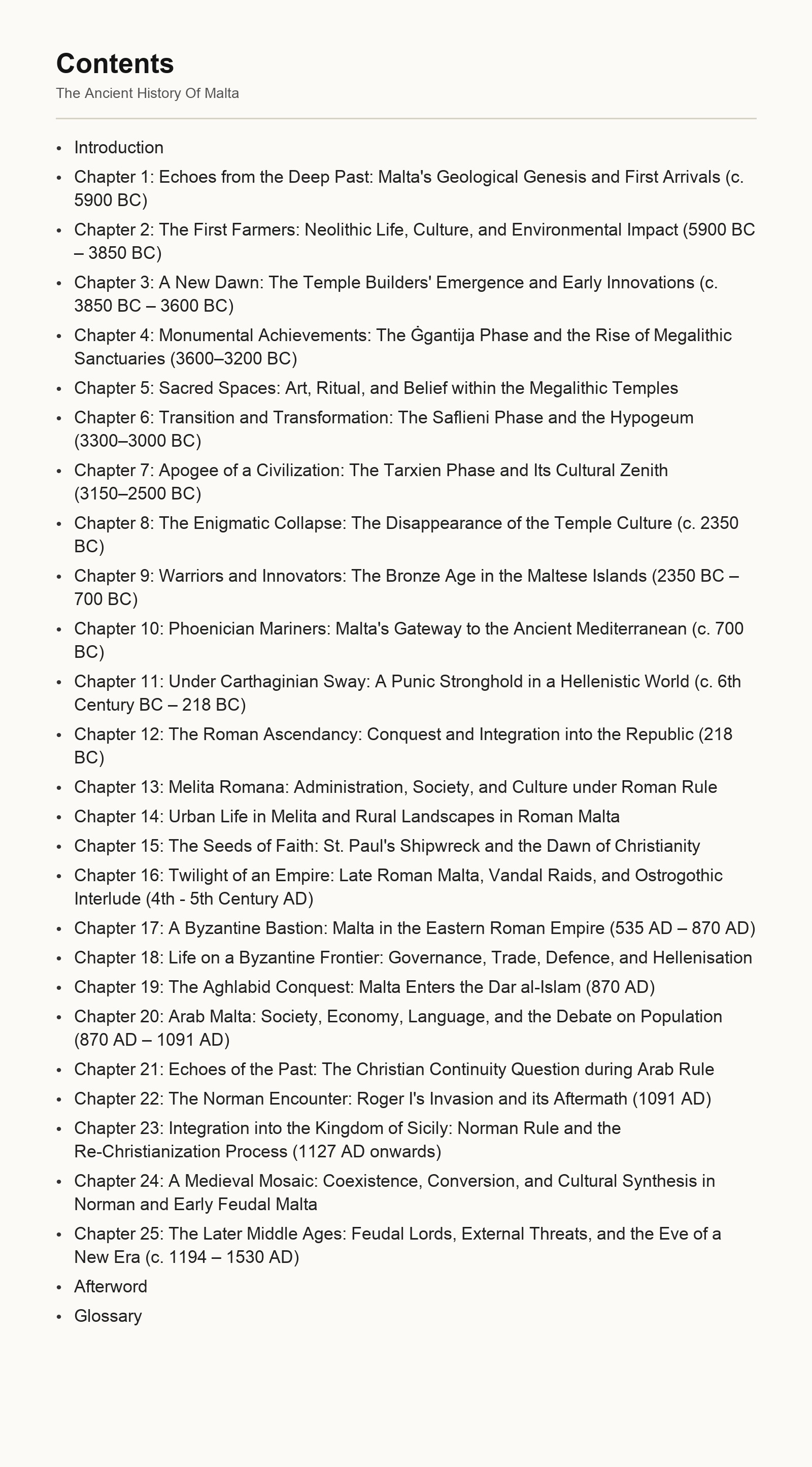
Table of Contents:
- Introduction
- Chapter 1: Echoes from the Deep Past: Malta's Geological Genesis and First Arrivals (c. 5900 BC)
- Chapter 2: The First Farmers: Neolithic Life, Culture, and Environmental Impact (5900 BC – 3850 BC)
- Chapter 3: A New Dawn: The Temple Builders' Emergence and Early Innovations (c. 3850 BC – 3600 BC)
- Chapter 4: Monumental Achievements: The Ġgantija Phase and the Rise of Megalithic Sanctuaries (3600–3200 BC)
- Chapter 5: Sacred Spaces: Art, Ritual, and Belief within the Megalithic Temples
- Chapter 6: Transition and Transformation: The Saflieni Phase and the Hypogeum (3300–3000 BC)
- Chapter 7: Apogee of a Civilization: The Tarxien Phase and Its Cultural Zenith (3150–2500 BC)
- Chapter 8: The Enigmatic Collapse: The Disappearance of the Temple Culture (c. 2350 BC)
- Chapter 9: Warriors and Innovators: The Bronze Age in the Maltese Islands (2350 BC – 700 BC)
- Chapter 10: Phoenician Mariners: Malta's Gateway to the Ancient Mediterranean (c. 700 BC)
- Chapter 11: Under Carthaginian Sway: A Punic Stronghold in a Hellenistic World (c. 6th Century BC – 218 BC)
- Chapter 12: The Roman Ascendancy: Conquest and Integration into the Republic (218 BC)
- Chapter 13: Melita Romana: Administration, Society, and Culture under Roman Rule
- Chapter 14: Urban Life in Melita and Rural Landscapes in Roman Malta
- Chapter 15: The Seeds of Faith: St. Paul's Shipwreck and the Dawn of Christianity
- Chapter 16: Twilight of an Empire: Late Roman Malta, Vandal Raids, and Ostrogothic Interlude (4th - 5th Century AD)
- Chapter 17: A Byzantine Bastion: Malta in the Eastern Roman Empire (535 AD – 870 AD)
- Chapter 18: Life on a Byzantine Frontier: Governance, Trade, Defence, and Hellenisation
- Chapter 19: The Aghlabid Conquest: Malta Enters the Dar al-Islam (870 AD)
- Chapter 20: Arab Malta: Society, Economy, Language, and the Debate on Population (870 AD – 1091 AD)
- Chapter 21: Echoes of the Past: The Christian Continuity Question during Arab Rule
- Chapter 22: The Norman Encounter: Roger I's Invasion and its Aftermath (1091 AD)
- Chapter 23: Integration into the Kingdom of Sicily: Norman Rule and the Re-Christianization Process (1127 AD onwards)
- Chapter 24: A Medieval Mosaic: Coexistence, Conversion, and Cultural Synthesis in Norman and Early Feudal Malta
- Chapter 25: The Later Middle Ages: Feudal Lords, External Threats, and the Eve of a New Era (c. 1194 – 1530 AD)
- Afterword
- Glossary
Author:
Published By:
Date Published:
May 23, 2026
Type:
Nonfiction
Language:
English
Also Available In:
Word Count:
44,150 words
Reading Time:
3 hours 6 minutes
Sample:
Order:
Order The Ancient History Of Malta (Hardcover) on MixCache.com:
Buy NowPrint copy is made to order and ships worldwide. Includes the ebook free, ready to read instantly.
$5 account credit for all new MixCache.com accounts, usable toward any ebook purchase!*