
Browse by Category
Fiction
- Action & Adventure
- African American
- Anthologies
- Children's Fiction
- Classics
- Comics & Graphic Novels
- Coming of Age
- Contemporary
- Cultural & Regional
- Drama
- Erotica
- Fantasy
- General
- Historical Fiction
- Horror
- Humor & Satire
- Literary Fiction
- Mystery, Thriller & Suspense
- Poetry
- Religious & Inspirational
- Romance
- Science Fiction
- Short Stories
- War & Military
- Westerns
- Women's Fiction
- Young Adult
Non-Fiction
- Antiques & Collectibles
- Arts & Photography
- Biographies & Memoirs
- Business & Money
- Children's Non-Fiction
-
Computers & Technology
- Artificial Intelligence
- Computer Science
- Cybersecurity & Cryptography
- Data Science & Analytics
- Databases & Big Data
- Game Development & Design
- General
- Hardware & DIY
- Mobile App Development
- Networking & Cloud Computing
- Operating Systems
- Programming
- Robotics
- Software
- Software Engineering
- User Experience (UX) & Design
- Web Development & Design
- Cooking, Food & Wine
- Crafts, Hobbies & Home
- Education & Teaching
- Engineering
- General
- Health, Fitness & Dieting
-
History
- African History
- African History - North Africa
- African History - Sub-Saharan Africa
- American History
- American History - 20th Century
- American History - Civil War
- American History - Colonial Period
- Ancient History
- Asian History
- Asian History - China
- Asian History - India
- Asian History - Japan
- Asian History - Southeast Asia
- European History
- European History - Ancient Greece
- European History - Ancient Rome
- European History - Medieval
- European History - Modern
- European History - Renaissance
- General
- Middle Eastern History
- Military History
- Military History - Aviation
- Military History - Naval
- Social & Cultural History
- World History
- Humor & Entertainment
- Industrial Technology
- Language Learning
- Law
- LGBTQ+ Non-Fiction
- Literary Criticism
- Medical Books
- Parenting & Relationships
- Philosophy
- Politics & Social Sciences
- Reference
- Religion & Spirituality
-
Science & Math
- Agricultural Sciences
- Astronomy & Space Science
- Behavioral Sciences
- Biological Sciences
- Botany & Plant Science
- Chemistry
- Earth Sciences
- Engineering - Chemical
- Engineering - Civil
- Engineering - Electrical
- Engineering - Mechanical
- Environment
- General
- Geology
- Mathematics
- Nature & Ecology
- Oceanography
- Paleontology
- Physics
- Statistics
- Self-Help
- Sports & Outdoors
- Study Aids
- Sustainability & Green Living
- Textbooks
- Transportation
- Travel
- True Crime
- Urban Planning & Development
- Veterinary Medicine
- Writing & Publishing
Jump to Section
MixCache.com Total Access
Unlimited reading and audiobooks for every book published by MixCache.com.
Included titles carry the MTA badge.
Learn more →A History of the Sahel
About this book:
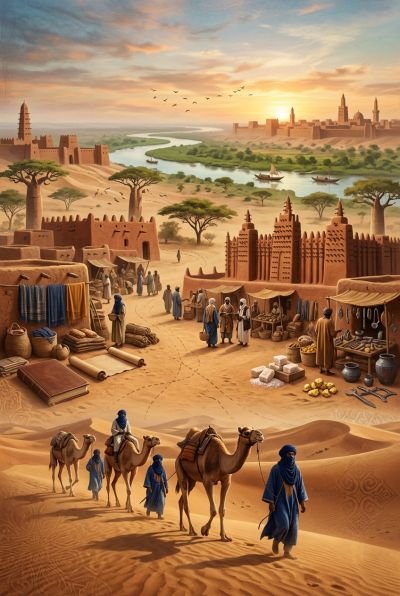
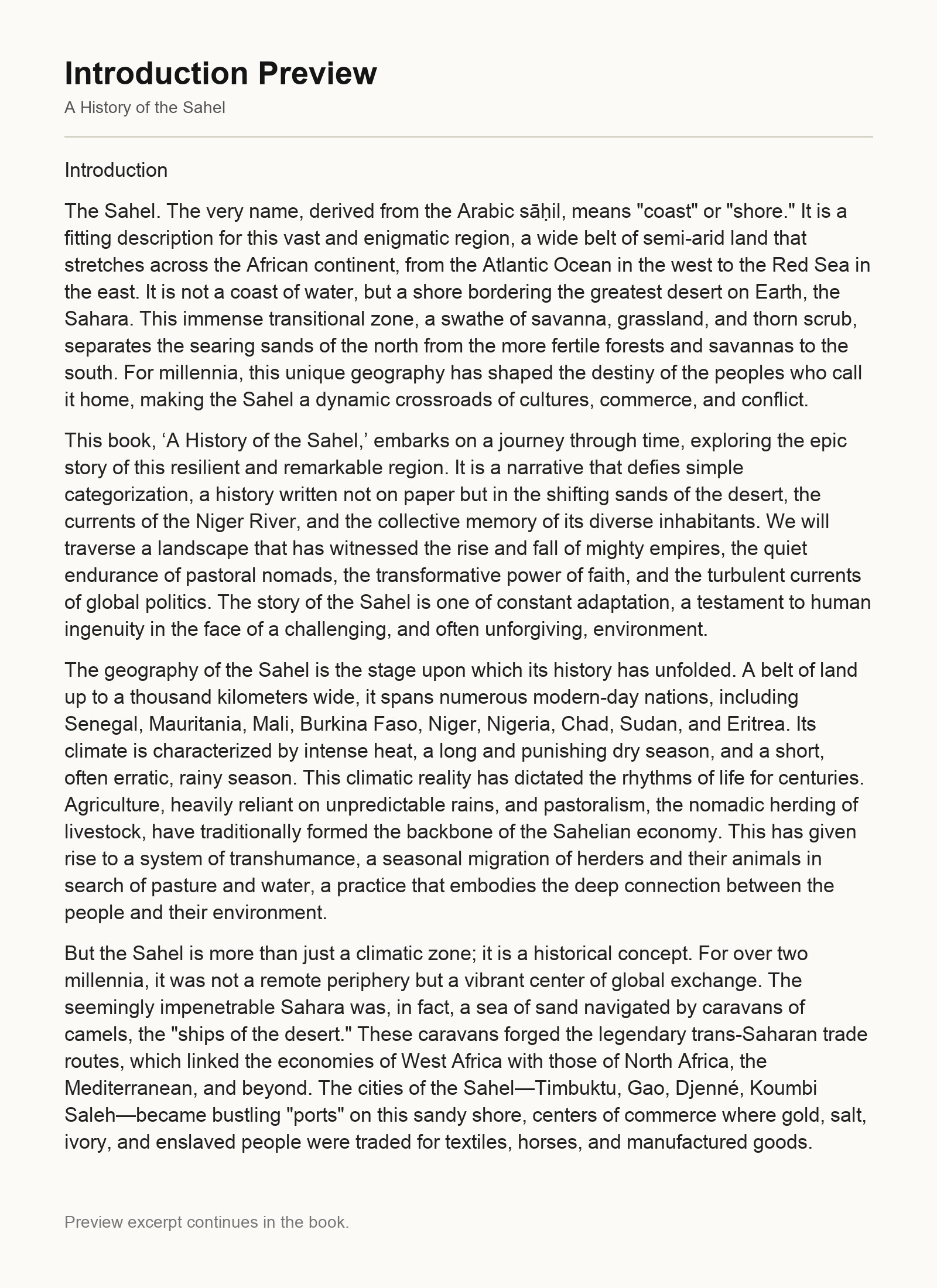
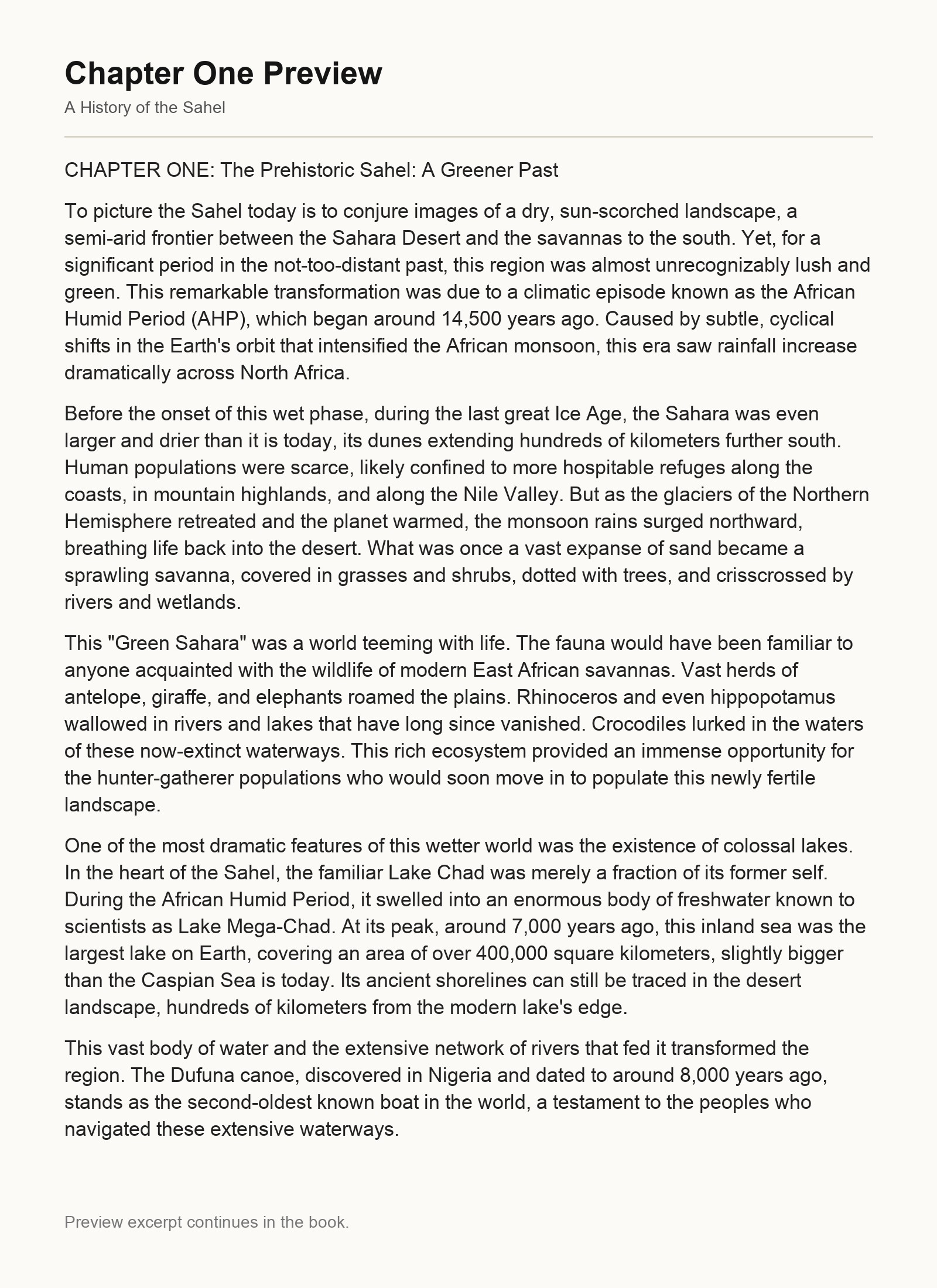
A History of the Sahel invites readers on a sweeping journey across millennia, tracing the region’s transformation from a lush, green savanna during the African Humid Period to the arid belt that frames the Sahara today. The narrative begins with prehistoric hunter‑gatherers, early pastoralists, and the first experiments with pottery and grain domestication, revealing how environmental shifts forged the foundations of Sahelian life. Through vivid archaeological evidence and ancient rock art, the book paints a picture of a once‑wet landscape teeming with elephants, giraffes, and vast lakes, setting the stage for the human adaptations that would echo throughout history.
From these early roots, the work follows the rise and fall of the great Sahelian empires—Ghana, Mali, Songhai, and Kanem‑Bornu—showing how control of trans‑Saharan trade in gold, salt, and ideas built wealthy cities like Timbuktu and Gao into centers of commerce and Islamic scholarship. Readers will encounter legendary figures such as Mansa Musa, Sundiata Keita, and Askia Muhammad, and learn how the caravan routes not only moved goods but also spread faith, technology, and cultural exchange across continents, creating a legacy of interconnected empires that shaped the medieval world.
The story then turns to the tumultuous encounter with European powers, detailing the scramble for Africa, the imposition of colonial borders, and the exploitative systems of taxation and forced labor that reoriented the Sahel’s economies toward export crops and resource extraction. Chapters on post‑colonial independence reveal the hopes and hardships of nation‑building, the struggle with artificial borders, the rise and fall of one‑party states and military coups, and the devastating droughts of the 1970s and 1980s that exposed the fragility of new governments and triggered massive migrations and social upheaval.
In the contemporary era, the book examines the intertwined crises of political instability, jihadist insurgencies, resource competition over oil, uranium, and water, and the disruptive effects of climate change—from erratic rains and desertification to flash floods and the shrinking Lake Chad. Yet it also highlights the resilience of Sahelian peoples: the vibrancy of urban informal economies, the creativity of music, art, and literature, and grassroots innovations like Farmer‑Managed Natural Regeneration and the Great Green Wall that offer hope for a sustainable future. By the end, readers will have gained a deep, nuanced understanding of how geography, trade, faith, conflict, and adaptation have continually reshaped the Sahel, and why this region remains a pivotal frontier of challenge and opportunity in the twenty‑first century.
What You'll Find Inside:
- The Sahel's history spans from a prehistoric 'Green Sahara' to the rise and fall of great empires (Ghana, Mali, Songhai) built on trans-Saharan trade in gold and salt.
- Colonial conquest redrew borders, disrupted traditional economies, and established extractive systems that created lasting dependencies and artificial state boundaries still affecting the region today.
- Post-independence challenges included environmental crises (devastating droughts), political instability (frequent coups), and the rise of radical Islam exploiting state fragility and resource conflicts.
- Contemporary Sahel faces interconnected challenges of climate change, rapid urbanization, youth population boom, and evolving security threats, while demonstrating resilience through local innovations like Farmer-Managed Natural Regeneration.
- The book examines how external interventions (French military operations, international aid) and shifting alliances (from G5 Sahel to AES) have shaped the region's 21st-century trajectory amid competing global interests in its resources.
Who's It For:
This comprehensive history would be valuable for students and scholars of African history, particularly those focusing on the Sahel region. It would also benefit policymakers, development workers, and international relations specialists seeking to understand the deep historical roots of contemporary Sahelian challenges. General readers interested in world history, post-colonial studies, or current events in Africa would find the narrative accessible and informative.
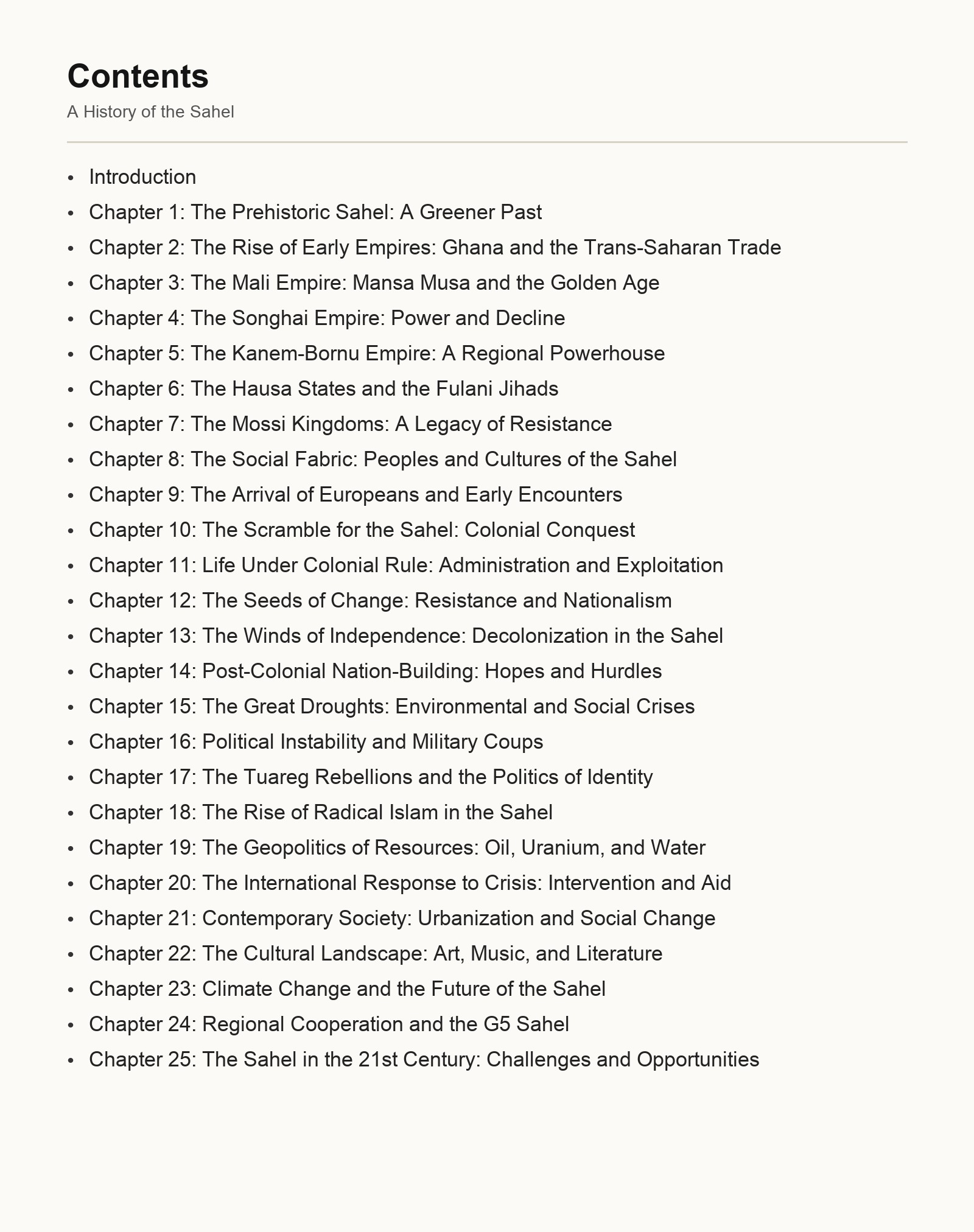
Table of Contents:
- Introduction
- Chapter 1: The Prehistoric Sahel: A Greener Past
- Chapter 2: The Rise of Early Empires: Ghana and the Trans-Saharan Trade
- Chapter 3: The Mali Empire: Mansa Musa and the Golden Age
- Chapter 4: The Songhai Empire: Power and Decline
- Chapter 5: The Kanem-Bornu Empire: A Regional Powerhouse
- Chapter 6: The Hausa States and the Fulani Jihads
- Chapter 7: The Mossi Kingdoms: A Legacy of Resistance
- Chapter 8: The Social Fabric: Peoples and Cultures of the Sahel
- Chapter 9: The Arrival of Europeans and Early Encounters
- Chapter 10: The Scramble for the Sahel: Colonial Conquest
- Chapter 11: Life Under Colonial Rule: Administration and Exploitation
- Chapter 12: The Seeds of Change: Resistance and Nationalism
- Chapter 13: The Winds of Independence: Decolonization in the Sahel
- Chapter 14: Post-Colonial Nation-Building: Hopes and Hurdles
- Chapter 15: The Great Droughts: Environmental and Social Crises
- Chapter 16: Political Instability and Military Coups
- Chapter 17: The Tuareg Rebellions and the Politics of Identity
- Chapter 18: The Rise of Radical Islam in the Sahel
- Chapter 19: The Geopolitics of Resources: Oil, Uranium, and Water
- Chapter 20: The International Response to Crisis: Intervention and Aid
- Chapter 21: Contemporary Society: Urbanization and Social Change
- Chapter 22: The Cultural Landscape: Art, Music, and Literature
- Chapter 23: Climate Change and the Future of the Sahel
- Chapter 24: Regional Cooperation and the G5 Sahel
- Chapter 25: The Sahel in the 21st Century: Challenges and Opportunities
Author:
Published By:
Date Published:
May 22, 2026
Type:
Nonfiction
Language:
English
Also Available In:
Word Count:
43,611 words
Reading Time:
3 hours 3 minutes
Sample:
Order:
Buy the A History of the Sahel ebook on MixCache.com:
Buy NowThe full ebook will be available immediately to read instantly on any device.
$5 account credit for all new MixCache.com accounts, usable toward any ebook purchase!*





Ratings & Reviews
Ask Questions About This Book
Have a question about the content? Ask our AI assistant!
Start by asking a question about "A History of the Sahel"
Example: "Does this book mention William Shakespeare?"
Thinking...