
Browse by Category
Fiction
- Action & Adventure
- African American
- Anthologies
- Children's Fiction
- Classics
- Comics & Graphic Novels
- Coming of Age
- Contemporary
- Cultural & Regional
- Drama
- Erotica
- Fantasy
- General
- Historical Fiction
- Horror
- Humor & Satire
- Literary Fiction
- Mystery, Thriller & Suspense
- Poetry
- Religious & Inspirational
- Romance
- Science Fiction
- Short Stories
- War & Military
- Westerns
- Women's Fiction
- Young Adult
Non-Fiction
- Antiques & Collectibles
- Arts & Photography
- Biographies & Memoirs
- Business & Money
- Children's Non-Fiction
-
Computers & Technology
- Artificial Intelligence
- Computer Science
- Cybersecurity & Cryptography
- Data Science & Analytics
- Databases & Big Data
- Game Development & Design
- General
- Hardware & DIY
- Mobile App Development
- Networking & Cloud Computing
- Operating Systems
- Programming
- Robotics
- Software
- Software Engineering
- User Experience (UX) & Design
- Web Development & Design
- Cooking, Food & Wine
- Crafts, Hobbies & Home
- Education & Teaching
- Engineering
- General
- Health, Fitness & Dieting
-
History
- African History
- African History - North Africa
- African History - Sub-Saharan Africa
- American History
- American History - 20th Century
- American History - Civil War
- American History - Colonial Period
- Ancient History
- Asian History
- Asian History - China
- Asian History - India
- Asian History - Japan
- Asian History - Southeast Asia
- European History
- European History - Ancient Greece
- European History - Ancient Rome
- European History - Medieval
- European History - Modern
- European History - Renaissance
- General
- Middle Eastern History
- Military History
- Military History - Aviation
- Military History - Naval
- Social & Cultural History
- World History
- Humor & Entertainment
- Industrial Technology
- Language Learning
- Law
- LGBTQ+ Non-Fiction
- Literary Criticism
- Medical Books
- Parenting & Relationships
- Philosophy
- Politics & Social Sciences
- Reference
- Religion & Spirituality
-
Science & Math
- Agricultural Sciences
- Astronomy & Space Science
- Behavioral Sciences
- Biological Sciences
- Botany & Plant Science
- Chemistry
- Earth Sciences
- Engineering - Chemical
- Engineering - Civil
- Engineering - Electrical
- Engineering - Mechanical
- Environment
- General
- Geology
- Mathematics
- Nature & Ecology
- Oceanography
- Paleontology
- Physics
- Statistics
- Self-Help
- Sports & Outdoors
- Study Aids
- Sustainability & Green Living
- Textbooks
- Transportation
- Travel
- True Crime
- Urban Planning & Development
- Veterinary Medicine
- Writing & Publishing
Jump to Section
MixCache.com Total Access
Unlimited reading and audiobooks for every book published by MixCache.com.
Included titles carry the MTA badge.
Learn more →A History of Philosophy
About this book:



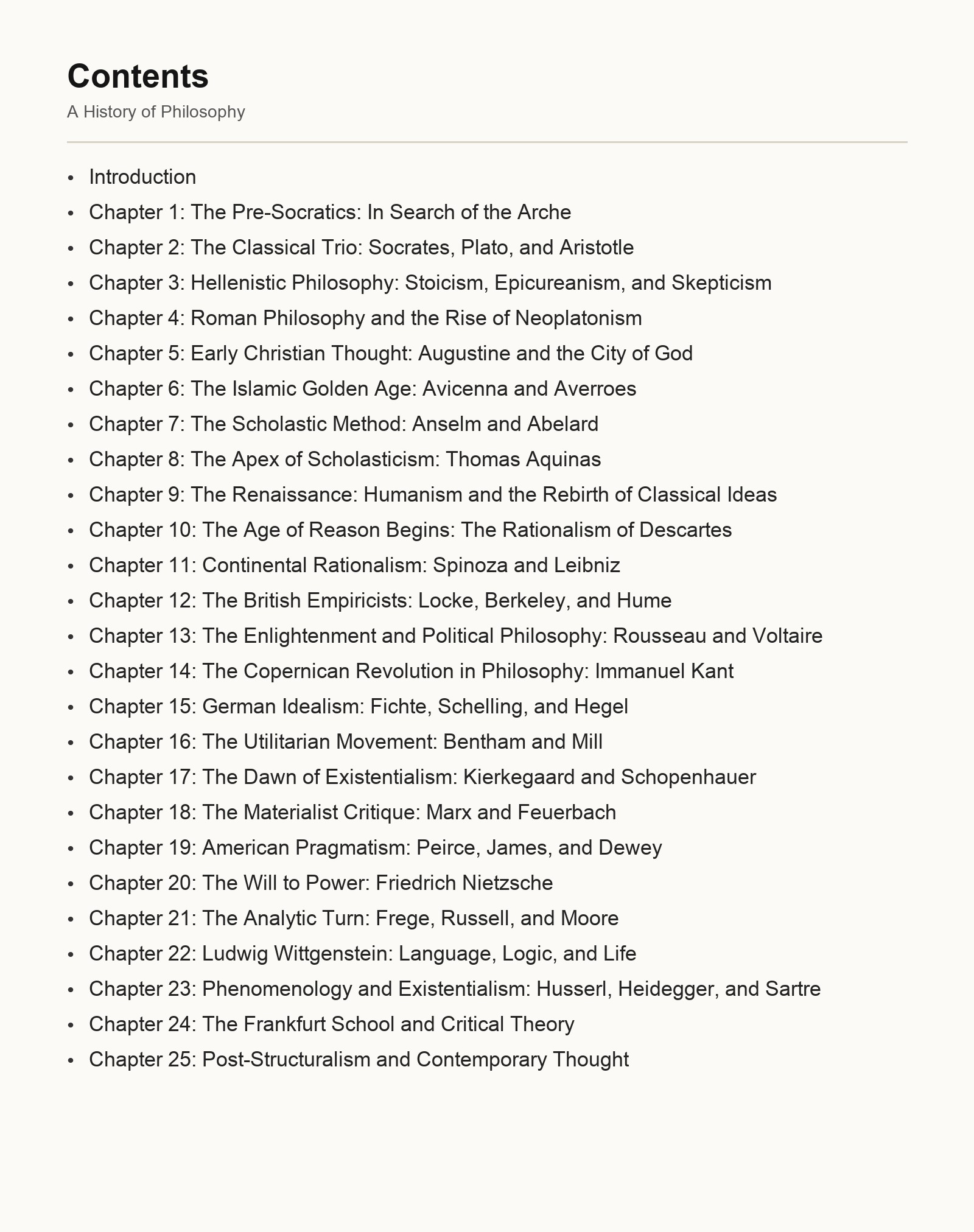
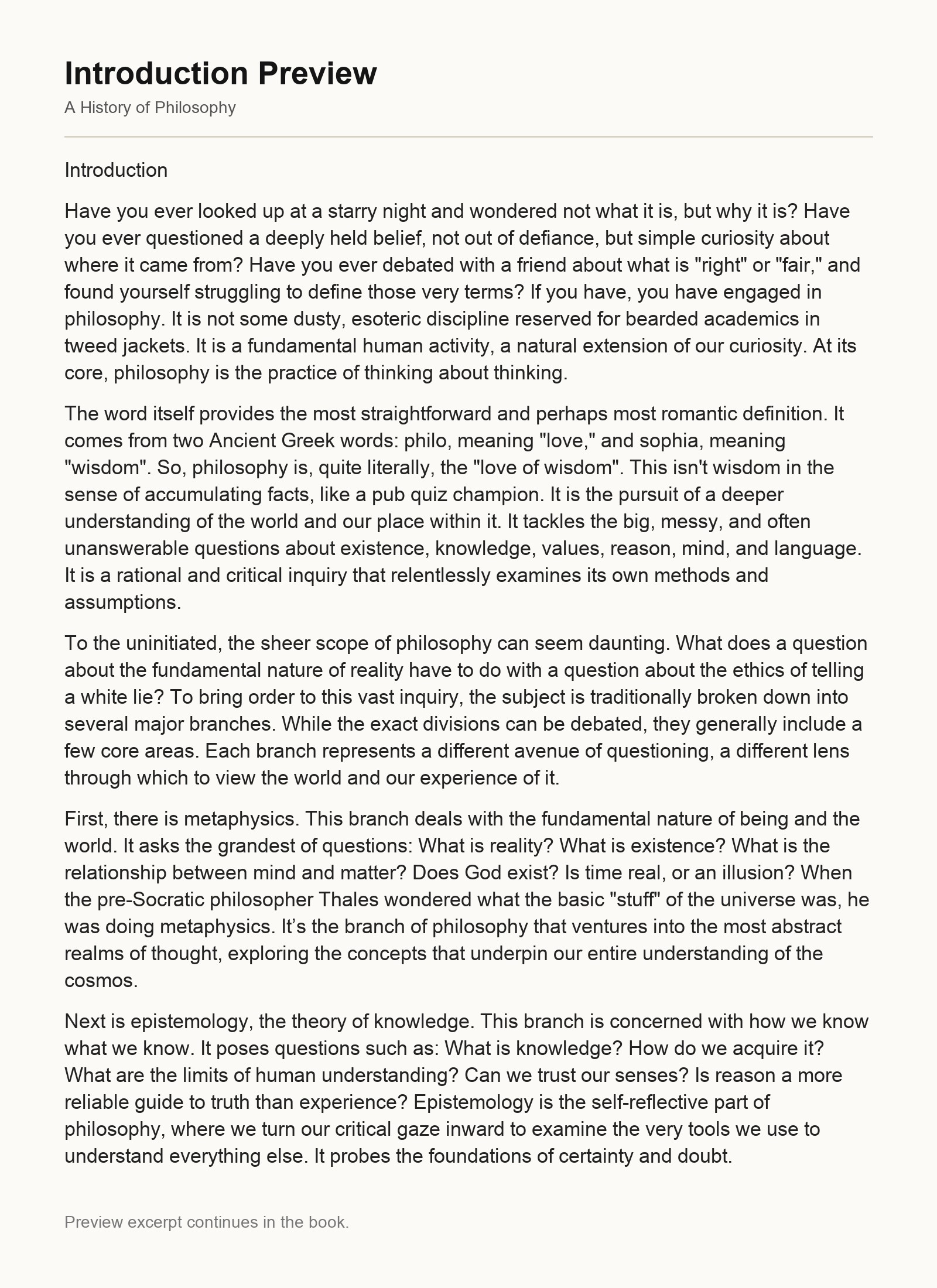
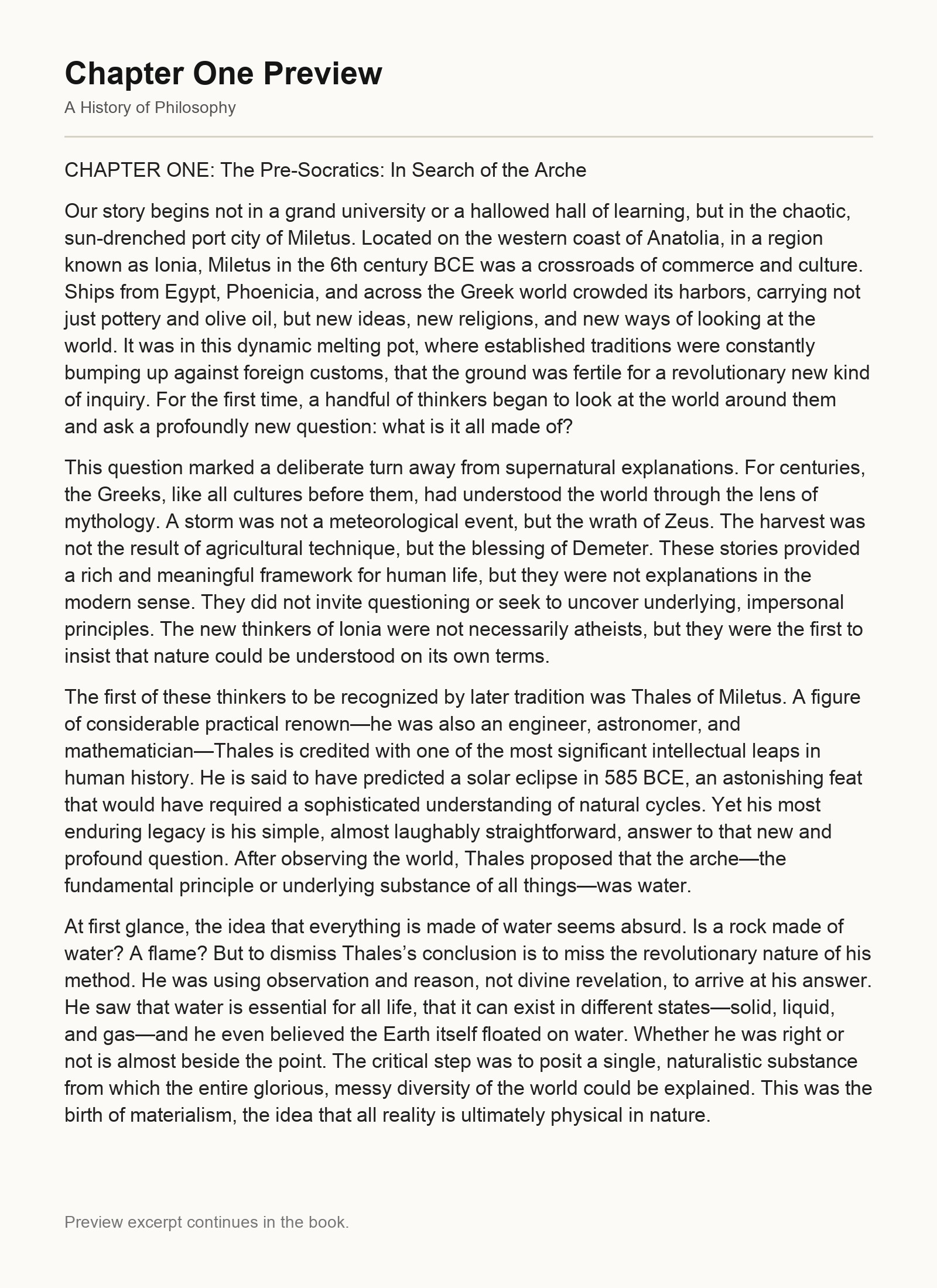
This book invites readers on a sweeping chronological tour of Western philosophy, from the first natural‑questioning thinkers of Miletus to the fragmented debates of the twenty‑first century. Each chapter introduces a major thinker or movement, explains their core ideas in clear language, and shows how those ideas responded to the scientific, religious, and political challenges of their time. By following this narrative, you will see how concepts such as substance, causality, freedom, and virtue have been reshaped across centuries and how they continue to inform contemporary discussions about knowledge, ethics, and society.
You will learn the foundations of the discipline’s main branches—metaphysics, epistemology, ethics, logic, and aesthetics—and see how they interconnect. The text walks you through the Pre‑Socratic search for the arche, the Socratic turn toward the examined life, Plato’s theory of Forms, Aristotle’s four causes, the Hellenistic schools’ practical guides to tranquility, and the Roman adoption of Stoic and Epicurean ideals. It then traces the synthesis of faith and reason in Augustine, the preservation and expansion of Greek thought in the Islamic Golden Age, and the Scholastic method that culminated in Thomas Aquinas’s Five Ways and natural law theory.
The journey continues through the Renaissance’s humanist revival, the Rationalist‑Empiricist clash of Descartes, Spinoza, Locke, and Hume, and Kant’s Copernican revolution that redefined the limits of knowledge. You will encounter German Idealism’s daring dialectics, the utilitarian calculus of Bentham and Mill, the existential anxieties of Kierkegaard and Schopenhauer, Marx’s materialist critique of capitalism, and the pragmatic turn of Peirce, James, and Dewey. Later chapters illuminate Nietzsche’s revaluation of values, the analytic rigor of Frege, Russell, and Moore, Wittgenstein’s linguistic turn, and the phenomenological insights of Husserl, Heidegger, and Sartre.
Beyond historical facts, the book equips you with the tools of critical thinking: how to distinguish sound argument from fallacy, how to trace the origins of our own beliefs, and how to engage with opposing viewpoints. By wrestling with the same questions that have driven philosophers for over two millennia—what is real, how we know, what we ought to do, and how we should live—you will develop a deeper awareness of the assumptions behind everyday judgments and a more nuanced capacity to reflect on your own place in the world. This is not a dry survey of dead doctrines; it is an invitation to join the ongoing conversation of wisdom and to emerge with a sharper, more reflective mind.
What You'll Find Inside:
- The book begins with the Pre-Socratics' revolutionary shift from mythological to rational explanations of nature, exemplified by their search for the arche (fundamental substance) underlying all reality.
- It covers the foundational contributions of Socrates, Plato, and Aristotle—Socrates' ethical method, Plato's Theory of Forms, and Aristotle's empirical system—that established the core framework for Western philosophy.
- The text details how Immanuel Kant resolved the Rationalism-Empiricism conflict through his 'Copernican Revolution,' arguing that the mind actively structures experience rather than passively conforming to it.
- Modern philosophical developments are explored, including Existentialism's focus on individual freedom and authenticity, Pragmatism's emphasis on practical consequences, and the Analytic turn's focus on linguistic clarity.
- Throughout its chronological journey, the book demonstrates how philosophy has continuously interacted with and responded to its historical, religious, and social contexts—from Augustine's synthesis of faith and reason to the Frankfurt School's critique of modern capitalism.
Who's It For:
This book is ideal for undergraduate philosophy students, lifelong learners, and general readers seeking a comprehensive yet accessible overview of Western philosophical thought. It will particularly benefit those interested in understanding how historical contexts have shaped philosophical ideas, from ancient Greece to contemporary movements. Readers aiming to strengthen their critical thinking skills by engaging with foundational arguments and concepts will find this historical journey invaluable. No prior philosophical background is required, as the text emphasizes philosophy as a universal human activity rooted in curiosity.
Table of Contents:
- Introduction
- Chapter 1: The Pre-Socratics: In Search of the Arche
- Chapter 2: The Classical Trio: Socrates, Plato, and Aristotle
- Chapter 3: Hellenistic Philosophy: Stoicism, Epicureanism, and Skepticism
- Chapter 4: Roman Philosophy and the Rise of Neoplatonism
- Chapter 5: Early Christian Thought: Augustine and the City of God
- Chapter 6: The Islamic Golden Age: Avicenna and Averroes
- Chapter 7: The Scholastic Method: Anselm and Abelard
- Chapter 8: The Apex of Scholasticism: Thomas Aquinas
- Chapter 9: The Renaissance: Humanism and the Rebirth of Classical Ideas
- Chapter 10: The Age of Reason Begins: The Rationalism of Descartes
- Chapter 11: Continental Rationalism: Spinoza and Leibniz
- Chapter 12: The British Empiricists: Locke, Berkeley, and Hume
- Chapter 13: The Enlightenment and Political Philosophy: Rousseau and Voltaire
- Chapter 14: The Copernican Revolution in Philosophy: Immanuel Kant
- Chapter 15: German Idealism: Fichte, Schelling, and Hegel
- Chapter 16: The Utilitarian Movement: Bentham and Mill
- Chapter 17: The Dawn of Existentialism: Kierkegaard and Schopenhauer
- Chapter 18: The Materialist Critique: Marx and Feuerbach
- Chapter 19: American Pragmatism: Peirce, James, and Dewey
- Chapter 20: The Will to Power: Friedrich Nietzsche
- Chapter 21: The Analytic Turn: Frege, Russell, and Moore
- Chapter 22: Ludwig Wittgenstein: Language, Logic, and Life
- Chapter 23: Phenomenology and Existentialism: Husserl, Heidegger, and Sartre
- Chapter 24: The Frankfurt School and Critical Theory
- Chapter 25: Post-Structuralism and Contemporary Thought
Author:
Published By:
Date Published:
May 22, 2026
Type:
Nonfiction
Language:
English
Also Available In:
Spanish, French, Italian, Dutch
Word Count:
68,667 words
Reading Time:
4 hours 49 minutes
Sample:
Order:
Buy the A History of Philosophy ebook on MixCache.com:
Buy NowThe full ebook will be available immediately to read instantly on any device.
$5 account credit for all new MixCache.com accounts, usable toward any ebook purchase!*





Ratings & Reviews
Ask Questions About This Book
Have a question about the content? Ask our AI assistant!
Start by asking a question about "A History of Philosophy"
Example: "Does this book mention William Shakespeare?"
Thinking...