
Browse by Category
Fiction
- Action & Adventure
- African American
- Anthologies
- Children's Fiction
- Classics
- Comics & Graphic Novels
- Coming of Age
- Contemporary
- Cultural & Regional
- Drama
- Erotica
- Fantasy
- General
- Historical Fiction
- Horror
- Humor & Satire
- Literary Fiction
- Mystery, Thriller & Suspense
- Poetry
- Religious & Inspirational
- Romance
- Science Fiction
- Short Stories
- War & Military
- Westerns
- Women's Fiction
- Young Adult
Non-Fiction
- Antiques & Collectibles
- Arts & Photography
- Biographies & Memoirs
- Business & Money
- Children's Non-Fiction
-
Computers & Technology
- Artificial Intelligence
- Computer Science
- Cybersecurity & Cryptography
- Data Science & Analytics
- Databases & Big Data
- Game Development & Design
- General
- Hardware & DIY
- Mobile App Development
- Networking & Cloud Computing
- Operating Systems
- Programming
- Robotics
- Software
- Software Engineering
- User Experience (UX) & Design
- Web Development & Design
- Cooking, Food & Wine
- Crafts, Hobbies & Home
- Education & Teaching
- Engineering
- General
- Health, Fitness & Dieting
-
History
- African History
- African History - North Africa
- African History - Sub-Saharan Africa
- American History
- American History - 20th Century
- American History - Civil War
- American History - Colonial Period
- Ancient History
- Asian History
- Asian History - China
- Asian History - India
- Asian History - Japan
- Asian History - Southeast Asia
- European History
- European History - Ancient Greece
- European History - Ancient Rome
- European History - Medieval
- European History - Modern
- European History - Renaissance
- General
- Middle Eastern History
- Military History
- Military History - Aviation
- Military History - Naval
- Social & Cultural History
- World History
- Humor & Entertainment
- Industrial Technology
- Language Learning
- Law
- LGBTQ+ Non-Fiction
- Literary Criticism
- Medical Books
- Parenting & Relationships
- Philosophy
- Politics & Social Sciences
- Reference
- Religion & Spirituality
-
Science & Math
- Agricultural Sciences
- Astronomy & Space Science
- Behavioral Sciences
- Biological Sciences
- Botany & Plant Science
- Chemistry
- Earth Sciences
- Engineering - Chemical
- Engineering - Civil
- Engineering - Electrical
- Engineering - Mechanical
- Environment
- General
- Geology
- Mathematics
- Nature & Ecology
- Oceanography
- Paleontology
- Physics
- Statistics
- Self-Help
- Sports & Outdoors
- Study Aids
- Sustainability & Green Living
- Textbooks
- Transportation
- Travel
- True Crime
- Urban Planning & Development
- Veterinary Medicine
- Writing & Publishing
Jump to Section
MixCache.com Total Access
Unlimited reading and audiobooks for every book published by MixCache.com.
Included titles carry the MTA badge.
Learn more →A History of Zambia
About this book:
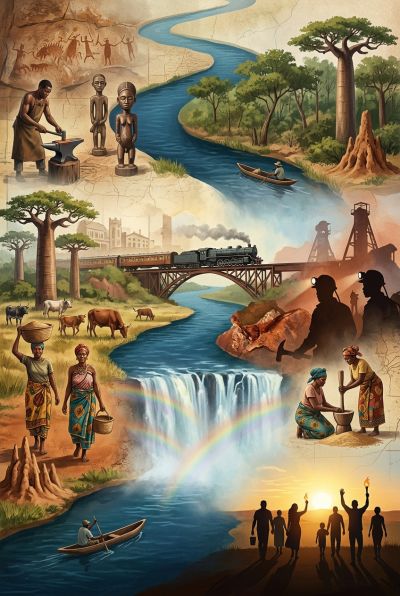
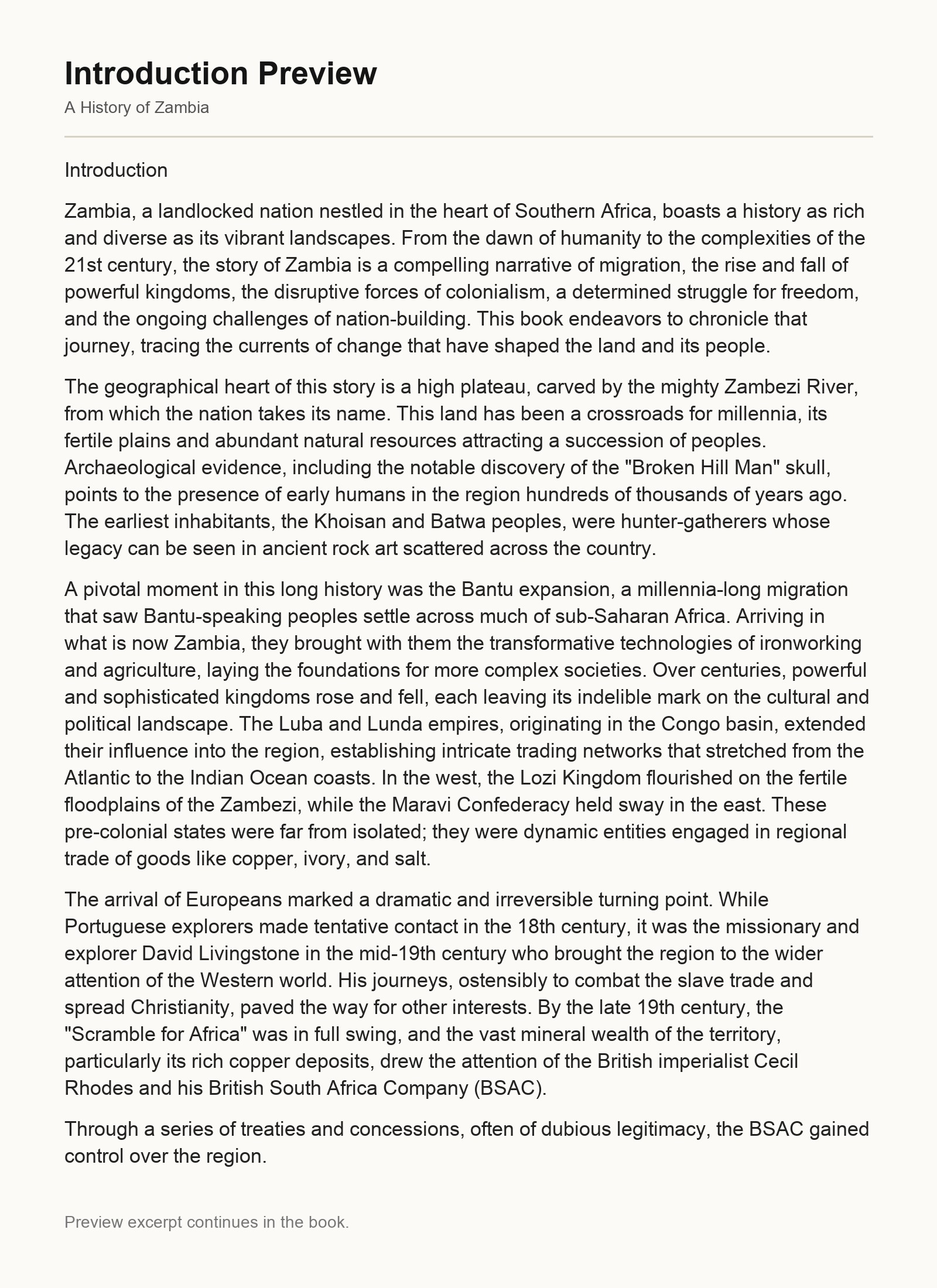
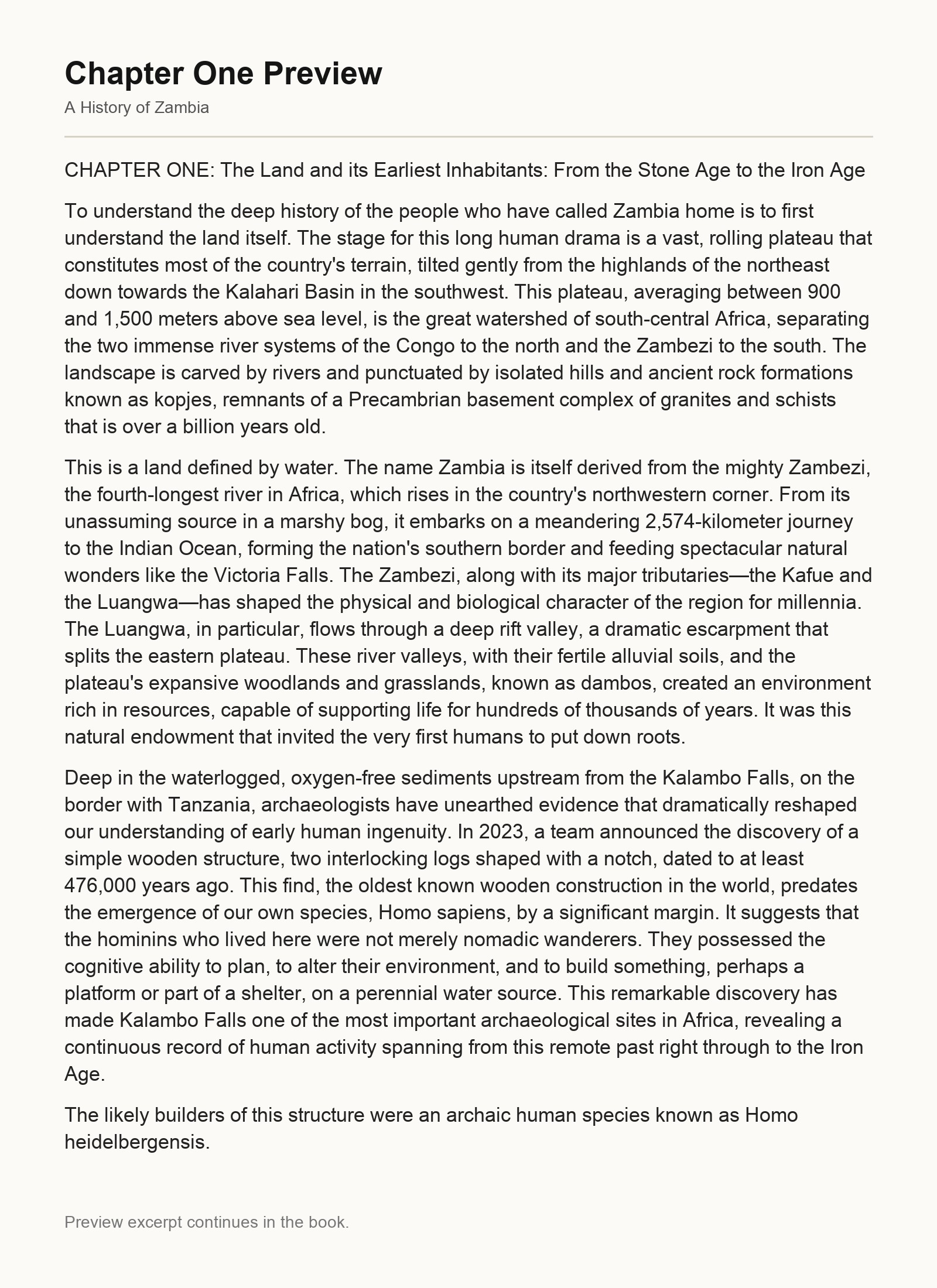
Discover the sweeping story of Zambia, a nation whose past stretches from the dawn of humanity to the challenges of the 21st century. This comprehensive history takes readers deep into the Stone Age, revealing astonishing archaeological finds such as the 476,000‑year‑old wooden structure at Kalambo Falls and the Broken Hill Man skull, and follows the lives of the Khoisan, Batwa, and early Bantu settlers who introduced ironworking and agriculture to the plateau. You will trace the rise of powerful pre‑colonial states—the Luba and Lunda empires, the Lozi kingdom on the Zambezi floodplains, and the Maravi confederacy—understanding how trade in copper, ivory, and salt wove a complex web of influence across central Africa before European contact.
The narrative then shifts to the tumultuous era of exploration and colonisation, detailing the arrival of Portuguese traders, the devastation of the slave trade, and the pivotal role of missionaries like David Livingstone. Witness how Cecil Rhodes and the British South Africa Company carved out North‑Western and North‑Eastern Rhodesia, imposed the hut tax and indirect rule, and eventually merged the territories into Northern Rhodesia. The book explains how the discovery of vast copper reserves transformed the economy, creating the Copperbelt boom, a dual economy of modern mines and impoverished reserves, and how racial hierarchies, migrant labour, and limited education shaped daily life under colonial rule.
From the stirrings of African nationalism in welfare societies and trade unions to the fiery leadership of Kenneth Kaunda, the text chronicles the struggle against the Federation of Rhodesia and Nyasaland, the dramatic birth of independent Zambia in 1964, and the early nation‑building efforts guided by the philosophy of Zambian Humanism. Readers will experience the optimism of free education and healthcare initiatives, the controversies of the one‑party state, Zambia’s courageous role as a Frontline State supporting liberation movements across southern Africa, and the economic crises that followed the collapse of copper prices, structural adjustment programmes, and rising debt.
The latter half of the book brings the story into the modern era, examining the transition to multi‑party democracy, the Chiluba years of economic liberalisation and privatisation, the turbulent 2000s marked by debt relief, anti‑corruption campaigns, and shifting foreign relations with China and the West. It explores contemporary Zambian society—vibrant urban informal sectors, enduring rural traditions, the centrality of nshima, the explosion of Pentecostal Christianity, and the unifying power of football, highlighted by the historic 2012 Africa Cup of Nations victory. Finally, the work looks ahead, analysing Zambia’s opportunities in the green‑energy copper boom, agricultural diversification, tourism, and its youthful population, while confronting obstacles such as debt dependence, climate vulnerability, and the need for democratic consolidation. This is an essential read for anyone who wishes to understand how a landlocked African nation has continually reshaped its identity amid internal challenges and global forces.
What You'll Find Inside:
- Explores Zambia's deepest origins, including 476,000-year-old wooden structures at Kalambo Falls and the 'Broken Hill Man' skull, tracing human habitation from Stone Age hunter-gatherers through Bantu migrations and the rise of pre-colonial kingdoms like Luba-Lunda, Lozi, and Maravi.
- Examines the colonial era's profound impacts: Portuguese slave trade influences, British South Africa Company rule through treaties like the Lochner Concession, hut tax labor systems, and the transformative Copperbelt mining development that created Zambia's cash economy.
- Chronicles the independence movement led by Kenneth Kaunda and UNIP, detailing non-violent resistance campaigns, the dissolution of the Federation of Rhodesia and Nyasaland, and Zambia's peaceful transition to sovereignty in 1964 with the 'One Zambia, One Nation' founding ideal.
- Analyzes post-independence challenges including Kaunda's Zambian Humanism philosophy, the one-party state era, economic vulnerability from copper dependence, and Zambia's costly role as a Frontline State supporting liberation movements across Southern Africa.
- Covers modern Zambia's democratic transition after 1991, economic liberalization under Chiluba, 21st-century challenges like debt crises and copper price volatility, and ongoing efforts to diversify the economy while addressing youth unemployment, climate vulnerability, and democratic consolidation.
Who's It For:
This book is ideal for students, scholars, and general readers seeking a comprehensive understanding of Zambia's historical journey from prehistoric times to the present day. It will particularly benefit researchers of African history focusing on colonialism, resource-dependent economies, independence movements, and post-colonial nation-building. Development professionals, policymakers, and anyone interested in Southern Africa's political and economic trajectories will find valuable insights into Zambia's challenges and opportunities.
Table of Contents:
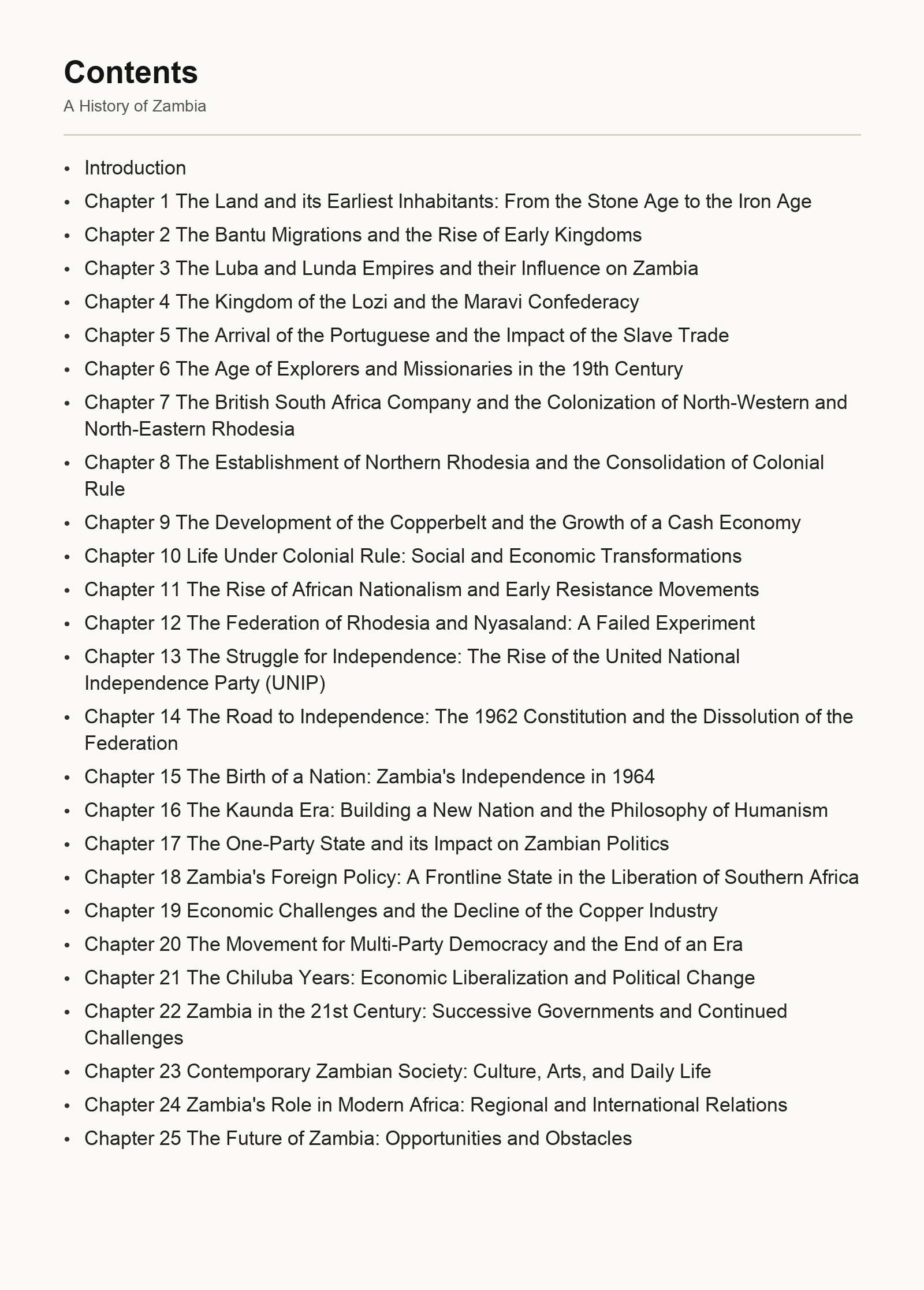
- Introduction
- Chapter 1 The Land and its Earliest Inhabitants: From the Stone Age to the Iron Age
- Chapter 2 The Bantu Migrations and the Rise of Early Kingdoms
- Chapter 3 The Luba and Lunda Empires and their Influence on Zambia
- Chapter 4 The Kingdom of the Lozi and the Maravi Confederacy
- Chapter 5 The Arrival of the Portuguese and the Impact of the Slave Trade
- Chapter 6 The Age of Explorers and Missionaries in the 19th Century
- Chapter 7 The British South Africa Company and the Colonization of North-Western and North-Eastern Rhodesia
- Chapter 8 The Establishment of Northern Rhodesia and the Consolidation of Colonial Rule
- Chapter 9 The Development of the Copperbelt and the Growth of a Cash Economy
- Chapter 10 Life Under Colonial Rule: Social and Economic Transformations
- Chapter 11 The Rise of African Nationalism and Early Resistance Movements
- Chapter 12 The Federation of Rhodesia and Nyasaland: A Failed Experiment
- Chapter 13 The Struggle for Independence: The Rise of the United National Independence Party (UNIP)
- Chapter 14 The Road to Independence: The 1962 Constitution and the Dissolution of the Federation
- Chapter 15 The Birth of a Nation: Zambia's Independence in 1964
- Chapter 16 The Kaunda Era: Building a New Nation and the Philosophy of Humanism
- Chapter 17 The One-Party State and its Impact on Zambian Politics
- Chapter 18 Zambia's Foreign Policy: A Frontline State in the Liberation of Southern Africa
- Chapter 19 Economic Challenges and the Decline of the Copper Industry
- Chapter 20 The Movement for Multi-Party Democracy and the End of an Era
- Chapter 21 The Chiluba Years: Economic Liberalization and Political Change
- Chapter 22 Zambia in the 21st Century: Successive Governments and Continued Challenges
- Chapter 23 Contemporary Zambian Society: Culture, Arts, and Daily Life
- Chapter 24 Zambia's Role in Modern Africa: Regional and International Relations
- Chapter 25 The Future of Zambia: Opportunities and Obstacles
Author:
Published By:
Date Published:
May 21, 2026
Type:
Nonfiction
Language:
English
Also Available In:
Word Count:
43,958 words
Reading Time:
3 hours 5 minutes
Sample:
Order:
Buy the A History of Zambia ebook on MixCache.com:
Buy NowThe full ebook will be available immediately to read instantly on any device.
$5 account credit for all new MixCache.com accounts, usable toward any ebook purchase!*



Ratings & Reviews
Ask Questions About This Book
Have a question about the content? Ask our AI assistant!
Start by asking a question about "A History of Zambia"
Example: "Does this book mention William Shakespeare?"
Thinking...