Browse by Category
Fiction
- Action & Adventure
- African American
- Anthologies
- Children's Fiction
- Classics
- Comics & Graphic Novels
- Coming of Age
- Contemporary
- Cultural & Regional
- Drama
- Erotica
- Fantasy
- General
- Historical Fiction
- Horror
- Humor & Satire
- Literary Fiction
- Mystery, Thriller & Suspense
- Poetry
- Religious & Inspirational
- Romance
- Science Fiction
- Short Stories
- War & Military
- Westerns
- Women's Fiction
- Young Adult
Non-Fiction
- Antiques & Collectibles
- Arts & Photography
- Biographies & Memoirs
- Business & Money
- Children's Non-Fiction
-
Computers & Technology
- Artificial Intelligence
- Computer Science
- Cybersecurity & Cryptography
- Data Science & Analytics
- Databases & Big Data
- Game Development & Design
- General
- Hardware & DIY
- Mobile App Development
- Networking & Cloud Computing
- Operating Systems
- Programming
- Robotics
- Software
- Software Engineering
- User Experience (UX) & Design
- Web Development & Design
- Cooking, Food & Wine
- Crafts, Hobbies & Home
- Education & Teaching
- Engineering
- General
- Health, Fitness & Dieting
-
History
- African History
- African History - North Africa
- African History - Sub-Saharan Africa
- American History
- American History - 20th Century
- American History - Civil War
- American History - Colonial Period
- Ancient History
- Asian History
- Asian History - China
- Asian History - India
- Asian History - Japan
- Asian History - Southeast Asia
- European History
- European History - Ancient Greece
- European History - Ancient Rome
- European History - Medieval
- European History - Modern
- European History - Renaissance
- General
- Middle Eastern History
- Military History
- Military History - Aviation
- Military History - Naval
- Social & Cultural History
- World History
- Humor & Entertainment
- Industrial Technology
- Language Learning
- Law
- LGBTQ+ Non-Fiction
- Literary Criticism
- Medical Books
- Parenting & Relationships
- Philosophy
- Politics & Social Sciences
- Reference
- Religion & Spirituality
-
Science & Math
- Agricultural Sciences
- Astronomy & Space Science
- Behavioral Sciences
- Biological Sciences
- Botany & Plant Science
- Chemistry
- Earth Sciences
- Engineering - Chemical
- Engineering - Civil
- Engineering - Electrical
- Engineering - Mechanical
- Environment
- General
- Geology
- Mathematics
- Nature & Ecology
- Oceanography
- Paleontology
- Physics
- Statistics
- Self-Help
- Sports & Outdoors
- Study Aids
- Sustainability & Green Living
- Textbooks
- Transportation
- Travel
- True Crime
- Urban Planning & Development
- Veterinary Medicine
- Writing & Publishing
Jump to Section
MixCache.com Total Access
Unlimited reading and audiobooks for every book published by MixCache.com.
Included titles carry the MTA badge.
Learn more →A History of Public Health
About this book:



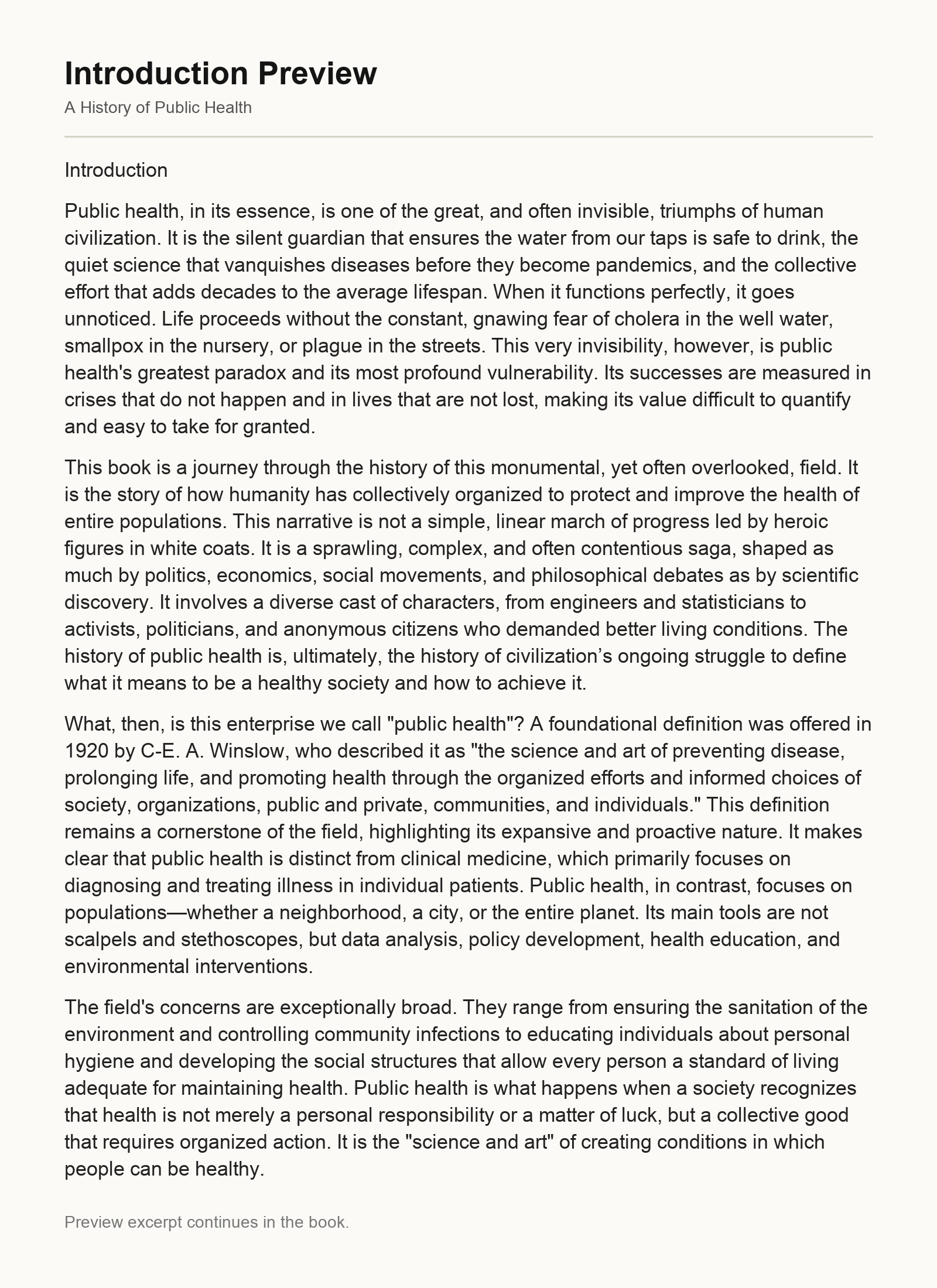
A History of Public Health takes readers on a sweeping journey from the earliest sanitary practices of ancient civilizations to the cutting‑edge challenges of the twenty‑first century. It reveals how societies first grappled with waste, water, and crowding in Mesopotamia, Egypt, the Indus Valley, Greece, and Rome, laying the groundwork for organized efforts to protect community well‑being. By tracing the evolution of ideas—from Hippocrates’ link between environment and health to the miasma theory of the Middle Ages—readers gain a clear picture of how cultural, philosophical, and technological shifts shaped the first public health interventions.
The book then follows the dramatic turning points that transformed public health into a scientific discipline: John Snow’s map of cholera, the germ‑proof work of Pasteur, Koch, and Lister, and the rise of epidemiology as a tool for outbreak investigation. Readers experience the triumphs of vaccination, from Jenner’s cowpox experiment to the global eradication of smallpox, and see how these victories set the stage for modern immunization campaigns, antibiotics, and the expansion of health services into maternal, child, and mental health care.
Moving into the modern era, the narrative explores the epidemiologic transition, the rise of chronic diseases, and the growing recognition of social determinants, environmental health, and mental illness as central public health concerns. Chapters on the HIV/AIDS epidemic, health promotion frameworks like the Ottawa Charter, and the role of biostatistics and surveillance illustrate how the field has broadened its scope, embraced community empowerment, and grappled with equity, politics, and ethics. The discussion of recent pandemics—SARS, H1N1, Ebola—and the lessons they offer for global preparedness connects historical patterns to contemporary threats.
Finally, the book looks ahead to the frontiers where public health must now operate: climate change, antimicrobial resistance, and the emerging paradigm of planetary health. Readers will come away with a deep appreciation of how past successes and failures inform today’s strategies for protecting populations, and they will understand why public health remains a vital, interconnected endeavor that shapes the health of individuals, communities, and the planet itself. This comprehensive account equips anyone interested in health, history, or policy with the knowledge to see both the achievements and the ongoing challenges of safeguarding human well‑being.
What You'll Find Inside:
- Traces the evolution of public health from ancient sanitation innovations (Indus Valley drains, Roman aqueducts) to modern scientific foundations.
- Highlights pivotal breakthroughs such as John Snow's cholera mapping, the germ theory revolution, and the birth of epidemiology.
- Details the development of vaccines and mass immunization campaigns, culminating in the global eradication of smallpox.
- Examines the epidemiologic transition to chronic diseases, the rise of environmental health, and the growing focus on social determinants of health.
- Analyzes contemporary global health governance, pandemic preparedness lessons, and future frontiers like climate change and antimicrobial resistance.
Who's It For:
This book is ideal for undergraduate and graduate students in public health, history of medicine, or related fields; public health practitioners seeking historical context for current practices; policymakers and global health workers interested in lessons from past successes and failures; and educated general readers curious about how societal efforts have shaped population health over millennia.
Table of Contents:
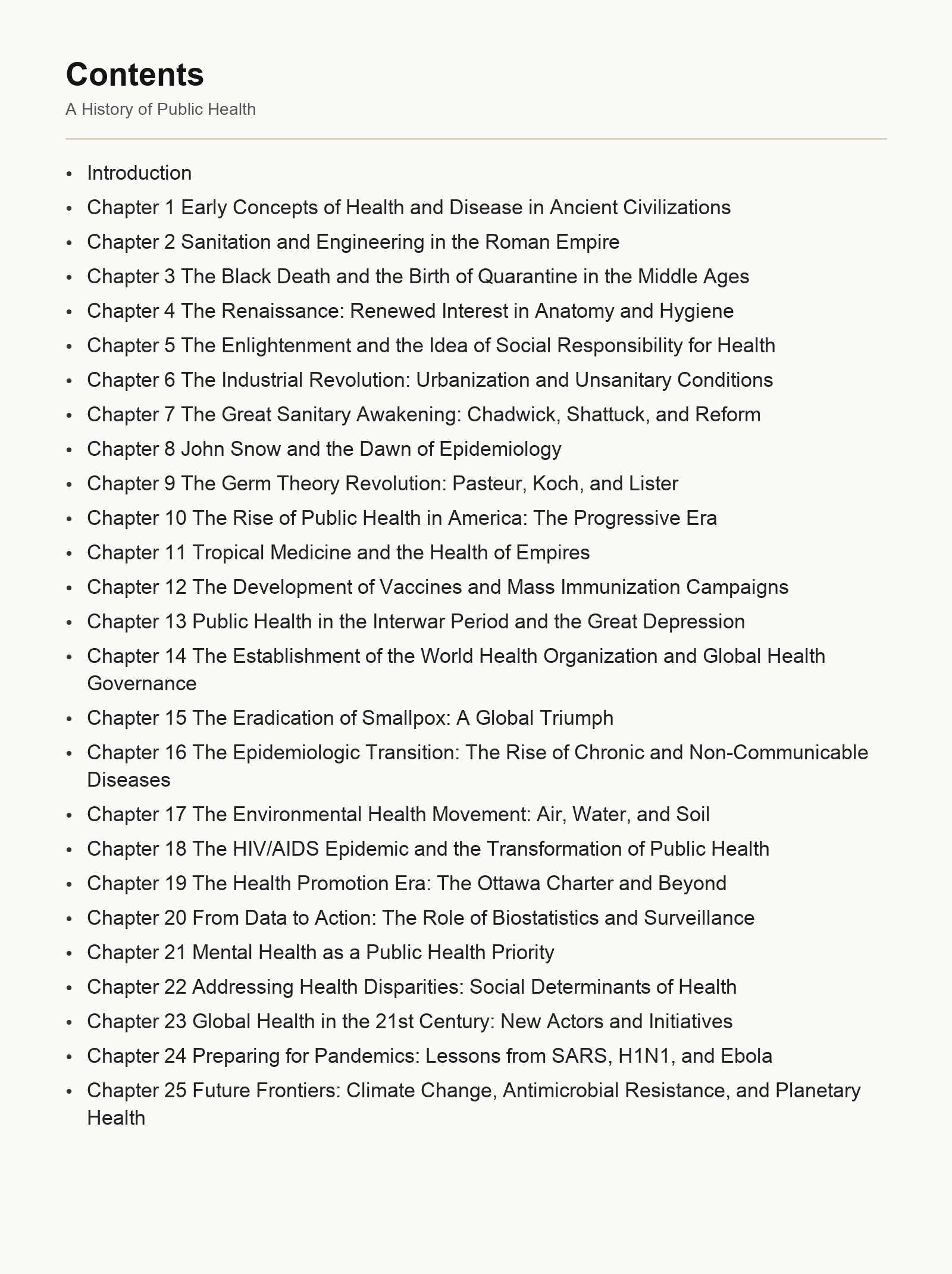
- Introduction
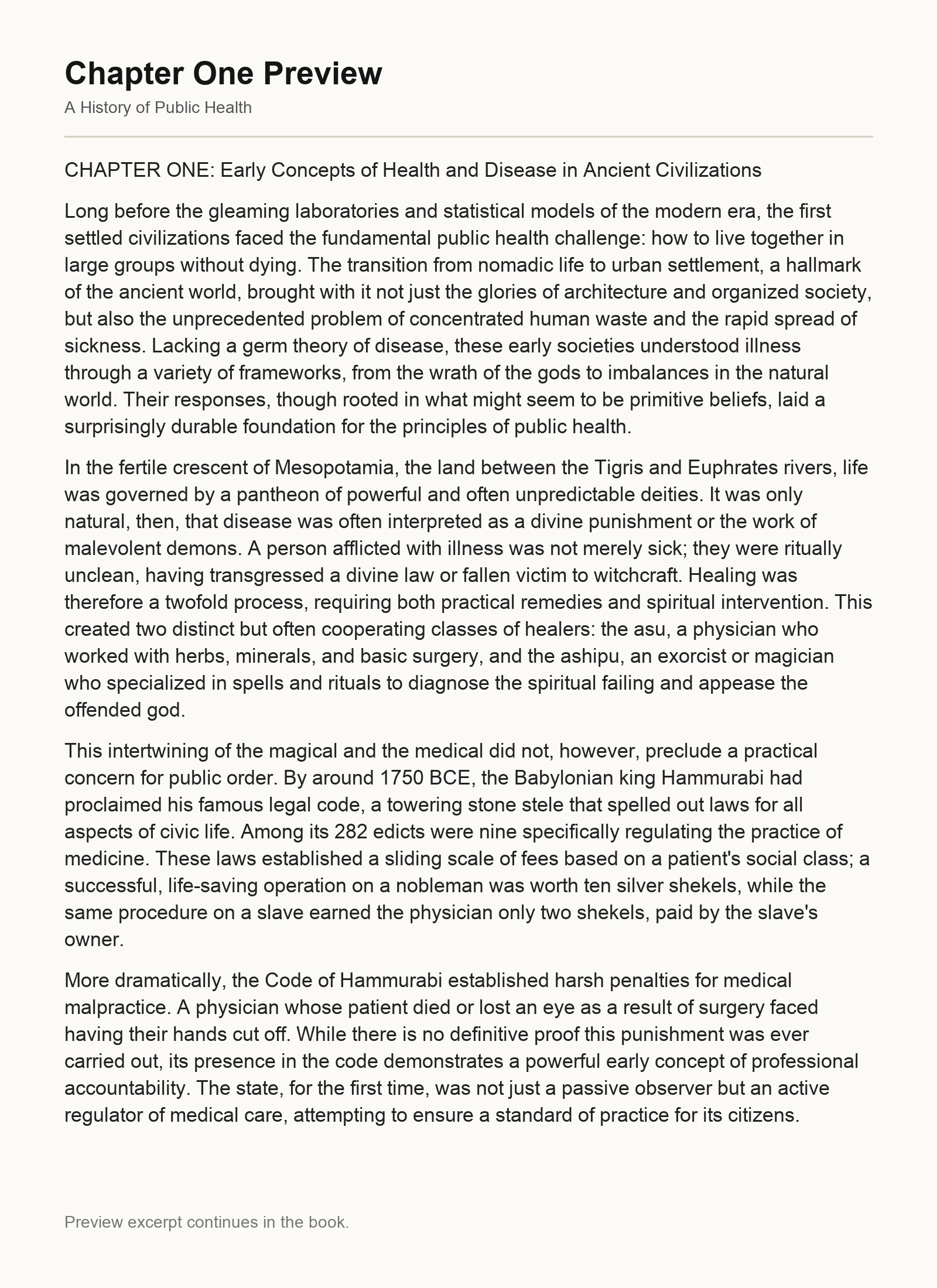
- Chapter 1 Early Concepts of Health and Disease in Ancient Civilizations
- Chapter 2 Sanitation and Engineering in the Roman Empire
- Chapter 3 The Black Death and the Birth of Quarantine in the Middle Ages
- Chapter 4 The Renaissance: Renewed Interest in Anatomy and Hygiene
- Chapter 5 The Enlightenment and the Idea of Social Responsibility for Health
- Chapter 6 The Industrial Revolution: Urbanization and Unsanitary Conditions
- Chapter 7 The Great Sanitary Awakening: Chadwick, Shattuck, and Reform
- Chapter 8 John Snow and the Dawn of Epidemiology
- Chapter 9 The Germ Theory Revolution: Pasteur, Koch, and Lister
- Chapter 10 The Rise of Public Health in America: The Progressive Era
- Chapter 11 Tropical Medicine and the Health of Empires
- Chapter 12 The Development of Vaccines and Mass Immunization Campaigns
- Chapter 13 Public Health in the Interwar Period and the Great Depression
- Chapter 14 The Establishment of the World Health Organization and Global Health Governance
- Chapter 15 The Eradication of Smallpox: A Global Triumph
- Chapter 16 The Epidemiologic Transition: The Rise of Chronic and Non-Communicable Diseases
- Chapter 17 The Environmental Health Movement: Air, Water, and Soil
- Chapter 18 The HIV/AIDS Epidemic and the Transformation of Public Health
- Chapter 19 The Health Promotion Era: The Ottawa Charter and Beyond
- Chapter 20 From Data to Action: The Role of Biostatistics and Surveillance
- Chapter 21 Mental Health as a Public Health Priority
- Chapter 22 Addressing Health Disparities: Social Determinants of Health
- Chapter 23 Global Health in the 21st Century: New Actors and Initiatives
- Chapter 24 Preparing for Pandemics: Lessons from SARS, H1N1, and Ebola
- Chapter 25 Future Frontiers: Climate Change, Antimicrobial Resistance, and Planetary Health
Author:
Published By:
Date Published:
May 21, 2026
Type:
Nonfiction
Language:
English
Also Available In:
Word Count:
50,480 words
Reading Time:
3 hours 32 minutes
Sample:
Order:
Order A History of Public Health (Paperback) on MixCache.com:
Buy NowPrint copy is made to order and ships worldwide. Includes the ebook free, ready to read instantly.
$5 account credit for all new MixCache.com accounts, usable toward any ebook purchase!*