Browse by Category
Fiction
- Action & Adventure
- African American
- Anthologies
- Children's Fiction
- Classics
- Comics & Graphic Novels
- Coming of Age
- Contemporary
- Cultural & Regional
- Drama
- Erotica
- Fantasy
- General
- Historical Fiction
- Horror
- Humor & Satire
- Literary Fiction
- Mystery, Thriller & Suspense
- Poetry
- Religious & Inspirational
- Romance
- Science Fiction
- Short Stories
- War & Military
- Westerns
- Women's Fiction
- Young Adult
Non-Fiction
- Antiques & Collectibles
- Arts & Photography
- Biographies & Memoirs
- Business & Money
- Children's Non-Fiction
-
Computers & Technology
- Artificial Intelligence
- Computer Science
- Cybersecurity & Cryptography
- Data Science & Analytics
- Databases & Big Data
- Game Development & Design
- General
- Hardware & DIY
- Mobile App Development
- Networking & Cloud Computing
- Operating Systems
- Programming
- Robotics
- Software
- Software Engineering
- User Experience (UX) & Design
- Web Development & Design
- Cooking, Food & Wine
- Crafts, Hobbies & Home
- Education & Teaching
- Engineering
- General
- Health, Fitness & Dieting
-
History
- African History
- African History - North Africa
- African History - Sub-Saharan Africa
- American History
- American History - 20th Century
- American History - Civil War
- American History - Colonial Period
- Ancient History
- Asian History
- Asian History - China
- Asian History - India
- Asian History - Japan
- Asian History - Southeast Asia
- European History
- European History - Ancient Greece
- European History - Ancient Rome
- European History - Medieval
- European History - Modern
- European History - Renaissance
- General
- Middle Eastern History
- Military History
- Military History - Aviation
- Military History - Naval
- Social & Cultural History
- World History
- Humor & Entertainment
- Industrial Technology
- Language Learning
- Law
- LGBTQ+ Non-Fiction
- Literary Criticism
- Medical Books
- Parenting & Relationships
- Philosophy
- Politics & Social Sciences
- Reference
- Religion & Spirituality
-
Science & Math
- Agricultural Sciences
- Astronomy & Space Science
- Behavioral Sciences
- Biological Sciences
- Botany & Plant Science
- Chemistry
- Earth Sciences
- Engineering - Chemical
- Engineering - Civil
- Engineering - Electrical
- Engineering - Mechanical
- Environment
- General
- Geology
- Mathematics
- Nature & Ecology
- Oceanography
- Paleontology
- Physics
- Statistics
- Self-Help
- Sports & Outdoors
- Study Aids
- Sustainability & Green Living
- Textbooks
- Transportation
- Travel
- True Crime
- Urban Planning & Development
- Veterinary Medicine
- Writing & Publishing
Jump to Section

Want unlimited access to all books published by MixCache.com (plus their audiobooks)? Try MixCache.com Total Access. Look for the MTA badge on book covers to identify included titles.
Access to infinite ebooks: Don't see the book you want? Suggest it and we'll create it (free!) for you from scratch with our powerful AI book writer. Then read it with MTA - besides profiting from any sales it makes!
A History of Turkmenistan
About this book:
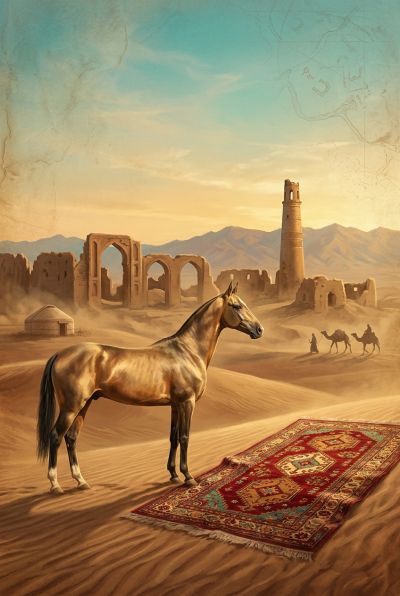
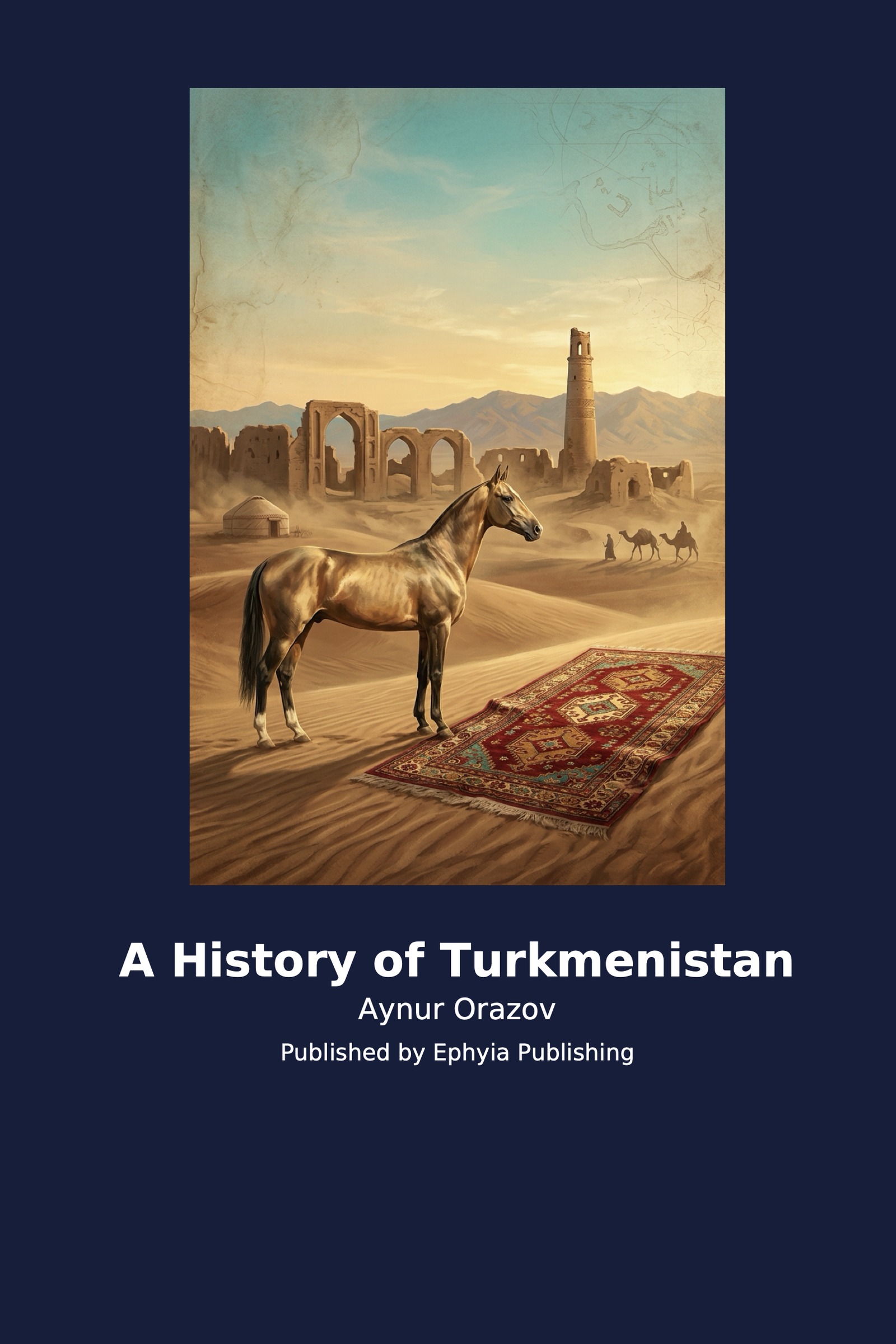
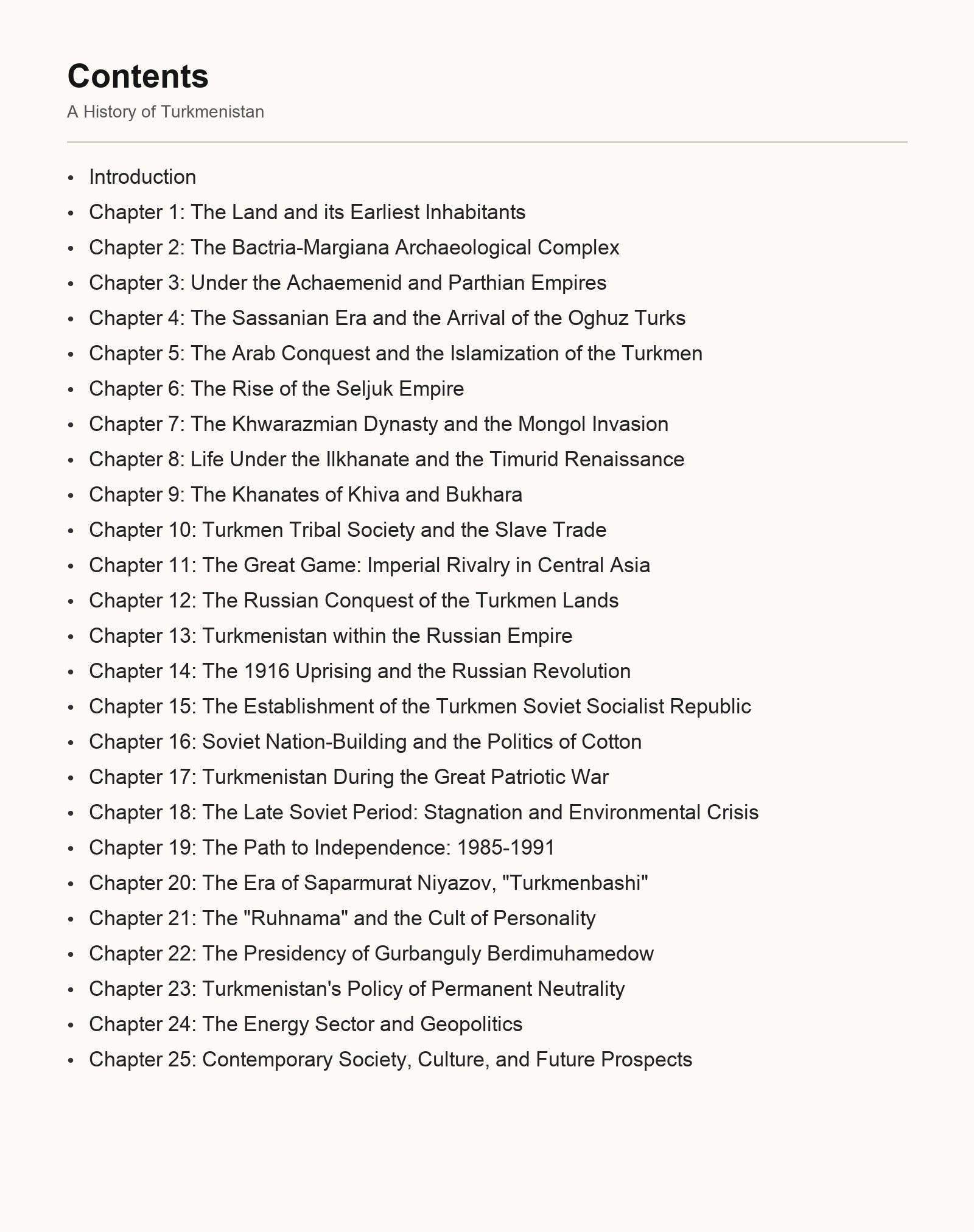
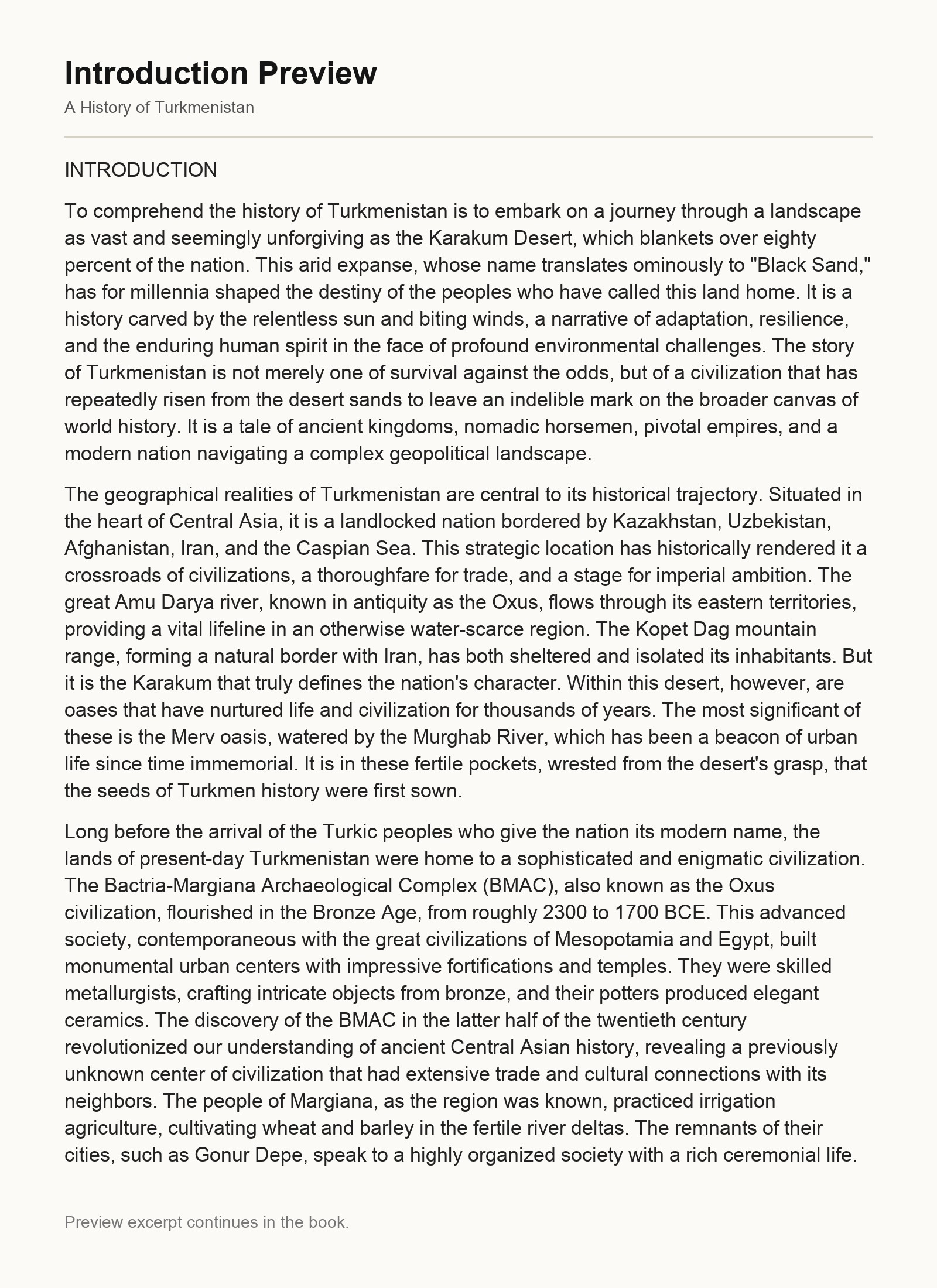
To comprehend Turkmenistan is to understand a land where desert sands have preserved whispers of some of humanity's earliest experiments in settled life, where oasis cities once pulsed as vital arteries of the Silk Road, and where nomadic horsemen repeatedly rose to reshape empires across Eurasia. This book invites readers on an extraordinary journey through millennia, revealing how the stark beauty of the Karakum Desert and the life-giving waters of the Amu Darya have forged a narrative of resilience, adaptation, and profound historical significance that extends far beyond Central Asia's borders.
Readers will explore the dawn of civilization in this region, from the pioneering agricultural communities of Jeitun around 6000 BCE to the astonishing discovery of the Bactria-Margiana Archaeological Complex – a sophisticated Bronze Age urban culture contemporaneous with Egypt and Mesopotamia that rewrote our understanding of ancient Central Asia. The narrative then follows Turkmenistan's pivotal role as a crossroads of empires: absorbed into the Achaemenid and Parthian worlds, transformed by the arrival of Islamized Oghuz Turks, and elevated to global prominence as the heartland of the Seljuk Empire, whose legacy echoes in the architectural marvels from Anatolia to Iran and whose westward migration laid ethnic foundations for modern Turkey and Azerbaijan.
The journey continues through periods of devastation and renewal – the catastrophic Mongol invasions that shattered flourishing oasis cities like Merv and Gurganj, the centuries of Turkmen tribal autonomy within the contested khanates of Khiva and Bukhara, and the brutal Russian conquest culminating in the massacre at Geok Tepe that ended centuries of independence. Under Russian and later Soviet rule, Turkmenistan underwent radical transformation through forced cotton monoculture, sedentarization campaigns, and devastating environmental engineering projects like the Karakum Canal, which initially boosted production but precipitated the slow death of the Aral Sea – an ecological tragedy that continues to impact the region today.
The book examines Turkmenistan's unique post-Soviet path: a quiet emergence into independence following the Soviet collapse, the extraordinary era of Saparmurat Niyazov whose cult of personality redefined national identity through the mandatory Ruhnama and surreal marble monuments, and the cautious evolution under his successor Gurbanguly Berdimuhamedow as the nation navigated its vast natural gas wealth, maintained its hard-won policy of permanent neutrality, and began the complex work of economic diversification while preserving deep-rooted tribal traditions beneath a state-curated national narrative.
Finally, readers will encounter contemporary Turkmenistan – a land of striking contrasts where the gleaming white marble boulevards of Ashgabat stand in stark relief to the traditional rhythms of life in the oases, where the Akhal-Teke horse and intricate carpet weaving remain cherished symbols of national pride, and where a young nation grapples with the paradox of immense hydrocarbon wealth amid environmental fragility and the challenge of building a sustainable future beyond resource dependence. This is not merely a history of a distant land, but an essential key to understanding the complex interplay of geography, empire, culture, and resilience that continues to shape our interconnected world.
What You'll Find Inside:
- The book explores Turkmenistan's ancient roots, including the sophisticated Bronze Age Bactria-Margiana Archaeological Complex (BMAC) that flourished in desert oases contemporaneously with Mesopotamia and Egypt.
- It details the nation's pivotal role as a Silk Road crossroads, where cities like Merv became cosmopolitan hubs connecting Chinese, Indian, Persian, and Roman civilizations through trade and cultural exchange.
- The text traces the migration of Oghuz Turkic tribes, their conversion to Islam, and the rise of the Seljuk Empire—which originated in Turkmen lands and stretched from the Hindu Kush to the Aegean Sea—reshaping the Islamic world.
- It examines Turkmenistan's experience under Russian and Soviet rule, from the brutal conquest at Geok Tepe to Soviet cotton monoculture policies that devastated the Aral Sea and triggered ecological crisis.
- The book analyzes modern Turkmenistan since independence, covering the authoritarian cults of personality under Niyazov and Berdimuhamedow, the policy of permanent neutrality, and the nation's dependence on natural gas exports.
Who's It For:
This book is ideal for students, researchers, and general readers interested in Central Asian history, particularly those studying how geography shapes civilizations from ancient times to the present. It provides essential context for understanding the interplay of imperial powers (Achaemenid, Arab, Mongol, Russian), Soviet nation-building projects, and post-Soviet authoritarianism in a strategically located but environmentally challenged nation. Readers focused on the Great Game, Silk Road dynamics, or energy geopolitics will find especially valuable insights.
Author:
Published By:
Date Published:
May 19, 2026
Type:
Nonfiction
Language:
English
Also Available In:
Word Count:
50,373 words
Reading Time:
3 hours 32 minutes
Sample:
Order:
Order A History of Turkmenistan (Paperback) on MixCache.com:
Buy NowPrint copy is made to order and ships worldwide. Includes the ebook free, ready to read instantly.
$5 account credit for all new MixCache.com accounts, usable toward any ebook purchase!*