Browse by Category
Fiction
- Action & Adventure
- African American
- Anthologies
- Children's Fiction
- Classics
- Comics & Graphic Novels
- Coming of Age
- Contemporary
- Cultural & Regional
- Drama
- Erotica
- Fantasy
- General
- Historical Fiction
- Horror
- Humor & Satire
- Literary Fiction
- Mystery, Thriller & Suspense
- Poetry
- Religious & Inspirational
- Romance
- Science Fiction
- Short Stories
- War & Military
- Westerns
- Women's Fiction
- Young Adult
Non-Fiction
- Antiques & Collectibles
- Arts & Photography
- Biographies & Memoirs
- Business & Money
- Children's Non-Fiction
-
Computers & Technology
- Artificial Intelligence
- Computer Science
- Cybersecurity & Cryptography
- Data Science & Analytics
- Databases & Big Data
- Game Development & Design
- General
- Hardware & DIY
- Mobile App Development
- Networking & Cloud Computing
- Operating Systems
- Programming
- Robotics
- Software
- Software Engineering
- User Experience (UX) & Design
- Web Development & Design
- Cooking, Food & Wine
- Crafts, Hobbies & Home
- Education & Teaching
- Engineering
- General
- Health, Fitness & Dieting
-
History
- African History
- African History - North Africa
- African History - Sub-Saharan Africa
- American History
- American History - 20th Century
- American History - Civil War
- American History - Colonial Period
- Ancient History
- Asian History
- Asian History - China
- Asian History - India
- Asian History - Japan
- Asian History - Southeast Asia
- European History
- European History - Ancient Greece
- European History - Ancient Rome
- European History - Medieval
- European History - Modern
- European History - Renaissance
- General
- Middle Eastern History
- Military History
- Military History - Aviation
- Military History - Naval
- Social & Cultural History
- World History
- Humor & Entertainment
- Industrial Technology
- Language Learning
- Law
- LGBTQ+ Non-Fiction
- Literary Criticism
- Medical Books
- Parenting & Relationships
- Philosophy
- Politics & Social Sciences
- Reference
- Religion & Spirituality
-
Science & Math
- Agricultural Sciences
- Astronomy & Space Science
- Behavioral Sciences
- Biological Sciences
- Botany & Plant Science
- Chemistry
- Earth Sciences
- Engineering - Chemical
- Engineering - Civil
- Engineering - Electrical
- Engineering - Mechanical
- Environment
- General
- Geology
- Mathematics
- Nature & Ecology
- Oceanography
- Paleontology
- Physics
- Statistics
- Self-Help
- Sports & Outdoors
- Study Aids
- Sustainability & Green Living
- Textbooks
- Transportation
- Travel
- True Crime
- Urban Planning & Development
- Veterinary Medicine
- Writing & Publishing
Jump to Section

Want unlimited access to all books published by MixCache.com (plus their audiobooks)? Try MixCache.com Total Access. Look for the MTA badge on book covers to identify included titles.
Access to infinite ebooks: Don't see the book you want? Suggest it and we'll create it (free!) for you from scratch with our powerful AI book writer. Then read it with MTA - besides profiting from any sales it makes!
A History of Vanuatu
About this book:


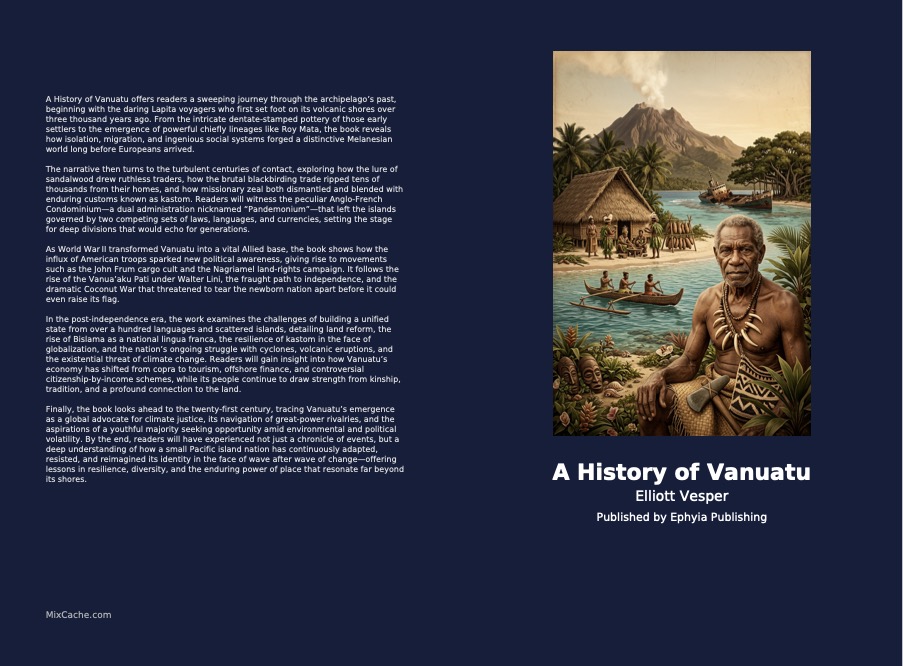
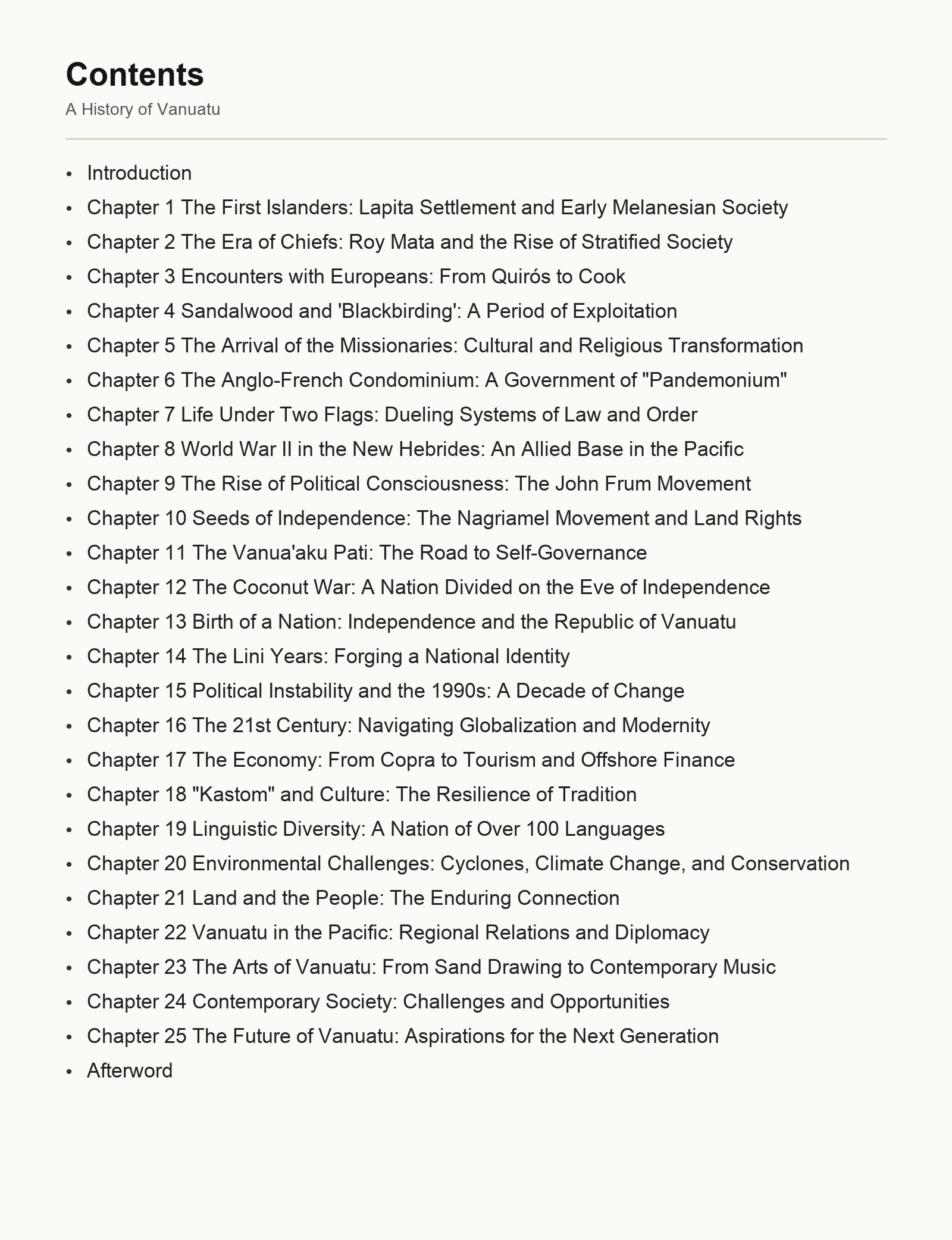
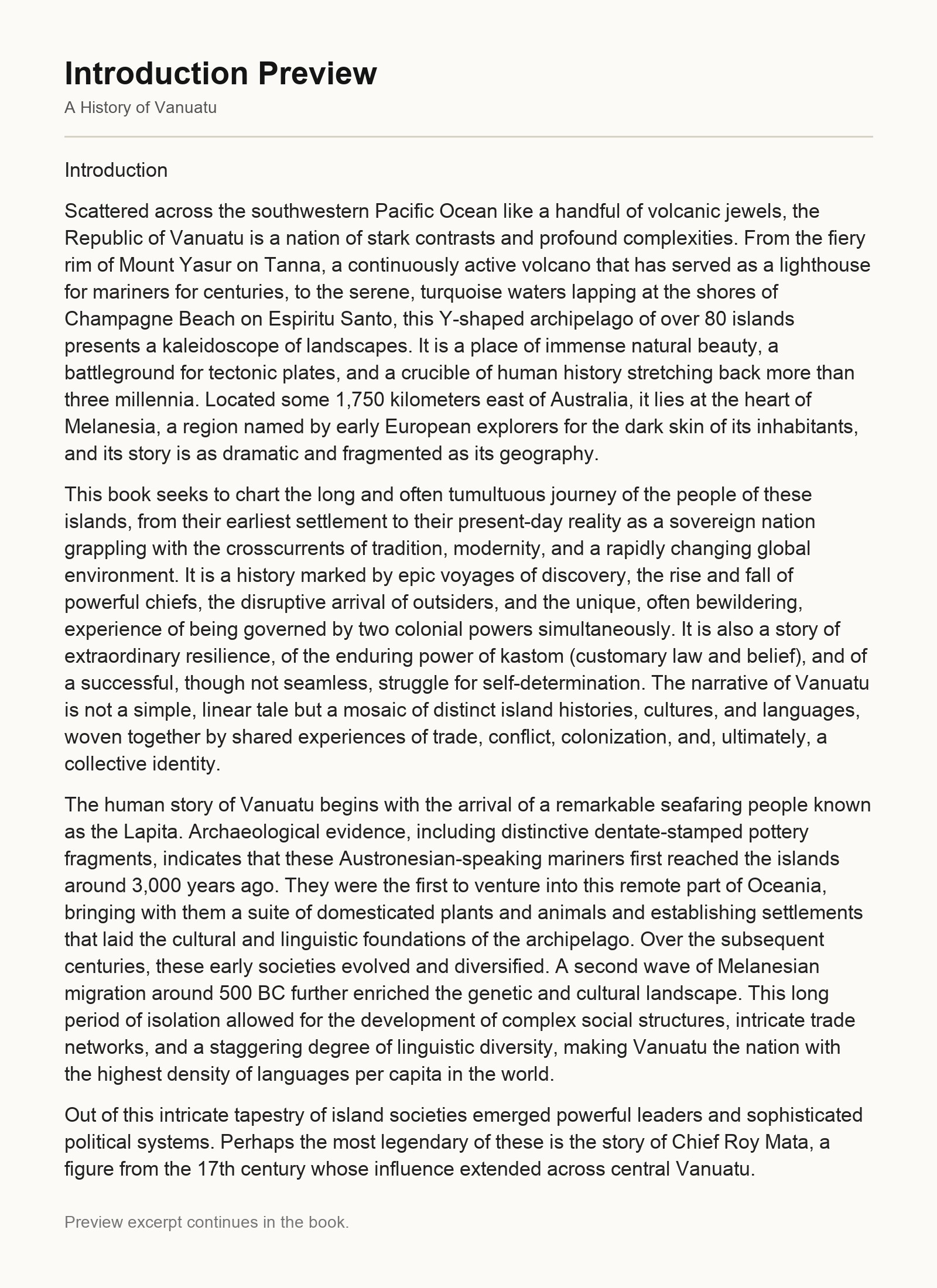
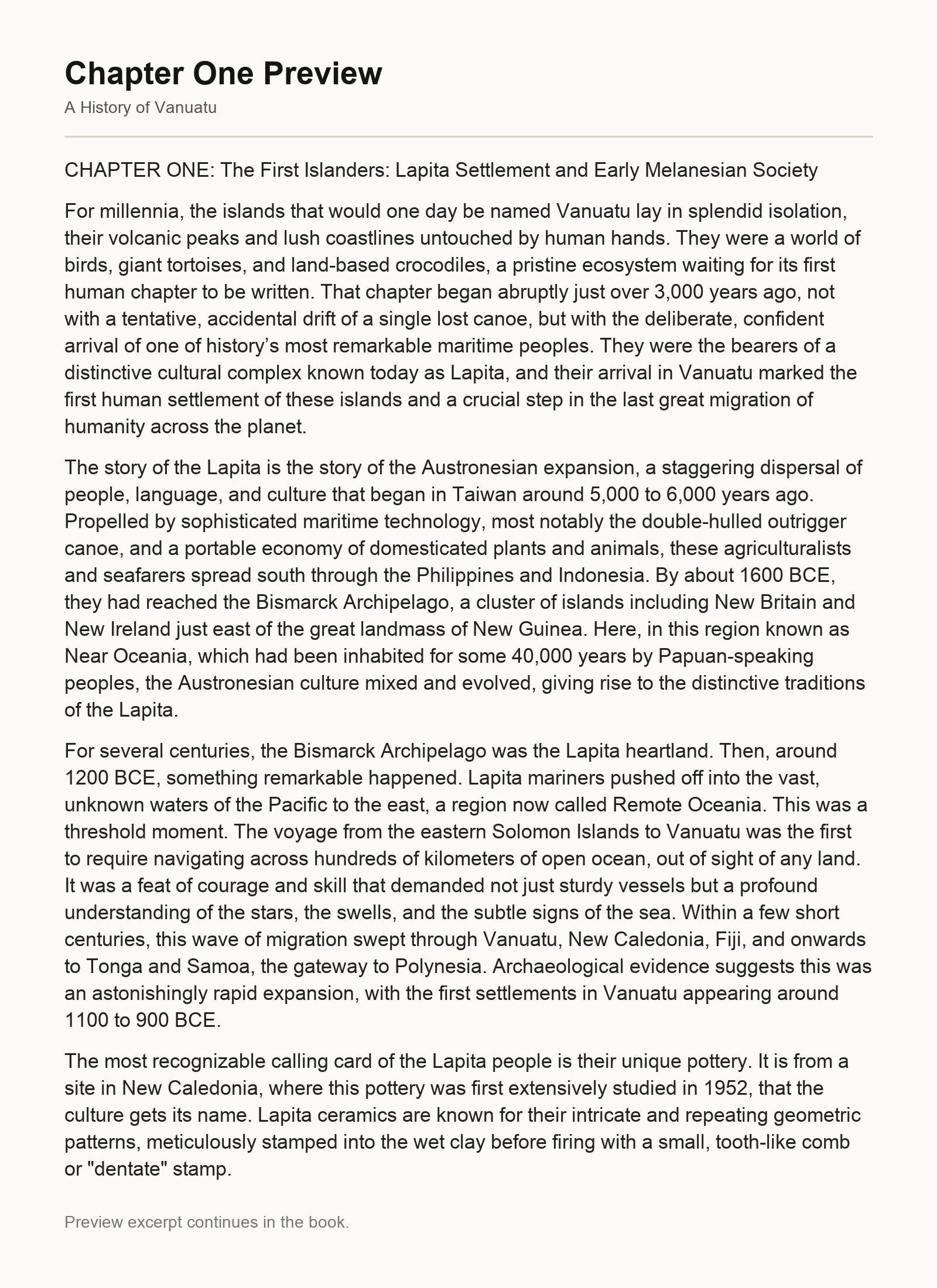
A History of Vanuatu offers readers a sweeping journey through the archipelago’s past, beginning with the daring Lapita voyagers who first set foot on its volcanic shores over three thousand years ago. From the intricate dentate‑stamped pottery of those early settlers to the emergence of powerful chiefly lineages like Roy Mata, the book reveals how isolation, migration, and ingenious social systems forged a distinctive Melanesian world long before Europeans arrived.
The narrative then turns to the turbulent centuries of contact, exploring how the lure of sandalwood drew ruthless traders, how the brutal blackbirding trade ripped tens of thousands from their homes, and how missionary zeal both dismantled and blended with enduring customs known as kastom. Readers will witness the peculiar Anglo‑French Condominium—a dual administration nicknamed “Pandemonium”—that left the islands governed by two competing sets of laws, languages, and currencies, setting the stage for deep divisions that would echo for generations.
As World War II transformed Vanuatu into a vital Allied base, the book shows how the influx of American troops sparked new political awareness, giving rise to movements such as the John Frum cargo cult and the Nagriamel land‑rights campaign. It follows the rise of the Vanua’aku Pati under Walter Lini, the fraught path to independence, and the dramatic Coconut War that threatened to tear the newborn nation apart before it could even raise its flag.
In the post‑independence era, the work examines the challenges of building a unified state from over a hundred languages and scattered islands, detailing land reform, the rise of Bislama as a national lingua franca, the resilience of kastom in the face of globalization, and the nation’s ongoing struggle with cyclones, volcanic eruptions, and the existential threat of climate change. Readers will gain insight into how Vanuatu’s economy has shifted from copra to tourism, offshore finance, and controversial citizenship‑by‑income schemes, while its people continue to draw strength from kinship, tradition, and a profound connection to the land.
Finally, the book looks ahead to the twenty‑first century, tracing Vanuatu’s emergence as a global advocate for climate justice, its navigation of great‑power rivalries, and the aspirations of a youthful majority seeking opportunity amid environmental and political volatility. By the end, readers will have experienced not just a chronicle of events, but a deep understanding of how a small Pacific island nation has continuously adapted, resisted, and reimagined its identity in the face of wave after wave of change—offering lessons in resilience, diversity, and the enduring power of place that resonate far beyond its shores.
What You'll Find Inside:
- A comprehensive chronicle from Lapita settlers (c. 1100–900 BCE) through European contact, colonial exploitation, and the unique Anglo‑French Condominium.
- In‑depth analysis of indigenous resistance movements—John Frum, Nagriamel, and the Vanua'aku Pati—that shaped the path to independence.
- Detailed account of the turbulent birth of the Republic of Vanuatu, including the Coconut War and intervention by regional Melanesian forces.
- Exploration of post‑independence nation‑building, political instability, economic diversification (copra to tourism, offshore finance, citizenship‑by‑investment), and ongoing challenges.
- Examination of Vanuatu’s cultural resilience—kastom, linguistic diversity (over 100 languages), traditional arts, and contemporary struggles with climate change, urbanization, and gender inequality.
Who's It For:
This book is ideal for undergraduate and graduate students of history, anthropology, and Pacific studies seeking a comprehensive, scholarly yet accessible overview of Vanuatu’s past. It will also appeal to policymakers, development practitioners, and NGOs working in the region who need context on land rights, governance, and climate vulnerability. General readers with an interest in indigenous cultures, decolonization movements, and small‑nation resilience will find the narrative engaging and informative.
Author:
Published By:
Date Published:
May 19, 2026
Type:
Nonfiction
Language:
English
Word Count:
46,965 words
Reading Time:
3 hours 17 minutes
Sample:
Order:
Order A History of Vanuatu (Paperback) on MixCache.com:
Buy NowPrint copy is made to order and ships worldwide. Includes the ebook free, ready to read instantly.
$5 account credit for all new MixCache.com accounts, usable toward any ebook purchase!*