
Browse by Category
Fiction
- Action & Adventure
- African American
- Anthologies
- Children's Fiction
- Classics
- Comics & Graphic Novels
- Coming of Age
- Contemporary
- Cultural & Regional
- Drama
- Erotica
- Fantasy
- General
- Historical Fiction
- Horror
- Humor & Satire
- Literary Fiction
- Mystery, Thriller & Suspense
- Poetry
- Religious & Inspirational
- Romance
- Science Fiction
- Short Stories
- War & Military
- Westerns
- Women's Fiction
- Young Adult
Non-Fiction
- Antiques & Collectibles
- Arts & Photography
- Biographies & Memoirs
- Business & Money
- Children's Non-Fiction
-
Computers & Technology
- Artificial Intelligence
- Computer Science
- Cybersecurity & Cryptography
- Data Science & Analytics
- Databases & Big Data
- Game Development & Design
- General
- Hardware & DIY
- Mobile App Development
- Networking & Cloud Computing
- Operating Systems
- Programming
- Robotics
- Software
- Software Engineering
- User Experience (UX) & Design
- Web Development & Design
- Cooking, Food & Wine
- Crafts, Hobbies & Home
- Education & Teaching
- Engineering
- General
- Health, Fitness & Dieting
-
History
- African History
- African History - North Africa
- African History - Sub-Saharan Africa
- American History
- American History - 20th Century
- American History - Civil War
- American History - Colonial Period
- Ancient History
- Asian History
- Asian History - China
- Asian History - India
- Asian History - Japan
- Asian History - Southeast Asia
- European History
- European History - Ancient Greece
- European History - Ancient Rome
- European History - Medieval
- European History - Modern
- European History - Renaissance
- General
- Middle Eastern History
- Military History
- Military History - Aviation
- Military History - Naval
- Social & Cultural History
- World History
- Humor & Entertainment
- Industrial Technology
- Language Learning
- Law
- LGBTQ+ Non-Fiction
- Literary Criticism
- Medical Books
- Parenting & Relationships
- Philosophy
- Politics & Social Sciences
- Reference
- Religion & Spirituality
-
Science & Math
- Agricultural Sciences
- Astronomy & Space Science
- Behavioral Sciences
- Biological Sciences
- Botany & Plant Science
- Chemistry
- Earth Sciences
- Engineering - Chemical
- Engineering - Civil
- Engineering - Electrical
- Engineering - Mechanical
- Environment
- General
- Geology
- Mathematics
- Nature & Ecology
- Oceanography
- Paleontology
- Physics
- Statistics
- Self-Help
- Sports & Outdoors
- Study Aids
- Sustainability & Green Living
- Textbooks
- Transportation
- Travel
- True Crime
- Urban Planning & Development
- Veterinary Medicine
- Writing & Publishing
Jump to Section
MixCache.com Total Access
Unlimited reading and audiobooks for every book published by MixCache.com.
Included titles carry the MTA badge.
Learn more →A History of Chemistry
About this book:
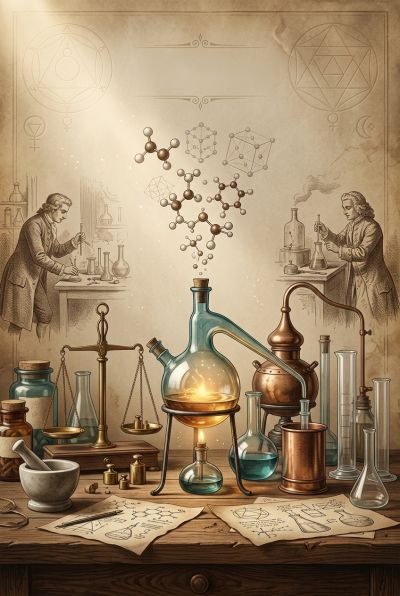
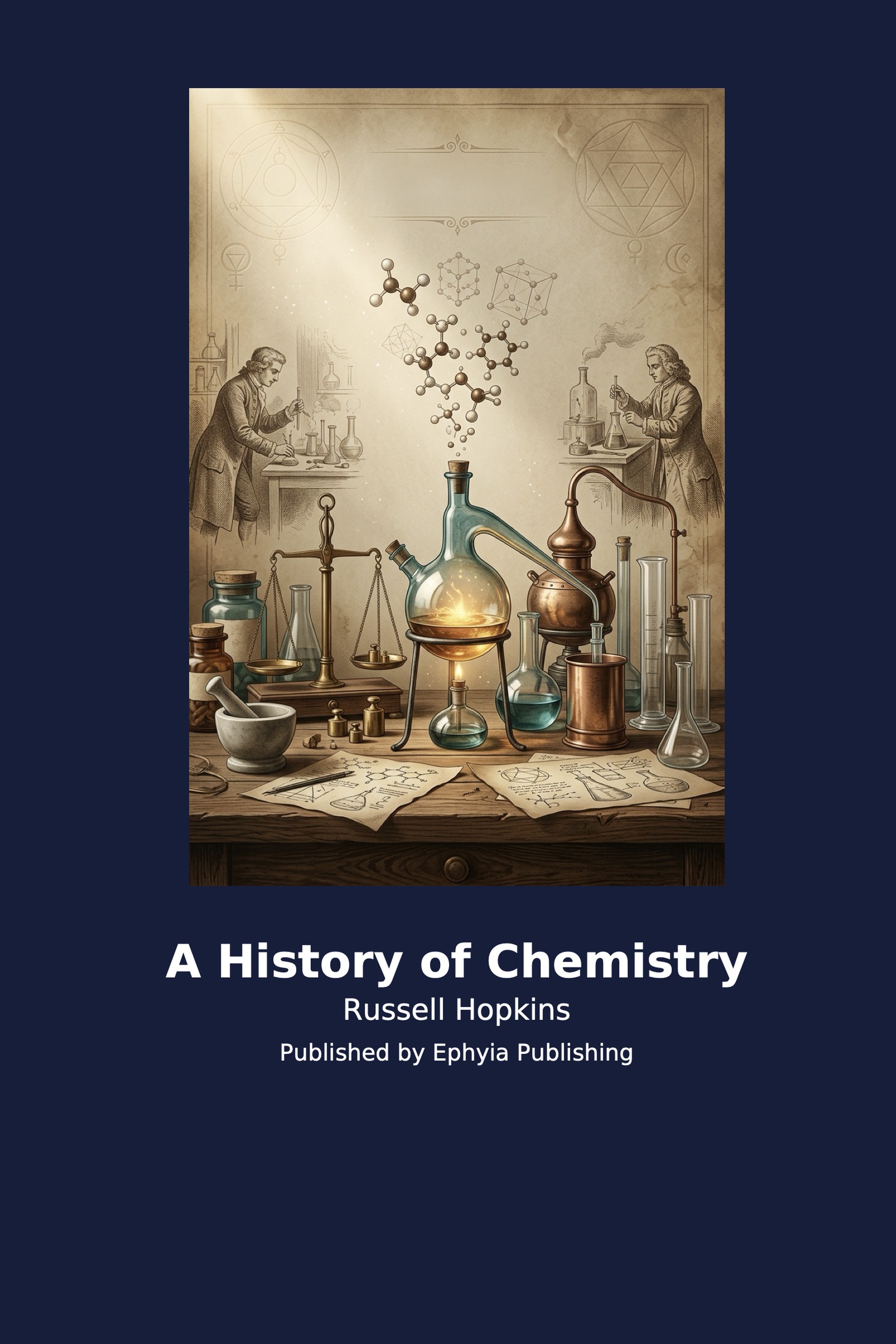
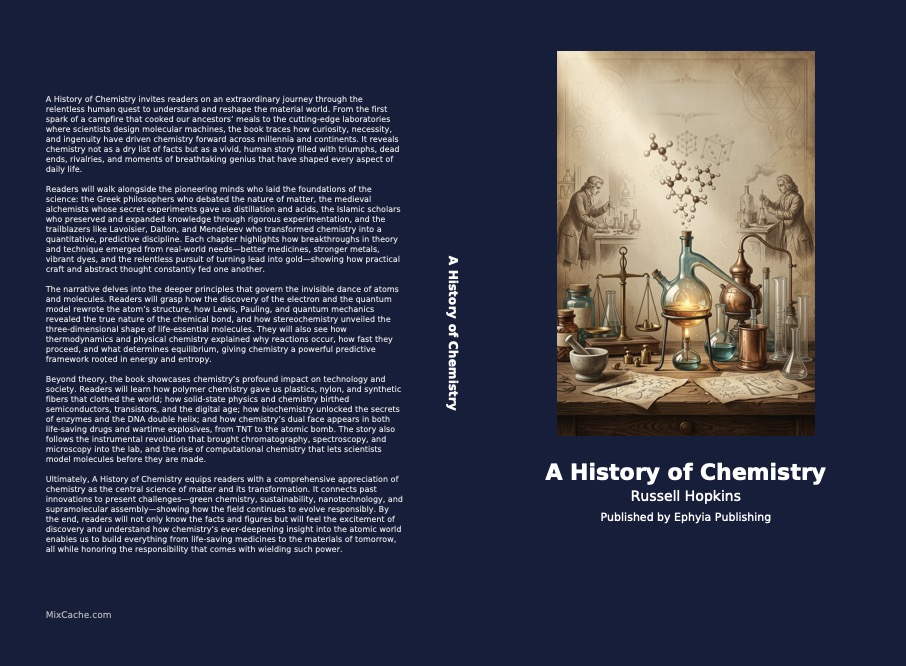
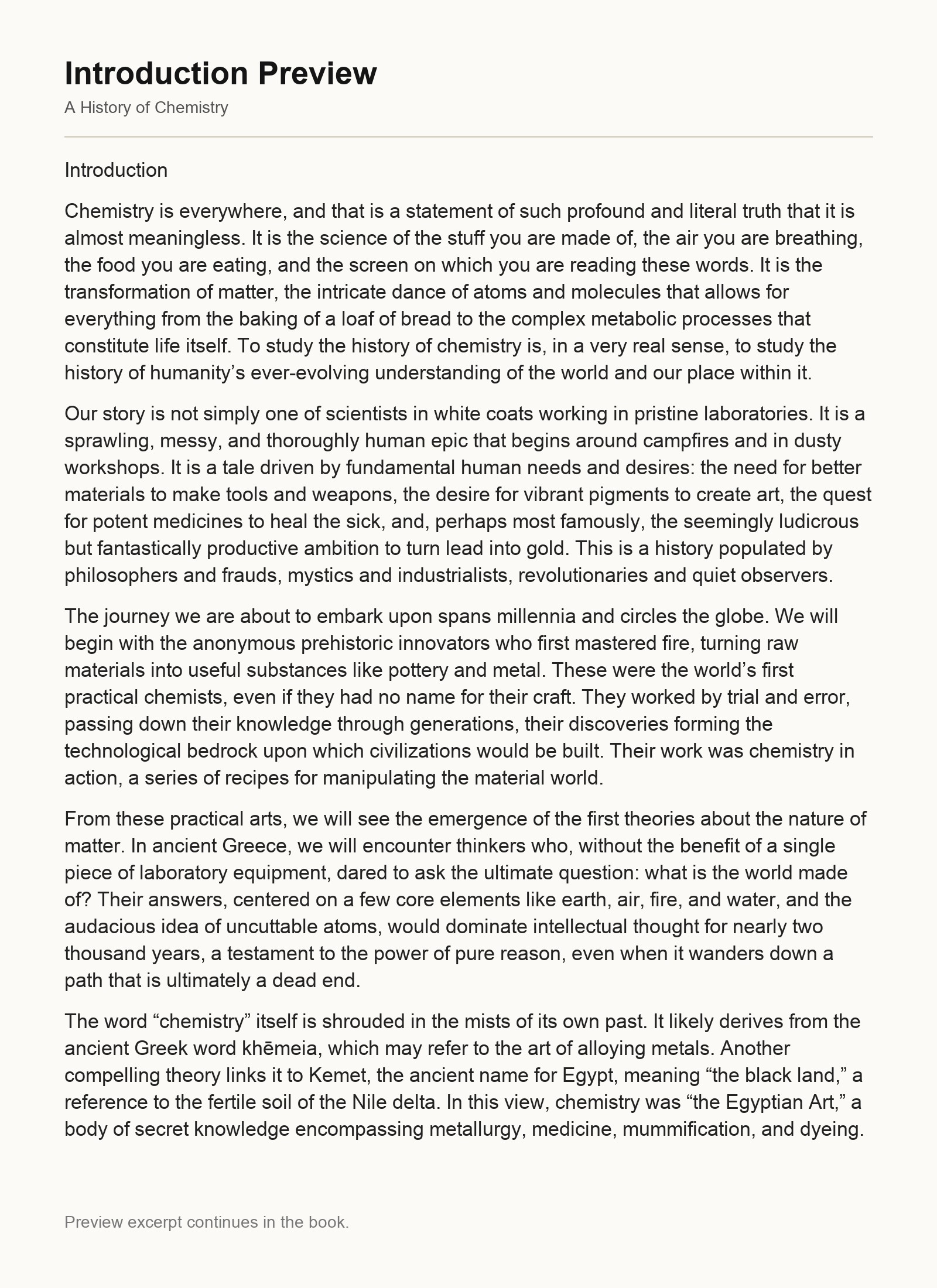
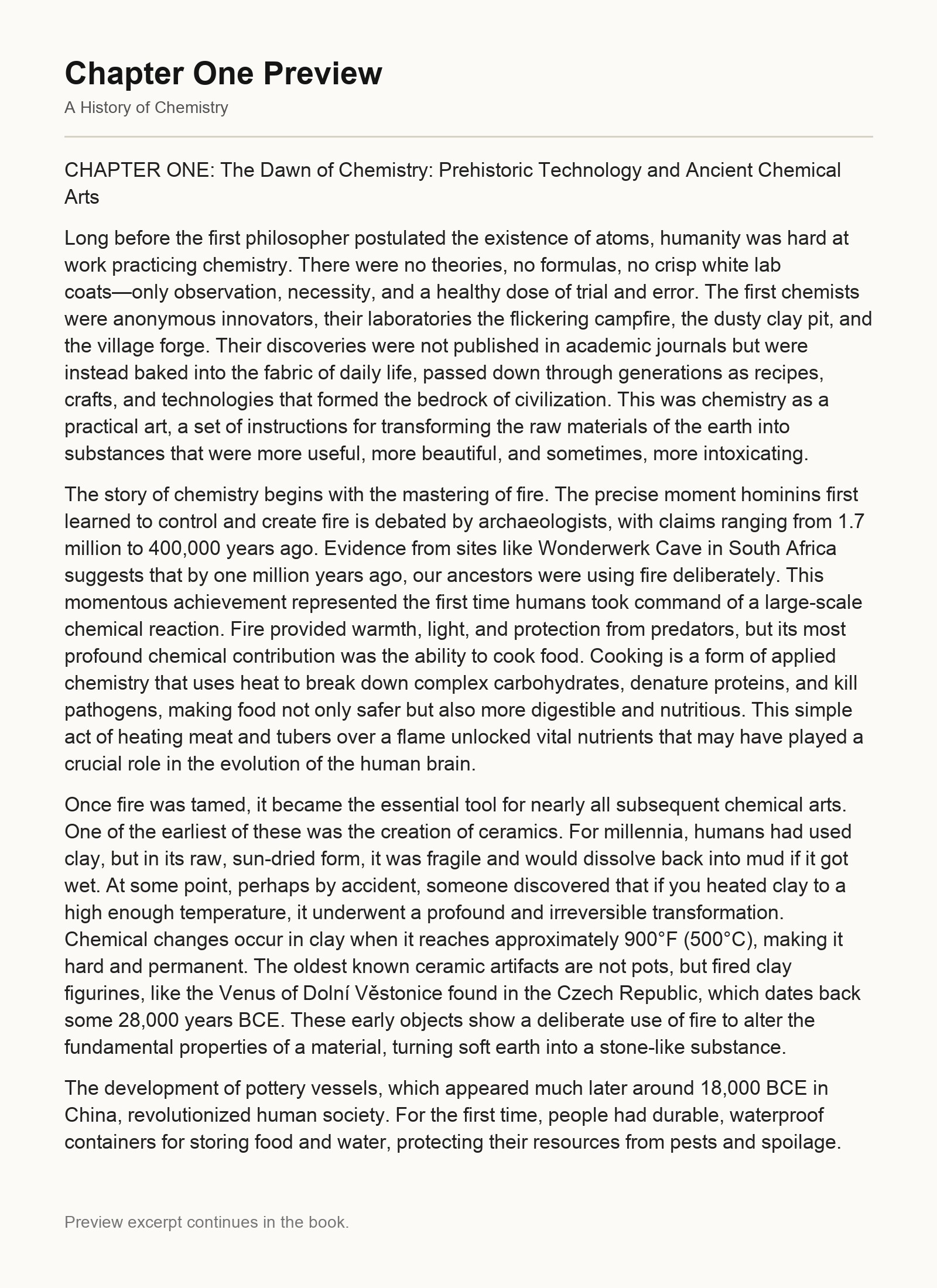
A History of Chemistry invites readers on an extraordinary journey through the relentless human quest to understand and reshape the material world. From the first spark of a campfire that cooked our ancestors’ meals to the cutting‑edge laboratories where scientists design molecular machines, the book traces how curiosity, necessity, and ingenuity have driven chemistry forward across millennia and continents. It reveals chemistry not as a dry list of facts but as a vivid, human story filled with triumphs, dead ends, rivalries, and moments of breathtaking genius that have shaped every aspect of daily life.
Readers will walk alongside the pioneering minds who laid the foundations of the science: the Greek philosophers who debated the nature of matter, the medieval alchemists whose secret experiments gave us distillation and acids, the Islamic scholars who preserved and expanded knowledge through rigorous experimentation, and the trailblazers like Lavoisier, Dalton, and Mendeleev who transformed chemistry into a quantitative, predictive discipline. Each chapter highlights how breakthroughs in theory and technique emerged from real‑world needs—better medicines, stronger metals, vibrant dyes, and the relentless pursuit of turning lead into gold—showing how practical craft and abstract thought constantly fed one another.
The narrative delves into the deeper principles that govern the invisible dance of atoms and molecules. Readers will grasp how the discovery of the electron and the quantum model rewrote the atom’s structure, how Lewis, Pauling, and quantum mechanics revealed the true nature of the chemical bond, and how stereochemistry unveiled the three‑dimensional shape of life‑essential molecules. They will also see how thermodynamics and physical chemistry explained why reactions occur, how fast they proceed, and what determines equilibrium, giving chemistry a powerful predictive framework rooted in energy and entropy.
Beyond theory, the book showcases chemistry’s profound impact on technology and society. Readers will learn how polymer chemistry gave us plastics, nylon, and synthetic fibers that clothed the world; how solid‑state physics and chemistry birthed semiconductors, transistors, and the digital age; how biochemistry unlocked the secrets of enzymes and the DNA double helix; and how chemistry’s dual face appears in both life‑saving drugs and wartime explosives, from TNT to the atomic bomb. The story also follows the instrumental revolution that brought chromatography, spectroscopy, and microscopy into the lab, and the rise of computational chemistry that lets scientists model molecules before they are made.
Ultimately, A History of Chemistry equips readers with a comprehensive appreciation of chemistry as the central science of matter and its transformation. It connects past innovations to present challenges—green chemistry, sustainability, nanotechnology, and supramolecular assembly—showing how the field continues to evolve responsibly. By the end, readers will not only know the facts and figures but will feel the excitement of discovery and understand how chemistry’s ever‑deepening insight into the atomic world enables us to build everything from life‑saving medicines to the materials of tomorrow, all while honoring the responsibility that comes with wielding such power.
What You'll Find Inside:
- From prehistoric fire mastery to modern nanotechnology: A chronological journey through chemistry's evolution across millennia
- Key figures who transformed the field: Lavoisier's chemical revolution, Dalton's atomic theory, Mendeleev's periodic table, and Pauling's bonding theory
- Theoretical foundations: How quantum mechanics explained chemical bonding, molecular structure, and the periodic table's organization
- Practical impact: Chemistry's role in developing materials, medicines, technologies, and its complex relationship with warfare and industry
- Contemporary challenges: Green chemistry, sustainability efforts, and cutting-edge frontiers like supramolecular chemistry and molecular machines
Who's It For:
This book is ideal for chemistry students seeking to understand the historical development of their discipline, science enthusiasts interested in the narrative of scientific discovery, and educators looking for rich contextual material to complement technical instruction. Written in an accessible yet substantive style, it also serves general readers with a keen interest in science history who want to grasp both the concepts and human stories behind chemistry's evolution.
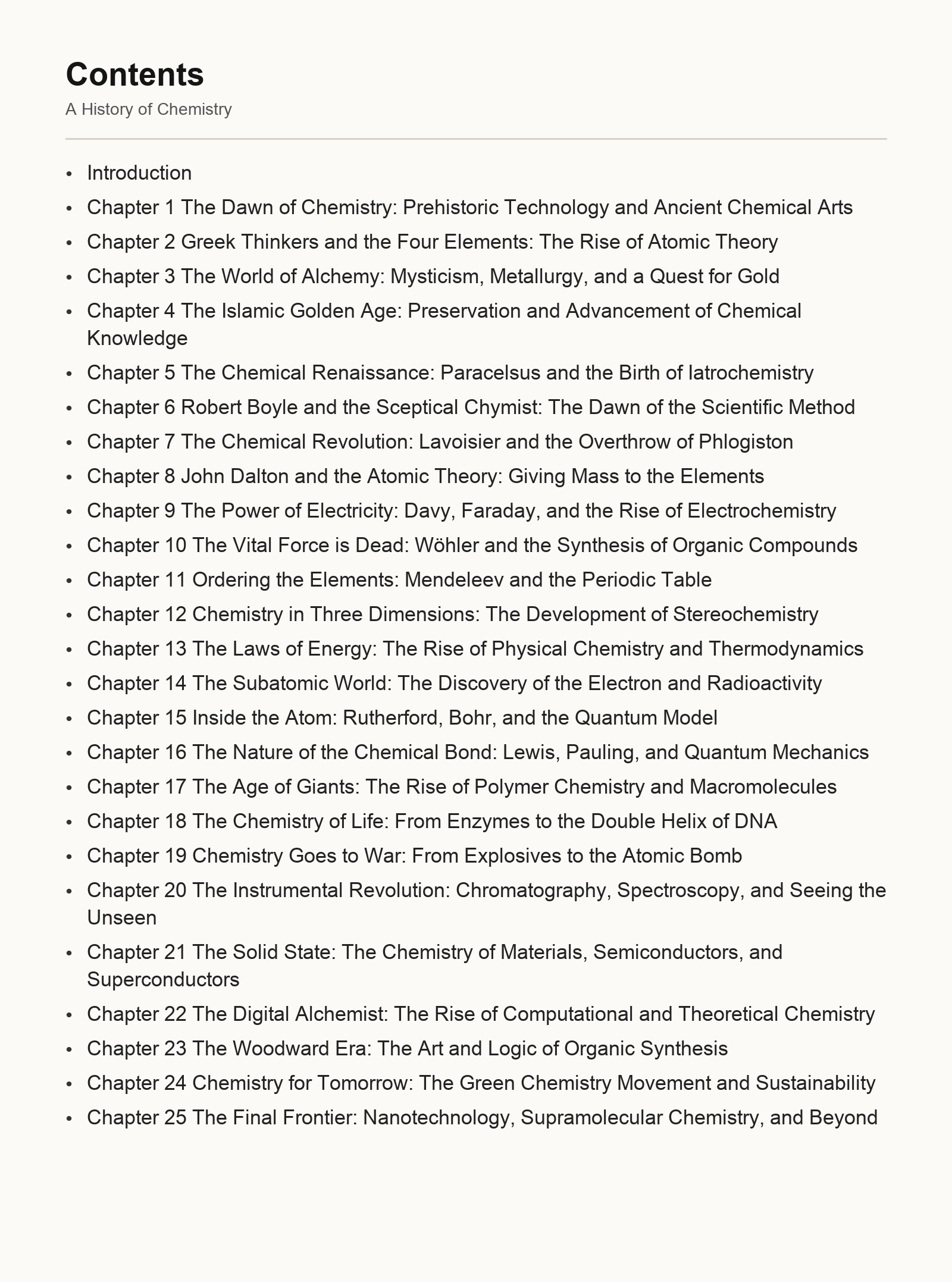
Table of Contents:
- Introduction
- Chapter 1 The Dawn of Chemistry: Prehistoric Technology and Ancient Chemical Arts
- Chapter 2 Greek Thinkers and the Four Elements: The Rise of Atomic Theory
- Chapter 3 The World of Alchemy: Mysticism, Metallurgy, and a Quest for Gold
- Chapter 4 The Islamic Golden Age: Preservation and Advancement of Chemical Knowledge
- Chapter 5 The Chemical Renaissance: Paracelsus and the Birth of Iatrochemistry
- Chapter 6 Robert Boyle and the Sceptical Chymist: The Dawn of the Scientific Method
- Chapter 7 The Chemical Revolution: Lavoisier and the Overthrow of Phlogiston
- Chapter 8 John Dalton and the Atomic Theory: Giving Mass to the Elements
- Chapter 9 The Power of Electricity: Davy, Faraday, and the Rise of Electrochemistry
- Chapter 10 The Vital Force is Dead: Wöhler and the Synthesis of Organic Compounds
- Chapter 11 Ordering the Elements: Mendeleev and the Periodic Table
- Chapter 12 Chemistry in Three Dimensions: The Development of Stereochemistry
- Chapter 13 The Laws of Energy: The Rise of Physical Chemistry and Thermodynamics
- Chapter 14 The Subatomic World: The Discovery of the Electron and Radioactivity
- Chapter 15 Inside the Atom: Rutherford, Bohr, and the Quantum Model
- Chapter 16 The Nature of the Chemical Bond: Lewis, Pauling, and Quantum Mechanics
- Chapter 17 The Age of Giants: The Rise of Polymer Chemistry and Macromolecules
- Chapter 18 The Chemistry of Life: From Enzymes to the Double Helix of DNA
- Chapter 19 Chemistry Goes to War: From Explosives to the Atomic Bomb
- Chapter 20 The Instrumental Revolution: Chromatography, Spectroscopy, and Seeing the Unseen
- Chapter 21 The Solid State: The Chemistry of Materials, Semiconductors, and Superconductors
- Chapter 22 The Digital Alchemist: The Rise of Computational and Theoretical Chemistry
- Chapter 23 The Woodward Era: The Art and Logic of Organic Synthesis
- Chapter 24 Chemistry for Tomorrow: The Green Chemistry Movement and Sustainability
- Chapter 25 The Final Frontier: Nanotechnology, Supramolecular Chemistry, and Beyond
Author:
Published By:
Date Published:
May 18, 2026
Type:
Nonfiction
Language:
English
Also Available In:
Word Count:
58,650 words
Reading Time:
4 hours 6 minutes
Sample:
Order:
Buy the A History of Chemistry ebook on MixCache.com:
Buy NowThe full ebook will be available immediately to read instantly on any device.
$5 account credit for all new MixCache.com accounts, usable toward any ebook purchase!*






Ratings & Reviews
Ask Questions About This Book
Have a question about the content? Ask our AI assistant!
Start by asking a question about "A History of Chemistry"
Example: "Does this book mention William Shakespeare?"
Thinking...