
Browse by Category
Fiction
- Action & Adventure
- African American
- Anthologies
- Children's Fiction
- Classics
- Comics & Graphic Novels
- Coming of Age
- Contemporary
- Cultural & Regional
- Drama
- Erotica
- Fantasy
- General
- Historical Fiction
- Horror
- Humor & Satire
- Literary Fiction
- Mystery, Thriller & Suspense
- Poetry
- Religious & Inspirational
- Romance
- Science Fiction
- Short Stories
- War & Military
- Westerns
- Women's Fiction
- Young Adult
Non-Fiction
- Antiques & Collectibles
- Arts & Photography
- Biographies & Memoirs
- Business & Money
- Children's Non-Fiction
-
Computers & Technology
- Artificial Intelligence
- Computer Science
- Cybersecurity & Cryptography
- Data Science & Analytics
- Databases & Big Data
- Game Development & Design
- General
- Hardware & DIY
- Mobile App Development
- Networking & Cloud Computing
- Operating Systems
- Programming
- Robotics
- Software
- Software Engineering
- User Experience (UX) & Design
- Web Development & Design
- Cooking, Food & Wine
- Crafts, Hobbies & Home
- Education & Teaching
- Engineering
- General
- Health, Fitness & Dieting
-
History
- African History
- African History - North Africa
- African History - Sub-Saharan Africa
- American History
- American History - 20th Century
- American History - Civil War
- American History - Colonial Period
- Ancient History
- Asian History
- Asian History - China
- Asian History - India
- Asian History - Japan
- Asian History - Southeast Asia
- European History
- European History - Ancient Greece
- European History - Ancient Rome
- European History - Medieval
- European History - Modern
- European History - Renaissance
- General
- Middle Eastern History
- Military History
- Military History - Aviation
- Military History - Naval
- Social & Cultural History
- World History
- Humor & Entertainment
- Industrial Technology
- Language Learning
- Law
- LGBTQ+ Non-Fiction
- Literary Criticism
- Medical Books
- Parenting & Relationships
- Philosophy
- Politics & Social Sciences
- Reference
- Religion & Spirituality
-
Science & Math
- Agricultural Sciences
- Astronomy & Space Science
- Behavioral Sciences
- Biological Sciences
- Botany & Plant Science
- Chemistry
- Earth Sciences
- Engineering - Chemical
- Engineering - Civil
- Engineering - Electrical
- Engineering - Mechanical
- Environment
- General
- Geology
- Mathematics
- Nature & Ecology
- Oceanography
- Paleontology
- Physics
- Statistics
- Self-Help
- Sports & Outdoors
- Study Aids
- Sustainability & Green Living
- Textbooks
- Transportation
- Travel
- True Crime
- Urban Planning & Development
- Veterinary Medicine
- Writing & Publishing
Jump to Section
MixCache.com Total Access
Unlimited reading and audiobooks for every book published by MixCache.com.
Included titles carry the MTA badge.
Learn more →
Christianity and Science
MTA
Dialogues on Origins, Ethics, and the Natural World
About this book:
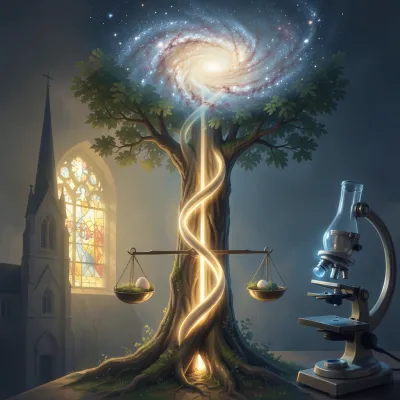
This book presents a sustained dialogue between Christianity and the sciences, rejecting the simplistic warfare thesis in favor of a model where faith and reason inform one another. It begins by showing that many founders of modern science were devout Christians who saw their work as uncovering the rational order God placed in creation, and it traces how theological convictions have historically motivated scientific inquiry rather than impeded it. The contributors—drawn from cosmology, biology, neuroscience, environmental studies, theology, and ethics—emphasize shared virtues of honesty, patience, openness to revision, and gratitude for the world’s intelligibility, while acknowledging the distinct methods and questions of each discipline.
The volume surveys a wide range of topics where scientific discoveries intersect with theological reflection. Chapters on cosmology engage the Big Bang with the doctrine of creation ex nihilo, examine fine‑tuning of the universe’s constants, and explore the nature of time and eternity in light of relativity and an expanding cosmos. Discussions of Earth’s deep time, the fossil record, and radiometric dating set the stage for chapters on evolution, natural selection, genetics, and the theological concept of the imago Dei, proposing models such as evolutionary creation and emergent understandings of the image of God. Subsequent sections turn to mind, brain, and soul, addressing consciousness, free will, moral responsibility, and the challenge of miracles, all while considering how methodological naturalism functions as a scientific discipline that leaves room for theological reflection on ultimate meaning and purpose.
Ethical and practical concerns form a substantial part of the dialogue. The book examines bioethical issues surrounding genetics, reproductive technologies, end‑of‑life care, and the allocation of medical resources; it evaluates the moral implications of artificial intelligence, urging a critical yet hopeful engagement guided by wisdom and human dignity. Ecological stewardship is developed from a reinterpretation of dominion into care, drawing on scientific insights about interdependence, biodiversity, and ecosystem services to address climate change, environmental justice, and the treatment of nonhuman creatures. Theological themes such as sacrament, prayer, providence, and the problem of evil are revisited in light of scientific understandings of causality, suffering, and evolutionary processes, with attention to eschatological hope and the call to participate in God’s healing work. The volume concludes with reflections on science education in church and school, interfaith perspectives on science–religion dialogue, and a sketch of a twenty‑first‑century theology of nature that affirms a dynamic, evolving creation, the interconnectedness of all life, humanity’s role as priest‑like image‑bearers, and the necessity of intellectual humility, compassion, and responsible innovation in the face of technological power.
What You'll Find Inside:
- How scientific discoveries like Big Bang cosmology and evolution can enrich theological understanding of creation without requiring conflict between faith and science
- The ethical implications of modern science and technology (AI, genetics, climate change) examined through Christian moral traditions and theological reflection
- Understanding divine action and providence in a scientifically described universe, moving beyond 'God of the gaps' thinking toward non-interventionist models of divine action
- Humanity's unique place and responsibility in creation as informed by both theological concepts (Imago Dei) and scientific understanding (evolution, ecology, and interconnectedness)
- The complementary nature of scientific and theological ways of knowing, with science addressing 'how' and 'when' questions while theology addresses 'who' and 'why' questions
Who's It For:
This book is designed for students encountering faith-science questions for the first time, pastors and educators seeking to foster wise conversations about origins and ethics, and scientists and theologians desiring meaningful dialogue across disciplinary boundaries. It will benefit anyone interested in how Christian theology can engage constructively with contemporary scientific discoveries while maintaining intellectual integrity and spiritual depth. Readers will find resources for thinking more clearly about complex issues, acting more justly in response to scientific and technological challenges, and loving more deeply within God's creation.
Table of Contents:
- Introduction
- Chapter 1 Why Dialogue Matters: Faith, Reason, and the Pursuit of Truth
- Chapter 2 Reading Genesis in a Scientific Age
- Chapter 3 Big Bang and Creation ex Nihilo
- Chapter 4 Fine-Tuning, Anthropic Reflections, and Providence
- Chapter 5 Time, Eternity, and the Expanding Universe
- Chapter 6 Earth’s Story: Deep Time, Fossils, and Geological Narratives
- Chapter 7 Evolution and Imago Dei: Human Origins Revisited
- Chapter 8 Natural Selection, Chance, and Divine Action
- Chapter 9 Genetics, Common Descent, and Original Sin
- Chapter 10 Mind, Brain, and Soul: A Neuroscience Dialogue
- Chapter 11 Consciousness, Free Will, and Moral Responsibility
- Chapter 12 Miracles and the Laws of Nature
- Chapter 13 Methodological Naturalism and Theological Method
- Chapter 14 Science as Vocation: Virtues, Practices, and Communities
- Chapter 15 Technology, AI, and the Moral Imagination
- Chapter 16 Bioethics: Life, Suffering, and Medical Decision-Making
- Chapter 17 Ecology and Stewardship: From Dominion to Care
- Chapter 18 Climate Change: Justice, Hope, and Responsibility
- Chapter 19 Nonhuman Creatures: Animal Minds and Moral Considerability
- Chapter 20 Sacrament and Cosmos: Matter, Meaning, and Worship
- Chapter 21 Prayer, Providence, and Causality
- Chapter 22 The Problem of Evil in a Darwinian World
- Chapter 23 Science Education in Church and School
- Chapter 24 Interfaith and Global Perspectives on Science–Religion Dialogue
- Chapter 25 Toward a Theology of Nature for the Twenty-First Century
Author:
Published By:
Date Published:
May 18, 2026
Type:
Nonfiction
Language:
English
Word Count:
66,547 words
Reading Time:
4 hours 40 minutes
Sample:
Order:
Order Christianity and Science (Hardcover) on MixCache.com:
Buy NowPrint copy is made to order and ships worldwide. Includes the ebook free, ready to read instantly.
$5 account credit for all new MixCache.com accounts, usable toward any ebook purchase!*


