
Browse by Category
Fiction
- Action & Adventure
- African American
- Anthologies
- Children's Fiction
- Classics
- Comics & Graphic Novels
- Coming of Age
- Contemporary
- Cultural & Regional
- Drama
- Erotica
- Fantasy
- General
- Historical Fiction
- Horror
- Humor & Satire
- Literary Fiction
- Mystery, Thriller & Suspense
- Poetry
- Religious & Inspirational
- Romance
- Science Fiction
- Short Stories
- War & Military
- Westerns
- Women's Fiction
- Young Adult
Non-Fiction
- Antiques & Collectibles
- Arts & Photography
- Biographies & Memoirs
- Business & Money
- Children's Non-Fiction
-
Computers & Technology
- Artificial Intelligence
- Computer Science
- Cybersecurity & Cryptography
- Data Science & Analytics
- Databases & Big Data
- Game Development & Design
- General
- Hardware & DIY
- Mobile App Development
- Networking & Cloud Computing
- Operating Systems
- Programming
- Robotics
- Software
- Software Engineering
- User Experience (UX) & Design
- Web Development & Design
- Cooking, Food & Wine
- Crafts, Hobbies & Home
- Education & Teaching
- Engineering
- General
- Health, Fitness & Dieting
-
History
- African History
- African History - North Africa
- African History - Sub-Saharan Africa
- American History
- American History - 20th Century
- American History - Civil War
- American History - Colonial Period
- Ancient History
- Asian History
- Asian History - China
- Asian History - India
- Asian History - Japan
- Asian History - Southeast Asia
- European History
- European History - Ancient Greece
- European History - Ancient Rome
- European History - Medieval
- European History - Modern
- European History - Renaissance
- General
- Middle Eastern History
- Military History
- Military History - Aviation
- Military History - Naval
- Social & Cultural History
- World History
- Humor & Entertainment
- Industrial Technology
- Language Learning
- Law
- LGBTQ+ Non-Fiction
- Literary Criticism
- Medical Books
- Parenting & Relationships
- Philosophy
- Politics & Social Sciences
- Reference
- Religion & Spirituality
-
Science & Math
- Agricultural Sciences
- Astronomy & Space Science
- Behavioral Sciences
- Biological Sciences
- Botany & Plant Science
- Chemistry
- Earth Sciences
- Engineering - Chemical
- Engineering - Civil
- Engineering - Electrical
- Engineering - Mechanical
- Environment
- General
- Geology
- Mathematics
- Nature & Ecology
- Oceanography
- Paleontology
- Physics
- Statistics
- Self-Help
- Sports & Outdoors
- Study Aids
- Sustainability & Green Living
- Textbooks
- Transportation
- Travel
- True Crime
- Urban Planning & Development
- Veterinary Medicine
- Writing & Publishing
Jump to Section
MixCache.com Total Access
Unlimited reading and audiobooks for every book published by MixCache.com.
Included titles carry the MTA badge.
Learn more →Disasters That Changed The World
About this book:
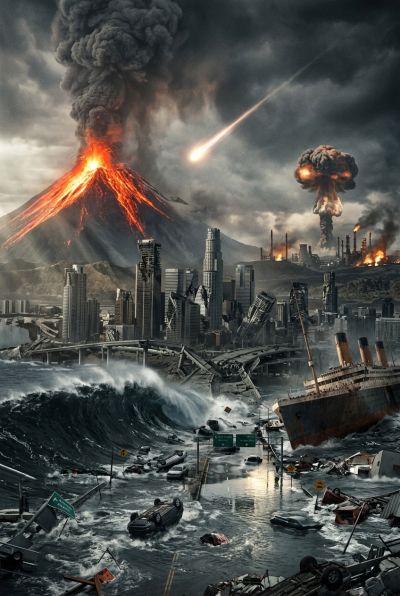
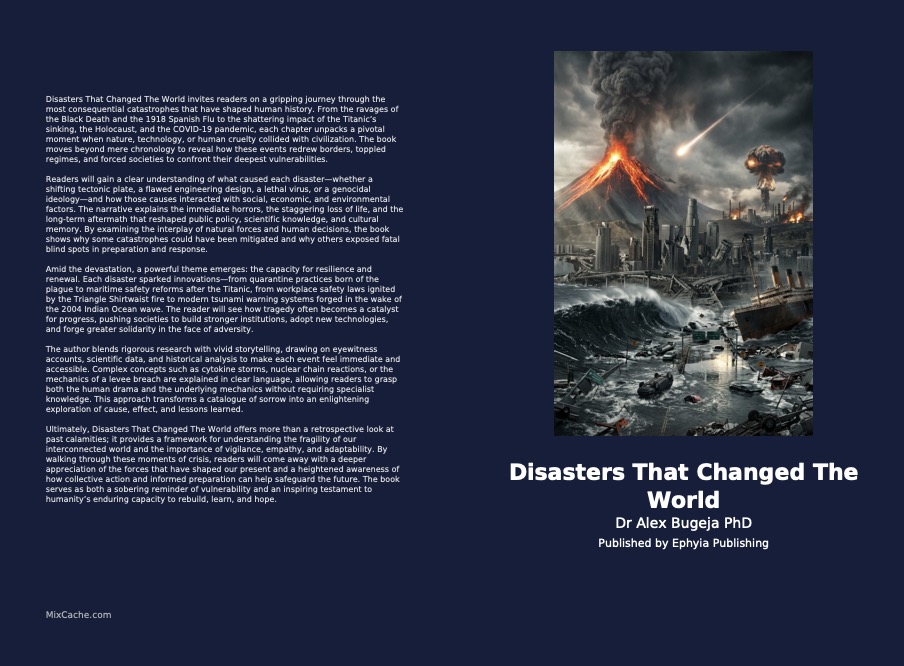
Disasters That Changed The World invites readers on a gripping journey through the most consequential catastrophes that have shaped human history. From the ravages of the Black Death and the 1918 Spanish Flu to the shattering impact of the Titanic’s sinking, the Holocaust, and the COVID‑19 pandemic, each chapter unpacks a pivotal moment when nature, technology, or human cruelty collided with civilization. The book moves beyond mere chronology to reveal how these events redrew borders, toppled regimes, and forced societies to confront their deepest vulnerabilities.
Readers will gain a clear understanding of what caused each disaster—whether a shifting tectonic plate, a flawed engineering design, a lethal virus, or a genocidal ideology—and how those causes interacted with social, economic, and environmental factors. The narrative explains the immediate horrors, the staggering loss of life, and the long‑term aftermath that reshaped public policy, scientific knowledge, and cultural memory. By examining the interplay of natural forces and human decisions, the book shows why some catastrophes could have been mitigated and why others exposed fatal blind spots in preparation and response.
Amid the devastation, a powerful theme emerges: the capacity for resilience and renewal. Each disaster sparked innovations—from quarantine practices born of the plague to maritime safety reforms after the Titanic, from workplace safety laws ignited by the Triangle Shirtwaist fire to modern tsunami warning systems forged in the wake of the 2004 Indian Ocean wave. The reader will see how tragedy often becomes a catalyst for progress, pushing societies to build stronger institutions, adopt new technologies, and forge greater solidarity in the face of adversity.
The author blends rigorous research with vivid storytelling, drawing on eyewitness accounts, scientific data, and historical analysis to make each event feel immediate and accessible. Complex concepts such as cytokine storms, nuclear chain reactions, or the mechanics of a levee breach are explained in clear language, allowing readers to grasp both the human drama and the underlying mechanics without requiring specialist knowledge. This approach transforms a catalogue of sorrow into an enlightening exploration of cause, effect, and lessons learned.
Ultimately, Disasters That Changed The World offers more than a retrospective look at past calamities; it provides a framework for understanding the fragility of our interconnected world and the importance of vigilance, empathy, and adaptability. By walking through these moments of crisis, readers will come away with a deeper appreciation of the forces that have shaped our present and a heightened awareness of how collective action and informed preparation can help safeguard the future. The book serves as both a sobering reminder of vulnerability and an inspiring testament to humanity’s enduring capacity to rebuild, learn, and hope.
What You'll Find Inside:
- The Black Death shows how a pandemic can collapse feudalism, raise living standards for survivors, and birth modern public health practices.
- Technological disasters like the Titanic, Chernobyl, and Bhopal expose hubris and negligence, leading to enduring safety and regulatory reforms.
- Genocides such as the Holocaust and Rwanda reveal humanity's capacity for systematic cruelty and have driven the development of international human rights law.
- Natural catastrophes—from earthquakes to floods—highlight societal inequities and often spur advances in engineering, urban planning, and environmental policy.
- Across all events, the book emphasizes human resilience, adaptation, and the lessons learned that rebuild societies stronger and more aware.
Who's It For:
This book is ideal for history enthusiasts, students of social sciences, policymakers, and general readers interested in how catastrophic events—whether natural, technological, or human‑driven—have reshaped societies, spurred reform, and revealed both the fragility and resilience of humanity.
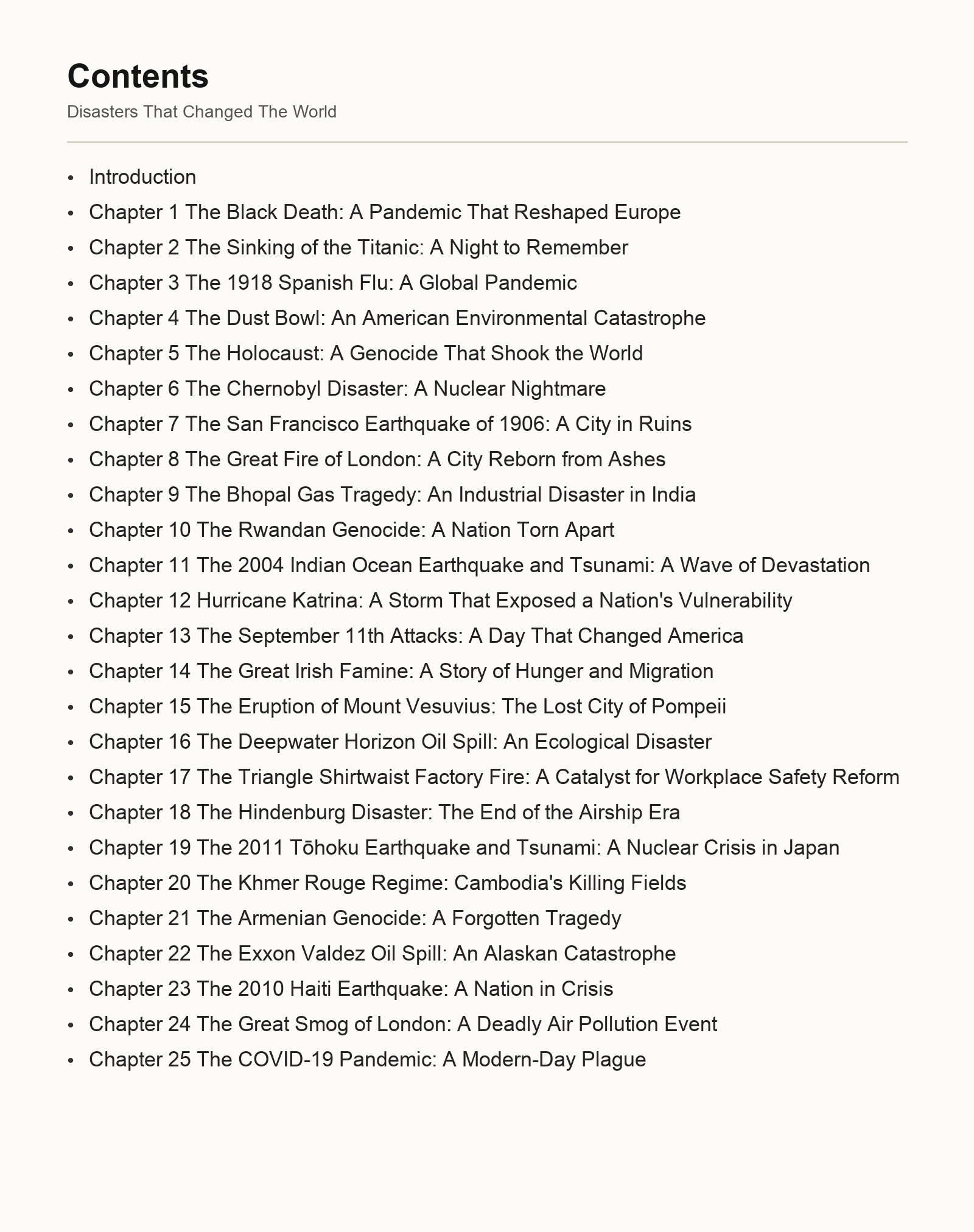
Table of Contents:
- Introduction
- Chapter 1 The Black Death: A Pandemic That Reshaped Europe
- Chapter 2 The Sinking of the Titanic: A Night to Remember
- Chapter 3 The 1918 Spanish Flu: A Global Pandemic
- Chapter 4 The Dust Bowl: An American Environmental Catastrophe
- Chapter 5 The Holocaust: A Genocide That Shook the World
- Chapter 6 The Chernobyl Disaster: A Nuclear Nightmare
- Chapter 7 The San Francisco Earthquake of 1906: A City in Ruins
- Chapter 8 The Great Fire of London: A City Reborn from Ashes
- Chapter 9 The Bhopal Gas Tragedy: An Industrial Disaster in India
- Chapter 10 The Rwandan Genocide: A Nation Torn Apart
- Chapter 11 The 2004 Indian Ocean Earthquake and Tsunami: A Wave of Devastation
- Chapter 12 Hurricane Katrina: A Storm That Exposed a Nation's Vulnerability
- Chapter 13 The September 11th Attacks: A Day That Changed America
- Chapter 14 The Great Irish Famine: A Story of Hunger and Migration
- Chapter 15 The Eruption of Mount Vesuvius: The Lost City of Pompeii
- Chapter 16 The Deepwater Horizon Oil Spill: An Ecological Disaster
- Chapter 17 The Triangle Shirtwaist Factory Fire: A Catalyst for Workplace Safety Reform
- Chapter 18 The Hindenburg Disaster: The End of the Airship Era
- Chapter 19 The 2011 Tōhoku Earthquake and Tsunami: A Nuclear Crisis in Japan
- Chapter 20 The Khmer Rouge Regime: Cambodia's Killing Fields
- Chapter 21 The Armenian Genocide: A Forgotten Tragedy
- Chapter 22 The Exxon Valdez Oil Spill: An Alaskan Catastrophe
- Chapter 23 The 2010 Haiti Earthquake: A Nation in Crisis
- Chapter 24 The Great Smog of London: A Deadly Air Pollution Event
- Chapter 25 The COVID-19 Pandemic: A Modern-Day Plague
Author:
Published By:
Date Published:
May 18, 2026
Type:
Nonfiction
Language:
English
Word Count:
51,410 words
Reading Time:
3 hours 36 minutes
Sample:
Order:
Buy the Disasters That Changed The World ebook on MixCache.com:
Buy NowThe full ebook will be available immediately to read instantly on any device.
$5 account credit for all new MixCache.com accounts, usable toward any ebook purchase!*





Ratings & Reviews
Ask Questions About This Book
Have a question about the content? Ask our AI assistant!
Start by asking a question about "Disasters That Changed The World"
Example: "Does this book mention William Shakespeare?"
Thinking...