
Browse by Category
Fiction
- Action & Adventure
- African American
- Anthologies
- Children's Fiction
- Classics
- Comics & Graphic Novels
- Coming of Age
- Contemporary
- Cultural & Regional
- Drama
- Erotica
- Fantasy
- General
- Historical Fiction
- Horror
- Humor & Satire
- Literary Fiction
- Mystery, Thriller & Suspense
- Poetry
- Religious & Inspirational
- Romance
- Science Fiction
- Short Stories
- War & Military
- Westerns
- Women's Fiction
- Young Adult
Non-Fiction
- Antiques & Collectibles
- Arts & Photography
- Biographies & Memoirs
- Business & Money
- Children's Non-Fiction
-
Computers & Technology
- Artificial Intelligence
- Computer Science
- Cybersecurity & Cryptography
- Data Science & Analytics
- Databases & Big Data
- Game Development & Design
- General
- Hardware & DIY
- Mobile App Development
- Networking & Cloud Computing
- Operating Systems
- Programming
- Robotics
- Software
- Software Engineering
- User Experience (UX) & Design
- Web Development & Design
- Cooking, Food & Wine
- Crafts, Hobbies & Home
- Education & Teaching
- Engineering
- General
- Health, Fitness & Dieting
-
History
- African History
- African History - North Africa
- African History - Sub-Saharan Africa
- American History
- American History - 20th Century
- American History - Civil War
- American History - Colonial Period
- Ancient History
- Asian History
- Asian History - China
- Asian History - India
- Asian History - Japan
- Asian History - Southeast Asia
- European History
- European History - Ancient Greece
- European History - Ancient Rome
- European History - Medieval
- European History - Modern
- European History - Renaissance
- General
- Middle Eastern History
- Military History
- Military History - Aviation
- Military History - Naval
- Social & Cultural History
- World History
- Humor & Entertainment
- Industrial Technology
- Language Learning
- Law
- LGBTQ+ Non-Fiction
- Literary Criticism
- Medical Books
- Parenting & Relationships
- Philosophy
- Politics & Social Sciences
- Reference
- Religion & Spirituality
-
Science & Math
- Agricultural Sciences
- Astronomy & Space Science
- Behavioral Sciences
- Biological Sciences
- Botany & Plant Science
- Chemistry
- Earth Sciences
- Engineering - Chemical
- Engineering - Civil
- Engineering - Electrical
- Engineering - Mechanical
- Environment
- General
- Geology
- Mathematics
- Nature & Ecology
- Oceanography
- Paleontology
- Physics
- Statistics
- Self-Help
- Sports & Outdoors
- Study Aids
- Sustainability & Green Living
- Textbooks
- Transportation
- Travel
- True Crime
- Urban Planning & Development
- Veterinary Medicine
- Writing & Publishing
Jump to Section
MixCache.com Total Access
Unlimited reading and audiobooks for every book published by MixCache.com.
Included titles carry the MTA badge.
Learn more →The Fall of Rome
About this book:
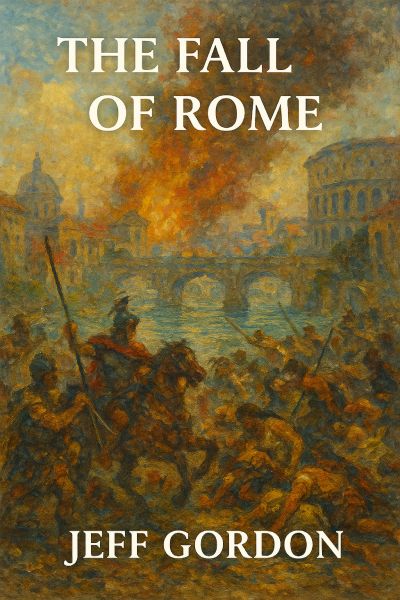
The Fall of Rome explores one of history’s most dramatic transformations: the long decline of Roman power from the height of imperial strength to the disappearance of the Western Roman throne and the eventual fall of Constantinople. Rather than presenting Rome’s fall as a single event, the book examines it as a complex process shaped by political instability, economic pressure, military change, social upheaval, and external threats.
The book begins by examining the Roman Empire at its height, showing how its institutions, legal traditions, cities, armies, and networks of trade held together a vast and diverse world. It then traces the growing strains beneath that system, including fiscal crisis, currency debasement, heavy taxation, civil war, and the rise of soldier-emperors whose power depended increasingly on military loyalty.
As the narrative moves through late antiquity, the book explores the pressures that weakened the Western Empire: barbarian migrations, the Huns, the Goths, the Vandals, the sacks of Rome in 410 and 455, and the gradual collapse of imperial defense. It also looks beyond invasion alone, considering how the Church, local elites, bishops, and regional powers filled civic roles once performed by the Roman state.
The final sections follow the transformation of Roman authority after the fall of the West, examining the survival of the Eastern Empire in Constantinople, Justinian’s attempted reconquests, Byzantine resilience, and the slow erosion of Roman imperial power over the centuries. The story concludes with the fall of Constantinople in 1453, marking the last chapter of the Roman world.
Clear, wide-ranging, and richly detailed, The Fall of Rome offers readers an accessible account of how a mighty empire fractured, adapted, and endured in new forms. It is a compelling guide to the forces that brought down the Western Roman Empire while showing how Roman law, culture, identity, and institutions continued to shape history long after the empire’s political collapse.
What You'll Find Inside:
- The book examines the fall of Rome as a multi-century process driven by political instability, economic strain, military transformation, and social change rather than a single catastrophic event.
- It details the Crisis of the Third Century, Diocletian’s Tetrarchy, and Constantine’s Christianization as pivotal reforms that reshaped imperial structures.
- Chapters on barbarian groups (Goths, Vandals, Huns, etc.) explore their migrations, settlements, and impact on Roman frontiers and internal politics.
- The work traces the survival and evolution of the Eastern Roman Empire, highlighting Constantinople’s defenses, Justinian’s reconquest, and the eventual fall in 1453.
- Despite political collapse, Roman law, elite culture, and rural economic patterns persisted, influencing the emergence of medieval European societies.
Who's It For:
This book is ideal for undergraduate and graduate students of history, particularly those focusing on late antiquity, the Roman Empire, and early medieval Europe, as well as educated general readers seeking a comprehensive, scholarly yet accessible analysis of the complex factors behind Rome’s decline and the Byzantine continuation.
Table of Contents:
- Introduction
- Chapter 1 Rome at Its Height: Institutions, Identity, and Empire
- Chapter 2 Economic Strain and Fiscal Crisis
- Chapter 3 Military Transformation and the Soldier-Emperors
- Chapter 4 Political Instability and Civil War
- Chapter 5 The Crisis of the Third Century
- Chapter 6 Diocletian, Reforms, and the Tetrarchy
- Chapter 7 Constantine and the Christianization of the Empire
- Chapter 8 Social Change and Urban Decline
- Chapter 9 The Role of Barbarian Peoples: Goths, Vandals, Franks, Burgundians
- Chapter 10 The Huns and the Age of Migrations
- Chapter 11 The Sack of Rome (410): Alaric and the Visigoths
- Chapter 12 The Western Army and the Collapse of Defense
- Chapter 13 Economy, Taxation, and the Breakdown of Commerce
- Chapter 14 The Church, Bishops, and the Filling of Civic Roles
- Chapter 15 Law, Administration, and the Erosion of Imperial Control
- Chapter 16 The Vandals, North Africa, and the 455 Sack
- Chapter 17 Germanic Kingdoms within Roman Lands: Transition or Transformation?
- Chapter 18 Stilicho, Aetius, and the Last Great Roman Commanders
- Chapter 19 Open Battles and Local Revolts: Toward Political Fragmentation
- Chapter 20 Romulus Augustulus, Odoacer, and the Fall of the Western Throne
- Chapter 21 Continuities: Roman Law, Elite Culture, and Rural Stability
- Chapter 22 The Eastern Empire’s Survival: Constantinople’s Adaptation
- Chapter 23 Justinian, Reconquest, and the Limits of Restoration
- Chapter 24 Byzantine Resilience and the Slow Erosion of Power
- Chapter 25 The Fall of Constantinople (1453): The Last Chapter of the Roman World
Traffikoo LLC MixCache.com Book Reference: 15429
Author:
Published By:
Date Published:
May 17, 2026
Type:
Nonfiction
Language:
English
Word Count:
55,629 words
Reading Time:
3 hours 54 minutes
Sample:
Order:
Buy the The Fall of Rome ebook on MixCache.com:
Buy NowThe full ebook will be available immediately to read instantly on any device.
$5 account credit for all new MixCache.com accounts, usable toward any ebook purchase!*



Ratings & Reviews
Ask Questions About This Book
Have a question about the content? Ask our AI assistant!
Start by asking a question about "The Fall of Rome"
Example: "Does this book mention William Shakespeare?"
Thinking...