Browse by Category
Fiction
- Action & Adventure
- African American
- Anthologies
- Children's Fiction
- Classics
- Comics & Graphic Novels
- Coming of Age
- Contemporary
- Cultural & Regional
- Drama
- Erotica
- Fantasy
- General
- Historical Fiction
- Horror
- Humor & Satire
- Literary Fiction
- Mystery, Thriller & Suspense
- Poetry
- Religious & Inspirational
- Romance
- Science Fiction
- Short Stories
- War & Military
- Westerns
- Women's Fiction
- Young Adult
Non-Fiction
- Antiques & Collectibles
- Arts & Photography
- Biographies & Memoirs
- Business & Money
- Children's Non-Fiction
-
Computers & Technology
- Artificial Intelligence
- Computer Science
- Cybersecurity & Cryptography
- Data Science & Analytics
- Databases & Big Data
- Game Development & Design
- General
- Hardware & DIY
- Mobile App Development
- Networking & Cloud Computing
- Operating Systems
- Programming
- Robotics
- Software
- Software Engineering
- User Experience (UX) & Design
- Web Development & Design
- Cooking, Food & Wine
- Crafts, Hobbies & Home
- Education & Teaching
- Engineering
- General
- Health, Fitness & Dieting
-
History
- African History
- African History - North Africa
- African History - Sub-Saharan Africa
- American History
- American History - 20th Century
- American History - Civil War
- American History - Colonial Period
- Ancient History
- Asian History
- Asian History - China
- Asian History - India
- Asian History - Japan
- Asian History - Southeast Asia
- European History
- European History - Ancient Greece
- European History - Ancient Rome
- European History - Medieval
- European History - Modern
- European History - Renaissance
- General
- Middle Eastern History
- Military History
- Military History - Aviation
- Military History - Naval
- Social & Cultural History
- World History
- Humor & Entertainment
- Industrial Technology
- Language Learning
- Law
- LGBTQ+ Non-Fiction
- Literary Criticism
- Medical Books
- Parenting & Relationships
- Philosophy
- Politics & Social Sciences
- Reference
- Religion & Spirituality
-
Science & Math
- Agricultural Sciences
- Astronomy & Space Science
- Behavioral Sciences
- Biological Sciences
- Botany & Plant Science
- Chemistry
- Earth Sciences
- Engineering - Chemical
- Engineering - Civil
- Engineering - Electrical
- Engineering - Mechanical
- Environment
- General
- Geology
- Mathematics
- Nature & Ecology
- Oceanography
- Paleontology
- Physics
- Statistics
- Self-Help
- Sports & Outdoors
- Study Aids
- Sustainability & Green Living
- Textbooks
- Transportation
- Travel
- True Crime
- Urban Planning & Development
- Veterinary Medicine
- Writing & Publishing
Jump to Section
MixCache.com Total Access
Unlimited reading and audiobooks for every book published by MixCache.com.
Included titles carry the MTA badge.
Learn more →A History of Cuba
About this book:


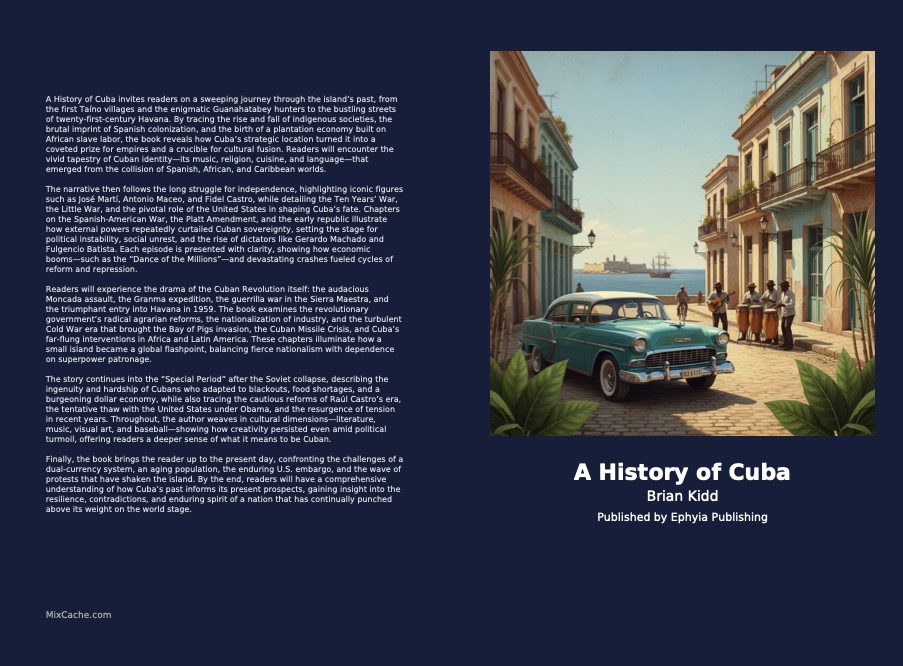
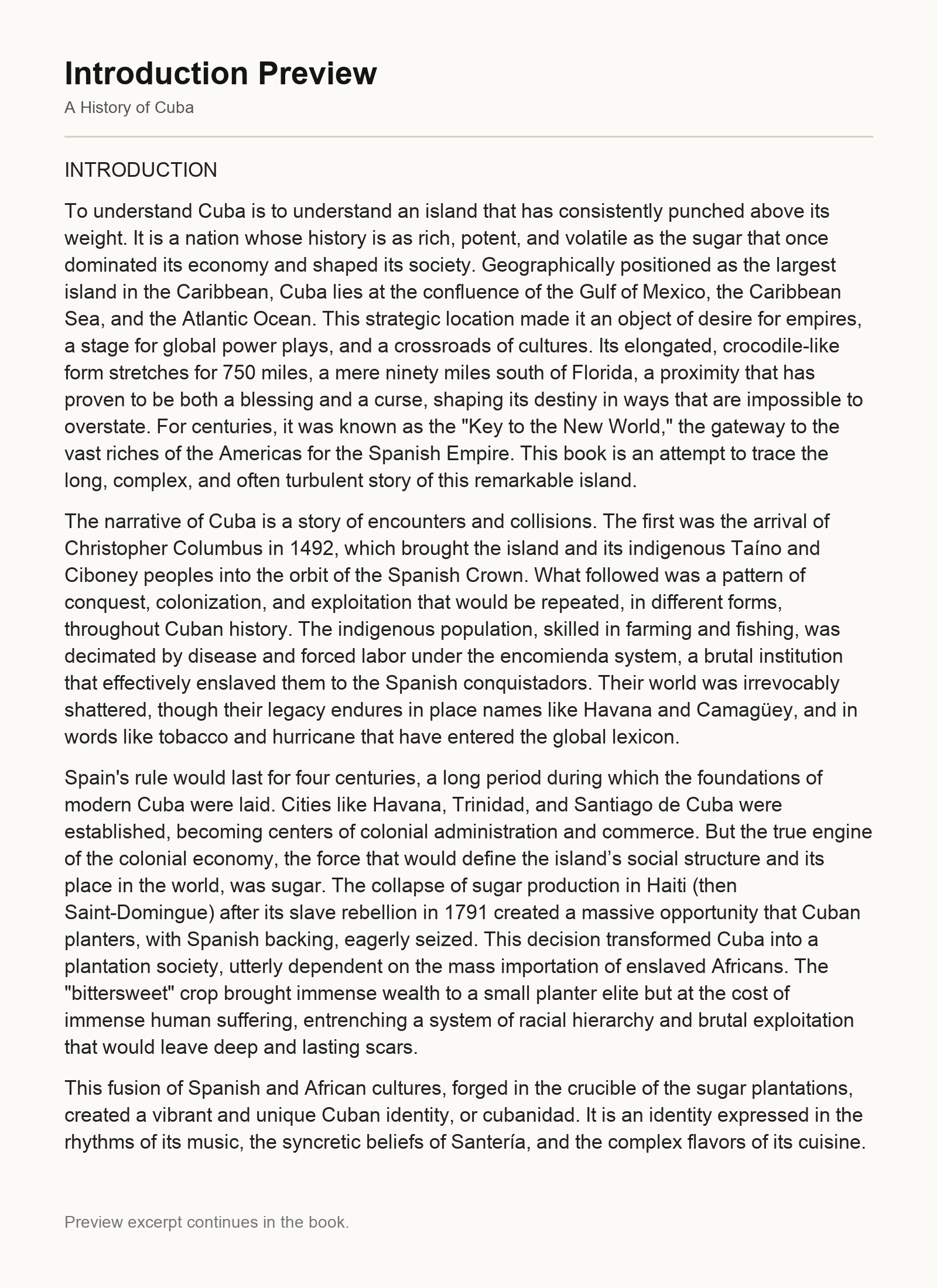
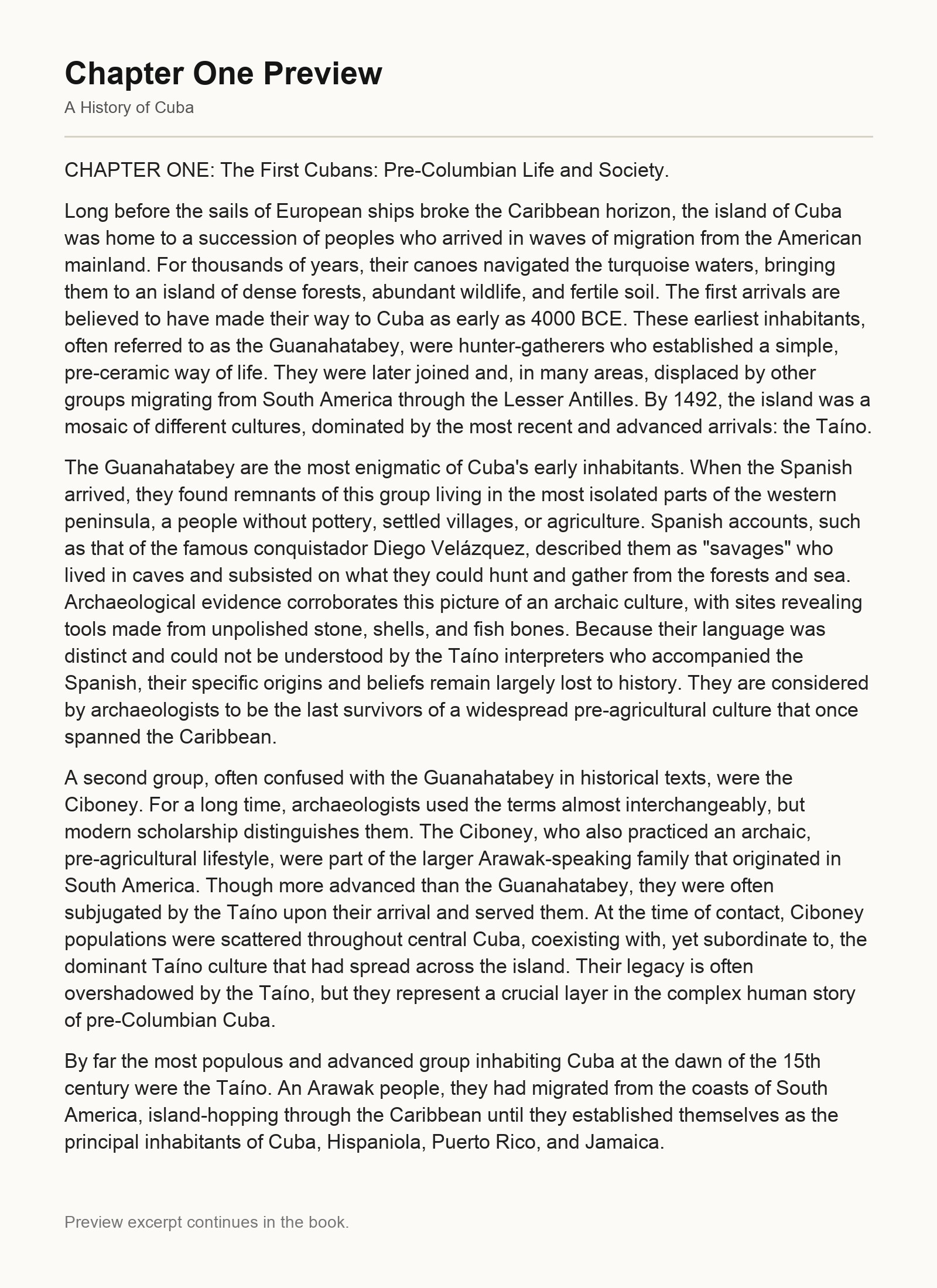
A History of Cuba invites readers on a sweeping journey through the island’s past, from the first Taíno villages and the enigmatic Guanahatabey hunters to the bustling streets of twenty‑first‑century Havana. By tracing the rise and fall of indigenous societies, the brutal imprint of Spanish colonization, and the birth of a plantation economy built on African slave labor, the book reveals how Cuba’s strategic location turned it into a coveted prize for empires and a crucible for cultural fusion. Readers will encounter the vivid tapestry of Cuban identity—its music, religion, cuisine, and language—that emerged from the collision of Spanish, African, and Caribbean worlds.
The narrative then follows the long struggle for independence, highlighting iconic figures such as José Martí, Antonio Maceo, and Fidel Castro, while detailing the Ten Years’ War, the Little War, and the pivotal role of the United States in shaping Cuba’s fate. Chapters on the Spanish‑American War, the Platt Amendment, and the early republic illustrate how external powers repeatedly curtailed Cuban sovereignty, setting the stage for political instability, social unrest, and the rise of dictators like Gerardo Machado and Fulgencio Batista. Each episode is presented with clarity, showing how economic booms—such as the “Dance of the Millions”—and devastating crashes fueled cycles of reform and repression.
Readers will experience the drama of the Cuban Revolution itself: the audacious Moncada assault, the Granma expedition, the guerrilla war in the Sierra Maestra, and the triumphant entry into Havana in 1959. The book examines the revolutionary government’s radical agrarian reforms, the nationalization of industry, and the turbulent Cold War era that brought the Bay of Pigs invasion, the Cuban Missile Crisis, and Cuba’s far‑flung interventions in Africa and Latin America. These chapters illuminate how a small island became a global flashpoint, balancing fierce nationalism with dependence on superpower patronage.
The story continues into the “Special Period” after the Soviet collapse, describing the ingenuity and hardship of Cubans who adapted to blackouts, food shortages, and a burgeoning dollar economy, while also tracing the cautious reforms of Raúl Castro’s era, the tentative thaw with the United States under Obama, and the resurgence of tension in recent years. Throughout, the author weaves in cultural dimensions—literature, music, visual art, and baseball—showing how creativity persisted even amid political turmoil, offering readers a deeper sense of what it means to be Cuban.
Finally, the book brings the reader up to the present day, confronting the challenges of a dual‑currency system, an aging population, the enduring U.S. embargo, and the wave of protests that have shaken the island. By the end, readers will have a comprehensive understanding of how Cuba’s past informs its present prospects, gaining insight into the resilience, contradictions, and enduring spirit of a nation that has continually punched above its weight on the world stage.
What You'll Find Inside:
- Explores Cuba's indigenous Taíno foundations and how Spanish conquest, sugar plantations, and African slavery created a plantation society with lasting social scars.
- Chronicles Cuba's century-long struggle for independence from Spain, featuring José Martí's intellectual leadership and pivotal conflicts like the Ten Years' War.
- Analyzes the tumultuous US-Cuba relationship from the Spanish-American War through the Platt Amendment, Bay of Pigs, Cuban Missile Crisis, to modern diplomatic shifts.
- Details the Cuban Revolution's triumph, Fidel Castro's rise, socialist transformation, and Cuba's Cold War interventions in Africa and Latin America.
- Examines Cuba's Special Period after Soviet collapse, economic reforms, and contemporary challenges including the US embargo and internal pressures.
Who's It For:
This book is ideal for students of Latin American history, political science, and international relations seeking to understand Cuba's complex trajectory. It will also benefit general readers interested in revolutionary movements, Cold War history, or US-Cuba relations, providing essential historical context for contemporary events on the island. Scholars and educators will find it a valuable resource for its comprehensive coverage from pre-Columbian times to the present day.
Table of Contents:
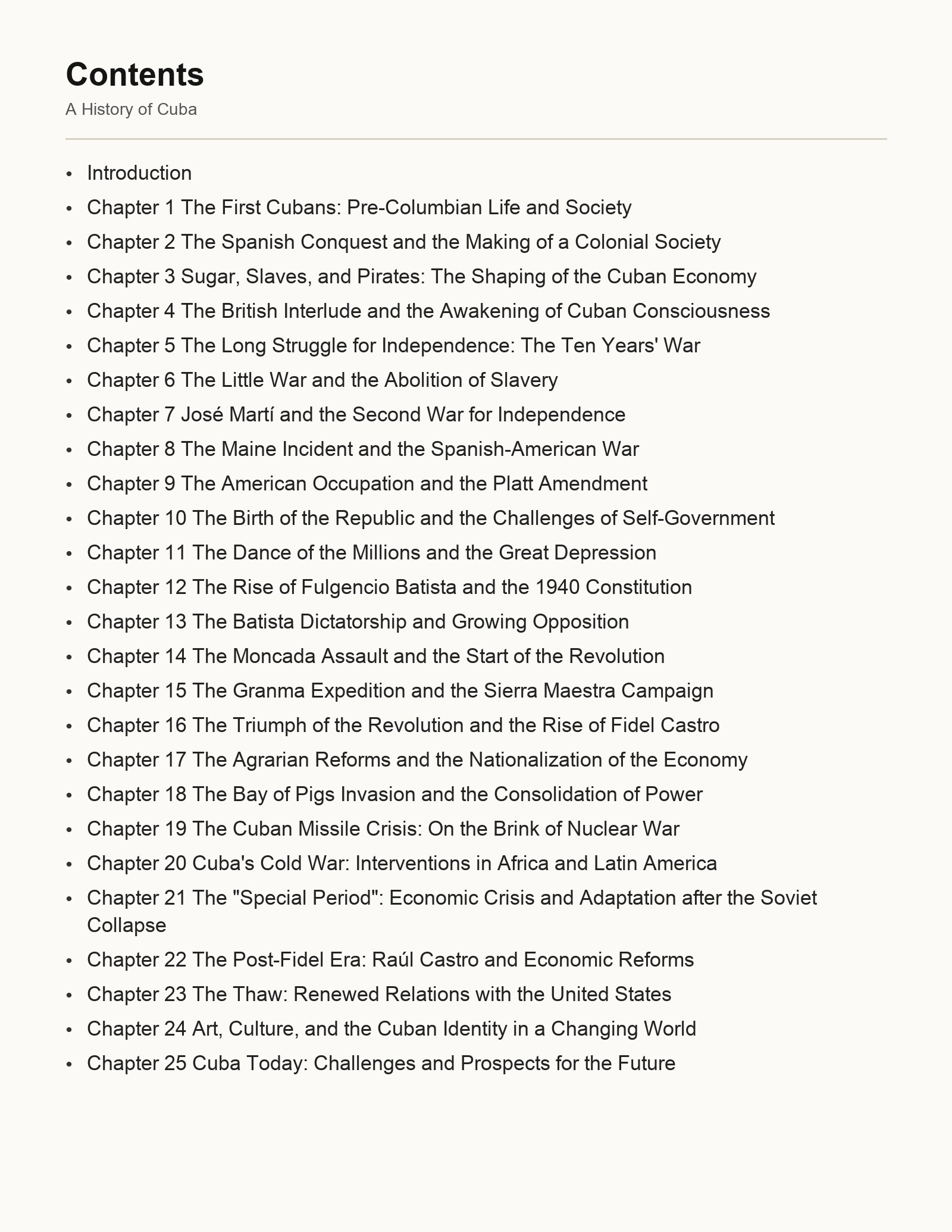
- Introduction
- Chapter 1 The First Cubans: Pre-Columbian Life and Society.
- Chapter 2 The Spanish Conquest and the Making of a Colonial Society.
- Chapter 3 Sugar, Slaves, and Pirates: The Shaping of the Cuban Economy.
- Chapter 4 The British Interlude and the Awakening of Cuban Consciousness.
- Chapter 5 The Long Struggle for Independence: The Ten Years' War.
- Chapter 6 The Little War and the Abolition of Slavery.
- Chapter 7 José Martí and the Second War for Independence.
- Chapter 8 The Maine Incident and the Spanish-American War.
- Chapter 9 The American Occupation and the Platt Amendment.
- Chapter 10 The Birth of the Republic and the Challenges of Self-Government.
- Chapter 11 The Dance of the Millions and the Great Depression.
- Chapter 12 The Rise of Fulgencio Batista and the 1940 Constitution.
- Chapter 13 The Batista Dictatorship and Growing Opposition.
- Chapter 14 The Moncada Assault and the Start of the Revolution.
- Chapter 15 The Granma Expedition and the Sierra Maestra Campaign.
- Chapter 16 The Triumph of the Revolution and the Rise of Fidel Castro.
- Chapter 17 The Agrarian Reforms and the Nationalization of the Economy.
- Chapter 18 The Bay of Pigs Invasion and the Consolidation of Power.
- Chapter 19 The Cuban Missile Crisis: On the Brink of Nuclear War.
- Chapter 20 Cuba's Cold War: Interventions in Africa and Latin America.
- Chapter 21 The "Special Period": Economic Crisis and Adaptation after the Soviet Collapse.
- Chapter 22 The Post-Fidel Era: Raúl Castro and Economic Reforms.
- Chapter 23 The Thaw: Renewed Relations with the United States.
- Chapter 24 Art, Culture, and the Cuban Identity in a Changing World.
- Chapter 25 Cuba Today: Challenges and Prospects for the Future.
Ephyia Publishing MixCache.com Book Reference: 15390
Author:
Published By:
Date Published:
May 17, 2026
Type:
Nonfiction
Language:
English
Word Count:
47,973 words
Reading Time:
3 hours 22 minutes
Sample:
Order:
Order A History of Cuba (Paperback) on MixCache.com:
Buy NowPrint copy is made to order and ships worldwide. Includes the ebook free, ready to read instantly.
$5 account credit for all new MixCache.com accounts, usable toward any ebook purchase!*