
Browse by Category
Fiction
- Action & Adventure
- African American
- Anthologies
- Children's Fiction
- Classics
- Comics & Graphic Novels
- Coming of Age
- Contemporary
- Cultural & Regional
- Drama
- Erotica
- Fantasy
- General
- Historical Fiction
- Horror
- Humor & Satire
- Literary Fiction
- Mystery, Thriller & Suspense
- Poetry
- Religious & Inspirational
- Romance
- Science Fiction
- Short Stories
- War & Military
- Westerns
- Women's Fiction
- Young Adult
Non-Fiction
- Antiques & Collectibles
- Arts & Photography
- Biographies & Memoirs
- Business & Money
- Children's Non-Fiction
-
Computers & Technology
- Artificial Intelligence
- Computer Science
- Cybersecurity & Cryptography
- Data Science & Analytics
- Databases & Big Data
- Game Development & Design
- General
- Hardware & DIY
- Mobile App Development
- Networking & Cloud Computing
- Operating Systems
- Programming
- Robotics
- Software
- Software Engineering
- User Experience (UX) & Design
- Web Development & Design
- Cooking, Food & Wine
- Crafts, Hobbies & Home
- Education & Teaching
- Engineering
- General
- Health, Fitness & Dieting
-
History
- African History
- African History - North Africa
- African History - Sub-Saharan Africa
- American History
- American History - 20th Century
- American History - Civil War
- American History - Colonial Period
- Ancient History
- Asian History
- Asian History - China
- Asian History - India
- Asian History - Japan
- Asian History - Southeast Asia
- European History
- European History - Ancient Greece
- European History - Ancient Rome
- European History - Medieval
- European History - Modern
- European History - Renaissance
- General
- Middle Eastern History
- Military History
- Military History - Aviation
- Military History - Naval
- Social & Cultural History
- World History
- Humor & Entertainment
- Industrial Technology
- Language Learning
- Law
- LGBTQ+ Non-Fiction
- Literary Criticism
- Medical Books
- Parenting & Relationships
- Philosophy
- Politics & Social Sciences
- Reference
- Religion & Spirituality
-
Science & Math
- Agricultural Sciences
- Astronomy & Space Science
- Behavioral Sciences
- Biological Sciences
- Botany & Plant Science
- Chemistry
- Earth Sciences
- Engineering - Chemical
- Engineering - Civil
- Engineering - Electrical
- Engineering - Mechanical
- Environment
- General
- Geology
- Mathematics
- Nature & Ecology
- Oceanography
- Paleontology
- Physics
- Statistics
- Self-Help
- Sports & Outdoors
- Study Aids
- Sustainability & Green Living
- Textbooks
- Transportation
- Travel
- True Crime
- Urban Planning & Development
- Veterinary Medicine
- Writing & Publishing
Jump to Section
MixCache.com Total Access
Unlimited reading and audiobooks for every book published by MixCache.com.
Included titles carry the MTA badge.
Learn more →A History of Sudan
About this book:
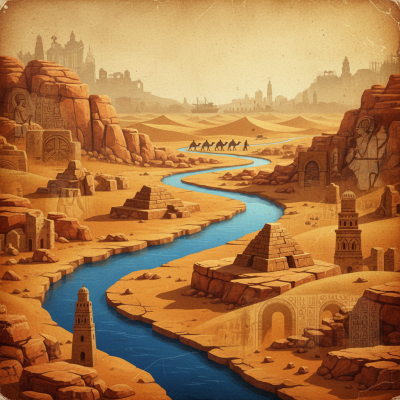
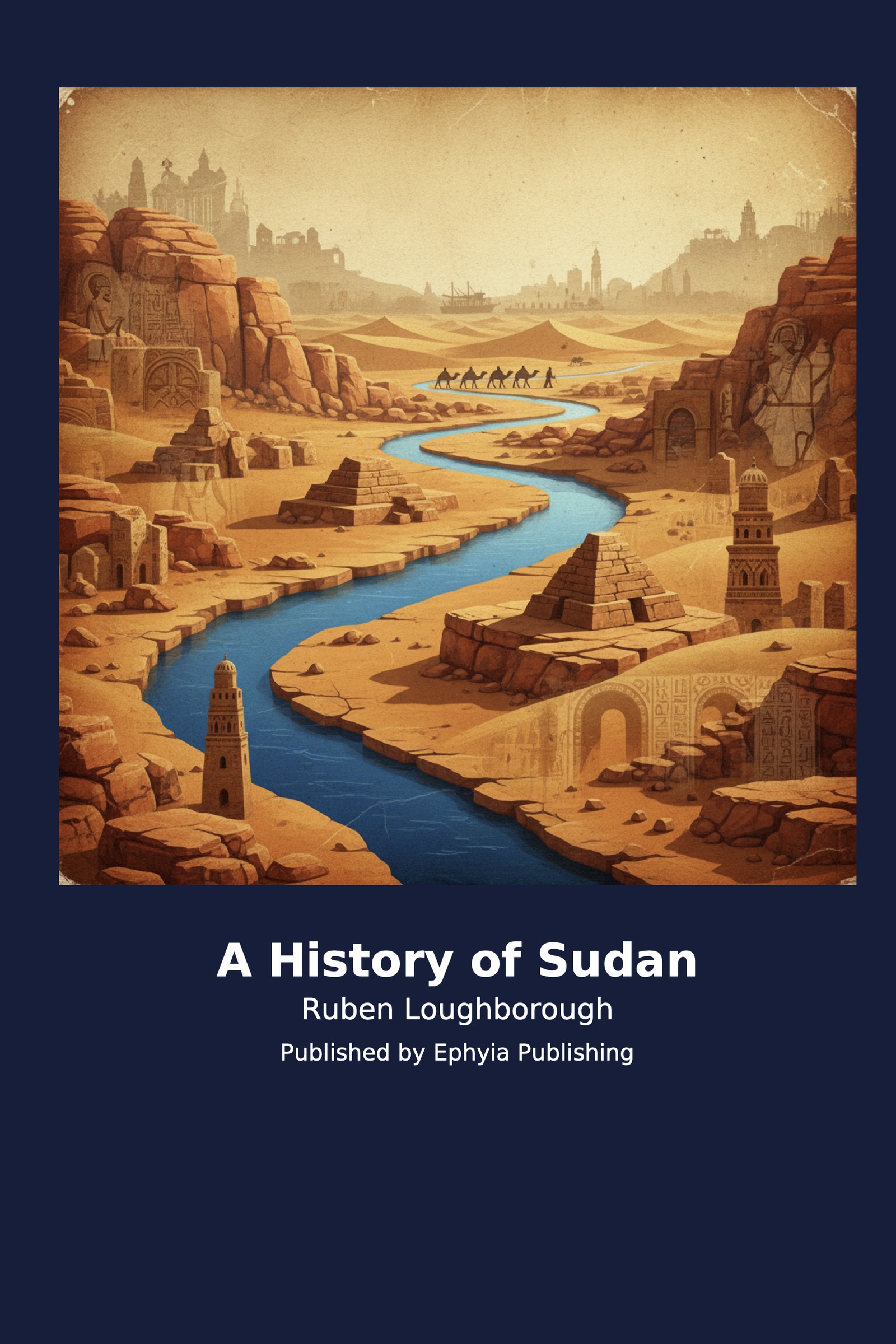
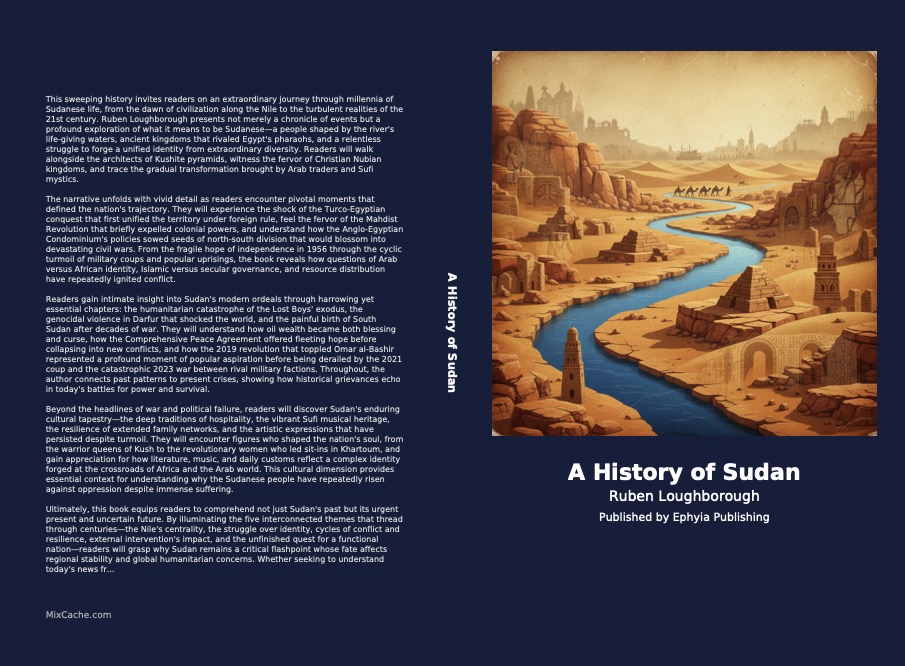
This sweeping history invites readers on an extraordinary journey through millennia of Sudanese life, from the dawn of civilization along the Nile to the turbulent realities of the 21st century. Ruben Loughborough presents not merely a chronicle of events but a profound exploration of what it means to be Sudanese—a people shaped by the river's life-giving waters, ancient kingdoms that rivaled Egypt's pharaohs, and a relentless struggle to forge a unified identity from extraordinary diversity. Readers will walk alongside the architects of Kushite pyramids, witness the fervor of Christian Nubian kingdoms, and trace the gradual transformation brought by Arab traders and Sufi mystics.
The narrative unfolds with vivid detail as readers encounter pivotal moments that defined the nation's trajectory. They will experience the shock of the Turco-Egyptian conquest that first unified the territory under foreign rule, feel the fervor of the Mahdist Revolution that briefly expelled colonial powers, and understand how the Anglo-Egyptian Condominium's policies sowed seeds of north-south division that would blossom into devastating civil wars. From the fragile hope of independence in 1956 through the cyclic turmoil of military coups and popular uprisings, the book reveals how questions of Arab versus African identity, Islamic versus secular governance, and resource distribution have repeatedly ignited conflict.
Readers gain intimate insight into Sudan's modern ordeals through harrowing yet essential chapters: the humanitarian catastrophe of the Lost Boys' exodus, the genocidal violence in Darfur that shocked the world, and the painful birth of South Sudan after decades of war. They will understand how oil wealth became both blessing and curse, how the Comprehensive Peace Agreement offered fleeting hope before collapsing into new conflicts, and how the 2019 revolution that toppled Omar al-Bashir represented a profound moment of popular aspiration before being derailed by the 2021 coup and the catastrophic 2023 war between rival military factions. Throughout, the author connects past patterns to present crises, showing how historical grievances echo in today's battles for power and survival.
Beyond the headlines of war and political failure, readers will discover Sudan's enduring cultural tapestry—the deep traditions of hospitality, the vibrant Sufi musical heritage, the resilience of extended family networks, and the artistic expressions that have persisted despite turmoil. They will encounter figures who shaped the nation's soul, from the warrior queens of Kush to the revolutionary women who led sit-ins in Khartoum, and gain appreciation for how literature, music, and daily customs reflect a complex identity forged at the crossroads of Africa and the Arab world. This cultural dimension provides essential context for understanding why the Sudanese people have repeatedly risen against oppression despite immense suffering.
Ultimately, this book equips readers to comprehend not just Sudan's past but its urgent present and uncertain future. By illuminating the five interconnected themes that thread through centuries—the Nile's centrality, the struggle over identity, cycles of conflict and resilience, external intervention's impact, and the unfinished quest for a functional nation—readers will grasp why Sudan remains a critical flashpoint whose fate affects regional stability and global humanitarian concerns. Whether seeking to understand today's news from Khartoum or Darfur, or simply to explore one of history's most compelling civilizational crossroads, readers will finish this work with a nuanced perspective on a nation that continues to search for itself amid profound challenges and enduring hope.
What You'll Find Inside:
- Sudan's history spans from the ancient Kingdom of Kush (with more pyramids than Egypt) through Christian kingdoms, Islamic sultanates, and into modern conflicts, revealing a civilization at the crossroads of Africa and the Arab world.
- The Nile River has been the lifeblood and central artery of Sudanese civilization for millennia, shaping settlement patterns, trade routes, and the rise and fall of kingdoms throughout history.
- A persistent and often violent struggle over national identity - between Arab-Islamic and African visions of what it means to be Sudanese - has been the primary driver of Sudan's turbulent post-independence history.
- Sudan's history demonstrates a relentless cycle of conflict and resilience, where periods of devastating war have repeatedly failed to extinguish the people's spirit and desire for peace and justice.
- The book traces Sudan's unfinished quest to build a stable, inclusive nation, examining how external intervention from ancient conquerors to modern global powers has repeatedly disrupted indigenous efforts at self-determination.
Who's It For:
This book is ideal for students and scholars of African history, Middle Eastern studies, and post-colonial conflicts, as well as general readers seeking to understand the deep historical roots of Sudan's current crises. It provides essential context for anyone interested in how ancient civilizations, colonial legacies, and identity struggles have shaped one of Africa's largest and most complex nations. Readers will gain insight into Sudan's role as a historical crossroads where African and Arab worlds have continuously interacted, often tumultuously, for thousands of years.
Table of Contents:
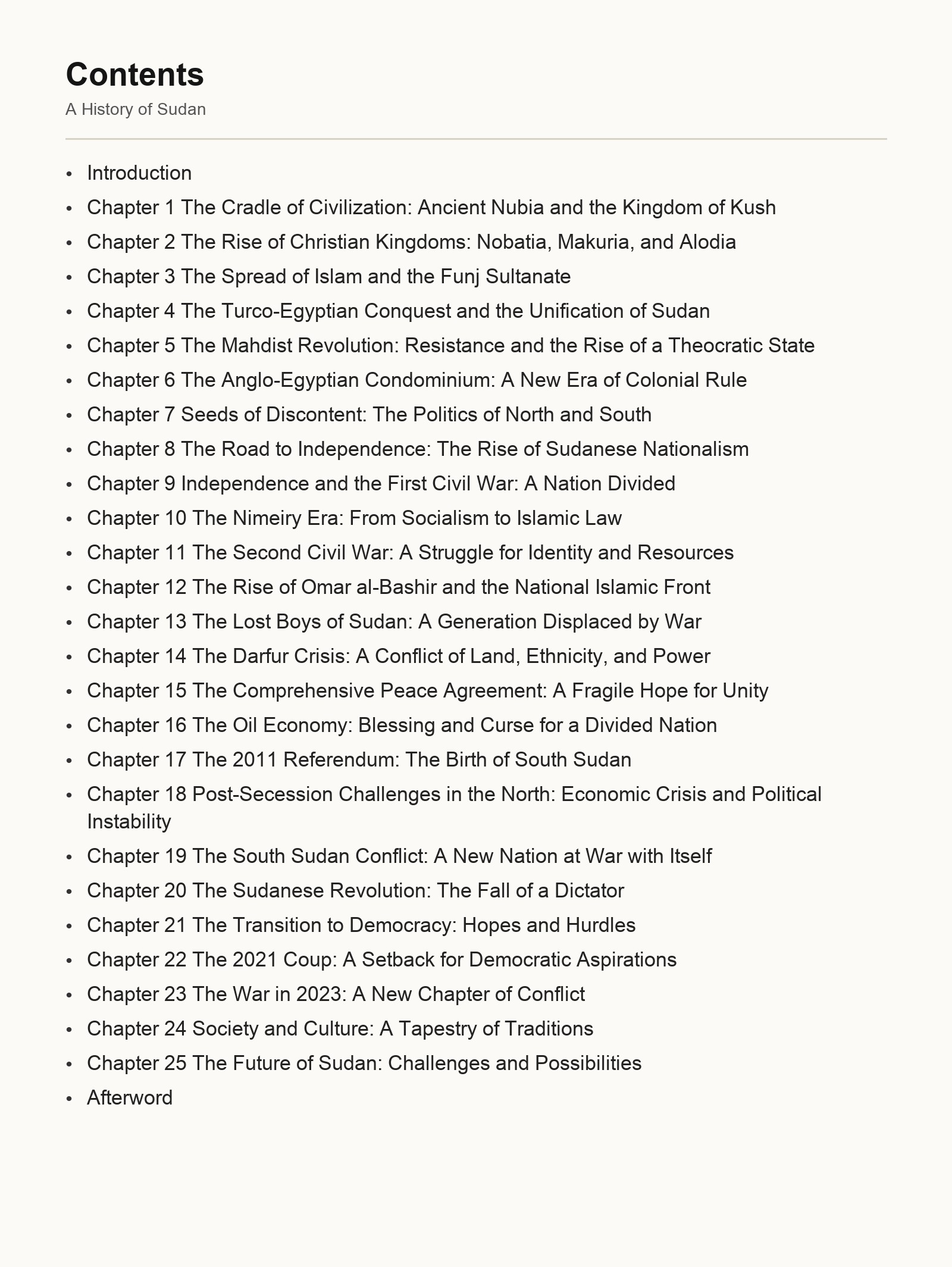
- Introduction
- Chapter 1 The Cradle of Civilization: Ancient Nubia and the Kingdom of Kush
- Chapter 2 The Rise of Christian Kingdoms: Nobatia, Makuria, and Alodia
- Chapter 3 The Spread of Islam and the Funj Sultanate
- Chapter 4 The Turco-Egyptian Conquest and the Unification of Sudan
- Chapter 5 The Mahdist Revolution: Resistance and the Rise of a Theocratic State
- Chapter 6 The Anglo-Egyptian Condominium: A New Era of Colonial Rule.
- Chapter 7 Seeds of Discontent: The Politics of North and South
- Chapter 8 The Road to Independence: The Rise of Sudanese Nationalism
- Chapter 9 Independence and the First Civil War: A Nation Divided.
- Chapter 10 The Nimeiry Era: From Socialism to Islamic Law
- Chapter 11 The Second Civil War: A Struggle for Identity and Resources.
- Chapter 12 The Rise of Omar al-Bashir and the National Islamic Front
- Chapter 13 The Lost Boys of Sudan: A Generation Displaced by War
- Chapter 14 The Darfur Crisis: A Conflict of Land, Ethnicity, and Power.
- Chapter 15 The Comprehensive Peace Agreement: A Fragile Hope for Unity
- Chapter 16 The Oil Economy: Blessing and Curse for a Divided Nation.
- Chapter 17 The 2011 Referendum: The Birth of South Sudan.
- Chapter 18 Post-Secession Challenges in the North: Economic Crisis and Political Instability
- Chapter 19 The South Sudan Conflict: A New Nation at War with Itself
- Chapter 20 The Sudanese Revolution: The Fall of a Dictator
- Chapter 21 The Transition to Democracy: Hopes and Hurdles
- Chapter 22 The 2021 Coup: A Setback for Democratic Aspirations
- Chapter 23 The War in 2023: A New Chapter of Conflict
- Chapter 24 Society and Culture: A Tapestry of Traditions
- Chapter 25 The Future of Sudan: Challenges and Possibilities
- Afterword
Author:
Published By:
Date Published:
May 17, 2026
Type:
Nonfiction
Language:
English
Also Available In:
Word Count:
52,581 words
Reading Time:
3 hours 41 minutes
Sample:
Order:
Buy the A History of Sudan ebook on MixCache.com:
Buy NowThe full ebook will be available immediately to read instantly on any device.
$5 account credit for all new MixCache.com accounts, usable toward any ebook purchase!*




Ratings & Reviews
Ask Questions About This Book
Have a question about the content? Ask our AI assistant!
Start by asking a question about "A History of Sudan"
Example: "Does this book mention William Shakespeare?"
Thinking...