Browse by Category
Fiction
- Action & Adventure
- African American
- Anthologies
- Children's Fiction
- Classics
- Comics & Graphic Novels
- Coming of Age
- Contemporary
- Cultural & Regional
- Drama
- Erotica
- Fantasy
- General
- Historical Fiction
- Horror
- Humor & Satire
- Literary Fiction
- Mystery, Thriller & Suspense
- Poetry
- Religious & Inspirational
- Romance
- Science Fiction
- Short Stories
- War & Military
- Westerns
- Women's Fiction
- Young Adult
Non-Fiction
- Antiques & Collectibles
- Arts & Photography
- Biographies & Memoirs
- Business & Money
- Children's Non-Fiction
-
Computers & Technology
- Artificial Intelligence
- Computer Science
- Cybersecurity & Cryptography
- Data Science & Analytics
- Databases & Big Data
- Game Development & Design
- General
- Hardware & DIY
- Mobile App Development
- Networking & Cloud Computing
- Operating Systems
- Programming
- Robotics
- Software
- Software Engineering
- User Experience (UX) & Design
- Web Development & Design
- Cooking, Food & Wine
- Crafts, Hobbies & Home
- Education & Teaching
- Engineering
- General
- Health, Fitness & Dieting
-
History
- African History
- African History - North Africa
- African History - Sub-Saharan Africa
- American History
- American History - 20th Century
- American History - Civil War
- American History - Colonial Period
- Ancient History
- Asian History
- Asian History - China
- Asian History - India
- Asian History - Japan
- Asian History - Southeast Asia
- European History
- European History - Ancient Greece
- European History - Ancient Rome
- European History - Medieval
- European History - Modern
- European History - Renaissance
- General
- Middle Eastern History
- Military History
- Military History - Aviation
- Military History - Naval
- Social & Cultural History
- World History
- Humor & Entertainment
- Industrial Technology
- Language Learning
- Law
- LGBTQ+ Non-Fiction
- Literary Criticism
- Medical Books
- Parenting & Relationships
- Philosophy
- Politics & Social Sciences
- Reference
- Religion & Spirituality
-
Science & Math
- Agricultural Sciences
- Astronomy & Space Science
- Behavioral Sciences
- Biological Sciences
- Botany & Plant Science
- Chemistry
- Earth Sciences
- Engineering - Chemical
- Engineering - Civil
- Engineering - Electrical
- Engineering - Mechanical
- Environment
- General
- Geology
- Mathematics
- Nature & Ecology
- Oceanography
- Paleontology
- Physics
- Statistics
- Self-Help
- Sports & Outdoors
- Study Aids
- Sustainability & Green Living
- Textbooks
- Transportation
- Travel
- True Crime
- Urban Planning & Development
- Veterinary Medicine
- Writing & Publishing
Jump to Section
MixCache.com Total Access
Unlimited reading and audiobooks for every book published by MixCache.com.
Included titles carry the MTA badge.
Learn more →The History of Explosives
About this book:
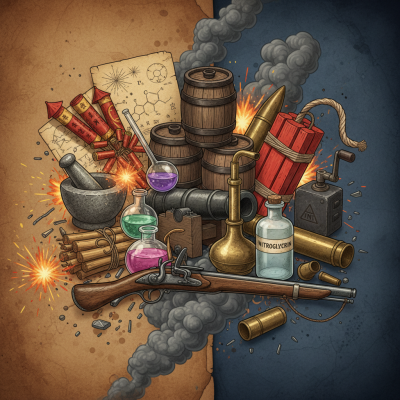
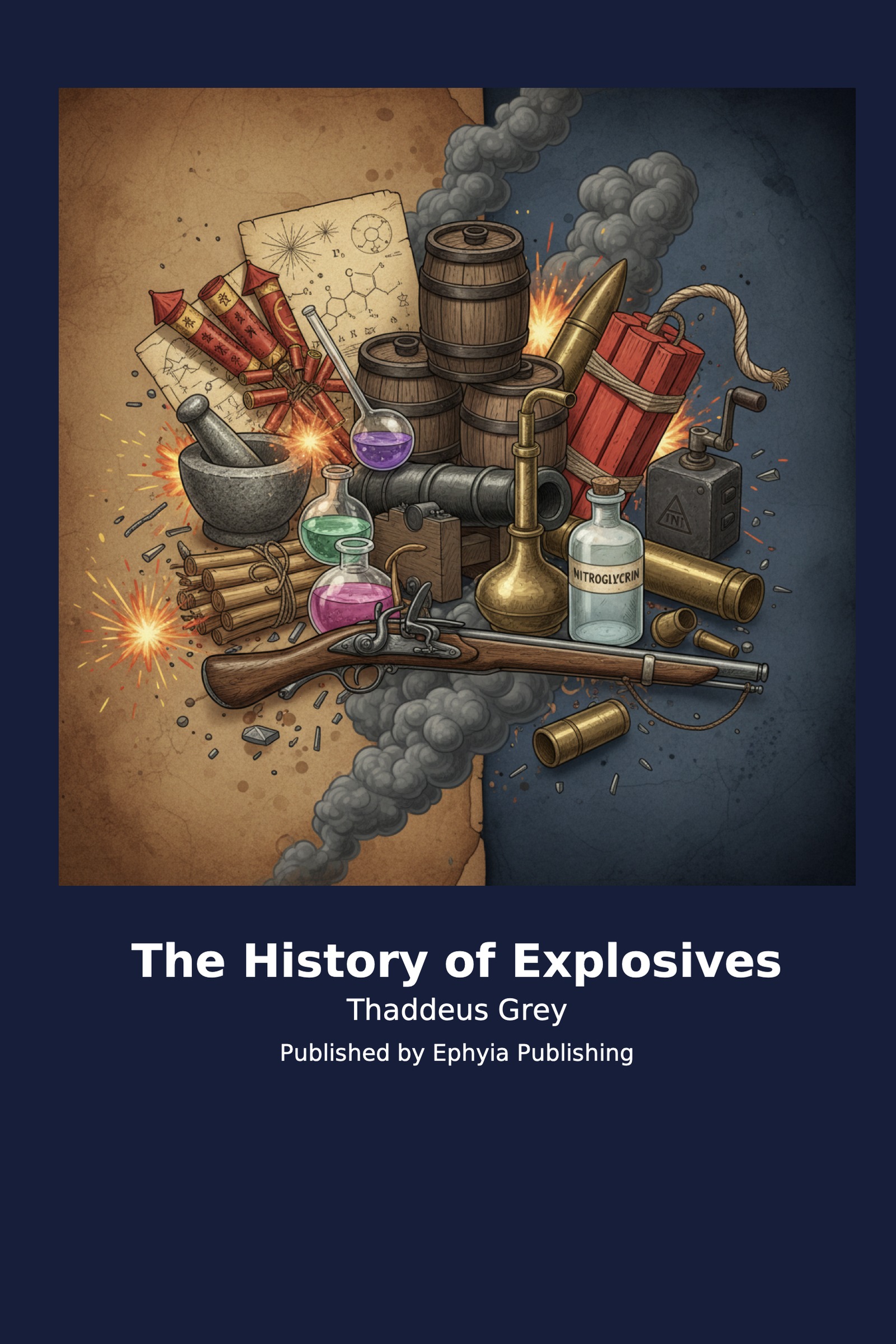

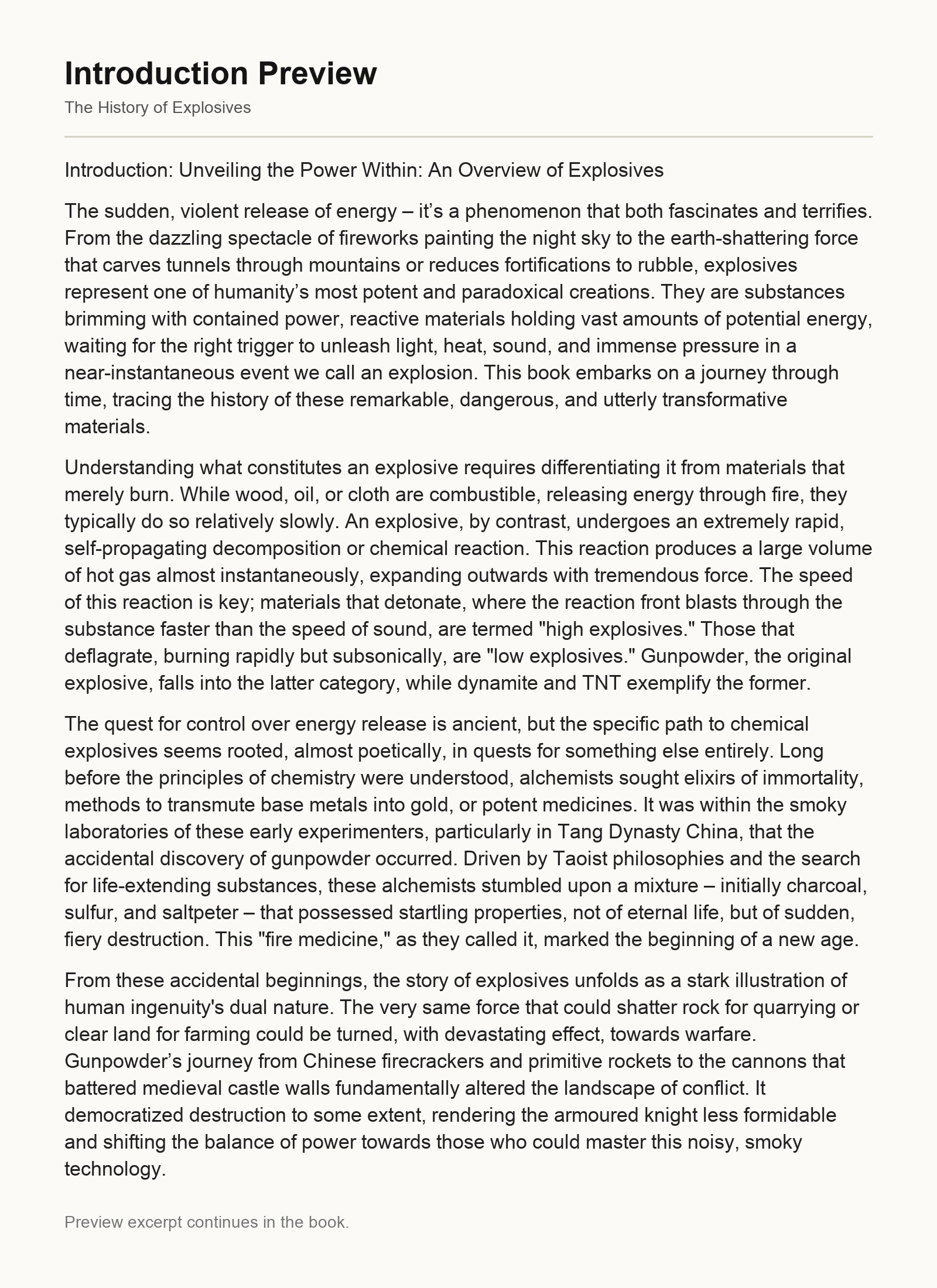
From the first accidental spark in an ancient alchemist’s workshop to the mushroom clouds that reshaped the modern world, this book traces the full sweep of explosives – their origins, their chemistry, and their impact on civilization. Readers will journey through centuries of discovery, learning how gunpowder emerged from Taoist quests for immortality, how it traveled along Silk Road caravans and Mongol conquests, and how it ignited the first firearms that ended the age of knights and castle walls. Each chapter reveals the human ingenuity – and sometimes folly – behind the substances that have both built tunnels through mountains and shattered cities in war.
The narrative moves beyond mere chronology to explain the science that makes an explosive tick. You will grasp the critical difference between low explosives like black powder, which push projectiles with a rapid burn, and high explosives such as TNT, RDX, and C‑4, which detonate with supersonic shock waves that shatter rock and steel. Concepts like sensitivity, detonation velocity, brisance, and oxygen balance are demystified, showing how chemists tweak molecules to balance power with safety, and how engineers harness that power for mining, construction, and even precision metal shaping.
From the alchemist’s fire medicine to Nobel’s dynamite, from the smoke‑filled battlefields of the World Wars to the silent, plastic‑like charges of today’s special forces, the book highlights the relentless drive to control ever‑greater energy. You’ll see how inventions like the blasting cap, smokeless propellants, and insensitive munitions transformed warfare and industry, and how the legacy of explosives continues in modern applications such as explosive welding, shock synthesis, and the emerging field of green energetics. Every technical advance is tied to its real‑world consequence, whether it’s a tunnel bored through the Alps or a humanitarian crisis caused by unexploded ordnance.
Finally, the work confronts the profound duality of explosives – their capacity for creation and destruction. Readers will examine the ethical dilemmas that arise when scientific breakthroughs become weapons of mass destruction, from the atomic bomb to improvised explosive devices in contemporary conflicts. The book concludes with a look at emerging trends: nitrogen‑rich high‑energy materials, polymer‑bonded explosives, and advanced initiation systems that promise greater control, safety, and environmental responsibility. By the end, you will not only know the history of explosives, but also understand how that history shapes the technological choices and moral challenges of today and tomorrow.
What You'll Find Inside:
- The accidental discovery of gunpowder in ancient China by Taoist alchemists seeking immortality elixirs, revealing how explosives originated from mystical pursuits rather than military intent.
- The transmission of gunpowder knowledge from China to Europe and the Islamic world via Mongol conquests and trade routes, enabling the evolution from fire lances to true firearms and artillery.
- The 19th-century revolution from black powder to high explosives through Nobel's dynamite, the development of TNT and RDX, and the advent of plastic explosives like C-4, transforming industrial and military capabilities.
- The scientific principles governing explosive behavior, including sensitivity classifications (primary/secondary/tertiary), detonation vs. deflagration, velocity of detonation, and key properties like brisance and oxygen balance.
- Modern applications of explosives in mining/civil engineering and materials science, the development of nuclear weapons, and ongoing efforts to balance explosive utility with safety regulations and humanitarian concerns.
Who's It For:
This book serves students, researchers, and professionals in history of science, military history, engineering (particularly civil/mining), and chemistry, as well as informed general readers interested in the technological evolution and societal impact of explosives from ancient origins to the nuclear age. It provides both historical narrative and technical depth suitable for academic study and educated enthusiasts seeking to understand how explosive materials have shaped warfare, industry, and civilization.
Table of Contents:
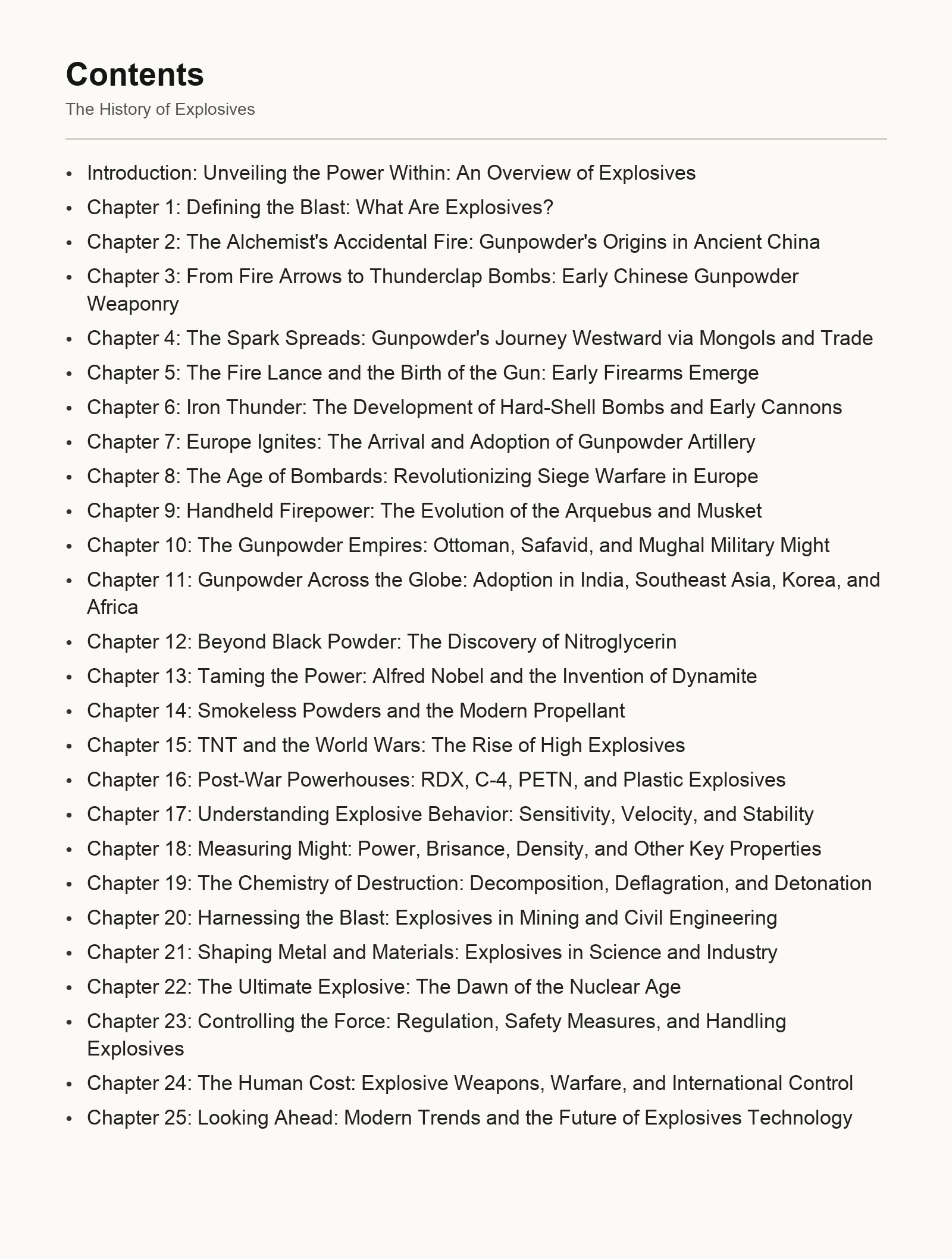
- Introduction: Unveiling the Power Within: An Overview of Explosives
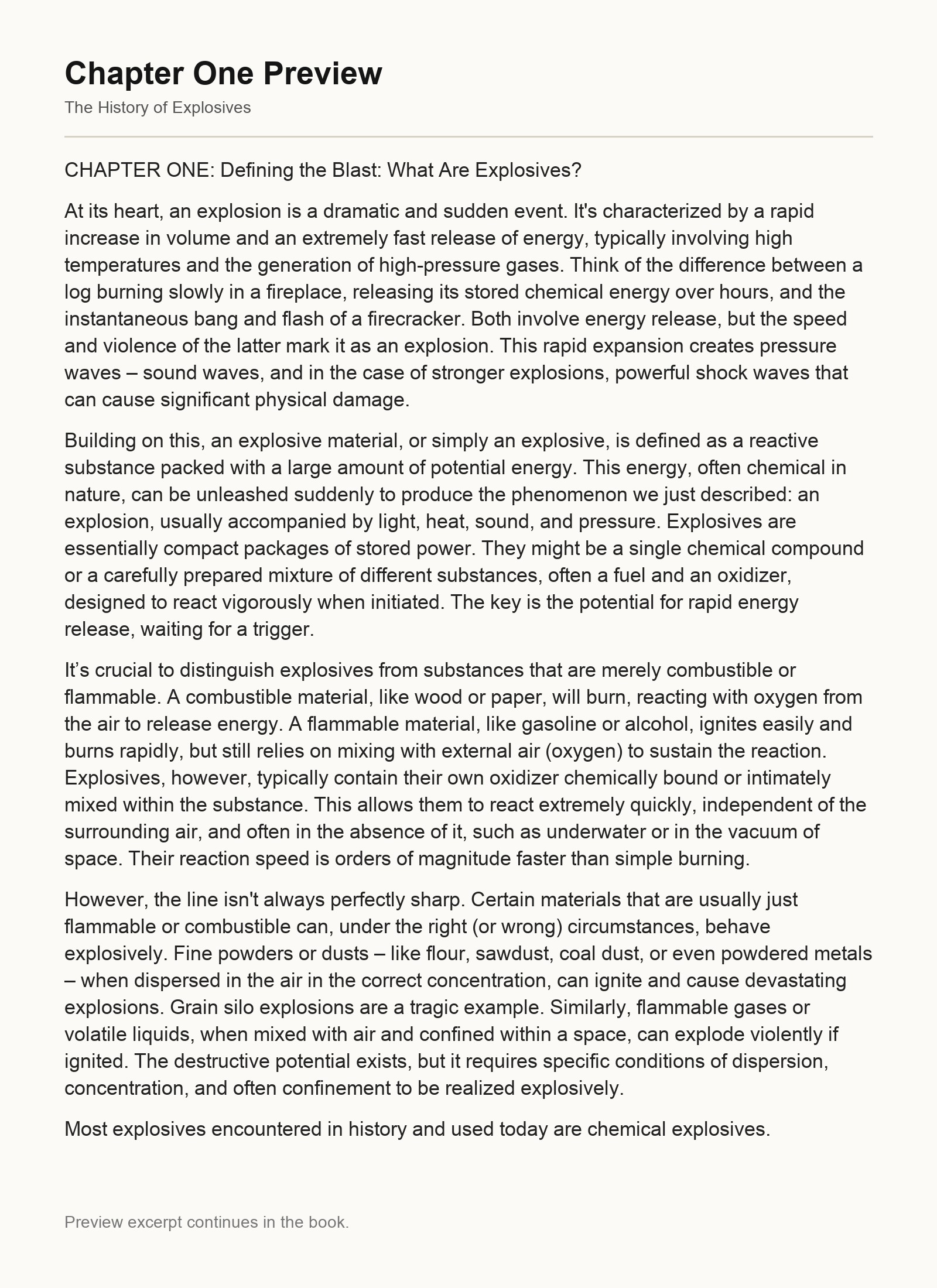
- Chapter 1: Defining the Blast: What Are Explosives?
- Chapter 2: The Alchemist's Accidental Fire: Gunpowder's Origins in Ancient China
- Chapter 3: From Fire Arrows to Thunderclap Bombs: Early Chinese Gunpowder Weaponry
- Chapter 4: The Spark Spreads: Gunpowder's Journey Westward via Mongols and Trade
- Chapter 5: The Fire Lance and the Birth of the Gun: Early Firearms Emerge
- Chapter 6: Iron Thunder: The Development of Hard-Shell Bombs and Early Cannons
- Chapter 7: Europe Ignites: The Arrival and Adoption of Gunpowder Artillery
- Chapter 8: The Age of Bombards: Revolutionizing Siege Warfare in Europe
- Chapter 9: Handheld Firepower: The Evolution of the Arquebus and Musket
- Chapter 10: The Gunpowder Empires: Ottoman, Safavid, and Mughal Military Might
- Chapter 11: Gunpowder Across the Globe: Adoption in India, Southeast Asia, Korea, and Africa
- Chapter 12: Beyond Black Powder: The Discovery of Nitroglycerin
- Chapter 13: Taming the Power: Alfred Nobel and the Invention of Dynamite
- Chapter 14: Smokeless Powders and the Modern Propellant
- Chapter 15: TNT and the World Wars: The Rise of High Explosives
- Chapter 16: Post-War Powerhouses: RDX, C-4, PETN, and Plastic Explosives
- Chapter 17: Understanding Explosive Behavior: Sensitivity, Velocity, and Stability
- Chapter 18: Measuring Might: Power, Brisance, Density, and Other Key Properties
- Chapter 19: The Chemistry of Destruction: Decomposition, Deflagration, and Detonation
- Chapter 20: Harnessing the Blast: Explosives in Mining and Civil Engineering
- Chapter 21: Shaping Metal and Materials: Explosives in Science and Industry
- Chapter 22: The Ultimate Explosive: The Dawn of the Nuclear Age
- Chapter 23: Controlling the Force: Regulation, Safety Measures, and Handling Explosives
- Chapter 24: The Human Cost: Explosive Weapons, Warfare, and International Control
- Chapter 25: Looking Ahead: Modern Trends and the Future of Explosives Technology
Author:
Published By:
Date Published:
May 16, 2026
Type:
Nonfiction
Language:
English
Also Available In:
Word Count:
55,366 words
Reading Time:
3 hours 53 minutes
Sample:
Order:
Order The History of Explosives (Hardcover) on MixCache.com:
Buy NowPrint copy is made to order and ships worldwide. Includes the ebook free, ready to read instantly.
$5 account credit for all new MixCache.com accounts, usable toward any ebook purchase!*