Browse by Category
Fiction
- Action & Adventure
- African American
- Anthologies
- Children's Fiction
- Classics
- Comics & Graphic Novels
- Coming of Age
- Contemporary
- Cultural & Regional
- Drama
- Erotica
- Fantasy
- General
- Historical Fiction
- Horror
- Humor & Satire
- Literary Fiction
- Mystery, Thriller & Suspense
- Poetry
- Religious & Inspirational
- Romance
- Science Fiction
- Short Stories
- War & Military
- Westerns
- Women's Fiction
- Young Adult
Non-Fiction
- Antiques & Collectibles
- Arts & Photography
- Biographies & Memoirs
- Business & Money
- Children's Non-Fiction
-
Computers & Technology
- Artificial Intelligence
- Computer Science
- Cybersecurity & Cryptography
- Data Science & Analytics
- Databases & Big Data
- Game Development & Design
- General
- Hardware & DIY
- Mobile App Development
- Networking & Cloud Computing
- Operating Systems
- Programming
- Robotics
- Software
- Software Engineering
- User Experience (UX) & Design
- Web Development & Design
- Cooking, Food & Wine
- Crafts, Hobbies & Home
- Education & Teaching
- Engineering
- General
- Health, Fitness & Dieting
-
History
- African History
- African History - North Africa
- African History - Sub-Saharan Africa
- American History
- American History - 20th Century
- American History - Civil War
- American History - Colonial Period
- Ancient History
- Asian History
- Asian History - China
- Asian History - India
- Asian History - Japan
- Asian History - Southeast Asia
- European History
- European History - Ancient Greece
- European History - Ancient Rome
- European History - Medieval
- European History - Modern
- European History - Renaissance
- General
- Middle Eastern History
- Military History
- Military History - Aviation
- Military History - Naval
- Social & Cultural History
- World History
- Humor & Entertainment
- Industrial Technology
- Language Learning
- Law
- LGBTQ+ Non-Fiction
- Literary Criticism
- Medical Books
- Parenting & Relationships
- Philosophy
- Politics & Social Sciences
- Reference
- Religion & Spirituality
-
Science & Math
- Agricultural Sciences
- Astronomy & Space Science
- Behavioral Sciences
- Biological Sciences
- Botany & Plant Science
- Chemistry
- Earth Sciences
- Engineering - Chemical
- Engineering - Civil
- Engineering - Electrical
- Engineering - Mechanical
- Environment
- General
- Geology
- Mathematics
- Nature & Ecology
- Oceanography
- Paleontology
- Physics
- Statistics
- Self-Help
- Sports & Outdoors
- Study Aids
- Sustainability & Green Living
- Textbooks
- Transportation
- Travel
- True Crime
- Urban Planning & Development
- Veterinary Medicine
- Writing & Publishing
Jump to Section
MixCache.com Total Access
Unlimited reading and audiobooks for every book published by MixCache.com.
Included titles carry the MTA badge.
Learn more →A History of Malawi
About this book:


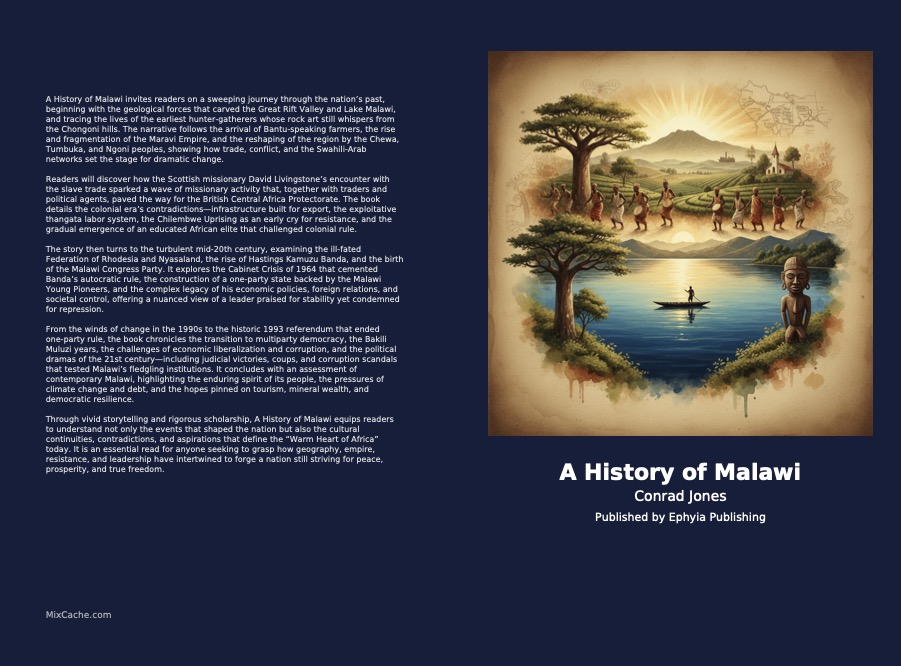
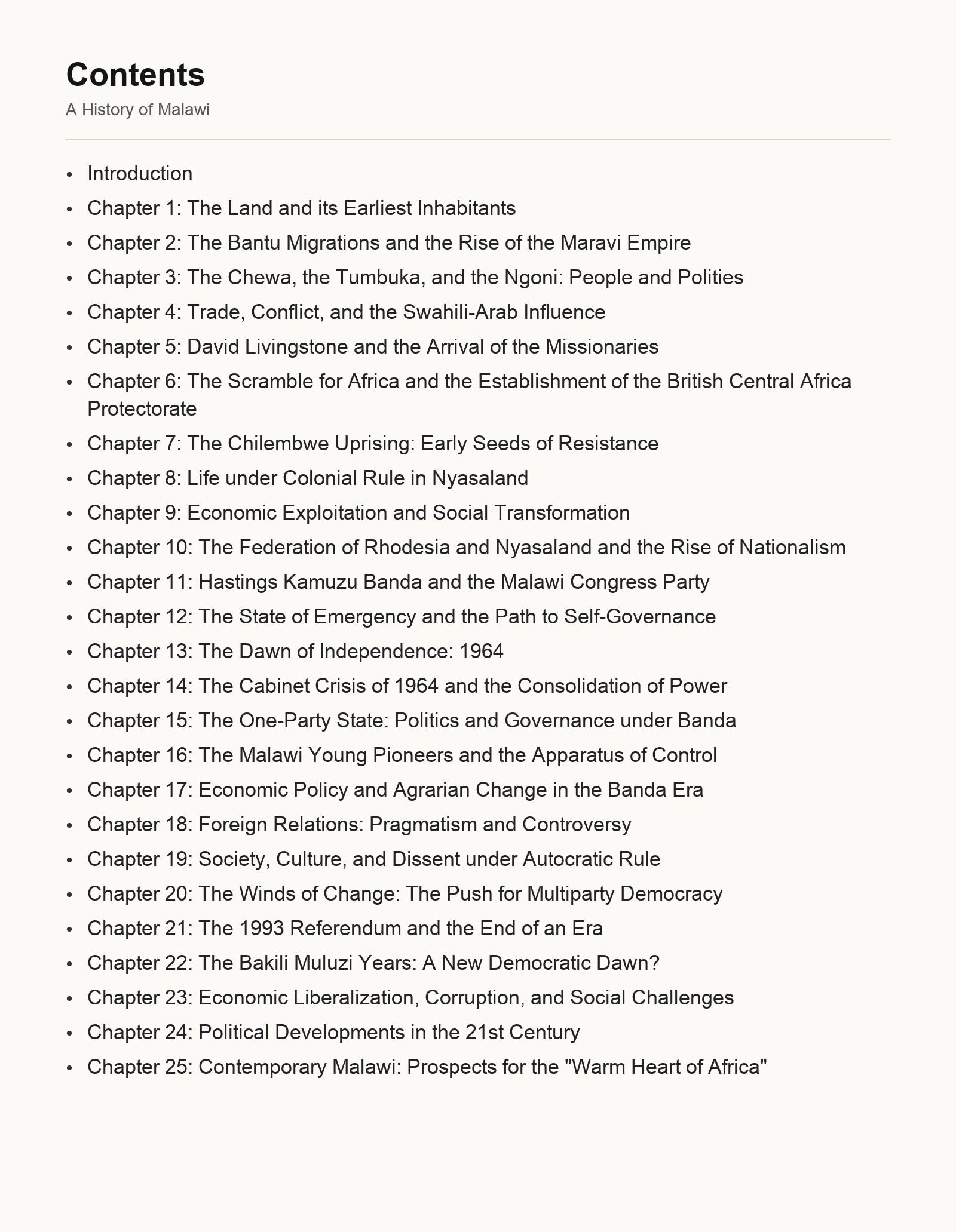
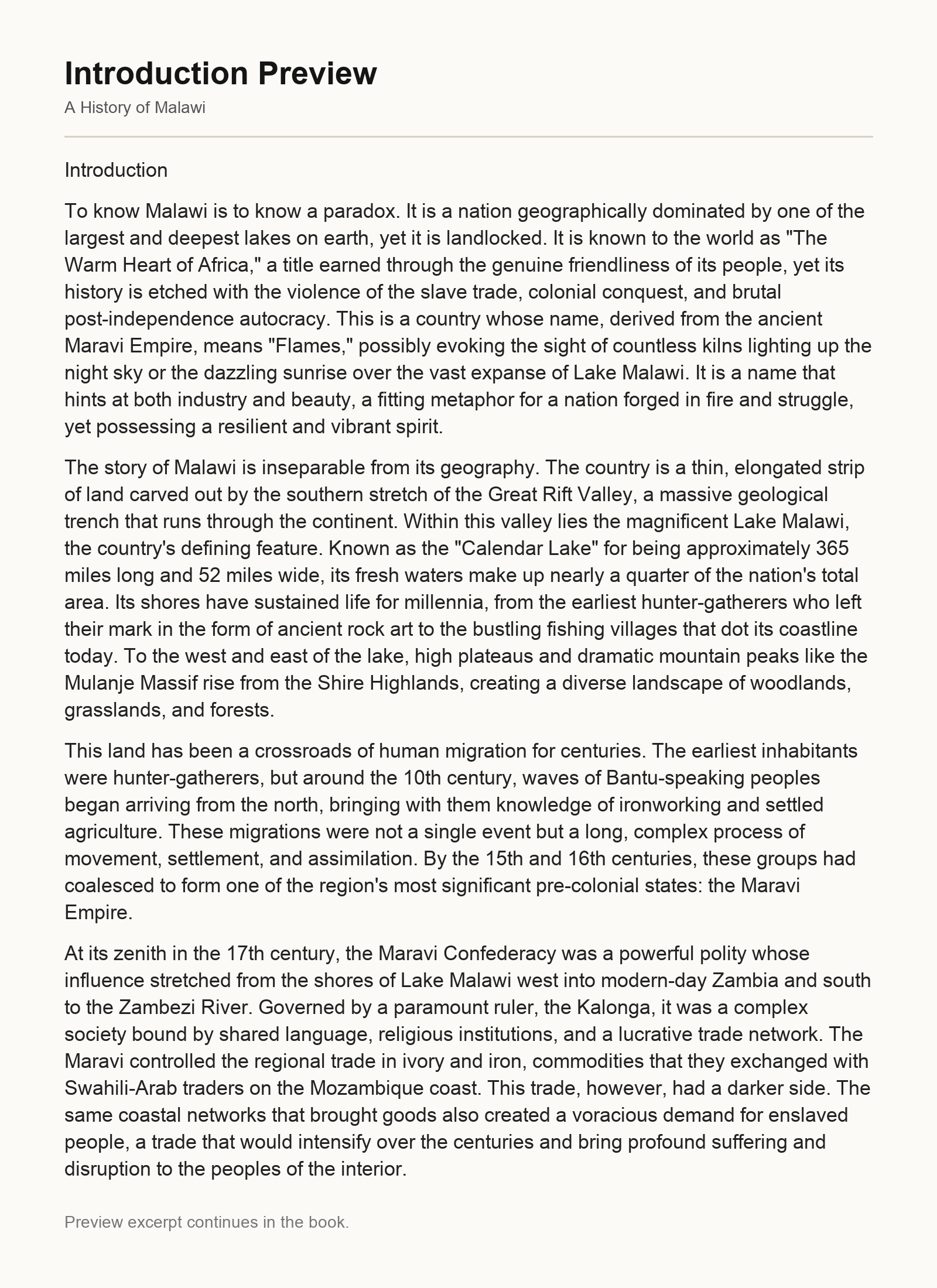
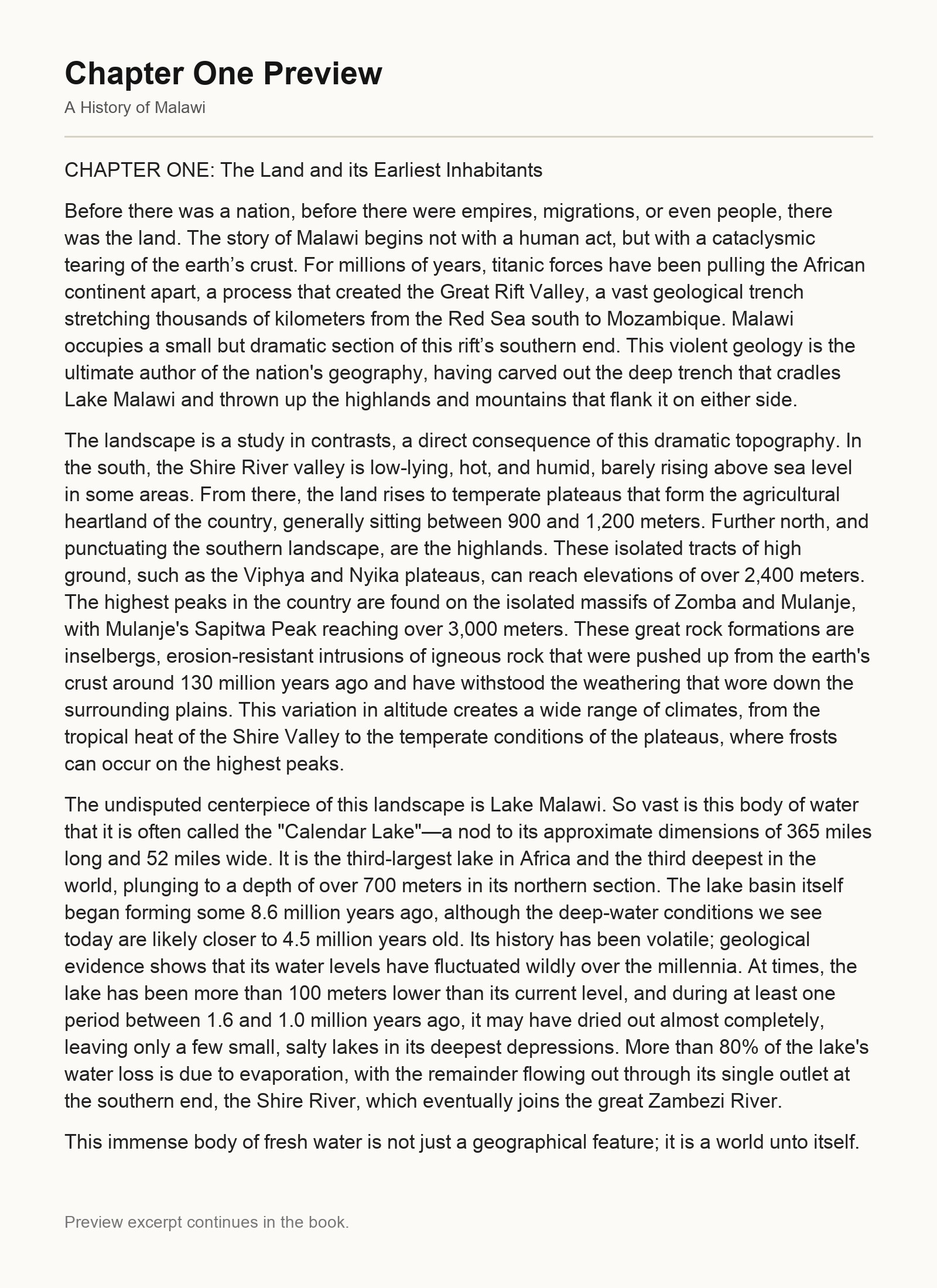
A History of Malawi invites readers on a sweeping journey through the nation’s past, beginning with the geological forces that carved the Great Rift Valley and Lake Malawi, and tracing the lives of the earliest hunter‑gatherers whose rock art still whispers from the Chongoni hills. The narrative follows the arrival of Bantu‑speaking farmers, the rise and fragmentation of the Maravi Empire, and the reshaping of the region by the Chewa, Tumbuka, and Ngoni peoples, showing how trade, conflict, and the Swahili‑Arab networks set the stage for dramatic change.
Readers will discover how the Scottish missionary David Livingstone’s encounter with the slave trade sparked a wave of missionary activity that, together with traders and political agents, paved the way for the British Central Africa Protectorate. The book details the colonial era’s contradictions—infrastructure built for export, the exploitative thangata labor system, the Chilembwe Uprising as an early cry for resistance, and the gradual emergence of an educated African elite that challenged colonial rule.
The story then turns to the turbulent mid‑20th century, examining the ill‑fated Federation of Rhodesia and Nyasaland, the rise of Hastings Kamuzu Banda, and the birth of the Malawi Congress Party. It explores the Cabinet Crisis of 1964 that cemented Banda’s autocratic rule, the construction of a one‑party state backed by the Malawi Young Pioneers, and the complex legacy of his economic policies, foreign relations, and societal control, offering a nuanced view of a leader praised for stability yet condemned for repression.
From the winds of change in the 1990s to the historic 1993 referendum that ended one‑party rule, the book chronicles the transition to multiparty democracy, the Bakili Muluzi years, the challenges of economic liberalization and corruption, and the political dramas of the 21st century—including judicial victories, coups, and corruption scandals that tested Malawi’s fledgling institutions. It concludes with an assessment of contemporary Malawi, highlighting the enduring spirit of its people, the pressures of climate change and debt, and the hopes pinned on tourism, mineral wealth, and democratic resilience.
Through vivid storytelling and rigorous scholarship, A History of Malawi equips readers to understand not only the events that shaped the nation but also the cultural continuities, contradictions, and aspirations that define the “Warm Heart of Africa” today. It is an essential read for anyone seeking to grasp how geography, empire, resistance, and leadership have intertwined to forge a nation still striving for peace, prosperity, and true freedom.
What You'll Find Inside:
- The book explores how Malawi's unique geography - dominated by Lake Malawi and shaped by the Great Rift Valley - influenced human settlement from ancient hunter-gatherers to the rise of the Maravi Empire.
- It details the devastating impact of the slave trade, colonial exploitation, and resistance movements like the 1915 Chilembwe Uprising that planted early seeds of Malawian nationalism.
- The text examines Hastings Kamuzu Banda's rise to power, the establishment of a repressive one-party state, and the apparatus of control including the Malawi Young Pioneers.
- It covers Malawi's turbulent transition to multiparty democracy, including the 1993 referendum, the Bakili Muluzi era, and subsequent political developments.
- The book concludes with an analysis of contemporary Malawi's challenges and prospects, addressing economic struggles, democratic consolidation, and the enduring spirit of the 'Warm Heart of Africa'.
Who's It For:
This book is ideal for students, researchers, and general readers seeking a comprehensive understanding of Malawi's historical journey from ancient times to the present. It will particularly benefit those studying African history, post-colonial studies, or political development, offering detailed insights into the nation's geography, pre-colonial states, colonial experience, authoritarian rule, and democratic transition. Readers interested in how geography shapes national development, the mechanics of authoritarian control, and the challenges of democratic consolidation in African contexts will find this work especially valuable.
Table of Contents:
- Introduction
- Chapter 1: The Land and its Earliest Inhabitants
- Chapter 2: The Bantu Migrations and the Rise of the Maravi Empire
- Chapter 3: The Chewa, the Tumbuka, and the Ngoni: People and Polities
- Chapter 4: Trade, Conflict, and the Swahili-Arab Influence
- Chapter 5: David Livingstone and the Arrival of the Missionaries
- Chapter 6: The Scramble for Africa and the Establishment of the British Central Africa Protectorate
- Chapter 7: The Chilembwe Uprising: Early Seeds of Resistance
- Chapter 8: Life under Colonial Rule in Nyasaland
- Chapter 9: Economic Exploitation and Social Transformation
- Chapter 10: The Federation of Rhodesia and Nyasaland and the Rise of Nationalism
- Chapter 11: Hastings Kamuzu Banda and the Malawi Congress Party
- Chapter 12: The State of Emergency and the Path to Self-Governance
- Chapter 13: The Dawn of Independence: 1964
- Chapter 14: The Cabinet Crisis of 1964 and the Consolidation of Power
- Chapter 15: The One-Party State: Politics and Governance under Banda
- Chapter 16: The Malawi Young Pioneers and the Apparatus of Control
- Chapter 17: Economic Policy and Agrarian Change in the Banda Era
- Chapter 18: Foreign Relations: Pragmatism and Controversy
- Chapter 19: Society, Culture, and Dissent under Autocratic Rule
- Chapter 20: The Winds of Change: The Push for Multiparty Democracy
- Chapter 21: The 1993 Referendum and the End of an Era
- Chapter 22: The Bakili Muluzi Years: A New Democratic Dawn?
- Chapter 23: Economic Liberalization, Corruption, and Social Challenges
- Chapter 24: Political Developments in the 21st Century
- Chapter 25: Contemporary Malawi: Prospects for the "Warm Heart of Africa"
Author:
Published By:
Date Published:
May 16, 2026
Type:
Nonfiction
Language:
English
Also Available In:
Word Count:
42,336 words
Reading Time:
2 hours 58 minutes
Sample:
Order:
Order A History of Malawi (Paperback) on MixCache.com:
Buy NowPrint copy is made to order and ships worldwide. Includes the ebook free, ready to read instantly.
$5 account credit for all new MixCache.com accounts, usable toward any ebook purchase!*