Browse by Category
Fiction
- Action & Adventure
- African American
- Anthologies
- Children's Fiction
- Classics
- Comics & Graphic Novels
- Coming of Age
- Contemporary
- Cultural & Regional
- Drama
- Erotica
- Fantasy
- General
- Historical Fiction
- Horror
- Humor & Satire
- Literary Fiction
- Mystery, Thriller & Suspense
- Poetry
- Religious & Inspirational
- Romance
- Science Fiction
- Short Stories
- War & Military
- Westerns
- Women's Fiction
- Young Adult
Non-Fiction
- Antiques & Collectibles
- Arts & Photography
- Biographies & Memoirs
- Business & Money
- Children's Non-Fiction
-
Computers & Technology
- Artificial Intelligence
- Computer Science
- Cybersecurity & Cryptography
- Data Science & Analytics
- Databases & Big Data
- Game Development & Design
- General
- Hardware & DIY
- Mobile App Development
- Networking & Cloud Computing
- Operating Systems
- Programming
- Robotics
- Software
- Software Engineering
- User Experience (UX) & Design
- Web Development & Design
- Cooking, Food & Wine
- Crafts, Hobbies & Home
- Education & Teaching
- Engineering
- General
- Health, Fitness & Dieting
-
History
- African History
- African History - North Africa
- African History - Sub-Saharan Africa
- American History
- American History - 20th Century
- American History - Civil War
- American History - Colonial Period
- Ancient History
- Asian History
- Asian History - China
- Asian History - India
- Asian History - Japan
- Asian History - Southeast Asia
- European History
- European History - Ancient Greece
- European History - Ancient Rome
- European History - Medieval
- European History - Modern
- European History - Renaissance
- General
- Middle Eastern History
- Military History
- Military History - Aviation
- Military History - Naval
- Social & Cultural History
- World History
- Humor & Entertainment
- Industrial Technology
- Language Learning
- Law
- LGBTQ+ Non-Fiction
- Literary Criticism
- Medical Books
- Parenting & Relationships
- Philosophy
- Politics & Social Sciences
- Reference
- Religion & Spirituality
-
Science & Math
- Agricultural Sciences
- Astronomy & Space Science
- Behavioral Sciences
- Biological Sciences
- Botany & Plant Science
- Chemistry
- Earth Sciences
- Engineering - Chemical
- Engineering - Civil
- Engineering - Electrical
- Engineering - Mechanical
- Environment
- General
- Geology
- Mathematics
- Nature & Ecology
- Oceanography
- Paleontology
- Physics
- Statistics
- Self-Help
- Sports & Outdoors
- Study Aids
- Sustainability & Green Living
- Textbooks
- Transportation
- Travel
- True Crime
- Urban Planning & Development
- Veterinary Medicine
- Writing & Publishing
Jump to Section
MixCache.com Total Access
Unlimited reading and audiobooks for every book published by MixCache.com.
Included titles carry the MTA badge.
Learn more →
Mariners and Merchants: The Age of Exploration and Europe's Global Reach
MTA
A maritime and economic history of exploration, colonization, and trade networks that expanded Europe
About this book:
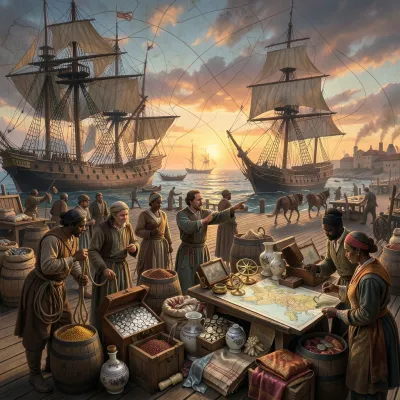
*Mariners and Merchants* explores the pivotal era when European nations transformed the world’s oceans into a global network of trade, conquest, and cultural exchange. Beginning with Portuguese and Spanish maritime innovations in the fifteenth century, the book traces the development of essential technologies—such as the caravel, the mariner’s astrolabe, and the *volta do mar*—that allowed explorers to navigate beyond the sight of land. These technical achievements were supported by the rise of merchant capitalism, which introduced sophisticated financial instruments like joint-stock companies, marine insurance, and credit systems. Cities such as Antwerp, Amsterdam, and London emerged as the command centers of this new global economy, coordinating the flow of silver, spices, and textiles across vast distances.
The narrative emphasizes that European expansion was not a unilateral triumph but a complex process heavily dependent on indigenous knowledge and collaboration. From the pilots of the Indian Ocean to the diplomatic alliances forged with the Tlaxcalans and Haudenosaunee, non-European actors exercised significant agency, often adapting European tools and trade to serve their own political ends. However, this connectivity came at a staggering human and ecological cost. The book provides a detailed analysis of the "Columbian Exchange," the catastrophic demographic collapse of indigenous populations due to disease, and the brutal institutionalization of coerced labor through the *encomienda*, the *mita*, and the transatlantic slave trade, which forcibly moved millions of Africans to American plantations.
As the maritime world matured, the focus shifted from Iberian pioneers to the corporate empires of the Dutch and English East India Companies. The seventeenth and eighteenth centuries were defined by intense commercial rivalries and "wars for trade," such as the Seven Years’ War, where control of maritime choke points and commodity monopolies became the ultimate goal of state power. The text follows the transition into the nineteenth century, where the introduction of steam power and the telegraph further compressed global circuits of information and transport. These technologies integrated the world more tightly than ever before, but also reinforced the structural inequalities established in earlier centuries.
The concluding chapters reflect on the enduring legacies of this maritime age, noting how the legal, linguistic, and economic frameworks of the modern world remain rooted in early modern exploration. The author argues that contemporary global issues—including climate change, wealth inequality, and the ongoing reckoning with colonial history—are direct consequences of the era when oceans became the connective tissue of a changing world. By placing technological ingenuity alongside systemic exploitation, the book offers a balanced assessment of how Europe’s global reach was built, whom it served, and the environmental and social costs that continue to be navigated today.
What You'll Find Inside:
- Explores how maritime innovation (caravels, navigational science) enabled European global expansion while emphasizing the complex interplay of cooperation and conflict with existing global networks.
- Details the development of merchant capitalism through financial instruments like bills of exchange, marine insurance, and joint-stock companies that underwrote long-distance trade.
- Examines the Columbian Exchange's profound biological impacts—pathogens, plants, animals—and how they reshaped ecosystems and societies worldwide.
- Highlights indigenous agency and adaptation, showing how peoples across the Americas, Africa, and Asia engaged diplomatically, traded, and resisted European expansion.
- Analyzes environmental transformations from deforestation for plantations to overfishing and the ecological legacies of early modern globalization.
Who's It For:
This book is ideal for students, scholars, and general readers interested in maritime history, economic history, and global studies. It will particularly benefit those seeking a nuanced, interdisciplinary understanding of the Age of Exploration that moves beyond Eurocentric narratives to incorporate indigenous perspectives, environmental consequences, and the entangled histories of trade, technology, and exploitation. Readers interested in the historical roots of modern globalization, capitalism, and ecological crises will find valuable insights.
Table of Contents:
- Introduction
- Chapter 1 The Edge of the Atlantic: Portuguese Pioneers and Island Laboratories
- Chapter 2 Across the Ocean Sea: Castile, Columbus, and the Caribbean Encounter
- Chapter 3 Ships, Sails, and Instruments: Caravels, Galleons, and Navigational Science
- Chapter 4 Mapping the World: Cartographers, Cosmographers, Winds, and Currents
- Chapter 5 Routes to the Indies: The Cape Passage and the Estado da Índia
- Chapter 6 Conquest and Alliance in the Americas: Indigenous States, Steel, and Strategy
- Chapter 7 The Columbian Exchange: Pathogens, Plants, Animals, and Ecologies
- Chapter 8 Building Merchant Capitalism: Credit, Risk, and the Business of Long-Distance Trade
- Chapter 9 Labor and Coercion: Encomienda, Mita, and the Atlantic Plantation Complex
- Chapter 10 The Transatlantic Slave Trade: Human Commodification, Resistance, and Abolition
- Chapter 11 Corporations at Sea: VOC, EIC, and the Rise of Joint-Stock Empire
- Chapter 12 The Pacific Connection: Manila Galleons, Silver, and the China Trade
- Chapter 13 The Dutch Seaborne World: Indonesia, the Cape Corridor, and the North Sea
- Chapter 14 English and French Atlantics: Settlement, Fisheries, and the Fur Frontiers
- Chapter 15 Pirates, Privateers, and the Legalities of Plunder
- Chapter 16 Port Cities, Insurance, and Information: Antwerp, Amsterdam, Cádiz, and London
- Chapter 17 Missionaries, Interpreters, and Go-Betweens: Cultural Brokers of Empire
- Chapter 18 Dividing and Debating the Oceans: Tordesillas, Zaragoza, and the Law of the Sea
- Chapter 19 Indigenous Agency and Adaptation: Diplomacy, Trade, and Resistance
- Chapter 20 Global Commodities and Changing Tastes: Sugar, Tobacco, Coffee, Tea, Cotton, and Opium
- Chapter 21 Environmental Transformations: Forests, Fisheries, and the Maritime Commons
- Chapter 22 Wars for Trade: Anglo-Dutch Rivalry, the Seven Years’ War, and Napoleonic Blockades
- Chapter 23 Revolutions and Reform: Atlantic Upheavals and the Recasting of Imperial Economies
- Chapter 24 Steam, Telegraph, and New Global Circuits: The Nineteenth-Century Maritime Turn
- Chapter 25 Legacies, Memory, and Reckoning: Europe’s Maritime Past in a Global Present
Author:
Published By:
Date Published:
May 14, 2026
Type:
Nonfiction
Language:
English
Word Count:
70,353 words
Reading Time:
4 hours 56 minutes
Sample:
Order:
Order Mariners and Merchants: The Age of Exploration and Europe's Global Reach (Hardcover) on MixCache.com:
Buy NowPrint copy is made to order and ships worldwide. Includes the ebook free, ready to read instantly.
$5 account credit for all new MixCache.com accounts, usable toward any ebook purchase!*