Browse by Category
Fiction
- Action & Adventure
- African American
- Anthologies
- Children's Fiction
- Classics
- Comics & Graphic Novels
- Coming of Age
- Contemporary
- Cultural & Regional
- Drama
- Erotica
- Fantasy
- General
- Historical Fiction
- Horror
- Humor & Satire
- Literary Fiction
- Mystery, Thriller & Suspense
- Poetry
- Religious & Inspirational
- Romance
- Science Fiction
- Short Stories
- War & Military
- Westerns
- Women's Fiction
- Young Adult
Non-Fiction
- Antiques & Collectibles
- Arts & Photography
- Biographies & Memoirs
- Business & Money
- Children's Non-Fiction
-
Computers & Technology
- Artificial Intelligence
- Computer Science
- Cybersecurity & Cryptography
- Data Science & Analytics
- Databases & Big Data
- Game Development & Design
- General
- Hardware & DIY
- Mobile App Development
- Networking & Cloud Computing
- Operating Systems
- Programming
- Robotics
- Software
- Software Engineering
- User Experience (UX) & Design
- Web Development & Design
- Cooking, Food & Wine
- Crafts, Hobbies & Home
- Education & Teaching
- Engineering
- General
- Health, Fitness & Dieting
-
History
- African History
- African History - North Africa
- African History - Sub-Saharan Africa
- American History
- American History - 20th Century
- American History - Civil War
- American History - Colonial Period
- Ancient History
- Asian History
- Asian History - China
- Asian History - India
- Asian History - Japan
- Asian History - Southeast Asia
- European History
- European History - Ancient Greece
- European History - Ancient Rome
- European History - Medieval
- European History - Modern
- European History - Renaissance
- General
- Middle Eastern History
- Military History
- Military History - Aviation
- Military History - Naval
- Social & Cultural History
- World History
- Humor & Entertainment
- Industrial Technology
- Language Learning
- Law
- LGBTQ+ Non-Fiction
- Literary Criticism
- Medical Books
- Parenting & Relationships
- Philosophy
- Politics & Social Sciences
- Reference
- Religion & Spirituality
-
Science & Math
- Agricultural Sciences
- Astronomy & Space Science
- Behavioral Sciences
- Biological Sciences
- Botany & Plant Science
- Chemistry
- Earth Sciences
- Engineering - Chemical
- Engineering - Civil
- Engineering - Electrical
- Engineering - Mechanical
- Environment
- General
- Geology
- Mathematics
- Nature & Ecology
- Oceanography
- Paleontology
- Physics
- Statistics
- Self-Help
- Sports & Outdoors
- Study Aids
- Sustainability & Green Living
- Textbooks
- Transportation
- Travel
- True Crime
- Urban Planning & Development
- Veterinary Medicine
- Writing & Publishing
Jump to Section
MixCache.com Total Access
Unlimited reading and audiobooks for every book published by MixCache.com.
Included titles carry the MTA badge.
Learn more →
Spice Sensory Training for Chefs and Buyers
MTA
Tasting Protocols, Flavor Mapping, and Quality Assessment Tools
About this book:
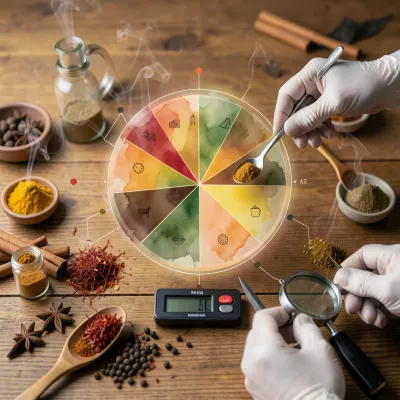
This book provides a comprehensive framework for chefs and commodity buyers to transition from intuitive spice selection to a rigorous, data-driven sensory evaluation system. It begins with the physiological foundations of taste, aroma, and pungency, establishing that sensory acuity is a trainable professional skill rather than an innate gift. By setting up standardized sensory labs and adopting disciplined tasting protocols for both whole and ground spices, professionals can move beyond visual inspection to detect subtle volatile integrity, identify deliberate adulteration, and measure the "heat" of trigeminal stimulants like capsaicin and piperine.
Central to the book’s methodology is the creation of a shared organizational language and visual tools for flavor mapping. Through the use of flavor wheels, spider charts, and calibrated reference standards, teams can externalize individual perceptions into objective data. The text emphasizes the importance of documentation via standardized scorecards, which transform fleeting sensory impressions into a permanent record. This structured approach allows for the implementation of three-tier decision models (Accept, Conditional, or Reject) that protect a brand’s flavor profile and financial bottom line.
The latter half of the book connects sensory science to the practicalities of the global supply chain. It details how to conduct shelf-life studies and culinary application tests in various media—such as oils and broths—to ensure spices perform under real-world cooking conditions. Furthermore, it provides a strategic roadmap for sourcing, supplier qualification, and regulatory compliance, using sensory data as a powerful lever in price negotiations and contract specifications.
Ultimately, the book advocates for a culture of continuous improvement through the use of data dashboards and operational playbooks. By tracking sensory trends over time and identifying the root causes of quality fluctuations, organizations can build institutional knowledge that survives staff turnover. This systematic rigor transforms spices from variable commodities into dependable sources of culinary distinction, ensuring that every ingredient is evaluated with the same professional scrutiny as fine wine or coffee.
What You'll Find Inside:
- Comprehensive tasting protocols for whole and ground spices, covering visual inspection, aroma evaluation, taste assessment, texture analysis, and defect detection
- Practical guidance for establishing a functional spice sensory lab on any budget, from essential tools to moderate investments
- Techniques for building a shared flavor vocabulary and creating flavor maps (wheels, axes, spider charts) to translate sensory perceptions into actionable data
- Methods for identifying spice defects including adulteration, environmental taints, and degradation off-notes through systematic sensory evaluation
- Frameworks for applying sensory data to sourcing decisions, supplier qualification, and cost-value negotiations in the spice supply chain
Who's It For:
This book is essential for chefs, spice buyers, quality assurance professionals, and food industry practitioners who work with spices in culinary or procurement settings. Whether you manage a spice program for a multi-unit restaurant operation, purchase spices for food manufacturing, or oversee quality control in distribution, you'll gain practical tools to elevate your spice evaluation skills. The content is specifically designed for professionals responsible for incoming goods inspection, blend development, menu creation, or supplier management who need to transform subjective impressions into objective, defensible quality assessments that support purchasing decisions and culinary excellence.
Table of Contents:
- Introduction
- Chapter 1 Why Sensory Training Matters in Spice Work
- Chapter 2 The Physiology of Taste, Aroma, and Pungency
- Chapter 3 Setting Up a Spice Sensory Lab on Any Budget
- Chapter 4 Hygiene, Safety, and Allergen Controls
- Chapter 5 Calibrating Your Palate: Thresholds and Intensity
- Chapter 6 Building a Shared Flavor Vocabulary
- Chapter 7 Tasting Protocols for Whole Spices
- Chapter 8 Tasting Protocols for Ground Spices and Blends
- Chapter 9 Evaluating Freshness and Volatile Integrity
- Chapter 10 Detecting Defects: Adulteration, Taints, and Off-Notes
- Chapter 11 Moisture, Particle Size, and Texture Assessment
- Chapter 12 Heat and Trigeminal Effects: Measuring Pungency
- Chapter 13 Flavor Mapping: Wheels, Axes, and Spider Charts
- Chapter 14 Reference Standards and Control Samples
- Chapter 15 Designing and Using Scorecards
- Chapter 16 Panel Management: Training, Bias, and Basic Statistics
- Chapter 17 From Sample to Decision: Acceptance Criteria and Cutoffs
- Chapter 18 Cupping and Brewing Methods for Spices and Botanicals
- Chapter 19 Culinary Application Tests: Broths, Oils, and Infusions
- Chapter 20 Shelf-Life Studies and Aroma Retention
- Chapter 21 Sourcing Checklists and Supplier Qualification
- Chapter 22 Traceability, Certifications, and Regulatory Basics
- Chapter 23 Origin, Terroir, and Cultural Markers
- Chapter 24 Cost, Value, and Negotiation for Buyers
- Chapter 25 Continuous Improvement: Data, Dashboards, and Playbooks
Author:
Published By:
Date Published:
May 13, 2026
Type:
Nonfiction
Language:
English
Word Count:
78,082 words
Reading Time:
5 hours 28 minutes
Sample:
Order:
Order Spice Sensory Training for Chefs and Buyers (Hardcover) on MixCache.com:
Buy NowPrint copy is made to order and ships worldwide. Includes the ebook free, ready to read instantly.
$5 account credit for all new MixCache.com accounts, usable toward any ebook purchase!*