
Browse by Category
Fiction
- Action & Adventure
- African American
- Anthologies
- Children's Fiction
- Classics
- Comics & Graphic Novels
- Coming of Age
- Contemporary
- Cultural & Regional
- Drama
- Erotica
- Fantasy
- General
- Historical Fiction
- Horror
- Humor & Satire
- Literary Fiction
- Mystery, Thriller & Suspense
- Poetry
- Religious & Inspirational
- Romance
- Science Fiction
- Short Stories
- War & Military
- Westerns
- Women's Fiction
- Young Adult
Non-Fiction
- Antiques & Collectibles
- Arts & Photography
- Biographies & Memoirs
- Business & Money
- Children's Non-Fiction
-
Computers & Technology
- Artificial Intelligence
- Computer Science
- Cybersecurity & Cryptography
- Data Science & Analytics
- Databases & Big Data
- Game Development & Design
- General
- Hardware & DIY
- Mobile App Development
- Networking & Cloud Computing
- Operating Systems
- Programming
- Robotics
- Software
- Software Engineering
- User Experience (UX) & Design
- Web Development & Design
- Cooking, Food & Wine
- Crafts, Hobbies & Home
- Education & Teaching
- Engineering
- General
- Health, Fitness & Dieting
-
History
- African History
- African History - North Africa
- African History - Sub-Saharan Africa
- American History
- American History - 20th Century
- American History - Civil War
- American History - Colonial Period
- Ancient History
- Asian History
- Asian History - China
- Asian History - India
- Asian History - Japan
- Asian History - Southeast Asia
- European History
- European History - Ancient Greece
- European History - Ancient Rome
- European History - Medieval
- European History - Modern
- European History - Renaissance
- General
- Middle Eastern History
- Military History
- Military History - Aviation
- Military History - Naval
- Social & Cultural History
- World History
- Humor & Entertainment
- Industrial Technology
- Language Learning
- Law
- LGBTQ+ Non-Fiction
- Literary Criticism
- Medical Books
- Parenting & Relationships
- Philosophy
- Politics & Social Sciences
- Reference
- Religion & Spirituality
-
Science & Math
- Agricultural Sciences
- Astronomy & Space Science
- Behavioral Sciences
- Biological Sciences
- Botany & Plant Science
- Chemistry
- Earth Sciences
- Engineering - Chemical
- Engineering - Civil
- Engineering - Electrical
- Engineering - Mechanical
- Environment
- General
- Geology
- Mathematics
- Nature & Ecology
- Oceanography
- Paleontology
- Physics
- Statistics
- Self-Help
- Sports & Outdoors
- Study Aids
- Sustainability & Green Living
- Textbooks
- Transportation
- Travel
- True Crime
- Urban Planning & Development
- Veterinary Medicine
- Writing & Publishing
Jump to Section
MixCache.com Total Access
Unlimited reading and audiobooks for every book published by MixCache.com.
Included titles carry the MTA badge.
Learn more →
Roman Legions Unveiled: Logistics, Command, and Empire Building
MTA
How Supply, Organization, and Engineering Created Rome's Military Dominance
About this book:
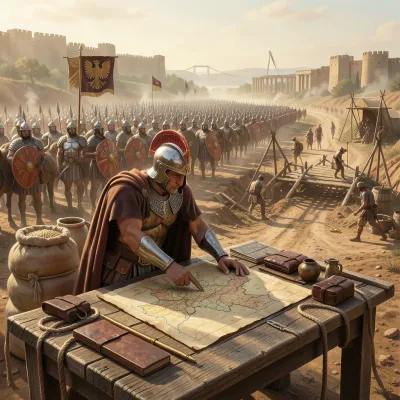
The Roman legions' centuries of dominance were not solely the result of battlefield courage, but rather the product of a sophisticated, self-sustaining administrative machine that treated warfare as a problem of logistics and engineering. By transforming the military from a seasonal citizen militia into a professional standing force, Rome established a modular system characterized by extreme standardization in equipment, training, and command. This institutional consistency allowed the state to project power across three continents, ensuring that a soldier or officer could be transferred from Britain to Syria and immediately integrate into a familiar framework of daily routines, record-keeping, and fortified camp construction.
Central to this military dominance was the creation of a vast, permanent infrastructure designed to collapse the "tyranny of distance." The construction of over 80,000 kilometers of engineered roads, alongside innovative bridges and the *cursus publicus* (imperial postal service), enabled the rapid movement of troops and intelligence. Behind the front lines, a massive bureaucratic apparatus managed the "digestive system" of the empire, utilizing provincial taxation and private contractors to fill enormous granaries and maintain complex supply chains. This system ensured that the legions were reliably fed, paid, and equipped, even in the most inhospitable environments.
Roman engineering served as a critical force multiplier, enabling the military to negotiate or manufacture terrain to its advantage. Whether through the nightly construction of the *castra* (fortified camps), the building of massive siege ramps, or the deployment of calibrated artillery like the ballista, Rome treated geographic and tactical obstacles as engineering problems with material solutions. This technical proficiency, combined with the strategic integration of non-citizen auxiliary forces—who provided local expertise and specialized skills—allowed Rome to maintain a resilient presence along its diverse frontiers, from the Rhine to the Euphrates.
Ultimately, the Roman military thrived by prioritizing sustainability and accountability over individual heroics. Every ration, tool, and nail was tracked through detailed ledgers, creating an institutional memory that persisted through centuries of political and economic shifts. Even as the empire faced the crises of the third and fourth centuries, its ability to adapt logistical practices—such as shifting to a command economy and "defense in depth" strategies—bought the state hundreds of years of survival. The enduring lesson of the Roman legions is that military success is a predictable outcome of organizational design, where logistics creates the options that lead to empire.
What You'll Find Inside:
- How Rome's administrative revolution transformed a seasonal militia into a professional standing army through standardized equipment, systematic record-keeping, and career soldiers
- The empire's logistical infrastructure - roads, bridges, granaries, and transport systems - that enabled sustained military campaigns across three continents
- Engineering solutions that converted geographical obstacles into solvable challenges, from river bridges to siege works and fortified camps
- The hybrid command structure that combined aristocratic leadership with professional centurion expertise to maintain tactical consistency
- Real-world case studies demonstrating logistics in action: Caesar's rapid campaigns in Gaul, Trajan's engineering in Dacia, and frontier management in the East
Who's It For:
This book is essential reading for military historians, logisticians, and defense professionals seeking to understand how administrative systems enable military effectiveness. It will also appeal to students of ancient history interested in the practical mechanisms behind Rome's empire-building, as well as modern organizational leaders looking for historical precedents in standardization, supply chain management, and integrated command structures.
Table of Contents:
- Introduction
- Chapter 1 From Militia to Machine: The Administrative Revolution
- Chapter 2 Recruitment, Oath, and Pay: Building the Human System
- Chapter 3 The Chain of Command: Consuls, Legates, and Centurions
- Chapter 4 Paperwork and Power: Records, Rations, and Accountability
- Chapter 5 Standardization: Equipment, Munitions, and the Legionary Kit
- Chapter 6 Marching Order: Daily Routines, Loads, and Discipline
- Chapter 7 The Roman Road: Survey, Construction, and Maintenance
- Chapter 8 Bridges and Ferries: Crossing the Impassable
- Chapter 9 Fortified Rhythm: Castra, Forts, and Frontier Architecture
- Chapter 10 Granaries and Foodways: Feeding Armies at Scale
- Chapter 11 Beasts and Wheels: Animals, Wagons, and Transport
- Chapter 12 Rivers and Seas: Naval and Fluvial Logistics
- Chapter 13 Siegecraft and Engineering: From Ramps to Ballistae
- Chapter 14 Intelligence and Maps: Knowing the Battlespace
- Chapter 15 Communications at Speed: Couriers, Signals, and the Cursus Publicus
- Chapter 16 Medical Support: Sanitation, Surgery, and Survival
- Chapter 17 Finance of Conquest: Taxation, Contracts, and Spoils
- Chapter 18 Local Allies and Auxilia: Integrating Non‑Roman Forces
- Chapter 19 Law, Order, and Military Justice: Discipline as Logistics
- Chapter 20 Frontier Systems: The Limes and Long-Term Control
- Chapter 21 Case Study—Caesar in Gaul: Logistics of Rapid Campaigning
- Chapter 22 Case Study—Trajan and the Dacian Wars: Engineering for Escalation
- Chapter 23 Case Study—The Eastern Frontier: Parthia, Persia, and the Problem of Distance
- Chapter 24 Decline and Adaptation: Crisis, Reform, and Supply under Strain
- Chapter 25 Lessons for Modern Practitioners: What Endures and What Does Not
Author:
Published By:
Date Published:
May 13, 2026
Type:
Nonfiction
Language:
English
Word Count:
70,122 words
Reading Time:
4 hours 55 minutes
Sample:
MixCache.com Total Access
Get unlimited access to this book + all books published by MixCache.com for $11.99/month
Subscribe to MTAOr purchase this book individually below
Order:
Buy the Roman Legions Unveiled: Logistics, Command, and Empire Building ebook on MixCache.com:
Buy Now
Full ebook will be available immediately
- read online or download as a PDF file.
$5 account credit for all new MixCache.com accounts, usable toward any ebook purchase!*


Ratings & Reviews
Ask Questions About This Book
Have a question about the content? Ask our AI assistant!
Start by asking a question about "Roman Legions Unveiled: Logistics, Command, and Empire Building"
Example: "Does this book mention William Shakespeare?"
Thinking...