
Browse by Category
Fiction
- Action & Adventure
- African American
- Anthologies
- Children's Fiction
- Classics
- Comics & Graphic Novels
- Coming of Age
- Contemporary
- Cultural & Regional
- Drama
- Erotica
- Fantasy
- General
- Historical Fiction
- Horror
- Humor & Satire
- Literary Fiction
- Mystery, Thriller & Suspense
- Poetry
- Religious & Inspirational
- Romance
- Science Fiction
- Short Stories
- War & Military
- Westerns
- Women's Fiction
- Young Adult
Non-Fiction
- Antiques & Collectibles
- Arts & Photography
- Biographies & Memoirs
- Business & Money
- Children's Non-Fiction
-
Computers & Technology
- Artificial Intelligence
- Computer Science
- Cybersecurity & Cryptography
- Data Science & Analytics
- Databases & Big Data
- Game Development & Design
- General
- Hardware & DIY
- Mobile App Development
- Networking & Cloud Computing
- Operating Systems
- Programming
- Robotics
- Software
- Software Engineering
- User Experience (UX) & Design
- Web Development & Design
- Cooking, Food & Wine
- Crafts, Hobbies & Home
- Education & Teaching
- Engineering
- General
- Health, Fitness & Dieting
-
History
- African History
- African History - North Africa
- African History - Sub-Saharan Africa
- American History
- American History - 20th Century
- American History - Civil War
- American History - Colonial Period
- Ancient History
- Asian History
- Asian History - China
- Asian History - India
- Asian History - Japan
- Asian History - Southeast Asia
- European History
- European History - Ancient Greece
- European History - Ancient Rome
- European History - Medieval
- European History - Modern
- European History - Renaissance
- General
- Middle Eastern History
- Military History
- Military History - Aviation
- Military History - Naval
- Social & Cultural History
- World History
- Humor & Entertainment
- Industrial Technology
- Language Learning
- Law
- LGBTQ+ Non-Fiction
- Literary Criticism
- Medical Books
- Parenting & Relationships
- Philosophy
- Politics & Social Sciences
- Reference
- Religion & Spirituality
-
Science & Math
- Agricultural Sciences
- Astronomy & Space Science
- Behavioral Sciences
- Biological Sciences
- Botany & Plant Science
- Chemistry
- Earth Sciences
- Engineering - Chemical
- Engineering - Civil
- Engineering - Electrical
- Engineering - Mechanical
- Environment
- General
- Geology
- Mathematics
- Nature & Ecology
- Oceanography
- Paleontology
- Physics
- Statistics
- Self-Help
- Sports & Outdoors
- Study Aids
- Sustainability & Green Living
- Textbooks
- Transportation
- Travel
- True Crime
- Urban Planning & Development
- Veterinary Medicine
- Writing & Publishing
Jump to Section
MixCache.com Total Access
Unlimited reading and audiobooks for every book published by MixCache.com.
Included titles carry the MTA badge.
Learn more →
Women of the Continent: Gender, Power, and Social Change in African History
MTA
Matriarchs, Warriors, and Everyday Agents across Precolonial and Colonial Eras
About this book:
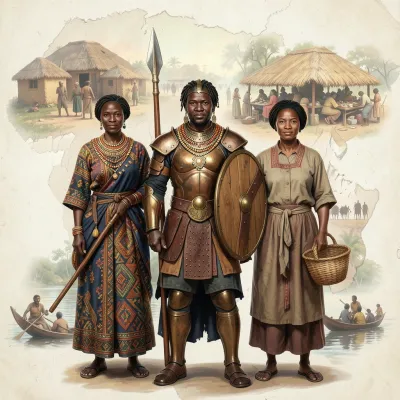
"Women of the Continent: Gender, Power, and Social Change in African History" offers a sweeping re-examination of African history through the lens of women's experiences, challenging traditional narratives that often marginalize or erase their contributions. The book argues that African women were not merely present during precolonial and colonial transformations, but were central architects of change, wielding diverse forms of authority as matriarchs, monarchs, warriors, traders, healers, and everyday agents. It demonstrates how gender was a fluid social technology shaping access to resources, power, and prestige across varied African societies, from ancient Kush to the eve of independence.
The book delves into specific regional and thematic case studies to illustrate these points. It explores the constitutional power of Queen Mothers in Akan matrilineal societies, the military prowess of the Dahomean Agoji (female warriors), and the statecraft of Nubian and Meroitic queens. It also highlights the economic influence of Swahili coast traders, Amazigh and Saharan women in caravan networks and credit systems, and the pivotal roles of female healers, midwives, and herbalists in knowledge and care systems. Moreover, the book examines the complex interactions of African women with major external forces like Islamization, the spread of Christianity, and the devastating Atlantic and Indian Ocean slave trades, showing how women adapted, resisted, and navigated these profound changes.
As the narrative moves into the colonial era, the book analyzes how women responded to new legal systems, extractive economies, and mission education. It sheds light on significant moments of collective action, such as the 1929 Nigeria Aba Protest, where women mobilized against colonial taxation and administrative policies. It further explores women's enduring roles in food sovereignty amidst famine and their shaping of new public spheres through print, performance, and orature. The concluding chapters discuss the complexities of legal pluralism under colonial rule and the generational negotiations around youth and sexuality, leading into a reflection on the continuities and ruptures in women's activism as African nations achieved independence.
Methodologically, the book emphasizes reading "against the grain" of colonial archives, triangulating diverse sources like oral histories, archaeology, court records, and missionary accounts to uncover women's agency. By foregrounding African women's roles in shaping political authority, economic systems, and social reforms, "Women of the Continent" provides a rich, nuanced understanding of African history, asserting that the continent's past can only be fully grasped when women's intricate and often understated contributions are brought to the forefront.
What You'll Find Inside:
- The book reveals African women as architects of political power through queenship, councils, ritual authority, and kinship systems across precolonial and colonial eras.
- It demonstrates women's central economic agency in trade networks, market systems, credit provision, and agricultural production that sustained regional and continental economies.
- The text examines how women shaped religious landscapes through spiritual leadership, healing practices, and patronage across Islamic, Christian, and indigenous traditions.
- It highlights women's resistance strategies and collective action, from the 1929 Aba Protest to everyday acts of defiance against colonial and patriarchal structures.
- The book provides methodological insights for reading gender in historical records, addressing archival silences and using diverse sources to recover women's histories.
Who's It For:
This book is designed for students and scholars of African history, gender studies, and postcolonial studies, as well as researchers interested in women's history and gender dynamics. It will also benefit educators teaching courses on African women's history and general readers with a strong interest in African history and gender studies who seek frameworks for recognizing power where it is often overlooked and hearing voices that have always been present.
Table of Contents:
- Introduction
- Chapter 1: Reframing Authority: Queenship, Councils, and the Gender of Power
- Chapter 2: Matrilineal Worlds: Akan Inheritance and the Politics of Kinship
- Chapter 3: Along the Nile: Nubian, Meroitic, and Kushite Women's Statecraft
- Chapter 4: Warriors of the Bight: The Dahomean Agoji and Military Service
- Chapter 5: Doorways to the Ocean: Swahili Coast Traders and Maritime Networks
- Chapter 6: Desert and Mountain: Amazigh and Saharan Women in Mobility and Mediation
- Chapter 7: Rain Queens and Royal Mothers: Southern African Monarchies in Gendered Perspective
- Chapter 8: The Horn of Africa: Empress Taytu and the Politics of Empire
- Chapter 9: Markets of the Sahel: From Kano to Timbuktu, Women, Caravan, and Credit
- Chapter 10: Healers, Midwives, and Herbalists: Knowledge, Care, and Authority
- Chapter 11: Islamization and Sufi Circuits: Piety, Scholarship, and Patronage
- Chapter 12: Christianities of Africa: Churchwomen, Queens, and Reform
- Chapter 13: Enslavement, Flight, and Freedom: Women in Atlantic and Indian Ocean Worlds
- Chapter 14: Households and the Law: Marriage, Bridewealth, and Property
- Chapter 15: Extractive Frontiers: Women, Labor, and the Early Colonial Economy
- Chapter 16: “We the Women”: The 1929 Nigeria Aba Protest and Collective Action
- Chapter 17: Farming, Famine, and Food Sovereignty: Gendered Ecologies
- Chapter 18: Classrooms and Compounds: Mission Schools, Literacies, and New Publics
- Chapter 19: Urban Markets and Moral Economies: Market Queens, Guilds, and Governance
- Chapter 20: Custom, Court, and Code: Legal Pluralism under Colonial Rule
- Chapter 21: Youth, Sexuality, and Social Regulation: Generational Negotiations
- Chapter 22: Print, Performance, and Orature: Making Publics, Making Politics
- Chapter 23: Intermediaries and Interpreters: Go-betweens in Empire
- Chapter 24: Archives, Silences, and Methods: Reading Gender in the Record
- Chapter 25: Horizons at Independence: Continuities and Ruptures in Women's Activism
Author:
Published By:
Date Published:
May 5, 2026
Type:
Nonfiction
Language:
English
Word Count:
75,968 words
Reading Time:
5 hours 19 minutes
Sample:
MixCache.com Total Access
Get unlimited access to this book + all books published by MixCache.com for $11.99/month
Subscribe to MTAOr purchase this book individually below
Order:
Buy the Women of the Continent: Gender, Power, and Social Change in African History ebook on MixCache.com:
Buy Now
Full ebook will be available immediately
- read online or download as a PDF file.
$5 account credit for all new MixCache.com accounts, usable toward any ebook purchase!*



Ratings & Reviews
Ask Questions About This Book
Have a question about the content? Ask our AI assistant!
Start by asking a question about "Women of the Continent: Gender, Power, and Social Change in African History"
Example: "Does this book mention William Shakespeare?"
Thinking...