Browse by Category
Fiction
- Action & Adventure
- African American
- Anthologies
- Children's Fiction
- Classics
- Comics & Graphic Novels
- Coming of Age
- Contemporary
- Cultural & Regional
- Drama
- Erotica
- Fantasy
- General
- Historical Fiction
- Horror
- Humor & Satire
- Literary Fiction
- Mystery, Thriller & Suspense
- Poetry
- Religious & Inspirational
- Romance
- Science Fiction
- Short Stories
- War & Military
- Westerns
- Women's Fiction
- Young Adult
Non-Fiction
- Antiques & Collectibles
- Arts & Photography
- Biographies & Memoirs
- Business & Money
- Children's Non-Fiction
-
Computers & Technology
- Artificial Intelligence
- Computer Science
- Cybersecurity & Cryptography
- Data Science & Analytics
- Databases & Big Data
- Game Development & Design
- General
- Hardware & DIY
- Mobile App Development
- Networking & Cloud Computing
- Operating Systems
- Programming
- Robotics
- Software
- Software Engineering
- User Experience (UX) & Design
- Web Development & Design
- Cooking, Food & Wine
- Crafts, Hobbies & Home
- Education & Teaching
- Engineering
- General
- Health, Fitness & Dieting
-
History
- African History
- African History - North Africa
- African History - Sub-Saharan Africa
- American History
- American History - 20th Century
- American History - Civil War
- American History - Colonial Period
- Ancient History
- Asian History
- Asian History - China
- Asian History - India
- Asian History - Japan
- Asian History - Southeast Asia
- European History
- European History - Ancient Greece
- European History - Ancient Rome
- European History - Medieval
- European History - Modern
- European History - Renaissance
- General
- Middle Eastern History
- Military History
- Military History - Aviation
- Military History - Naval
- Social & Cultural History
- World History
- Humor & Entertainment
- Industrial Technology
- Language Learning
- Law
- LGBTQ+ Non-Fiction
- Literary Criticism
- Medical Books
- Parenting & Relationships
- Philosophy
- Politics & Social Sciences
- Reference
- Religion & Spirituality
-
Science & Math
- Agricultural Sciences
- Astronomy & Space Science
- Behavioral Sciences
- Biological Sciences
- Botany & Plant Science
- Chemistry
- Earth Sciences
- Engineering - Chemical
- Engineering - Civil
- Engineering - Electrical
- Engineering - Mechanical
- Environment
- General
- Geology
- Mathematics
- Nature & Ecology
- Oceanography
- Paleontology
- Physics
- Statistics
- Self-Help
- Sports & Outdoors
- Study Aids
- Sustainability & Green Living
- Textbooks
- Transportation
- Travel
- True Crime
- Urban Planning & Development
- Veterinary Medicine
- Writing & Publishing
Jump to Section
MixCache.com Total Access
Unlimited reading and audiobooks for every book published by MixCache.com.
Included titles carry the MTA badge.
Learn more →
Foodways of the Americas: The Social History of Corn, Potatoes, and Cuisine
MTA
From Indigenous staples to global superfoods — culinary exchange and identity across the continents
About this book:
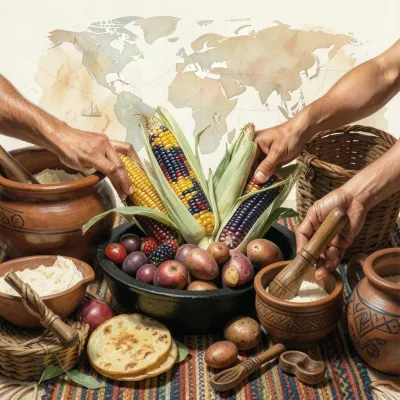
*Foodways of the Americas* provides a comprehensive social history of corn and potatoes, tracing their journey from Indigenous staples to global commodities. The narrative begins with the domestication of maize in Mesoamerica’s milpa systems and tubers in the Andean highlands, highlighting the sophisticated agricultural technologies like nixtamalization and freeze-drying (chuño) developed by ancient civilizations. These crops were not merely food but were deeply embedded in ritual, cosmology, and the urban provisioning systems of empires like the Aztec and Inca.
The book examines the seismic shift of the Columbian Exchange, which launched these American staples into Europe, Africa, and Asia. While corn and potatoes fueled global population growth and industrial revolutions, their adoption was fraught with the politics of prestige and the tragedies of monoculture, most notably seen in the Irish Potato Famine. In the Atlantic world, these crops were repurposed into rations for plantation labor and slavery, cementing their role as engines of colonial extraction and first-wave globalization.
As the narrative moves into the modern era, it explores the rise of "Corn Belts" and "Soy Republics," where agribusiness, government subsidies, and trade agreements like NAFTA transformed farming into a standardized industrial process. The text contrasts this industrialization with the persistent cultural power of food, seen in the migration of tamales and arepas across borders and the rise of culinary nationalism in Mexico and Peru. It highlights the tension between the "Green Revolution" of high-yield hybrids and the growing movements for seed sovereignty and food justice.
Ultimately, the book frames the history of these staples as a lens for modern challenges, including climate change and biodiversity loss. By analyzing recipes as archives and markets as social centers, the author argues that the future of food depends on blending scientific innovation with ecological wisdom. The conclusion calls for a "more just table," where the resilience of Indigenous practices and the dignity of labor are honored to ensure sustainable food security for a changing world.
What You'll Find Inside:
- Explores the deep origins of maize and potato domestication, showing how Indigenous knowledge shaped milpa and terrace farming systems across Mesoamerica and the Andes.
- Examines preservation techniques like nixtamalization and chuño, revealing how food technologies became tools of power, resilience, and cultural continuity.
- Traces the Columbian Exchange and global spread of American staples, illustrating how maize and potatoes transformed diets, economies, and labor systems worldwide.
- Analyzes how food became a site of identity and resistance, from culinary nationalism in Mexico and Peru to diasporic kitchens maintaining tamales, arepas, and other traditions.
- Addresses contemporary challenges—climate change, agribusiness, GMOs, and food sovereignty—highlighting pathways toward a more just and resilient food system.
Who's It For:
This book is ideal for students and scholars of food history, anthropology, Latin American studies, and agricultural science, as well as activists, policymakers, chefs, and anyone interested in understanding how staple crops shape culture, power, and sustainability across the Americas.
Table of Contents:
- Introduction
- Chapter 1 Origins in the Milpa: Maize Domestication in Mesoamerica
- Chapter 2 Highland Tubers: Potato Domestication and Andean Ecologies
- Chapter 3 The Three Sisters: Intercropping, Ecology, and Mutualism
- Chapter 4 Peoples of Maize: Ritual, Cosmology, and Community
- Chapter 5 Preservation and Power: Nixtamal, Chuño, and Culinary Technologies
- Chapter 6 Markets before Empires: Urban Foodways in Tenochtitlan and Cusco
- Chapter 7 Conquest and Conversion in the Kitchen: Early Colonial Transformations
- Chapter 8 The Columbian Exchange: The First Globalization of Taste
- Chapter 9 Provisioning the Atlantic World: Slavery, Plantations, and Rations
- Chapter 10 Crossing Oceans: Europe, Africa, and Asia Adopt American Staples
- Chapter 11 Hunger and Abundance: Famine, Surplus, and the Politics of Grain
- Chapter 12 Nation on a Plate: Culinary Nationalisms in Mexico, Peru, and Beyond
- Chapter 13 Borderlands and Migrations: Tamales, Arepas, and Diasporic Kitchens
- Chapter 14 From Hearth to Street: Urban Markets, Vendors, and Everyday Meals
- Chapter 15 Science at the Table: Agronomy, Nutrition, and Public Health
- Chapter 16 Hybrids, Green Revolutions, and GMOs: Ethics of Breeding
- Chapter 17 Corn Belts and Soy Republics: Agribusiness, Subsidies, and Trade
- Chapter 18 Labor, Land, and Power: Farmers, Farmworkers, and Food Sovereignty
- Chapter 19 Sacred Drinks and Daily Brews: Chicha, Atole, and Beyond
- Chapter 20 Sweet Meets Savory: Sugar, Chiles, and the Global Palate
- Chapter 21 Restaurants, Chefs, and the Politics of Prestige
- Chapter 22 Festivals, Faith, and Food: Calendars of Memory
- Chapter 23 Climate, Biodiversity, and Resilience in Staple Crops
- Chapter 24 Recipes as Archives: Cooking as Method and Cultural Memory
- Chapter 25 Toward a More Just Table: Sustainability, Identity, and Exchange
Author:
Published By:
Date Published:
May 5, 2026
Type:
Nonfiction
Language:
English
Word Count:
66,302 words
Reading Time:
4 hours 39 minutes
Sample:
Order:
Order Foodways of the Americas: The Social History of Corn, Potatoes, and Cuisine (Paperback) on MixCache.com:
Buy NowPrint copy is made to order and ships worldwide. Includes the ebook free, ready to read instantly.
$5 account credit for all new MixCache.com accounts, usable toward any ebook purchase!*