Browse by Category
Fiction
- Action & Adventure
- African American
- Anthologies
- Children's Fiction
- Classics
- Comics & Graphic Novels
- Coming of Age
- Contemporary
- Cultural & Regional
- Drama
- Erotica
- Fantasy
- General
- Historical Fiction
- Horror
- Humor & Satire
- Literary Fiction
- Mystery, Thriller & Suspense
- Poetry
- Religious & Inspirational
- Romance
- Science Fiction
- Short Stories
- War & Military
- Westerns
- Women's Fiction
- Young Adult
Non-Fiction
- Antiques & Collectibles
- Arts & Photography
- Biographies & Memoirs
- Business & Money
- Children's Non-Fiction
-
Computers & Technology
- Artificial Intelligence
- Computer Science
- Cybersecurity & Cryptography
- Data Science & Analytics
- Databases & Big Data
- Game Development & Design
- General
- Hardware & DIY
- Mobile App Development
- Networking & Cloud Computing
- Operating Systems
- Programming
- Robotics
- Software
- Software Engineering
- User Experience (UX) & Design
- Web Development & Design
- Cooking, Food & Wine
- Crafts, Hobbies & Home
- Education & Teaching
- Engineering
- General
- Health, Fitness & Dieting
-
History
- African History
- African History - North Africa
- African History - Sub-Saharan Africa
- American History
- American History - 20th Century
- American History - Civil War
- American History - Colonial Period
- Ancient History
- Asian History
- Asian History - China
- Asian History - India
- Asian History - Japan
- Asian History - Southeast Asia
- European History
- European History - Ancient Greece
- European History - Ancient Rome
- European History - Medieval
- European History - Modern
- European History - Renaissance
- General
- Middle Eastern History
- Military History
- Military History - Aviation
- Military History - Naval
- Social & Cultural History
- World History
- Humor & Entertainment
- Industrial Technology
- Language Learning
- Law
- LGBTQ+ Non-Fiction
- Literary Criticism
- Medical Books
- Parenting & Relationships
- Philosophy
- Politics & Social Sciences
- Reference
- Religion & Spirituality
-
Science & Math
- Agricultural Sciences
- Astronomy & Space Science
- Behavioral Sciences
- Biological Sciences
- Botany & Plant Science
- Chemistry
- Earth Sciences
- Engineering - Chemical
- Engineering - Civil
- Engineering - Electrical
- Engineering - Mechanical
- Environment
- General
- Geology
- Mathematics
- Nature & Ecology
- Oceanography
- Paleontology
- Physics
- Statistics
- Self-Help
- Sports & Outdoors
- Study Aids
- Sustainability & Green Living
- Textbooks
- Transportation
- Travel
- True Crime
- Urban Planning & Development
- Veterinary Medicine
- Writing & Publishing
Jump to Section
MixCache.com Total Access
Unlimited reading and audiobooks for every book published by MixCache.com.
Included titles carry the MTA badge.
Learn more →
From Compass to Printing: Chinese Innovations and Global Impact
MTA
Technology, science, and the transmission of inventions that shaped the world
About this book:
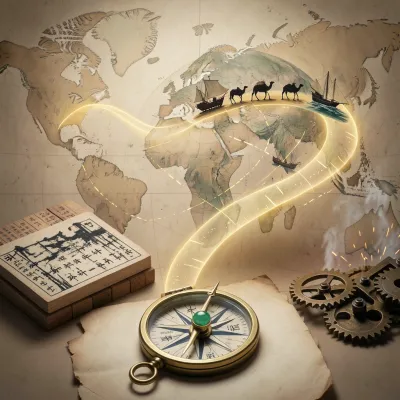
This book explores the trajectory of major Chinese innovations—including papermaking, printing, the magnetic compass, and gunpowder—from their material origins to their global integration. Rather than treating these inventions as singular "firsts," the text frames them as evolving systems of knowledge, labor, and resources that required specific social and institutional frameworks to thrive. It details how these technologies were not static but were continually adapted and refined through diverse networks, including the Mongol Pax, maritime hubs, and monastic circuits.
The narrative emphasizes that technological transmission was a process of constant translation and re-invention. As these innovations moved through the Islamic world and into Europe, they were modified to suit local materials and cultural needs. For instance, the transition from woodblock wisdom to movable type and the evolution of gunpowder from alchemical display to military artillery were driven by shifting economic and political priorities. Institutional structures, such as workshops, guilds, and the imperial state, played crucial roles in standardizing these technologies and ensuring their durability across centuries.
Beyond the "four great inventions," the book examines the broader infrastructure of Chinese ingenuity, including advanced shipbuilding, hydraulic engineering, and sophisticated economic systems like paper currency. It highlights how the ecology of invention—the interplay of resources, environment, and risk—dictated the success of these advancements. By debunking common myths regarding priority and isolated genius, the text reveals a more complex history of global exchange where Chinese breakthroughs acted as catalysts for a shared technological heritage.
Ultimately, the book draws lessons for the modern era, suggesting that the most transformative technologies are those that are modular, adaptable, and supported by robust social standards. It argues that innovation is a collective and cumulative process, heavily dependent on the "global commons" and the flow of information across borders. The legacy of these ancient Chinese inventions persists today in our global systems of communication, navigation, and commerce, serving as a testament to the enduring power of practical ingenuity and cross-cultural collaboration.
What You'll Find Inside:
- How Chinese innovations like paper, printing, the compass, and gunpowder spread globally through Silk Roads and maritime networks, adapting to local materials, needs, and cultural contexts
- The social and institutional frameworks that enabled Chinese innovation, including workshops, guilds, state support, and urban knowledge economies that balanced tradition with adaptation
- The critical role of cultural intermediaries (Buddhist monks, Muslim scholars, Jesuit missionaries) in transmitting, translating, and transforming technological knowledge across Eurasia
- How environmental factors, resource availability, and risk management shaped the development and adaptation of Chinese technologies from papermaking to iron production
- Comparative analysis showing how technological trajectories in China, the Islamic world, and Europe were interconnected rather than linear, with mutual influence and adaptation
Who's It For:
This book is ideal for students and scholars of world history, history of science and technology, and East Asian studies who seek to understand how innovations spread and transform societies. It will particularly benefit readers interested in the interconnectedness of global civilizations, the social and economic contexts of technological change, and those looking for a nuanced perspective that moves beyond simplistic 'firsts' narratives to examine how technologies were adapted, improved, and reinvented as they traveled across cultures.
Table of Contents:
- Introduction
- Chapter 1 Paper Before Print: The Invention and Spread of Papermaking
- Chapter 2 Woodblock Wisdom: Canon, Commerce, and the First Print Revolutions
- Chapter 3 Movable Type in East Asia: From Bi Sheng to Metal Type
- Chapter 4 The Magnetic Revolution: Understanding and Harnessing the Compass
- Chapter 5 Mapping the Seas: Charts, Stars, and Monsoon Knowledge
- Chapter 6 Shipbuilding and the Compass: Junks, Rudders, and Ocean Voyages
- Chapter 7 Gunpowder Alchemy: Recipes, Laboratories, and Early Fireworks
- Chapter 8 The Artillery Age: Bombs, Rockets, and Firearms Across Eurasia
- Chapter 9 Money Made of Fiber: Paper Currency, Credit, and the State
- Chapter 10 Iron, Cast and Wrought: Furnaces, Tools, and Industrial Scale
- Chapter 11 Turning Water into Power: Canals, Pumps, and Hydraulic Engineering
- Chapter 12 Agriculture Innovated: Seeds, Soils, and Southward Rice
- Chapter 13 Porcelain and the Kiln: Materials Science of Ceramics
- Chapter 14 Silk, Looms, and Printing on Cloth: Textiles and Technique
- Chapter 15 Timekeepers and the Heavens: Clocks, Calendars, and Astronomy
- Chapter 16 Measuring the World: Mathematics, Weights, and Standards
- Chapter 17 Knowledge on the Move: Silk Roads, Couriers, and Maritime Hubs
- Chapter 18 Translators and Go-Betweens: Buddhists, Muslims, and Jesuits
- Chapter 19 Empires of Exchange: Mongol Pax and Early Modern World-Systems
- Chapter 20 Workshops, Guilds, and the State: Institutions of Innovation
- Chapter 21 Urban Knowledge Economies: Markets, Bookshops, and the Literati
- Chapter 22 The Ecology of Invention: Resources, Risk, and Environment
- Chapter 23 Comparative Paths: China, the Islamic World, and Europe
- Chapter 24 Myths and Misconceptions: Priority, Influence, and Evidence
- Chapter 25 Lessons for Today: Innovation, Transfer, and the Global Commons
Author:
Published By:
Date Published:
May 4, 2026
Type:
Nonfiction
Language:
English
Word Count:
72,277 words
Reading Time:
5 hours 4 minutes
Sample:
Order:
Order From Compass to Printing: Chinese Innovations and Global Impact (Paperback) on MixCache.com:
Buy NowPrint copy is made to order and ships worldwide. Includes the ebook free, ready to read instantly.
$5 account credit for all new MixCache.com accounts, usable toward any ebook purchase!*